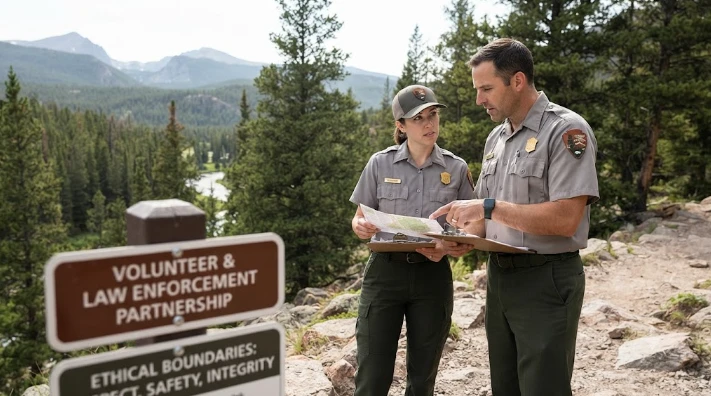
This article portrays National Park Service volunteers as a civic workforce that supports conservation, interpretation, visitor services, cultural preservation, science, maintenance, and public connection across America’s national parks. Volunteers contribute millions of hours in visitor centers, archives, trails, museums, monitoring programs, historic sites, and administrative settings. The article stresses that volunteering should complement rather than replace paid staff and that role boundaries, training, safety, supervision, and legal restrictions are essential. Volunteer science, cultural resource work, restoration projects, and visitor education can produce valuable public benefits when methods and responsibilities are clearly managed. Inclusion is also important because travel costs, equipment, housing, physical demands, and unfamiliar systems can limit participation. Programs are encouraged to diversify recruitment, provide flexible roles, support intergenerational mentoring, and recognize contribution through meaningful feedback rather than symbolic praise alone. Evaluation should consider mission outcomes, skills, stewardship, visitor support, conservation results, and coordination costs. The article concludes that well-managed volunteering strengthens both public lands and civic responsibility.
It's easy to get a feeling of the national park visit. The trails continue to be open, historic rooms are open to visitors, wildlife is counting, invasive plants are being eradicated and questions are patiently answered. Many of these elements of clearly structured order rely on the contribution of temporary federal staff. Volunteers create a civic workforce and link people and public lands who are willing to protect, interpret, study and maintain them.
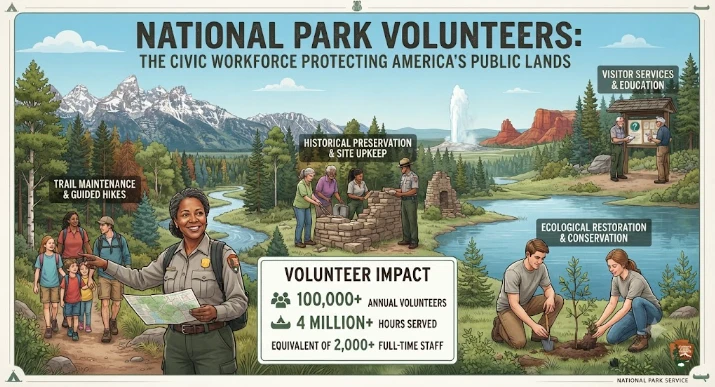
In 2023, there were over 123,000 volunteers for the National Park Service with a total of over 3.7 million hours of volunteer time. Those are the numbers which indicate scale, but not variety. Volunteers work in visitor centers, archives, campgrounds, laboratories, trails, museums and resource monitoring programs, historic sites, and administrative offices. Others come in to play one day, others come on several seasons.
The Volunteers-In-Parks program is a result of legislation passed by the Federal government in 1969. Its aim was by no means to provide an alternative army of workers to replace every paid job. Established a legal means of public involvement in the maintenance and explanation of national parks. This civic base is needed for volunteer value as it relates to only estimated labor cost.
One of the most prominent jobs is visitor service. Volunteers provide answers to questions, provide map explanations, assist with orientation, aid at camp areas and help educate about park rules. If a discussion is handled quietly, unsafe decisions and damage of resources can be avoided. When giving visitors advice, it is important to be trained since it can be serious and negative if the advice is not correct in the remote terrain.
Interpretation is the making of public meaning out of places. The volunteers conduct walks, perform historical activities, take part in school programs, and link artifacts to stories. This is not a job that can be done with out-of-the-book knowledge. Interpreters should be able to respond to historical contentions, be culturally sensitive, source aware, and have context.
Natural resource work can be as diverse as removal of invasive plants to observation of wildlife. Volunteers observe and record birds, survey nesting areas, take water samples, improve habitat and document seasonal changes. If the methods are maintained over time, valuable data sets can be obtained from long running programs. Collected information is safeguarded by scientific supervision, calibration and quality review to ensure it is useful.
Golden Gate Raptor Observatory is an example of volunteer science. Golden Gate NRE has been monitoring raptors for over 25 years by more than two thousand volunteers since 1984. Significant training and effort in the field is put into counts and banding. These programs include conservation, public education and extended observation.
It is important that cultural resource stewardship is given the same treatment. Volunteers can help describe archives, conduct oral history, work with museum collections, document cemeteries, work on preservation projects, and work with historic gardens. Identity, trauma, contested memory are all to be found in cultural materials. Pov, respectful language, community authority and restrictions on access to public areas are all aspects that should be covered in training.
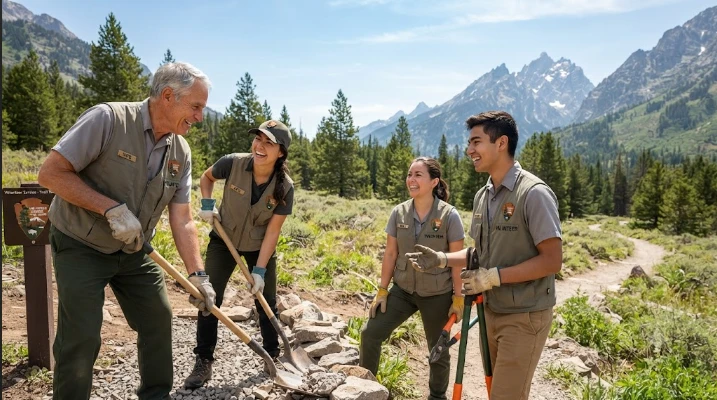
Direct Physical (T or M) Projects generate a direct result or affect a physical aspect. Crews do clearing, repairing, removing debris, painting structures or restoring landscapes under the direction of staff members. This can help to build relationships by working together. Tools, temperatures, ground, animals, and weather conditions are always a part of outdoor service and safety planning, protective equipment, task assessment, and competent supervision will always be critical.
Volunteer Programs can help to expand public ownership of parks. Hours of restoration and watching a species build a different relationship for a person to the trail or species than a short visitor. Service, so that there is knowledge of the institutional limitations, and ecological fragility. Participants are frequently educated advocates in the family, school, workplace and community.
Parks are not the only place where civic values are fostered. Volunteer teams gather as a community of people with diverse ages, professions, cultures and political perspectives to engage in a hands-on project. Social connection is fostered through repeated cooperation, and doesn't need to be based on agreement on all public issues. Shared stewardship is a kind of citizenship that is based on a sense of responsibility for shared resources.
People who are familiar with national parks should not be targeted.It is necessary to recruit beyond the group of people who are already comfortable with national parks. Many citizens are discouraged from taking part in the system due to the travel costs, equipment, housing, physical demands, absence of paid time, and unfamiliar systems involved. There are ways to expand access through partnerships with schools, tribal communities, disability groups, urban organizations, veterans and local nonprofit organizations. Financial considerations can be a reason to discard certain placements, which can be addressed by stipends and transport support.
People do not assume people can play a specific role.People don't assume that people can play a certain role. There are several different paths of service that may be offered through remote interpretation, archival services, communication with visitors, data review, photography, language support, and digital mapping. Physical tasks can be modified if necessary using appropriate equipment and team organisation. With the broad definition of contribution volunteer programs are strengthened.
Safety and Quality are both investments in training. Orientation should include information about the mission of the National Park Service, resources, conduct, procedures during an emergency, public communication and reporting lines. Careers that require advanced training and practice require extra training. Refreshers sessions ensure consistency if policies or conditions are changed.
VEC's do very important professional work. The coordinators recruit, screen, match, train, schedule, support, recognize and evaluate participants, operate records and risk. A good number of volunteers unorganized may place strains on the permanent staff. It is important to scale up program capacity as recruitment is scaled up.
The makeup of who serves at remote parks is determined by their housing. There are a number of long-term jobs that have campsites and shared accommodation, and many that don't. Housing may be in short supply for people that are flexible with their income or are retired. Clear and realistic criteria and costs allow applicants to evaluate if a placement is feasible.
Volunteers are safe from exploitation as they are protected by ethical boundaries. Unpaid service should not be used to replace employment that has been promised, be an extension of a seasonal position or be used to perform work that is not within the law. Volunteers are not allowed to do law enforcement or hazardous tasks according to the instructions of the National Park Service. Clarify roles to maintain separation of civic and work service.
It's important for them to be recognised but it's important for them to be appreciated. Certification, uniforms, awards and public recognition can help to validate contribution. More important forms are feedback as a tool for learning, safe equipment, respectful supervision, learning opportunities, and making it safe for everyone to be included in team communication. Volunteers are perceptive in identifying when a good word is given for poor administration.
The ability to be retained is related to meaningful fit. Some participants are looking for conservation impact, others want to learn, socialize, gain experience, take part in culture and spend time outside. Coordinators have to be knowledgeable of motivation, but also know that not every role will address every goal. Role Previews, and regular check-in, minimize mismatch.
Beyond hours is not enough to be considered impact assessment. Programs can review what habitat has been restored, who it helped, what types of records were processed, how visitors have been helped, how trails were maintained, skills that have been gained and partnering opportunities. Interviews can be used qualitatively to examine the identity of belonging, learning and stewardship. Costs of coordination, training, equipment and staff time should be co-ordinated and be visible as well.
Relationships with the community are strengthened when the voices of the community influence priorities for volunteers. A park can reach out to residents in the community to uncover stories that are not being told, barriers to access, environmental issues, and service projects to address these issues. Tribal consultation is particularly meaningful where working on ancestral lands, sacred places or cultural materials are concerned. Enthusiasm of volunteers is no substitute for sovereignty or expert advice.
Volunteerism is undergoing climate change. Safety and the requirements of resources are impacted by heat, wildfire smoke, flooding, invasive species, erosion and changing wildlife patterns. Program schedules, exposure protocols, protective equipment and training needs need to be flexible. Observation and recovery is possible with volunteers but staff must never pass on dangerous work to volunteers.
Special care should be taken when setting up boundaries during an emergency. Trained volunteers can help to pass on information and are available to help with nonhazardous aspects of the job and can help with communication with visitors during closures or incidents. The authority to command should always be with the authorized person(s) and participants should never be forced into unsafe circumstances. Stop Work Authority brings commitment to the civic level without taking the risk to the personal level.
There's another added benefit of intergenerational exchange. Experts can pass on their know-how and the younger people can ask new questions and bring their digital skills. Mentoring helps to hold onto expertise by having a structured approach. Mixed age teams can also improve the continuity of projects over a number of seasons, and in the event of staff changes, the mix can be designed to continue the project.
Nationwide, park volunteers are the ones that offer time, skill, attention and public connection throughout the parks' expansive network. They make a contribution to conservation and awareness of the importance of these sites. The best programs integrate civic invite and professional management, legal limits, inclusion and meaningful evaluation. Service can be effective for both the volunteer and the mission and public lands have long-term guardians as a result.
CITE THIS ARTICLE
Das, B. C. (2025). National Park Volunteers: The Civic Workforce Protecting America’s Public Lands. https://www.bikashchandra.com/article/10a24982-64bc-5ebd-88a7-215d76714a4d
B. C. Das, “National Park Volunteers: The Civic Workforce Protecting America’s Public Lands,” 2025. [Online]. Available: https://www.bikashchandra.com/article/10a24982-64bc-5ebd-88a7-215d76714a4d
Das, B. C. (2025) ‘National Park Volunteers: The Civic Workforce Protecting America’s Public Lands’. Available at: https://www.bikashchandra.com/article/10a24982-64bc-5ebd-88a7-215d76714a4d
Das, Bikash Chandra. “National Park Volunteers: The Civic Workforce Protecting America’s Public Lands.” 2025, https://www.bikashchandra.com/article/10a24982-64bc-5ebd-88a7-215d76714a4d.
Bikash Chandra Das. “National Park Volunteers: The Civic Workforce Protecting America’s Public Lands.” (2025). https://www.bikashchandra.com/article/10a24982-64bc-5ebd-88a7-215d76714a4d.
Das BC. National Park Volunteers: The Civic Workforce Protecting America’s Public Lands. 2025. https://www.bikashchandra.com/article/10a24982-64bc-5ebd-88a7-215d76714a4d
@misc{article_10a2498264bc5ebd88a7215d76714a4d,
  title = {National Park Volunteers: The Civic Workforce Protecting America’s Public Lands},
  author = {Bikash Chandra Das},
  year = {2025},
  url = {https://www.bikashchandra.com/article/10a24982-64bc-5ebd-88a7-215d76714a4d},
}
TY  - GEN
AU  - Bikash Chandra Das
TI  - National Park Volunteers: The Civic Workforce Protecting America’s Public Lands
PY  - 2025-03-19
UR  - https://www.bikashchandra.com/article/10a24982-64bc-5ebd-88a7-215d76714a4d
ER  -
This article explores why people volunteer in America’s national parks and how program design influences whether service remains meaningful. Volunteer motivations often overlap and include personal values, learning, social connection, career development, confidence, purpose, and attachment to place. The article uses motivational frameworks to show that volunteers are more likely to remain engaged when they experience autonomy, growing competence, respectful relationships, and a clear connection
Probation and parole are presented as essential community-based alternatives to incarceration that combine supervision, accountability, and reintegration. Probation generally allows eligible offenders to remain in the community instead of serving a prison sentence, while parole provides conditional release after part of a custodial sentence has been completed. The article explains that both approaches can preserve employment, family ties, education, and housing, all of which reduce the risk of r
This article defines the ethical boundaries that protect volunteers who support visitor safety and law-enforcement-related functions in national parks. Although volunteers can assist with information, observation, traffic support, administrative work, backcountry roves, and reporting hazards, they must not exercise powers such as arrest, detention, search, citation, evidence handling, use of force, or other commissioned enforcement duties. The article emphasizes clear position descriptions, accu