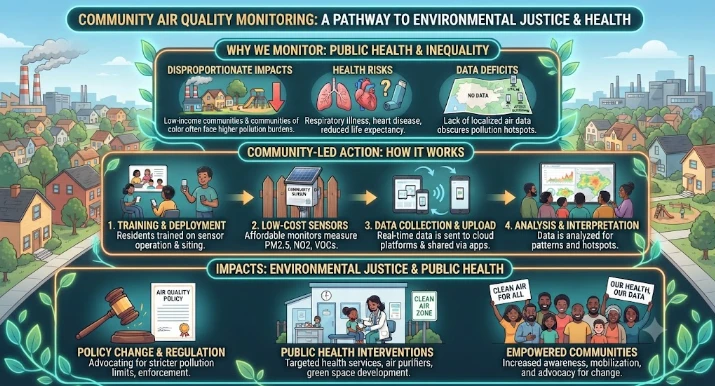
This article examines community air-quality monitoring as a tool for environmental justice, public health learning, and more responsive institutional decision-making. Low-cost sensors make it possible to observe local pollution patterns that may not be captured by sparse regulatory networks, but the article stresses that inexpensive devices still require clear research questions, careful placement, calibration, maintenance, metadata, and appropriate interpretation. Pollutant choice, collocation with reference monitors, correction methods, weather, local activity, and repeated measurements all influence reliability. Community data can identify patterns, hotspots, and questions for further investigation, but it should not automatically be treated as regulatory compliance evidence or as proof of individual medical harm. The article also addresses data visualization, privacy, source attribution, school monitoring, mobile measurement, wildfire smoke, community ownership, and partnerships with universities, health departments, agencies, and environmental justice organizations. Scientific and civic outcomes should both be evaluated. The article concludes that monitoring is most valuable when careful science is joined with local control, transparent communication, equitable access, and visible government response.
Air pollution is a local event that may only be statistically known. Headaches after traffic congestion, dust near an industrial site, smoke during the wildfire season, and diesel odor near a school are all detected by the families. Use of regulatory monitors supplies much valuable information on a regional basis, and the monitors may not be dense enough to capture large local variations in blocks. Community air monitoring attempts to capture that picture in the local arena.
This work has a democratic purpose that is provided by environmental justice. Communities of color and those living in low-income areas are more likely to be exposed to several pollution sources and lack adequate resources for health care, green space, and political power. There is a need for credible information about exposure conditions for residents and on decision processes. Devices can be useful to help monitor, but cannot fix imbalance of power when it comes to public inquiries.
Traditionally participation has been hampered by the high cost and technical expertise required when using reference instruments, however the use of low-cost sensors has increased participation. Many devices can be used to measure PM or specific gases, and they are compact enough to be located at numerous sites. Networks can show temporal and spatial patterns which are not detected by a single station. Cheap does not mean it isn't necessary to have a method, calibration and maintenance.
The Environmental Protection Agency (EPA) has created an Air Sensor Toolbox: Guidance, Performance Information and Technical Resources. In 2024, EPA released materials announcing many communities employ sensors to develop understanding of their community's air conditions and to facilitate community action to reduce exposures or improve air quality. This type of guidance helps to differentiate community information and regulatory measurement. This distinction should be maintained throughout the design of a project and beyond.
The first step in a monitoring project should be to have a clear question. Residents can inquire if pollution levels increase at certain times of the day, such as when the children return to school, when nearby freight routes are used, after industrial activities, or when the wind blows a certain way. The lack of a decision process does not mean that a large set of data is not created by a vague goal to measure air quality. Pollutant, location, timing, equipment and analysis determined by clear questions.
Pollutant choice matters. There are various technologies and interpretation for the optical sensor to measure particulate matter (PM) below 2.5 micrometers, while other pollutants, such as nitrogen dioxide, ozone, volatile compounds, and black carbon, require other technologies. There is no single instrument that measures the overall air quality. Technical guidance appropriate to the suspected source(s) and health issues is needed by communities.
The location of the sensor can have a greater influence on results than the brand of sensor. Readings can change due to height, distance from road, air currents, buildings, cooking, smoking, dust, humidity, and direct sunlight. A monitor next to an exhaust pipe responds to a different question as compared to one placed at a neighborhood background site. The installation notes and photos are used to generate required metadata.
Collocation strengthens confidence. Community sensors can be placed in parallel with a regulatory or research-quality monitor for a period of time for comparison under the local conditions. Systematic errors can be minimised with correction models, particularly for humidity- and aerosol type-dependent particulate sensors. EPA has created approaches to correct widely-used Purple Air devices. Corrections should be recorded and not done it invisibly.
Data quality is a part of maintenance. Sensors may drift, become clogged, lose their power, or fall off the network, or produce values that are not possible. Weak data is prevented from entering interpretation with the help of routine inspection, cleaning, time checks and performance flags. The villages' residents must be taught and have a point of contact in case of technical issues.
Caution needs to be used with data visualization. Precise readings can be given with bright maps and real-time graphs, regardless of uncertainty. Units, averaging periods and missing data, corrections and comparison standards must be explained in legends. One spike may be indicative of a true local event, an equipment malfunction, or a brief event in the vicinity of the monitor.
Language must be controlled in order to communicate health. While there is strong scientific evidence correlating air pollution with serious health impacts, no one community sensor can diagnose illness or determine the impact of one source on a medical outcome. Project teams should not try to downplay concern, but go over exposure, risk and uncertainty. The public health partners can assist in the responsible sharing of findings.
Regulatory standards are for a particular purpose, legal and scientific. Low-cost sensors are not certified instruments and as such are not suitable for compliance determining applications. Community data can help to clarify trends, inform inspection, provide placement of professional monitors or provide documentation of questions that should be explored further. Discard of nonregulatory data is waste of valuable local data.
Trust is an issue with community ownership. Local communities should be involved in selection of locations, selection of questions, access rules and communication plans. Expertise can be provided from outside researchers without giving control of all decisions. Agreements should include considerations for equipment use, raw data, publication, media contacts and re-use.
The aspects of privacy may be an unexpected problem. A monitor can be connected to a home and show who is in the house or who may be in the house, or sensitive location information, or the activity of cookery, all of which can be easily monitored. Households that are in a controversial project can be identified from public maps. Shielding and opt-in are two ways to safeguard residents while maintaining the analytical value.
It's hard to pinpoint the sources of this. Similar patterns can be caused by wind, topography, chemical transformation, multiple emitters and regional transport. The data from the sensors can be used in conjunction with meteorological data, the activity log, traffic counts, satellite data, and professional sampling to verify various hypotheses. Claims must be commensurate with the evidence of the combined claims.
Mobile monitoring provides spatial detail in the form of instruments being provided by people, bicycles or vehicles. Interpretation is influenced by the route design, speed, time of day, the location of the breathing zone and repetition of passes. Single trips can show a potential hotspot, but do not indicate a consistent annual trend. Repeated comparisons in a condition build comparison.
The issue of particulate matter information in real time has garnered public interest because of the problem of wildfire smoke. Community sensors can illustrate neighborhood differences and can help facilitate protective communication. Backup connectivity, comparison of indoor and outdoor readings, and smoke correction are of importance during large-scale events. The agencies need to correlate sensor maps with official instructions and not leave the interpretation of sensor value changes to the residents.
Schools are significant monitoring sites as they involve a significant amount of time spent on campus and a possible exposure to traffic or industrial emissions. Environmental assessment and science education is possible in projects. Protecting measures should be put in place to ensure that students do not become liable for any regulation, or fall into dispute with local businesses. Adults have responsibilities for consent, safety and response.
There are potential synergies that can be achieved with universities, health departments, air agencies and environmental justice organizations in order to boost method and influence. Every partner brings various capacities – calibration, epidemiology, regulatory, community trust and advocacy. The oversight of technical partners by governance should help to avoid overpowering resident issues. Records of meetings and shared decision rules, make responsibility apparent.
Action planning should start prior to the results. Potential solutions are professional monitoring, traffic adjustments, filters, compliance audit, land use review, school scheduling, public warning, and additional research. Not all of the patterns will warrant the same response. There are reduced opportunities to inflate findings afterwards, when predefined thresholds for review are given.
Scientific and civic measures are necessary to evaluation. Technical indicators may include completeness, precision, performance in collocation, spatial coverage and reproducibility. Civic indicators can be used to explore participation, learning, trust, agency response, policy use and perceived respect. A key indicator of the degree of empowerment that has been achieved through a project is found in interviews.
The funding has an impact on the independence and sustainability. While grants can help buy equipment, they don't cover staff time, replacement parts, data storage, training and coordinating with the community. Seasonal patterns may not be apparent during the short time period of a public grant, and industrial sponsorship may be seen as a potential conflict. We maintain transparency in funding and maintenance which safeguards credibility.
A related, but different question that can be answered with indoor monitoring. The way outdoor pollution gets into buildings varies with building ventilation, filtration, construction, cooking, and behaviors of the building occupants. Household interpretation requires privacy and context information which can be provided by paired indoor or outdoor devices and demonstrated as gaps in the protection. Don't make it a reason to blame the residents for the exposure due to the housing situation.
Access to results is a component of data equity. If residents don't have stable internet and don't feel comfortable with graphs, then a web dashboard is of little use. To expand use, printed summaries, community meetings, translated materials, telephone updates and displays in the community can be used. If there have been change in initial interpretations, this should be recorded and questions should be encouraged.
The best community air monitoring happens where there is local concern coupled with careful science and government response that is made public. Sensors can provide patterns, aid in learning and facilitate further investigation but they cannot remove uncertainty and the legal rules. There should be more to environmental justice than measurement. It should be based on fair involvement, open communication and understanding, protective measures, and institutions willing to listen to neighborhood information which challenges assumptions.
CITE THIS ARTICLE
Das, B. C. (2025). Community Air Quality Monitoring for Environmental Justice and Public Health. https://www.bikashchandra.com/article/41a4b833-29d8-504c-b103-812f6e0f3095
B. C. Das, “Community Air Quality Monitoring for Environmental Justice and Public Health,” 2025. [Online]. Available: https://www.bikashchandra.com/article/41a4b833-29d8-504c-b103-812f6e0f3095
Das, B. C. (2025) ‘Community Air Quality Monitoring for Environmental Justice and Public Health’. Available at: https://www.bikashchandra.com/article/41a4b833-29d8-504c-b103-812f6e0f3095
Das, Bikash Chandra. “Community Air Quality Monitoring for Environmental Justice and Public Health.” 2025, https://www.bikashchandra.com/article/41a4b833-29d8-504c-b103-812f6e0f3095.
Bikash Chandra Das. “Community Air Quality Monitoring for Environmental Justice and Public Health.” (2025). https://www.bikashchandra.com/article/41a4b833-29d8-504c-b103-812f6e0f3095.
Das BC. Community Air Quality Monitoring for Environmental Justice and Public Health. 2025. https://www.bikashchandra.com/article/41a4b833-29d8-504c-b103-812f6e0f3095
@misc{article_41a4b83329d8504cb103812f6e0f3095,
  title = {Community Air Quality Monitoring for Environmental Justice and Public Health},
  author = {Bikash Chandra Das},
  year = {2025},
  url = {https://www.bikashchandra.com/article/41a4b833-29d8-504c-b103-812f6e0f3095},
}
TY  - GEN
AU  - Bikash Chandra Das
TI  - Community Air Quality Monitoring for Environmental Justice and Public Health
PY  - 2025-04-23
UR  - https://www.bikashchandra.com/article/41a4b833-29d8-504c-b103-812f6e0f3095
ER  -
This article explores why people volunteer in America’s national parks and how program design influences whether service remains meaningful. Volunteer motivations often overlap and include personal values, learning, social connection, career development, confidence, purpose, and attachment to place. The article uses motivational frameworks to show that volunteers are more likely to remain engaged when they experience autonomy, growing competence, respectful relationships, and a clear connection
Probation and parole are presented as essential community-based alternatives to incarceration that combine supervision, accountability, and reintegration. Probation generally allows eligible offenders to remain in the community instead of serving a prison sentence, while parole provides conditional release after part of a custodial sentence has been completed. The article explains that both approaches can preserve employment, family ties, education, and housing, all of which reduce the risk of r
This article defines the ethical boundaries that protect volunteers who support visitor safety and law-enforcement-related functions in national parks. Although volunteers can assist with information, observation, traffic support, administrative work, backcountry roves, and reporting hazards, they must not exercise powers such as arrest, detention, search, citation, evidence handling, use of force, or other commissioned enforcement duties. The article emphasizes clear position descriptions, accu