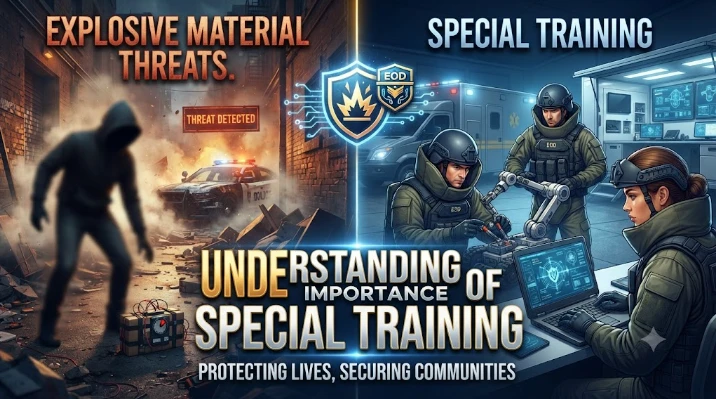
This article explains why specialized training is essential for law enforcement officers and first responders who may encounter explosive materials. It describes explosive threats as arising from terrorism, organized crime, industrial activities, accidents, and improvised explosive devices, all of which can cause mass casualties, infrastructure damage, fires, toxic releases, and widespread panic. The post emphasizes that responders must understand different explosive materials, triggering mechanisms, risk levels, and safe operating procedures before attempting to manage a scene. Bomb-disposal teams are highlighted for their use of protective suits, robots, controlled explosions, and specialized technical knowledge. The article also stresses crisis management, inter-agency coordination, communication, and post-explosion forensic investigation as key elements of effective response. In Bangladesh, where both terrorism and industrial hazards are described as relevant concerns, continued investment in training, equipment, technology, and international cooperation is recommended. The article concludes that explosive-threat preparedness cannot be treated as one-time instruction; regular professional development is necessary as methods, materials, and technologies continue to evolve.
One of the most dangerous and widespread threats to the safety of the population is explosive materials, which are used in the terror, criminal activities, or in the accidents at industries. The growing popularity of the use of explosives by numerous unscrupulous extremists, including terrorists and crime syndicates, demands a substantial amount of specialized training of law-enforcement agencies and first responders. The explosion may lead to mass destruction, panic and considerable loss of life that is why it is necessary to make sure that the individuals involved in the handing over of such threats are well prepared to handle them. In Bangladesh where terrorism and industrial risks are only increasing, it is important to make sure that the first responders have the appropriate training.
Explosive substances may be military explosives (bombs, grenades, improvised explosive devices (IEDs) and industrial explosives (often employed in the mining, construction and demolition sectors). Although industrial explosives can be used safely, they can be used against other people with bad intentions. In Bangladesh with the threat of terrorism growing over the past few years, terror groups have been more likely to employ explosives to strike on law enforcers, government organizations and civilians. In addition to terrorism, industrial accidents which include use of explosives are also major risks as negligence in handling them or lack of proper safety precautions may cause disastrous results.
In cases of explosives, the dangers are very direct and dire. Explosions may have physical effects, infrastructure damage, psychological effects and may even result in secondary effects like fire outbreak or toxic gas emissions. In the case of people who have to face the threat of explosive materials, there is a high probability of injuries, and specialized training is another important need to minimize the damage and act efficiently. Lack of proper training may ensure that the responders are not able to effectively assess the situation as well as safely deal with the explosive, which was disastrous.
There is no chance to overestimate the significance of special training in the work with explosive threats. To start with, the staff should be aware of the various materials of explosives and their operation. Each explosive is unique and it has a triggering mechanism, sensitivity and the damage it can possibly cause. As an example, an IED can be a remote detonator, a time-bomb, or triggered by a pressure or movement, and this needs a different procedure. The police and first responders should be ready to detect these threats and evaluate the hazard and remove the devices safely with the knowledge and equipment necessary. The knowledge about the behavior of explosives and how they may affect is core in the prevention of disastrous occurrences.
Another very important part of specialized training is safety protocols and procedures. There are certain guidelines that should be adhered to by rescuers in order to save lives of themselves and the community. Training will make sure that they wear appropriate protective equipment, protect the area, and prevent activities that will most likely cause an explosion. As long as the right precautions are taken, the threat of secondary explosions or the additional loss of lives is reduced. Special training is also effective in ensuring that the officers cope with high pressure situations in a calm and efficient manner. Fast and calculated decisions are essential in case of an explosive threat to eliminate damage.
It is usually the bomb disposal teams that are to render explosive devices harmless. Bomb disposal is a specialized training that trains officers in how to go around disabling and disposing bombs and IEDs. The necessity of such training is obvious: one error can cause the fatal explosion. In Bangladesh there has been the formation of special bomb-dismantling units within the law enforcement forces like Rapid Action Battalion (RAB) which have played a major role in the quest to enhance response efforts. These teams apply specialized equipment including bomb suits, robots and controlled explosions to make sure the safe elimination or destruction of explosive equipment.
Other important elements of specialized training include crisis management. In the case of explosive threats, the response of the law enforcement and emergency responders must collaborate in order to respond in a coordinated manner. Specialization aids these agencies in cooperating with one another in that every member of the team knows his or her role and responsibility. This is even more significant in Bangladesh where there are limited resources. It can be life and death when various agencies know how to communicate, make fast decisions, and work in collaboration.
The post-explosion analysis is a very ignored part of managing the threat of explosive material. In case of an explosion, forensic investigators are called to inspect the scene to find evidence that will result in the culprits identifying the culprits. Special training on post-explosion examination enables the law enforcement to examine the sources of explosive devices and trace their elements as well as collect vital evidence that can be used to resolve crimes. This study is essential not only to justice but also to avert future cases since it may show tendencies and vulnerabilities of security that must be compensated.
In the case of law enforcers, the knowledge of how to respond to energy threats is not merely about the immediate threat such as neutralizing the immediate danger, but also the safety in the long term. In cases whereby the officers are thoroughly trained in the handling of explosive materials, they can reduce the threats to themselves and the people around them, hence resulting in few casualties and the risk of any additional destruction is minimized. Also, the readiness, which is provided by the specific training, may serve as a deterrence to those who may be willing to use explosives to commit a crime. Being aware that the law enforcement has the capacity to respond to a bomb threat decreases the risk of such a threat happening in general.
The significance of special training in Bangladesh is evident. With the increasing challenges the country is experiencing both in the hands of the terrorist groups and the industrial hazards the country has never required trained personnel. Government and other law enforcement agencies should invest further in training and preparation of their employees and make them available with the most current training and resources. Technical cooperation with foreign institutions and training courses may help to give resources and experience in developing the capabilities of law enforcement agencies in Bangladesh to deal with explosions and threats posed by them.
Another important element in the training of law enforcement and emergency responders is the use of technology. Bomb disposal robots, surveillance drones, communication devices can play an important role in improving response efforts. Training should also change with the technological changes so that the staff can use these technology in order to enhance efficiency and safety. Law enforcement agencies should not lag behind technologically so that they are placed at a position where they have the best resources.
Lastly, the value of a powerful, ongoing training commitment can hardly be overestimated. The process of specialized training is not a single one, it should be continuous as the personnel should be ready to meet the threats that change with time. Law enforcement and emergency responders should be prepared to change and meet the new challenges as new techniques, materials and methods are developed and introduced. Professional growth, which is constant in dealing with explosive materials, makes sure that the individuals charged with the responsibility of securing the populace, are ready to face the worst case scenario.
To sum it up, specialized training on how to deal with threats of explosive materials is essential to law enforcement and emergency responders. In Bangladesh, where both the threats of both terrorism and industrial accidents are practical and on the rise, it is necessary to have highly trained staff. Specialized training equips the knowledge, skills, and tools required to respond efficiently to explosive threats to ensure safety of the responders and people. Through such investments and use of new advanced technology, Bangladesh will be able to secure its population and the chances of explosive related cases are minimized.
CITE THIS ARTICLE
Das, B. C. (2026). Explosive Material Threats: Understanding the Importance of Special Training. https://www.bikashchandra.com/article/1e7eaa20-46eb-5a86-9562-e9f8a5546b48
B. C. Das, “Explosive Material Threats: Understanding the Importance of Special Training,” 2026. [Online]. Available: https://www.bikashchandra.com/article/1e7eaa20-46eb-5a86-9562-e9f8a5546b48
Das, B. C. (2026) ‘Explosive Material Threats: Understanding the Importance of Special Training’. Available at: https://www.bikashchandra.com/article/1e7eaa20-46eb-5a86-9562-e9f8a5546b48
Das, Bikash Chandra. “Explosive Material Threats: Understanding the Importance of Special Training.” 2026, https://www.bikashchandra.com/article/1e7eaa20-46eb-5a86-9562-e9f8a5546b48.
Bikash Chandra Das. “Explosive Material Threats: Understanding the Importance of Special Training.” (2026). https://www.bikashchandra.com/article/1e7eaa20-46eb-5a86-9562-e9f8a5546b48.
Das BC. Explosive Material Threats: Understanding the Importance of Special Training. 2026. https://www.bikashchandra.com/article/1e7eaa20-46eb-5a86-9562-e9f8a5546b48
@misc{article_1e7eaa2046eb5a869562e9f8a5546b48,
  title = {Explosive Material Threats: Understanding the Importance of Special Training},
  author = {Bikash Chandra Das},
  year = {2026},
  url = {https://www.bikashchandra.com/article/1e7eaa20-46eb-5a86-9562-e9f8a5546b48},
}
TY  - GEN
AU  - Bikash Chandra Das
TI  - Explosive Material Threats: Understanding the Importance of Special Training
PY  - 2026-04-11
UR  - https://www.bikashchandra.com/article/1e7eaa20-46eb-5a86-9562-e9f8a5546b48
ER  -
This article explores why people volunteer in America’s national parks and how program design influences whether service remains meaningful. Volunteer motivations often overlap and include personal values, learning, social connection, career development, confidence, purpose, and attachment to place. The article uses motivational frameworks to show that volunteers are more likely to remain engaged when they experience autonomy, growing competence, respectful relationships, and a clear connection
Probation and parole are presented as essential community-based alternatives to incarceration that combine supervision, accountability, and reintegration. Probation generally allows eligible offenders to remain in the community instead of serving a prison sentence, while parole provides conditional release after part of a custodial sentence has been completed. The article explains that both approaches can preserve employment, family ties, education, and housing, all of which reduce the risk of r
This article defines the ethical boundaries that protect volunteers who support visitor safety and law-enforcement-related functions in national parks. Although volunteers can assist with information, observation, traffic support, administrative work, backcountry roves, and reporting hazards, they must not exercise powers such as arrest, detention, search, citation, evidence handling, use of force, or other commissioned enforcement duties. The article emphasizes clear position descriptions, accu