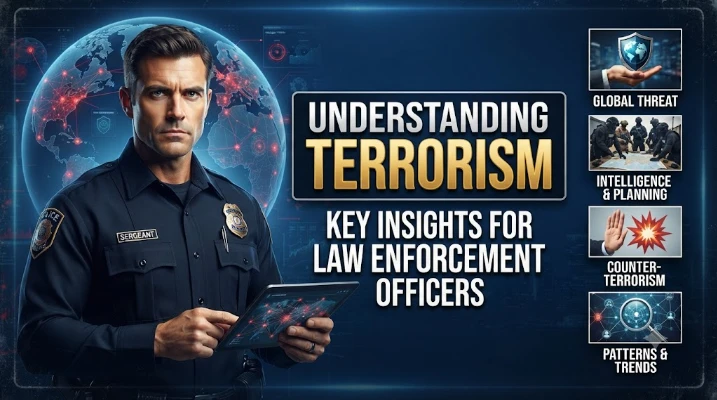
This article provides law enforcement officers with a broad understanding of terrorism, its drivers, operational methods, and prevention requirements. It describes terrorism as a complex phenomenon shaped by political, ideological, religious, social, economic, psychological, and cultural influences. In Bangladesh, the article highlights religious extremism as a significant concern while also acknowledging politically and ideologically motivated violence. It explains how radicalization can develop gradually through grievances, social isolation, propaganda, online networks, and extremist narratives that offer identity or belonging. Officers therefore need to recognize warning signs while avoiding unjustified targeting or rights violations. The article also discusses intelligence gathering, inter-agency cooperation, counterterrorism technology, terrorist financing, community engagement, and international collaboration as essential components of prevention. Because terrorist organizations increasingly use digital communication and cross-border networks, law enforcement must strengthen analytical, investigative, and cybersecurity capacity. At the same time, counterterrorism measures must respect civil liberties. The article concludes that effective terrorism prevention combines intelligence, community resilience, professional training, financial disruption, international cooperation, and lawful policing.
Terrorism is among the most challenging and critical issues of law enforcement agencies all over the world. It is an act of violence or threat to reach political, ideological or religious goals by using fear or coercion or intimidation. With the increasing changes in terrorism strategies, technologies, and world dynamics, the law enforcers should be armed with a holistic notion of what it is, what causes it and what can be used to counter it. In some nations such as Bangladesh where terrorism and extremism are gaining high-stakes, the law enforcement agencies must be ready to deal with this menace without compromising the security at the expense of human rights.
Terrorism is a complex phenomenon that consists of numerous actors, models, and goals. There are domestic and foreign terrorist organizations that work under different ideologies and goals, still, they all focus on the same purpose to cause fear and enforce change politically or socially. Others, such as Al-Qaeda or ISIS, can be violent jihadists, whereas others can be pursuing a nationalist, separatist, or left-wing agenda. In Bangladesh, radical religious extremism has been the most notable kind of terrorism, but violence that is politically and ideologically inclined has also occurred in politics. The growing globalisation and the emergence of social media have ensured that terrorist organisations are able to recruit, radicalize and organize their operations both locally and across borders.
To fight terrorism successfully, law enforcement officials should have a picture of the issues that initially make people resort to extremist beliefs. Terrorism has a tendency to take its origins in a mixture of socio-economic, political, psychological, and cultural factors. Radicalization can be more prone to poverty, low education standards, social disparity, and alienation. In Bangladesh, where a substantial part of the population is struggling economically with limited access to education, several people and, in particular, young people might experience disenfranchisement and susceptibility to the extremist message. Those people can be attracted to the terrorist organizations that will provide them with empowerment, belonging, and sense of purpose.
One more important thing that should be understood about terrorism is how ideology and propaganda contribute to the extremism. Ideology is also used by terrorist groups to legitimize their violence and find followers. Through capitalizing on grievances, political, social, or religious, terrorist groups provide narratives used to give identity, meaning, and vengeance against those perceived to be oppressive. Extremist religious beliefs that exploit religious beliefs have found fertile grounds in Bangladesh where religious identity is given much prominence in the society. Local and international terrorist groups propagate their ideologies with the help of social media, websites, and other internet resources to instill fear and provoke violence.
It is also essential that law enforcement officers should understand the psychology of terrorism. Radicalization can take time in most instances and it starts with exposure to radical ideas through social groups, the internet or media. The changes are likely to occur in the behaviors, attitudes, and worldviews of people as they grow increasingly ideologically attuned to terrorist groups. The police should be in a position to recognize the indicators of radicalization which may include a change in the socialization pattern of a person, being more isolated by the mainstream society and, being exposed to extremist materials. There is a chance that early interventions and interaction with the people who will be susceptible to radicalization can be used to stop them to involve themselves in terrorism.
Successful counterterrorism should also be in respect to the means and techniques of terrorist groups. The contemporary terrorist organizations use various methods, including conventional methods such as bombing and shootings to more advanced ones, such as cyberterrorism and unmanned aerial vehicles (drones). Terrorist attacks in Bangladesh have manifested in different forms that include bombings, assassinations and high profile hostages. The attacks usually aim at attacking a symbolic place, government facilities or foreigners and this is aimed at acquiring media coverage and arousing lots of fear. These various threats should influence the response of law enforcement officers who need to develop specific counterterrorism forces, enhance their intelligence collection, and use sophisticated technologies.
The other important area of law enforcement in combating terrorism is intelligence collection and dissemination. Terrorist organizations tend to work in the dark, and the law enforcement can hardly trace their actions and stop the attacks. In both the domestic and international sphere of intelligence, intelligence activities are central to uncovering the terrorist cells, the motive behind the terrorist cells, and averting attacks before they take place. Bangladesh law enforcement agencies need to work jointly with other agencies in the country including the Directorate General of Forces Intelligence (DGFI) and the Rapid Action Battalion (RAB), international organizations such as INTERPOL and United Nations Counter-Terrorism Centre to share information and coordinate their efforts towards disrupting terror activities. The intelligence collection needs to be followed by powerful analytical software to pinpoint the emerging threats and patterns that can be used to signify the presence of a terrorist activity.
The other important aspect of counter terrorism activities is the prevention of terrorism financing. Terrorist organizations are very dependent on financial resources to finance their activities, get members, and conduct warfare. Terrorist activities are usually funded through money laundering, smuggling and illicit trade. In Bangladesh, law enforcement agencies should trace financial transactions, trace the activities of the suspicious members and liaise with international financial institutions in fight against money flowing to terrorist organizations. The operational capabilities of the terrorist groups can be broken through counterterrorism financing activities such as monitoring funds flow, freeze assets and implementing financial controls.
The involvement of the community is a crucial measure in the war against terror. The police and the local communities should liaise with each other to build trust, collect intelligence and avert radicalization. In Bangladesh, where social marginalization is a common phenomenon in rural and urban regions, community-based interventions that correct the factors that led to radicalization would go a long way in curbing terrorism. These programs can be youth outreach, education, jobs, and counseling services so that they have an alternative to extremist ideologies. Through collaboration with community leaders, religious groups, and civil societies, law enforcement agencies may build community resilience and minimize the effect of terrorist groups.
Striking a trade-off between security and civil liberties is one of the most difficult parts of counterterrorism efforts. Law enforcement agencies need to make certain that counterterrorism interests do not violate human rights, and they do not infringe the rights of the innocent people. Bangladesh operating in the same environment as other democratic states is facing a fine line between the need to secure national security and upholding the basic rights of the citizens. Absence of restraint in the surveillance, detention of are random people, or mistreating of a particular ethnic or religious group may destroy the trust people have on the law enforcing authorities and create a surge in the extremist ideologies. The law enforcement agencies should be made answerable to their actions and they should work in the context of the law to ensure that they are legitimate in the perception of the populace.
In addition, the police should be provided with the training and equipment to deal with the sophisticated character of terrorism. This involves training on the specifics of counterterrorism, psychological readiness to work with crisis situations, and surveillance, communication, and investigation using sophisticated technologies. In Bangladesh, where the law enforcement agencies might lack the resources and technology, the cooperation with the international partners and the investment into the training programs are necessary to develop the abilities of the officers to react to the terrorist threats successfully.
Last, global partnership in combating terrorism is very essential. Terrorist organizations tend to be transnational and the cells have their activities across borders. Since terrorism is a transnational menace, there has to be cooperation among nations in interrupting the terrorist groups, intelligence, and coordination of counterterrorism. The country of Bangladesh is situated at a strategic position as it borders the conflict zones and a porous border against South Asia causes a distinctive security problem in this country. In order to fight terrorism successfully, Bangladesh should cooperate with its neighbors and the global community to enhance the effective security of the border, monitor the flow of people and goods and cooperate in the intelligence and counterterrorism plans.
In summary, it is important to note that intelligence of terrorism is very fundamental in enabling law enforcement agencies to be able to counter the threat of terrorist groups. Law enforcement can contribute to minimizing the terrorism threat and ensuring the safety of the population through analyzing the underlying causes of terrorism, identifying the tactics and strategies employed by the terrorist organizations, and applying intelligence, community involvement, and prevention. The law enforcement in Bangladesh through prevention of radicalization, intelligence gathering, and attack response is at the core of keeping the country safe in the wake of terrorism and extremism being a chronic problem in the country. Since the character of terrorism is constantly changing, law enforcement agencies must adjust and coordinate with their counterparts across the borders, and make sure that the counterterrorism operations does not prejudice against human rights to produce a safer and a more secure society.
CITE THIS ARTICLE
Das, B. C. (2026). Understanding Terrorism: Key Insights for Law Enforcement Officers. https://www.bikashchandra.com/article/1e9275be-c22f-5228-8ba7-e3ad7141fe90
B. C. Das, “Understanding Terrorism: Key Insights for Law Enforcement Officers,” 2026. [Online]. Available: https://www.bikashchandra.com/article/1e9275be-c22f-5228-8ba7-e3ad7141fe90
Das, B. C. (2026) ‘Understanding Terrorism: Key Insights for Law Enforcement Officers’. Available at: https://www.bikashchandra.com/article/1e9275be-c22f-5228-8ba7-e3ad7141fe90
Das, Bikash Chandra. “Understanding Terrorism: Key Insights for Law Enforcement Officers.” 2026, https://www.bikashchandra.com/article/1e9275be-c22f-5228-8ba7-e3ad7141fe90.
Bikash Chandra Das. “Understanding Terrorism: Key Insights for Law Enforcement Officers.” (2026). https://www.bikashchandra.com/article/1e9275be-c22f-5228-8ba7-e3ad7141fe90.
Das BC. Understanding Terrorism: Key Insights for Law Enforcement Officers. 2026. https://www.bikashchandra.com/article/1e9275be-c22f-5228-8ba7-e3ad7141fe90
@misc{article_1e9275bec22f52288ba7e3ad7141fe90,
  title = {Understanding Terrorism: Key Insights for Law Enforcement Officers},
  author = {Bikash Chandra Das},
  year = {2026},
  url = {https://www.bikashchandra.com/article/1e9275be-c22f-5228-8ba7-e3ad7141fe90},
}
TY  - GEN
AU  - Bikash Chandra Das
TI  - Understanding Terrorism: Key Insights for Law Enforcement Officers
PY  - 2026-07-05
UR  - https://www.bikashchandra.com/article/1e9275be-c22f-5228-8ba7-e3ad7141fe90
ER  -
This article explores why people volunteer in America’s national parks and how program design influences whether service remains meaningful. Volunteer motivations often overlap and include personal values, learning, social connection, career development, confidence, purpose, and attachment to place. The article uses motivational frameworks to show that volunteers are more likely to remain engaged when they experience autonomy, growing competence, respectful relationships, and a clear connection
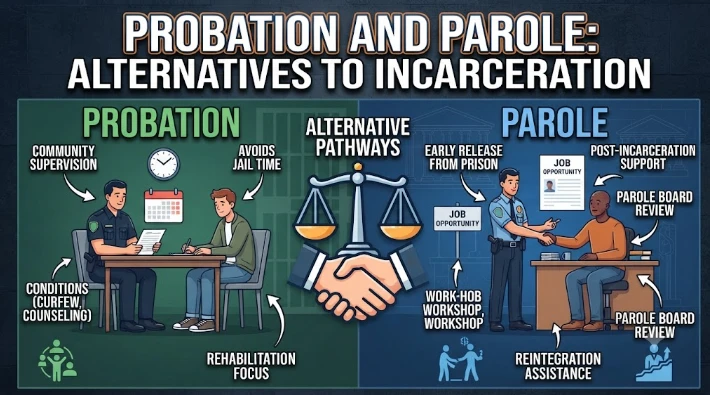
Probation and parole are presented as essential community-based alternatives to incarceration that combine supervision, accountability, and reintegration. Probation generally allows eligible offenders to remain in the community instead of serving a prison sentence, while parole provides conditional release after part of a custodial sentence has been completed. The article explains that both approaches can preserve employment, family ties, education, and housing, all of which reduce the risk of r
This article defines the ethical boundaries that protect volunteers who support visitor safety and law-enforcement-related functions in national parks. Although volunteers can assist with information, observation, traffic support, administrative work, backcountry roves, and reporting hazards, they must not exercise powers such as arrest, detention, search, citation, evidence handling, use of force, or other commissioned enforcement duties. The article emphasizes clear position descriptions, accu