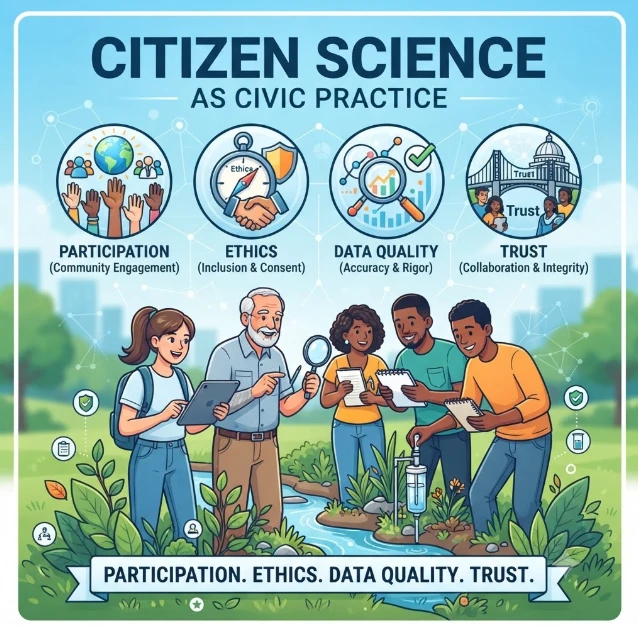
This article presents citizen science as both a research practice and a form of civic participation in which members of the public contribute to questions, observations, classification, interpretation, and the use of findings. Projects vary from simple data submission to deep community involvement in research design and decision-making, and quality depends on whether participant roles fit the project’s purpose. The article emphasizes protocol design, training, metadata, calibration, validation, sampling bias, uncertainty, and expert review as foundations of reliable data. Ethical concerns include consent, sensitive locations, community stigma, privacy, data access, credit, reuse, and public release. Reciprocity is strengthened when participants receive results, understand limitations, and see how their contributions matter. Government partnerships can connect local observation with technical support while preserving community independence. Inclusion requires equipment access, stipends, transport, translation, disability support, and safety planning. The article concludes that citizen science becomes civic practice when scientific rigor is combined with shared inquiry, ethical stewardship, fair recognition, transparent governance, and accountable action.
Citizen science starts with a shift of those involved in knowledge production. All citizens, students, volunteers, patients, farmers, birdwatchers and other community groups can participate in asking questions, making observations, categorizing images, deciphering patterns, and applying findings. When the practice is related to common responsibility, public learning, and decisions that impact common life it becomes civic.
The level of depth of projects is diverse. Some welcome the opportunity for participants to send a photo, or to count a species, and others engage communities in design of questions, in selection of methods, in interpretation of data, and in advocacy. There is no inherent advantage to either of the models. Quality is determined by the fit between the role and purpose, and by understanding of participants about the role of contribution in the research process.
The National Academies report Learning Through Citizen Science put forward that citizen science gives special opportunities to learn science. The exercises are based on actual investigations, not exercises with predetermined solutions. They may experience uncertainty, variation, error and revision as a part of science. Reflection is stronger when project design supports learning; and is not seen as a readily available sensor.
There is an additional layer to Civic Practice. A water monitoring group can develop its own water monitoring concerns, become familiar with the regulatory requirements, engage regulatory officials and create a local capacity to monitor water quality into the future. The Biodiversity project can link people to land management. Participation creates public awareness of the processes of institutionally problematizing and the use of evidence.
The choice of questions has an influence on the legitimacy. Professionally designed projects can have significant gaps in addressing community priorities and yet be very important for science. Concerns related to everyday experience can be addressed via co-design sessions, listening interviews and local advisory groups. Feasibility, ethics and scientific value still need to be evaluated, and should be done with the input of community knowledge.
Data quality is touted as the biggest problem with citizen science. Quality is actually a function of the protocol design, training, equipment, metadata, validation and proposed use. There is error in professional data sets as well. A good project establishes and tolerates uncertainty and incorporates checks appropriate to the decision supported.
Observations are made using a standard procedure, which helps to make observations comparable. Instructions should be provided as to where and when the data are collected, how and what conditions might impact the interpretation of data. Consistency can be achieved by practicing exercises and field guides. Supervised training is required for complex methods, not to be based on a brief online training.
Quality can be ensured using automated time stamp, location, range checks, image review and duplicate detection. These tools don't take the place of human judgment. However, there are other factors that can lead to inaccurate results, such as faulty sensors, poor connectivity, software updates, and classification errors. Transparent documentation and calibration of technical systems is required.
Unusual or high impact observations can be sent for expert verification. Structured data collection, area-based commentary and extensive monitoring programs are examples of how platforms like eBird can aid in biodiversity research. For image classification projects, multiple different judgments may be made prior to acceptance of a label. Validations should be proportionate as too many can make it burdensome and slow to participate.
Bias is not just about individual error and needs to be considered. Data collected by volunteers is often collected in areas close to their own home, along roads, in parks or on open and accessible trails, so that areas that are far or unsafe to access are underrepresented. It is possible to have a focus on participation from those who have time, equipment, education and confidence. Gaps of this kind can be minimised by sampling design and targeted recruitment.
Ethics doesn't just apply to the actual consent. Place names may reveal endangered species or sacred sites, private property, or vulnerable communities. Sensitive data about households can be uncovered from health and environmental projects. Rules for data access, masking, retention, reuse or publishing have to be created prior to data collection.
Community Risk is not the same as Individual Risk. Even if the names of individuals are removed from a map, it can still be stigmatizing, if it displays pollution, sickness or social circumstances. Residents need to be involved in decisions relating to interpretation and release. A scientific openness does not require that one be careless in revealing his own vulnerability.
A good design of credit is required. The participants may provide thousands of hours, local knowledge or key access and get just a general acknowledgement. Authorship or contributors, data as a component, public recognition, ownership should be discussed in the project plans. Various types of credit can be an indicator of various levels of responsibility without negating and demeaning volunteer contribution.
Whether participation is felt to be reciprocal is dependent upon feedback. Results, limitations and policy relevance are not explained in many of the projects that collect observations. Contribution mattered is regularly reported through updates, local meetings, dashboards, newsletters and accessible reports. It is also important that the participants understand that there are times when data is inconclusive or can't be used for the claim they want.
Honesty builds trust, by acknowledging uncertainty. Community groups can be frustrated if data is gathered with a lot of effort and it's not meeting the regulatory requirements, or if it isn't resulting in action. Purpose for collecting needs to be stated by researchers or agencies. Even though this evidence is not conclusive, it may be used to establish patterns, provide further monitoring information, or serve as a basis for public inquiries and questions without establishing a violation of law.
There can be greater impact through government partnership. EPA has created materials for citizen science and community air monitoring, including what to do with the data and recommendations for sensors. By partnering, local observation and technical support and official systems can be linked. At the same time, independence is important as communities must have the freedom to question the assumptions of the agencies.
The conflict may arise, when the findings of citizen and institutional data are not the same. Variations may be due to location, time, calibration, averaging or method and not dishonesty. Joint review needs to be carried out in order to compare protocols and raw information prior to discarding either source. Making the process transparent can help improve the data sets and understanding of the public.
Communities should not become the subjects of participation and lose their regulatory functions. Authorities need to investigate even if a resident who has been affected by pollution or ecological damage has not created the ideal data set. Citizen science can enhance public awareness but the monitoring, enforcement and protection of the government remains. Statutory capacity will not be waived for unpaid observation.
Practical supports are needed for inclusion. Wider participation can be achieved through equipment loans, stipends, transport, child care, translation and disability access, as well as flexible schedules and community-based training. Projects that are only available online may keep those with poor connection out. A project claiming public participation should examine which publics remain absent.
Safety planning is dependent on the field. Participants can face traffic, weather, difficult terrain, contaminated sites, wildlife, hostile property owners, or emotional distress. It is essential to have hazard assessments, protective equipment, check-in systems and clear stop work authority. There is no science goal that can be achieved with suboptimal exposure.
Assessment should include outcomes in the areas of science, education, civic and relational. Measures can include data quality, geographic area, participant engagement, learning, confidence, expansion of network, policy adoption and community satisfaction. Interviews are a way of finding out about changes in identity, trust and willingness to engage institutions. Mixed evidence is evidence that surpasses the number of records submitted.
It takes data stewardship and continuity to be sustainable. Platform switchings, grant funding terminations, staff turnover and equipment failures are all the norm. Preservation plans and documentation, maintenance resources, and community access to historical documentation is required for projects. Methods and data can still be beneficial and useful for a temporary project to create long-term value.
Governance boards can help to visualise responsibility. Changes to the project's protocol, requests, conflicts, and statements in the public eye are subject to a project involving researchers, community representatives, agencies, educators, and data specialists. There is a need for transparency in the selection of members and the need for members to have authority. The use of advisory language without decision-making power may reinforce the same imbalance as intended to be avoided by participation.
Durable civic infrastructure for participation can be provided at school and in the library. There is opportunity for teachers to link observation to curriculum and for libraries to provide equipment, trainings, and for facilitating access to data. Such institutions have the ability to connect with individuals outside of the existing science community. But partnerships must be realistic in staffing arrangements to ensure that public educators are not left with complex technical tasks without staff.
Mechanistic understanding and interpretation is strengthened. Explanation requires knowledge of physical, biological or social processes and a pattern in observations can be an indication for the need for deeper study. The use of community data and laboratory analysis, and professional monitoring, combined with contextual interviews, can test competing explanations. This is the layered approach to provide defense for action if greater than the data justifies. Citizen science becomes civic practice through shared inquiry, accountable action, scientific rigor, ethical care, fair credit, and honest feedback.
CITE THIS ARTICLE
Das, B. C. (2025). Citizen Science as Civic Practice: Participation, Ethics, Data Quality, and Trust. https://www.bikashchandra.com/article/f8cde562-ee54-5b89-9125-d1290acb2c6f
B. C. Das, “Citizen Science as Civic Practice: Participation, Ethics, Data Quality, and Trust,” 2025. [Online]. Available: https://www.bikashchandra.com/article/f8cde562-ee54-5b89-9125-d1290acb2c6f
Das, B. C. (2025) ‘Citizen Science as Civic Practice: Participation, Ethics, Data Quality, and Trust’. Available at: https://www.bikashchandra.com/article/f8cde562-ee54-5b89-9125-d1290acb2c6f
Das, Bikash Chandra. “Citizen Science as Civic Practice: Participation, Ethics, Data Quality, and Trust.” 2025, https://www.bikashchandra.com/article/f8cde562-ee54-5b89-9125-d1290acb2c6f.
Bikash Chandra Das. “Citizen Science as Civic Practice: Participation, Ethics, Data Quality, and Trust.” (2025). https://www.bikashchandra.com/article/f8cde562-ee54-5b89-9125-d1290acb2c6f.
Das BC. Citizen Science as Civic Practice: Participation, Ethics, Data Quality, and Trust. 2025. https://www.bikashchandra.com/article/f8cde562-ee54-5b89-9125-d1290acb2c6f
@misc{article_f8cde562ee545b899125d1290acb2c6f,
  title = {Citizen Science as Civic Practice: Participation, Ethics, Data Quality, and Trust},
  author = {Bikash Chandra Das},
  year = {2025},
  url = {https://www.bikashchandra.com/article/f8cde562-ee54-5b89-9125-d1290acb2c6f},
}
TY  - GEN
AU  - Bikash Chandra Das
TI  - Citizen Science as Civic Practice: Participation, Ethics, Data Quality, and Trust
PY  - 2025-04-16
UR  - https://www.bikashchandra.com/article/f8cde562-ee54-5b89-9125-d1290acb2c6f
ER  -
This article explores why people volunteer in America’s national parks and how program design influences whether service remains meaningful. Volunteer motivations often overlap and include personal values, learning, social connection, career development, confidence, purpose, and attachment to place. The article uses motivational frameworks to show that volunteers are more likely to remain engaged when they experience autonomy, growing competence, respectful relationships, and a clear connection
Probation and parole are presented as essential community-based alternatives to incarceration that combine supervision, accountability, and reintegration. Probation generally allows eligible offenders to remain in the community instead of serving a prison sentence, while parole provides conditional release after part of a custodial sentence has been completed. The article explains that both approaches can preserve employment, family ties, education, and housing, all of which reduce the risk of r
This article defines the ethical boundaries that protect volunteers who support visitor safety and law-enforcement-related functions in national parks. Although volunteers can assist with information, observation, traffic support, administrative work, backcountry roves, and reporting hazards, they must not exercise powers such as arrest, detention, search, citation, evidence handling, use of force, or other commissioned enforcement duties. The article emphasizes clear position descriptions, accu