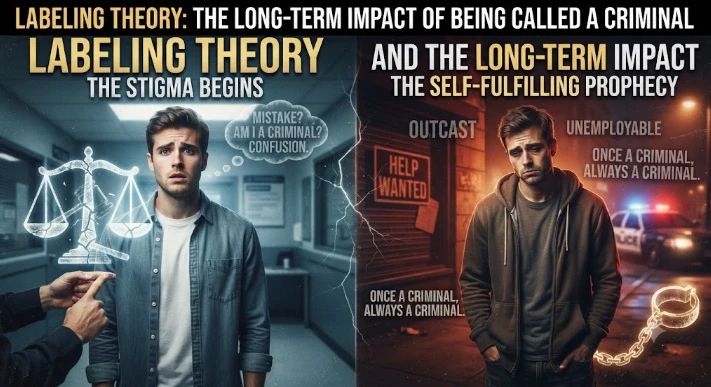
Punishment is not necessarily terminated by the sentence in the criminal justice setting of ; this is one of the most uneasy facts. In most instances it starts there. An individual can come out of probation, come out of prison, fulfill the conditions of the court, or simply grow up in the criminal youth, but he or she still has a social scar that accompanies him or her to every job interview, housing application, school environment, and personal relationship. The Labeling Theory can be used to explain this trend by positing that the social response to deviance may be equally significant as the deviant behavior in the first place. That is, it is not only what an individual does but what follows after the society determines who that individual is.
When a person is already branded a criminal, a felon, a delinquent, or an offender, this label can become so strong that it begins to determine further opportunities, social identity and even future behavior. This process is now more visible and more permanent in since labels are no longer the stuff that exists in court files and in gossip. They are stored in databases, search engines, history of social media, tenant background checks, school history and algorithmic recruitment platforms. The outcome is contemporary stigma economy in which the past is not just remembered. It is computerized, self-searchable, and enforced many times.
Related most closely with authors like Howard Becker and Edwin Lemert, Labeling Theory causes criminologists to no longer focus on the act of crime but rather the meaning that society ascribes to that act. This is the reason why the theory is so disturbing and significant. It does not just inquire why people break rules but why some of the rule breaking tendencies come to the heart of identity and other forms of misbehavior are discarded, forgiven or forgotten. Majority of the population engages in a deviance of some sort at some time in their lives. Underage drinking, cheating at school, petty theft, vandalism, drug experimentation, rowdy behavior, among other rules that are minor in violation are much more prevalent than criminal justice agencies commonly realize.
According to Lemert, these earlier acts were referred to as primary deviance. At this level, the person does not always identify himself/herself as deviant and neither can society label the person as deviant. The conduct can be episodic, circumstantial or even cultural in a particular group. The turning point is the point at which the act is publicly identified, formally prosecuted and imprinted on the individual as a mark. This is where secondary deviance starts. The person is not responding solely to his or her behavior anymore. The label that is put on them and the treatment that label allows is what they are responding to. When the world constantly tells a person that he or she is dangerous, untrustworthy, criminal, or morally damaged, this message gradually develops into what he or she thinks about him or herself.
This is the reason why labeling is so important. It makes an event out of an identity. When the label is established to be what sociologists term a master status, then it starts to eclipse all other things about the individual. They are no longer mainly viewed as a parent, student, worker, neighbor, artist, caregiver, or the young person who is attempting to come back into the world after a mistake. Institutions and, more often, the citizens make them a criminal. The impact of that change is gigantic. Expectations are made by labels. They alter the treatment of the teachers by students, the screening of job candidates by employers, the assessment of risk by landlords, the interpretation of behaviour by the police and the trust given to one in the community.
An individual who is labeled a criminal might be monitored more closely, forgiven less readily and excluded more regularly. Eventually, this social response can limit legitimate opportunities to such an extent that the individual goes even deeper into the very identity he or she was given. The label begins as an external appraisal though it may become internalized in a script. When all treat me as a criminal, the man may start believing, that is probably what I am. By this time, justice is no longer a reaction to deviance. It is assisting in the production of it.
By , the labeling force has increased further due to the fact that social stigma currently takes place through both technology and human judgment. A criminal record is no longer a paper record that is stored in a dusty vault. It is a digital tag which is easily recalled and can continuously be passed on. This allows employers to depend on automated background checks, landlords to rely on tenant databases, licensing boards to do their vetting digitally and searches online to find old arrests, mugshots and case references within a few seconds. The perception of a person can be influenced even by a mere look at the history of being in contact with the justice system even where he or she has never been convicted.
The digital scarlet letter is hard to avoid as it does not rely on memory lapsing and movement of people. It is ingrained in systems. Practically that translates to the fact that the label continues to appear way after a sentence is completed. In most instances, one can be turned down on a job before even a human being can open their qualifications. The record is flagged by an algorithm and the door closes automatically. The punishment is frictionless, perpetual and invisible. It is not proclaiming itself as a moral judgment. It is merely manifested in refusal, refusal to reply, or silent rejection.
One of the most explicit locations where labeling becomes the long-term exclusion is the labor market. Being labeled as a criminal will severely decrease access to stable employment and one of the most powerful predictors of crime desistance is a stable employment. This belongs to the sadistic thinking of labeling. Society instructs individuals to get on, accept responsibility and restart their lives, and at the same time thwarts the same institutions through which they can do so. An individual with a history can be seeking dozens of jobs, in active mode, demonstrate motivation, and still not get a serious opportunity as a result of the labelling leads to presumptions of danger, dishonesty, or unreliability.
With time, continuous rejection can be a psychologically corrosive influence. It does not just decrease income. It destroys hope, self esteem and faith in legal channels. When a career in law is no longer available, illegal employment may seem not as carefree of choice, but rather as the last economy that is open. Labeling Theory does not claim that all stigmatized people will repeat their crimes. It claims that stigma enhances the circumstances that predispose reoffending. That difference counts. The label is not some way of mechanically producing crime, although it may reduce the options to be so thin that crime is rationalized more easily and avoided more difficult.
This impact is worse among the youths. Labeling is particularly devastating in adolescence since identity is being created. A label as a troublemaker, delinquent, bad kid, gang member, problem student etc can start to structure the behavior of a young person around the label, especially when it is reinforced by those in power. This is severely destructive in school. When a student is labeled disruptive or dangerous, the discipline tends to be more severe, patience is less and expectations reduced. The peers can also internalize the label, and they will consider the student deviant even when he or she is trying to change. This is one of the reasons why there is a school-to-prison pipeline.
It is not only concerning tough discipline measures. It is also regarding the socialization of some children as the future offenders. When that picture is set in stone, then all actions are viewed with suspicion. A struggle turns out to be a test of character. An error is testimony of fate. As opposed to being assisted, the youngster is monitored. They are not directed to come back into the fold, but they are rather shunned. To others, such exclusion would be the start of a criminal identity that may not have ever become established in the first place, were the response not so stigmatizing and so destructive.
That is why it is so important to distinguish between stigmatizing shaming and reintegrative shaming. Stigmatizing shaming strikes against the entire individual. It goes, essentially, you are bad, you are polluted, you are one of them. By comparison, Reintegrative shaming criticizes the action and lets individuals back into the community with honor. It declares that you are wrong about that thing you did, but you are better than that thing you did. Such difference sounds to be easy, yet it alters everything. In case individuals are humiliated, publicly marked, and permanently ostracized, the social bond is undermined. Whenever they are answerable, in a manner that does not eliminate belonging, there is a high probability of making amends. A justice system that has the sole knowledge of how to brand will end up replicating the circumstances of future offending. When a justice system understands how to decouple the individual and the offense, it is far more likely to promote the person engaging in desistance.
The loss of social capital is one of the most significant ways that labels harm. The term social capital refers to the support networks, trust, and community that provide people with the way to go through life. These networks tend to break when one is labeled as criminal. Relatives can be humiliated or tired. Friends can be alienated. Religious groups can be critical instead of helpful. Mentors and employers can vanish. Then the individual becomes disconnected with the very relationships that would have grounded him/her back in the process of reentry or recovery. Deviant subcultures are made more desirable in that vacuum. It does not always happen that crime is glamorous, but rather because, when they feel rejected, deprived people tend to be accepted by other rejected ones. These organizations might provide security, identity, revenue, and fame. When the legitimate society tells you that you do not fit in, then the individual will seek to fit in other places. Labeling Theory assists us in realizing that this tendency towards deviant networks is not necessarily something that is preferential. In many cases, it is the fruit of social ostracism.
Another way that labels are turned into mechanical barriers is in housing. Safe and stable housing is among the most predictive factors of successful reentry in , and one of the most difficult factors that justice-involved individuals can obtain. Housing by private landlords filters out anyone with any criminal background and in the public housing systems it is frequently subject to their own regulations. The consequence is that the individual who comes out of jail or prison is forced into temporary accommodation, precarious living conditions, shelter, and an already established neighborhood characterized by high crime and poor institutional backing. The fact that it makes life more difficult is not the only effect of that instability. It builds the brand name. In the absence of a steady address, there is more difficulty in obtaining and maintaining employment. Lack of housing stability makes it harder to abide by supervision. The individual has no secure place to rest and therefore is caught in the emergency situations that increase the level of stress and compromise legitimate activities. By doing so, this label is not merely symbolic. It is made spatial. It determines to what areas and what places a person is and cannot live and hence what type of opportunities or hazards are presented to them daily.
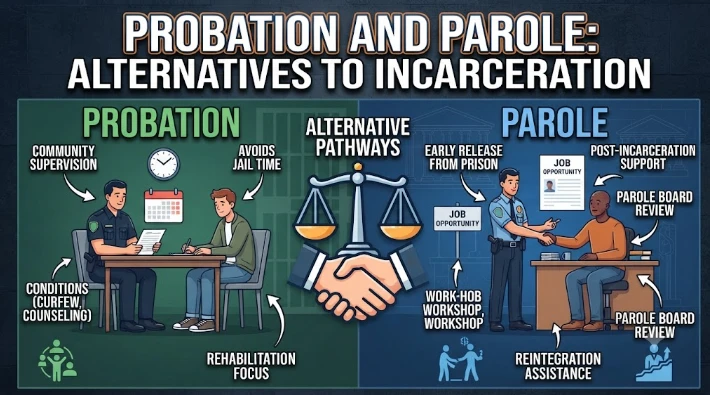
Another force that is also powerful in refreshing labels is the institutional contact. Each police stop, parole check-in, court inspection, and forced screening or surveillance contact reminds the criminal of his or her identity as well as those within his or her surroundings that the criminal is still alive and functioning. This is legally required in other cases. However, the cumulative impact can be very deep. The justice system turns to be the most stable institutional relationship of the person. They might be more familiar with probation officers than with employers, court appearances than with working hours, and supervision directives than with civil liberties. When this occurs then the system is not simply dealing with behavior. It is solidifying identity. In the real-world, the individual is still considered a justice subject before he/she can return to being a normal citizen. Labeling Theory gives a wake-up call that it is not just risk that is monitored by repeated institutional contact. It is also a communication of status. It informs the individual, repeatedly, of who he or she is supposed to be.
This is one of the reasons why diversion is so important. In the event that formal labeling can enhance criminal identity, then a justice system would do one of the most intelligent things possible, and prevent the needless labels in the first place. The success of pre-charge diversion programs, restorative conferencing, treatment based alternatives, youth panels and community accountability models all operate in part because they break the labeling process before it becomes solid. Once one is able to accomplish an outcome without bearing an indelible criminal brand, then he or she will have a better chance of going on without deviance becoming entrenched. This does not mean tenderness. It is strategy. It is aware that formal processing is not necessarily neutral and harmless. In other cases, it is even worse than the behavior in the first place, particularly with low-level offending, youth cases, behavior based on trauma, poverty, addiction, and immaturity.
Another significant change in the way the justice systems are starting to conceptualize labels is that of clean slate policies. By allowing records on minor crimes to be sealed or automatically wiped out at the end of a reasonable duration of responsible conduct, the law is recognizing something about humanity: it is possible to reform individuals, and the government should not forever stand in the way of that reform. A record can have some short-term legal purpose but it should never become a life sentence of exclusion. Automatic expungement is particularly critical since the systems, which presuppose individuals going through complicated legal petitions, tend to be advantageous to those who have money, are literate, possess time, and access to legal services, whereas the most needy become permanently stigmatized. A really equitable policy on de-labeling should be available, automatic where feasible, and reentry friendly.
The language issues are also important, although they might appear minor in comparison to jobs and accommodation. The imagery of people is created by the words that institutions apply. Words like inmate, convict, criminal, offender and ex-con can put a human being into one dimension. People-first language does not annul accountability but it provides a conceptual space of complexity. Referring to a person who is involved in or has been involved in justice may be seen as humble, but it is a way to disturb the habit of regarding legal status as essence. When labels cease to be descriptions of something that happened at some time in the past and begin to be complete explanations of a human being, then they become dangerous. Language cannot be the solution to structural exclusion, but it can either support or oppose the logic of permanent stigma.
Labeling Theory does not purport that every crime is a result of labels nor it denies individual responsibility. It is powerful because it demonstrates how social reaction may amplify, stabilize and perpetuate deviance. It challenges us to take a straight forward view of what follows official condemnation. Is the reaction rendering lawful life more accessible or inaccessible? Does it alienate the individual or re-integrate him? Does it entrap them in one identity or provide grounds of development? Those are not tender questions. These are open questions of safety. It should not come as a surprise when a society which has permanently branded people as other eventually finds that some of them no longer feel the need to invest in belonging. An exclusionary is criminogenic. Humiliation may be criminogenic. The hopelessness is criminogenic. To make sure that fewer people will revert to crime, we cannot just focus on what they have done but also what we are doing to them later.
That lesson is needed in more than ever before due to the instruments of labeling being quicker, broader, and more indelible. However, that also implies that the reform opportunity is now more obvious than ever. We are able to devise justice systems that interfere without labelling. We have the opportunity to establish ways back to housing, employment, education and civil involvement. We can turn diversion into reality, expungement into automaticity, reentry into practice and accountability into a human being. Above all we can cease to confound the worst thing a man does with his entire future. Labeling Theory makes us pose a difficult question: do we attempt to minimize harm or do we attempt to label people forever? The answer is relevant as people cannot create the real safety when they are held captives in the identity that they are trying to escape. It is constructed through making reintegration realistic. The society is not made safer by getting better at labeling people as criminals, but rather when they get better at transforming them into something different.