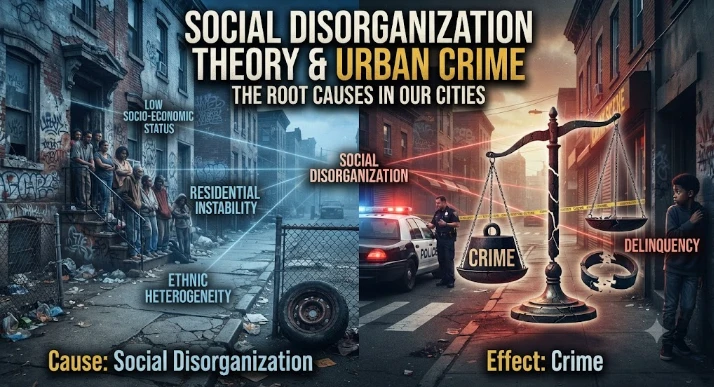
Social Disorganization Theory explains why crime tends to cluster in particular urban neighborhoods by focusing on weakened community structures rather than individual moral failure. The article identifies concentrated poverty, residential instability, and rapid social or cultural change as conditions that can weaken informal social control and make collective problem-solving more difficult. It also highlights collective efficacy, meaning shared trust and willingness among residents to intervene for the common good, as a major protective factor. Physical environments matter as well: neglected spaces, weak institutions, poor lighting, vacant properties, and limited community facilities can signal low guardianship and increase opportunities for disorder. The article therefore supports community-based prevention through stronger schools, youth programs, local organizations, environmental improvements, restorative conflict resolution, and Crime Prevention Through Environmental Design. Its central argument is that urban crime is often a product of weakened social bonds and institutions. Strengthening neighborhood cohesion, institutional capacity, and residents’ sense of shared responsibility can reduce crime while building more resilient communities.
The neighborhoods in the city centres of the contemporary urban center are in the stark contrast of the neighbourhoods that flourish with their social networks and economic stability, some just appear being in the loop of crime, turmoil, and social degradation. The long-standing differences between these regions have continued to be a mystic to criminologists and policymakers. With the economic inequalities, housing crises, and blistering digitalization taking unprecedented tolls on cities in , Social Disorganization Theory (SDT) will remain a critical context to explain the reasons why offenses are concentrated in specific settings and the role played by community factors in offending trends. The theory, which is based on the findings of the Chicago School of Sociology, is an opposition to the idea that crime is simply a consequence of the moral deficiencies of an individual. Rather, it assumes the occurrence of criminality as a result of the failure of social institutions that uphold the maintenance of cohesion such as families, school, religious groups, and local networks in performing their roles efficiently in a way that the communities become segmented and incapable of controlling behaviour within their groups.
Recent studies affirm that a symptom of structural and environmental failures is frequently crime, not the behaviors of bad actors. In , spatial analytics and real-time social metrics are able to create high-resolution information that enables researchers to identify the specific factors that undermine the stability of communities. There are three structural pillars that are always given as the major sources of disorganization. The former is disadvantage that is concentrated especially poverty, which compromises the capacity of residents to invest in social and physical infrastructure. Urban neighborhoods where poverty rates exceed twenty five percent always indicate weaker informal social controls, that is to say that neighbors are less prone to intervene in case they observe a crime or disorder.
Economic precarity also compels families to be subjected into stressful lives, restricts them to quality education and leisure activities and the ability of local institutions to interact with the youth appropriately. The second pillar is residential instability. The inability to form social bonds is because of high rates of population turnover be it due to gentrification, a crisis in rental, or displacement. Living in a community where they are not well acquainted with their neighbors, they will be less vigilant and able to offer mentorship and supervision, report suspicious acts, and will engage in problem solving as a community thus creating a vacuum in which criminal conduct can thrive. The third pillar is ethnic and cultural heterogeneity.
On one hand, diversity makes the community more vibrant, but on another hand, fast demographic shifts without a subsequent social integration may lead to the language barrier, the norm clashes, and the problems with the shared values. These changes may undermine trust and decrease readiness of residents to act jointly to counter disorder without deliberate activities to promote communication and inclusion.
Collective efficacy has become a crucial development of the Social Disorganization Theory that recognizes the interaction between social trust and collective expectation of community intervention. The collective efficacy in high neighborhoods leads individuals to believe in their ability to confront disorderly conduct because they are certain that their neighbors and the authorities would be on their side. On the other hand, in low collective efficacy settings, the individual will not intervene due to apathy and will not be indifferent, but will not believe that their actions will work or be encouraged to do so. By the early empirical findings indicate that even small gains of collective efficacy of about ten percent can be associated with a decrease in violent crime between 1.2 and 1.5 percent, independent of other socio-economic conditions. These results indicate that the cultivation of social units and cohesiveness with material investments is significant because trust and accountability to one another is the social glue with which informal social controls become functional.
The surroundings per se is also critical in either enhancing or compromising social control. Perception and opportunity to commit crime can be influenced by physical design, accessibility and visibility. The article by the Journal of Urban Health, published in 2025, confirms that community-based greening, such as facade repair, vacant lot maintenance, and shared gardens, can greatly reduce the firearm violence and other disorder risks. Such interventions are a message to the residents and would-be offenders that the community cares about its setting and puts up barriers on them by being seen and socially monitored. On the other hand, institutional isolation, where schools are low-resourced, community centers are closed, and local businesses go out of business, eliminates the key anchor institutions that help youths connect with the world and receive mentoring by adults, making them more vulnerable to crime.
The issues that the Social Disorganization Theory reveals have to be tackled holistically and on the community level. One of the strategies is the reinforcement of anchor institutions. Projects in the schools, youth programs, workforce development programs, and the nonprofit organizations directly increase the structural capacity of the neighborhoods to sustain the informal social controls. It has been shown that having any given community organization active in a city of 100,000 people in will result in an estimated one percent decrease in violent crime, indicating the multiplier effect of multiple overlapping support networks. Environmental Design Crime prevention (CPTED) has also been scaled down to involve communities directly. Through the enhanced illumination, the renovation of open areas, eradication of blight, and participation of the people in the neighborhood planning community members acquire both physical and psychological ownership of the surrounding, which enhances community efficacy and prevents crime.
Structural and environmental interventions are supplemented with restorative justice and local conflict -resolution networks. By urging families, religious groups and neighborhood to become mediators of disputes and solve local conflicts, trust is restored and social norms strengthened. Such strategies, it is estimated, will not only decrease recidivism but will also boost trust in the formal justice system as they will prove that the conflicts can be solved in the most efficient way at the community level. By applying transparency and cultural competence to the administration of justice, the gap between residents and the enforcement efforts, crime reporting, and active involvement in neighborhood safety programs is bridged, eliminating the ability of disorder to exist.
With the Social Disorganization Theory being applied on the modern urban environment, the general interaction of socio-economic factors, nature, and mass collective behavior can be comprehended. The high rates of crime are not accidental; the unprotected physical space, the lack of control over social ties, and the institutional disregard is the expected result. The contemporary problems of cities such as the consequences of digital economies, housing crisis, and demographic shifts exacerbate the weaknesses I have discovered about SDT, and thus the need to interfere with the area to enhance social cohesion, institutional presence, and environmental design becomes even more pressing. The cities that give these investments first cut down crime but they also create resilience, civic participation, and sense of belonging that turns the areas of neglect into self-governing living communities.
Social Disorganization Theory can be employed as an intervention and a diagnostic tool as urban planners, policymakers, and law enforcement agencies continue to struggle with the problems of the complex city in . It serves as a reminder that it is impossible to interpret crime without considering the behavior of the individuals; context in which the behavior takes place is also a defining factor, and in some way more so. Through addressing the individuals, the institutions of the city and the physical landscape that constitute urban neighbourhoods, the cities can disrupt the disorder cycles that breed criminal activity. The concept of justice is not only limited to the courtroom but it goes to every street corner, every school, and community meeting hall and defines the experiences of the people living there and the security of whole communities. By stating the centrality of place, we restate that good crime prevention is all about building strong, connected, and resilient communities, in which social norms are strengthened with each other based on mutual trust, shared responsibility, and active civic engagement.
CITE THIS ARTICLE
Das, B. C. (2025). Social Disorganization Theory and Crime in Urban Communities. https://www.bikashchandra.com/article/df1db524-f8c2-5740-a627-eab2ec40e1e2
B. C. Das, “Social Disorganization Theory and Crime in Urban Communities,” 2025. [Online]. Available: https://www.bikashchandra.com/article/df1db524-f8c2-5740-a627-eab2ec40e1e2
Das, B. C. (2025) ‘Social Disorganization Theory and Crime in Urban Communities’. Available at: https://www.bikashchandra.com/article/df1db524-f8c2-5740-a627-eab2ec40e1e2
Das, Bikash Chandra. “Social Disorganization Theory and Crime in Urban Communities.” 2025, https://www.bikashchandra.com/article/df1db524-f8c2-5740-a627-eab2ec40e1e2.
Bikash Chandra Das. “Social Disorganization Theory and Crime in Urban Communities.” (2025). https://www.bikashchandra.com/article/df1db524-f8c2-5740-a627-eab2ec40e1e2.
Das BC. Social Disorganization Theory and Crime in Urban Communities. 2025. https://www.bikashchandra.com/article/df1db524-f8c2-5740-a627-eab2ec40e1e2
@misc{article_df1db524f8c25740a627eab2ec40e1e2,
  title = {Social Disorganization Theory and Crime in Urban Communities},
  author = {Bikash Chandra Das},
  year = {2025},
  url = {https://www.bikashchandra.com/article/df1db524-f8c2-5740-a627-eab2ec40e1e2},
}
TY  - GEN
AU  - Bikash Chandra Das
TI  - Social Disorganization Theory and Crime in Urban Communities
PY  - 2025-10-08
UR  - https://www.bikashchandra.com/article/df1db524-f8c2-5740-a627-eab2ec40e1e2
ER  -
This article explores why people volunteer in America’s national parks and how program design influences whether service remains meaningful. Volunteer motivations often overlap and include personal values, learning, social connection, career development, confidence, purpose, and attachment to place. The article uses motivational frameworks to show that volunteers are more likely to remain engaged when they experience autonomy, growing competence, respectful relationships, and a clear connection
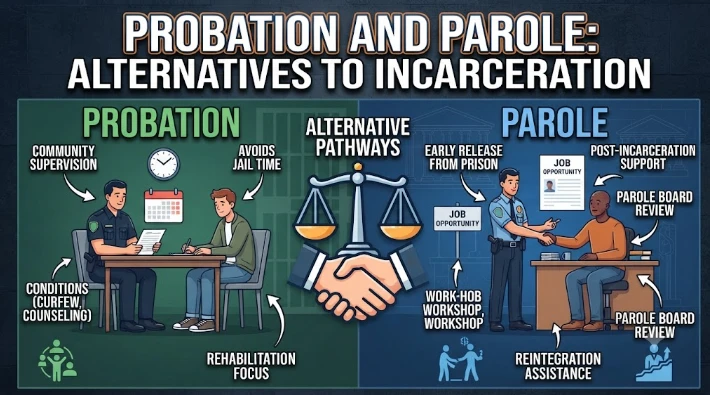
Probation and parole are presented as essential community-based alternatives to incarceration that combine supervision, accountability, and reintegration. Probation generally allows eligible offenders to remain in the community instead of serving a prison sentence, while parole provides conditional release after part of a custodial sentence has been completed. The article explains that both approaches can preserve employment, family ties, education, and housing, all of which reduce the risk of r
This article defines the ethical boundaries that protect volunteers who support visitor safety and law-enforcement-related functions in national parks. Although volunteers can assist with information, observation, traffic support, administrative work, backcountry roves, and reporting hazards, they must not exercise powers such as arrest, detention, search, citation, evidence handling, use of force, or other commissioned enforcement duties. The article emphasizes clear position descriptions, accu