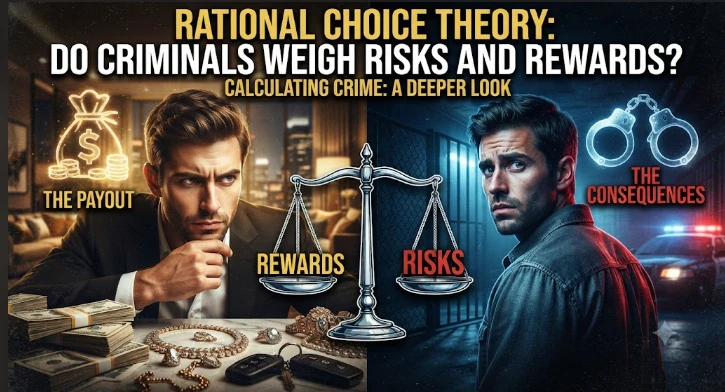
It is March , in a rather tranquil suburb, and a burglar is standing at the threshold of a street of almost identical houses. The houses are enclosed by conspicuous smart-security cameras, motion-activated lights, a closed side gate, and a sign that there is a large dog. The other is in comparative darkness, an overgrown hedge, a poor porch lamp, an unattended pile of mail, and a side door that looks easy to break in. This moment is not accidental and it is not mystical to a thinker who views the situation through the prism of Rational Choice Theory. It is a point of choice. The criminal is not just committing instinctively or by chance. They are, in fact, reading the environment, estimating effort, measuring risk and making a choice that seems to have the greatest reward at the least cost. That is the fundamental concept of the Rational Choice Theory: crime is a common occurrence, simply because at that given time it seems rational to the criminal.
The rational choice theory has been one of the most potent approaches in criminology since it sees offending not as a meaningless chaos but as a purposive behavior. It claims that not a large number of offenders are scooped into crime by some uncontrollable force. They are decision makers. They can be selfish, harmful, shortsighted, or morally indefensible but still are choices, which are made as a result of calculation. The theory argues that individuals engage in crimes when they feel that the potential rewards of committing a crime exceed the potential punishment of committing the crime. The reward may be money, excitement, retribution, prestige, sexual satisfaction, convenience, or control. Arrest, injury, imprisonment, disgrace, loss of a job, retaliation, or even moral guilt might be the price. When the reward that is expected is larger than the danger that is expected the crime is more likely to occur. That does not imply that the offender is an ideal strategist. It implies that the criminal is making a choice under the information, pressure, and the limitations of the circumstance.
This thinking will also be very valid in the year , however, the setting in which such calculations are made has changed significantly. The digital era has changed the prospects of crime as well as the danger posed by crime. A cross-border cybercriminal is able to initiate a ransomware attack that targets a hospital, a logistics company or a government agency and may make millions without stepping a foot in the door. The incentive is vast, whereas the direct physical threat is minimal. The criminal can reside in a jurisdiction where extradition is poorly enforced, he or she can act on encrypted channels, with cryptocurrency and behind many digital layers that make him hard to detect. According to the Rational Choice Theory, the appeal is self-evident. Payoff is high and the perceived risk of a personal capture might be low. Such an imbalance is one of the reasons why cybercrime has become so prevalent and why it is appealing to both organized criminal groups and freelancers as well as opportunistic offenders.
Meanwhile, the technology has increased the price of most of the conventional crimes in the street. Even in cities where AI-assisted surveillance systems are in place, there is facial recognition, automatic number plate recognition, smart cameras in retail locations, and extensive meshworks of both state- and privately-owned cameras, offenders encounter a far more complex environment than they did even ten years ago. A shopper is not only compelled to fear a shop assistant. They can be monitored on various cameras, marked on by behavioral analytics, or associated with previous incidents via digital systems. A car thief might face immobilizers, GPS tracking, biometric deadlocks and remote disabling technology. In these situations, criminals simply do what the Rational Choice Theory would anticipate of them; they adjust. Others are offender reducers. Other ones shift to more defenseless targets, less patrolled areas, or other crime categories. The increase in surveillance does not make crime dissipate. It changes so oftentimes. The equation is altered what remains is the equation.
The greatest misconception about the Rational Choice Theory is that it assumes criminals are perfect calculators who are economists or chess players. Contemporary criminology does not do so to the decision-making of criminals. Rather, it usually talks in the language of limited rationality. This implies that offenders attempt to be rational in their decisions, yet they are constrained due to the incomplete information, pressure to act emotionally, uncertainty of the environment and cognitive bias. When a burglar sees that the driveway is clear, he/she may believe that there is nobody at home when the person is actually working at home. A robber assumes that the victim will not fight back only to find that he or she has gone against his or her expectation. An unscrupulous person can believe that there is no digital trail to follow, and only to find that cooperation with law enforcement has been increased. In each of them, the criminal is also making a cost-benefit decision, although it is one influenced by incomplete information and faulty decision-making.
One of the key components of the bounded rationality is time pressure. Numerous crimes are not the ones that can be contemplated. The shoplifter who knows or does not know whether to hide something has just a matter of seconds. An armed robber can be someone who will do something on the spur of the moment. Even premeditated crimes usually have micro-decisions that are rushed. Under such circumstances, it is a real but compressed calculation. The criminal is not developing a spreadsheet. They are scanning cues and giving snap judgments. That is important because the quicker one goes, the more there is a risk of making a mistake, and it is where most crimes unravel. However, the fact of error does not refute rationality. It merely demonstrates the fact that rationality in crime can be local, situational and imperfect.
The theory is also complicated by emotions, which do not exclude it. The critics will occasionally state that the Rational Choice Theory is too cold since it fails to give reason to the behavior of anger, humiliation, jealousy, fear, intoxication, or panic. To an extent, that criticism is correct when the theory is applied with an extreme hand. Newer thinking however has recognized that emotion and rationality tend to interact and not to override each other. An individual in a highly motivated state can still make some calculations but the calculations are less extensive and more immediate. They can place too much emphasis on the short-term gratification of retaliation and insufficient emphasis on the long-term expense of arrest. A person who is drunk or otherwise influenced by some drug may not cease to weigh risks at all; what happens is that the image of the risks will be distorted. In that respect, even emotional or drunken crimes do not deprive the choice, the choice is taken with cloudy and shortsighted perspective.
The rational choice theory is most effective when it comes to a qualitative explanation of instrumental crimes, that is, the crime that is committed in order to attain a definite goal. Burglary, fraud, car theft, cyber extortion, organized smuggling, drug distribution, and most types of white-collar crime would well fit this model. Planning is an issue in these kinds of crimes. Criminals tend to select their victims, places, time, and ways to commit the crime according to convenience and risk. This makes organized crime groups very rational. They operate like corporations, monitor markets, evaluate exposure, diversify streams of income and move to less risky and more profitable areas in case of any changes. It is logical in as numerous criminal networks have expanded past the traditional narcotics to include cyber-scams, environmental crime, document fraud and illicit financial services due to the large returns and less aggressive enforcement. This is not a confusion of things. It is adjustment.
Another obvious implementation of the theory is white-collar and corporate crime. Executives, compliance officers and fraudulent firms might not believe that they are street criminals, yet the rationalization of decision-making may be strikingly similar. When it is possible to save millions of money by breaking the law and the potential regulatory penalty is relatively small, it may become tempting to some companies to choose to break the rules. When the manipulation of accounts can increase the value of stock, raise investment, or cushion executive compensation, the opportunity will be seized when the perceived risk of potential personal penalty is low. This is suitably rational choice. The behavior can be cloaked in spreadsheets, law grayness and boardroom jargon, but at the core of the activity, it is a gain-risk calculation.
Nevertheless, Rational Choice Theory becomes even more questionable when it comes to crimes that are purely expressive and thus cannot be explained by the attempt to achieve a certain material or strategic objective. An individual who attacks another person when they are in a state of severe emotional breakdown is not necessarily balancing reward in the same way that a fraudster or a burglar would. Similarly, the committed crimes in acute mental health crises or extreme panic will likely be characterized by poor judgment. In such instances, the theory has limits to explanations. It still can shed light on situational factors, but not completely describe the emotional-neurobiological intricacy of the behavior. This is why criminology requires various theories. Rational Choice Theory is very strong, not universal.
Among the most significant consequences of the Rational Choice Theory, it is possible to note the fact that crime prevention is possible through altering the decision environment. In the event that offenders are responsive to effort, risk, and reward, then the purpose of a public policy is to change these variables. This is the reasoning of situational crime prevention. Rather than attempting to change the personality of all offenders, or addressing all underlying social issues at once, situational prevention is aimed at making crime harder, more conspicuous, less lucrative and more acceptable. This can include improved lighting, hardening of the target, surveillance, access control, hardened product design, enhanced authentication, anti-theft tags, guardianship by the neighborhood and quick reporting mechanisms. The car that has high immobilization technology is less appealing as compared to one without this technology. Some offenders may be discouraged by a neighborhood where people are walking around and cameras can be spotted. A phone that can be wiped or remotely locked turns out to be a less significant prize. These are feasible methods of transforming the calculation.
This is evident in the retail environments in . They have smart shelves in the stores, AI-powered loss prevention, digital tagging, camera analytics, and staff alerts to minimize theft. It is not just to apprehend violators as they occur. It is to render the attempt more difficult and less worthwhile in the first place. The same reason is in the case of the Internet. Agreater account verification, suspicious-login detection, transaction monitoring, and fraud friction tools have the same effect of increasing the effort and decreasing the perceived benefit of cyber-offending. The Rational Choice Theory can be used to understand why such measures are important. They alter the opportunity structures and when the opportunities structures change, behavior tends to follow suit.
But there is a big ethical and intellectual boundary to the theory in case it is applied in isolation. It is able to neglect the underlying social conditions that inform the range of choice in the first place by concentrating on short-term decisions. An individual in abject poverty can easily make a logical choice to steal food, commit fraud, or enter an illegal economy. That is not to say that the theory has been satisfactorily explained. It can describe the choice at the time of action, and leave unexplained the inequality, blocked opportunity, trauma, neighborhood circumstances or social exclusion which made that choice seem necessary or desirable. That is, the Rational Choice Theory can be used to explain the process of people making decisions, but it is not always clear why the menu of choices available to them was so damaged.
This is particularly so when one considers economically peripheral communities. When the law business is volatile, salaries are too small to live on, accommodations are not safe, schools are poor, and the local institutions are wearing out, then the fruits of lawful conduct might seem meag and tardy. When this happens, the illegal markets may start to appear rational not by the fact that crime is cool, but by the fact that the legal avenue seems structurally constrained. This also applies in the digital sphere, where youths can observe the actions of friends who are quickly earning money on scams, account looting, or digital fraud as viable as legitimate ways to achieve financial mobility become far off, or unreachable. The theory assists us in viewing the decision, however, justice asks us to view the structure behind the decision also.
It is why the most powerful application of the Rational Choice Theory in is not the punitive simplification but the intelligent design. It must not cause us to think, that criminals reason, and hence more severe punishment is the remedy. Deterrence is not a one-sided process. More often than not, certainty and immediacy are of greater importance than the hypothetical risk of a lengthy sentence. A criminal who believes that he or she will never be caught is not powerfully affected by the penalty that he or she thinks is only applicable to other individuals. This is the reason why apparent guardianship, early identification and pragmatic prevention usually prove more effective than symbolic toughness. The theory compels us to pose a practical question, which is, what are the characteristics of this environment that are rendering offending an attractive endeavor, and how those characteristics can be altered?
It also drives us to a greater moral perception. The costs of crime should also be raised in a just society. It ought to raise the benefits of conformity. Predictable employment, livable salaries, good schools, mental care, addiction therapy, equitable access to housing and respectable ways to belong are all computation variants. Crime is not as appealing when legal existence is more gratifying. This is important since human beings do not make choices in isolation. They consider possibilities in the worlds they are in. When the legal avenue promises humiliation, time wastage, and marginalization and the illegal avenue promises instant cash, security, or fame, there are individuals who will choose to make the risky but more foreseeable decision. It is not only about the fear of punishment when it comes to reducing crime. It is also a question of making legally existing life materially and socially worth making a choice.
Risk and reward?--so do criminals? Yes, they do in most of the premeditated crimes. The testimony of modern crime trends is overwhelmingly in favor of that opinion. House readers are burglars. Fraudsters trial systems. cybercriminals are taking advantage of weak jurisdictions. The organized crime syndicates change markets. Profit-making corporations equate profit to punishment. And yet that rationale is hardly ideal. It is limited, emotional, circumstantial and environmental. Criminals are not machines in calculating. They are human beings who can compute on the spot with unfinished information and they are not always able to regulate their impulses or to have equal access to legitimate opportunities.
The Rational Choice Theory is not useless as it reminds us that crime is usually design-sensitive. Alter the target, alter the surveillance, alter the reward, alter the route, alter the support system and you might alter the behavior. The theory is however best when it is combined with social insight. It is able to inform us about the way decisions are made. It alone can not create a just society where the better-choice is available across the board. That bigger job is the prerogative of policymakers, communities, and institutions that are ready to do than to punish. The smarter justice systems will also start to realize this balance in . They are making targets harder, enhancing detection, and breaking the criminal opportunity. However, they are learning something more profound as well: social safety is strengthened when the society does not only put crime in a more dangerous position, but also puts law-abiding life into a more accessible, more stable, and more pleasant place.