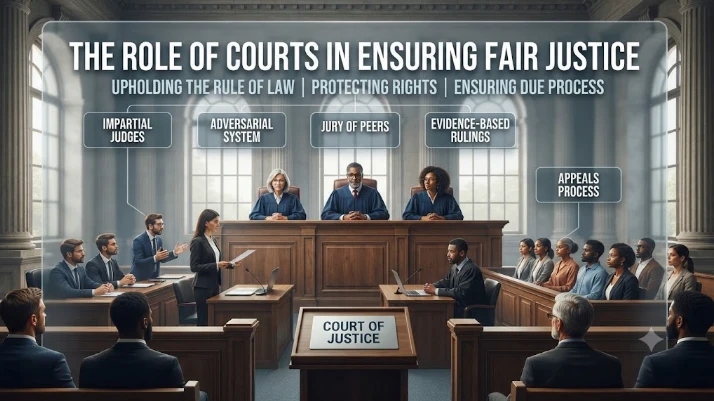
Courts are presented as the central institutions that transform legal rules into practical justice by protecting rights, evaluating evidence, ensuring due process, and issuing reasoned decisions. The article explains that modern courts face growing pressure from case backlogs, high legal costs, limited access to representation, political interference, and rapid technological change. Delays can weaken evidence, extend uncertainty for victims and defendants, and reduce public confidence. Unequal access to legal assistance also threatens fairness when self-represented individuals must navigate complex procedures without professional support. Judicial independence is therefore essential to prevent courts from becoming instruments of political power. The article also discusses artificial intelligence, digital evidence processing, and live-streaming as tools that can improve efficiency and transparency, while warning that technology must support rather than replace human judgment. Effective reform requires adequate staffing, stronger legal aid, procedural guidance, transparency, professional development, and safeguards for independence. Ultimately, courts maintain legitimacy when people believe decisions are timely, impartial, understandable, evidence-based, and equally accessible regardless of wealth or status.
In the wake of , the world has managed to enter the world of paradox, with the global judicial system facing the test of technological innovation and overloading. The current judiciaries have been installed with AI case management, digital processing of evidence and real time analytics aimed at simplifying the process. These innovations notwithstanding, there has been a recession in the rule of law on a global level, as noted by the 2025- World Justice Project Index, which has put an immense burden on the judicial institutions. Courts are the last line of defense of democracy and here abstract rules of fairness and justice come to realities. They are mandated with the responsibility of seeing that the state power is used in a responsible manner, individual rights are upheld as well as disputes that arise are settled in accordance with the law and not through the whim of the moment. These duties have become more complicated than ever before in , as the courts are faced by an unprecedented combination of case volume, technological change, and political interference.
The essential position of courts has not changed: they are the main decision-makers of justice, the institutions that bring the law to action. Courts should be able to defend rights in any given system, adjudicate in evidence, provide due process and give a reasoned and enforceable judgment. Rights protection involves guarding people against misuse of power be it through unlawful searches, random arrest, or the cut-backs of procedures that distort fair play. The courtroom provides a filter to sieve out valid evidence against invalid claims so that judgment is not made by prejudice or political expediency. Due process offers the framework under which justice is carried out to ensure that all individuals are notified of the charges, right to counsel, and the right to be heard by an impartial decision-maker. Lastly, the provision of judgments is not a mere act of either the defendant or prosecutor pronouncing a guilty or not guilty. It also needs proper reasoning, case law, and clarity of postulates that help to guide not only the parties themselves but also the society in general. The scope of decisions taken by the court in has increased significantly and includes questions about AI liability, online privacy, litigation related to climate, and multi-national cases.
In spite of these underlying obligations, delay is becoming a crisis in the courts in . The level of backlogs is at an all-time high and the concept of speedy justice is under fire. By early , the backlog of the Crown Court in the United Kingdom was close to eighty thousand cases, and some defendants and victims in the country could wait more than two years to stand trial. Delay inevitably destroys evidence integrity as witnesses relocate, memories become less vivid and important documentation becomes more difficult to get. In the US, the number of cases awaiting resolution in immigration courts is more than 3.3 million; procedural fairness is more akin to the production line than a judicial process. The impact of delay is not only personal but the courts also lose credibility on the part of the people when they think justice is not being served promptly or at all. In a survey of National Center of State Courts, 2025- , general confidence versus perceived fairness showed that sixty-two percent of all respondents expressed confidence in local courts but only forty-four percent of those courts were thought to administer justice equally to all, with delays and cost being the main factors to reduce access.
The other issue of concern is the growing disproportion of representation. Not only should the court be fair, but also should the parties be capable of presenting their case well. By , the millions of middle-income litigants will be too wealthy to receive legal aid yet too poor to spend money on hiring personal counsel. Eighty percent of family law cases are self-represented, which puts extra pressure on the judges to both describe the rules of the process and remain neutral. The low fee levels have created a shortage in the number of qualified attorneys available to offer legal aid assistance, which has created legal deserts in rural regions where access to defense counsel is all but non-existent. Such inequalities increase the chances of unequal treatment because less fortunate individuals cannot afford to pass through complicated legal systems, collect evidence, and present impressive points.
The independence of the judicial system has not gone without a fight, as it is a worldwide tendency that is recorded in the World Justice Project Rule of Law Index. The index recorded the decreasing power of the countries to restrict the government control on the judiciary in the eighth year in a row. Reports of executive overreach and political interference are also becoming common cases in , with governments seeking to affect the appointment of judges, to reward those judges that are willing to make unpopular rulings, or to punish those who make unpopular rulings. In the absence of independence, the courts will be used as a tool of political interests and not as a source of justice. On the other hand, countries like Bangladesh and Senegal have performed well, minimally deteriorating their rule of law scores despite the instability in the region, and this goes to show that the independence of courts can still be upheld to integrity even in the most difficult situations.
Technology is performing the same in this changing scenario. Artificial intelligence tools can now help the judge manage the thousands of pages of digital evidence, summarize documents, and detect the procedural discrepancies. Although they can enhance efficiency, the population does not trust such innovations. A survey of showed that most citizens were terrified that AI will be used to bring bias or come up with hallucinated findings that will undermine fairness. At the same time, courts have also started to live-stream their activities to make the process more transparent so that citizens can watch how courts operate and keep the institutions responsible. Such actions will help instill public confidence back by ensuring that the administration of justice is more transparent and that there are no connotations of secrecy or lack of transparency.
The effects of inefficiency and inequity in the court are serious. Sluggishness, lack of transparency and political intrusion into the judicial system and through it, the social contract is compromised. Where citizens believe that courts are unreachable or unfair, obedience to the law reduces, informal dispute resolution is on the increase and social trust is lost. The judiciary, being the foundation of democracy, has to strike a balance between the demands of high case burden, tricky law issues, and integration of technology at the expense of procedural fairness and neutrality.
When dealing with these issues, policymakers in the year have come to realize that there is a need to humanize the courts. Technological efficiency cannot take the place of human judgment, empathy or deliberation. Sufficient funding of the court personnel, enlarged legal assistance, and further professional growth of the judges and clerks are all critical elements of a fair justice system. No less vital is development of judicial independence whereby courts are not influenced by any outside forces and are free to make their rulings based on law as opposed to political. The implementation of AI and digital tools should be used to support, but not to substitute, human supervision, as a support system to judges, and not an independent decision-maker.
The future of courts in is based on the ability to balance efficiency and fairness. The use of expedited case management systems and digital evidence processing has the potential to decrease backlogs, but it should be accompanied by steps to make sure that representation is equal, transparency and accountability are upheld. It is important to ensure public confidence by endeavoring to live-stream hearings, introduce procedural manuals to self-represented litigants, and the provision of independent legal advice. In addition to that, courts have to keep evolving with the ever-changing law in the digital era, solving the problems of AI liability, online harassment, climate-related disputes, and making sure that each citizen has a right to the due process.
However, courts are ultimately the wheels that fuel the justice system. When they work properly, the society is stable, trusts the rule of law and just settlement of disputes. Social cohesion is destroyed when they succumb to backloads, politicking or lack of resources and the perception of justice is destroyed. The global issue that is to be considered as the year approaches is that the courts should not only be effective administrative systems but should be living institutions that promote the values of fairness, human dignity, and impartiality. Any human being appearing in a courtroom, irrespective of their wealth, status and identity must be made to believe that their voices are heard, their rights are considered and that the law is working as a true tool of justice. Investing in the independence of the judiciary, sufficient judicial staffing, procedural openness, and careful incorporation of technology, the societies will protect the courts as the ultimate source of justice, so that the promise of justice is not just a dream but is experienced by every one of the community members.
CITE THIS ARTICLE
Das, B. C. (2026). The Role of Courts in Ensuring Fair Justice. https://www.bikashchandra.com/article/0a45e800-e7e2-5485-aede-8e3a2bb08b7a
B. C. Das, “The Role of Courts in Ensuring Fair Justice,” 2026. [Online]. Available: https://www.bikashchandra.com/article/0a45e800-e7e2-5485-aede-8e3a2bb08b7a
Das, B. C. (2026) ‘The Role of Courts in Ensuring Fair Justice’. Available at: https://www.bikashchandra.com/article/0a45e800-e7e2-5485-aede-8e3a2bb08b7a
Das, Bikash Chandra. “The Role of Courts in Ensuring Fair Justice.” 2026, https://www.bikashchandra.com/article/0a45e800-e7e2-5485-aede-8e3a2bb08b7a.
Bikash Chandra Das. “The Role of Courts in Ensuring Fair Justice.” (2026). https://www.bikashchandra.com/article/0a45e800-e7e2-5485-aede-8e3a2bb08b7a.
Das BC. The Role of Courts in Ensuring Fair Justice. 2026. https://www.bikashchandra.com/article/0a45e800-e7e2-5485-aede-8e3a2bb08b7a
@misc{article_0a45e800e7e25485aede8e3a2bb08b7a,
  title = {The Role of Courts in Ensuring Fair Justice},
  author = {Bikash Chandra Das},
  year = {2026},
  url = {https://www.bikashchandra.com/article/0a45e800-e7e2-5485-aede-8e3a2bb08b7a},
}
TY  - GEN
AU  - Bikash Chandra Das
TI  - The Role of Courts in Ensuring Fair Justice
PY  - 2026-01-21
UR  - https://www.bikashchandra.com/article/0a45e800-e7e2-5485-aede-8e3a2bb08b7a
ER  -
This article explores why people volunteer in America’s national parks and how program design influences whether service remains meaningful. Volunteer motivations often overlap and include personal values, learning, social connection, career development, confidence, purpose, and attachment to place. The article uses motivational frameworks to show that volunteers are more likely to remain engaged when they experience autonomy, growing competence, respectful relationships, and a clear connection
Probation and parole are presented as essential community-based alternatives to incarceration that combine supervision, accountability, and reintegration. Probation generally allows eligible offenders to remain in the community instead of serving a prison sentence, while parole provides conditional release after part of a custodial sentence has been completed. The article explains that both approaches can preserve employment, family ties, education, and housing, all of which reduce the risk of r
This article defines the ethical boundaries that protect volunteers who support visitor safety and law-enforcement-related functions in national parks. Although volunteers can assist with information, observation, traffic support, administrative work, backcountry roves, and reporting hazards, they must not exercise powers such as arrest, detention, search, citation, evidence handling, use of force, or other commissioned enforcement duties. The article emphasizes clear position descriptions, accu