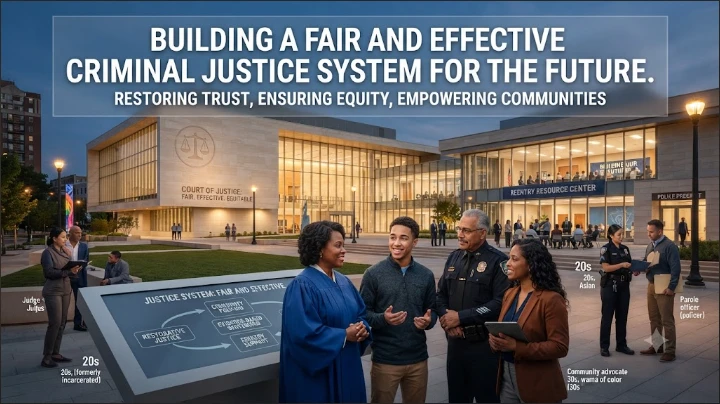
The final article presents a future-oriented vision of criminal justice built around prevention, proportionality, evidence, technology, rehabilitation, and human dignity. It argues that traditional tough-on-crime approaches are increasingly giving way to models that evaluate success through reduced harm and successful reintegration rather than imprisonment alone. Evidence-based practices such as hot-spot policing, targeted supervision, restorative justice, and structured reentry are highlighted as tools for improving effectiveness. Artificial intelligence and digital systems can support case management, risk analysis, evidence processing, and crime prevention, but the article warns that transparency and human oversight are essential to prevent bias and misuse. Community trust is treated as equally important, with policing models emphasizing communication, de-escalation, and long-term relationships. Humane correctional environments, vocational preparation, and early reentry planning are also central to reducing recidivism. The article concludes that the strongest future justice system will combine accountability with science, fairness, ethical technology, and realistic opportunities for change, measuring success through safer communities and stronger social legitimacy.
By March , the criminal justice landscape in the world has been on the brink of change. The tough-on-crime philosophy that prevailed in policy and popular opinion throughout the late twentieth century is slowly yielding to a novel, evidence-based, data-driven, human dignity-focused philosophy. This new approach focuses on prevention, proportionality, and reintegration into society unlike reactive models used in the past where punishment and incapacitation were used. Modern justice system has now become more informed by research and technology, and this enabled policymakers and practitioners to employ those strategies that do not just react to the harm but rather proactively strive to minimize the future chances of any offenses and also at the same time protect the rights and dignity of the parties involved. This is not a hypothetical change, but it is being put to practice and polished on a daily basis, and it opens up the possibility of breakthrough results in terms of public safety and social trust.
It is imperative to know the current situation of criminal justice in order to map the future. The contemporary trends of confinement have multifaceted dynamics, as shown by the global reports that are provided in March in the form of the Mass Incarceration: The Whole Pie analyses. The population of conventional prison in most democratic countries has been stable after decades of steadily increasing population, which indicates that the long-term dependence on incarceration as a main correctional measure to crime has reached its plateau. However, even as this has been going on, immigration detention has experienced some terrifying growths in some of the areas, with an increase of more than fifty percent in the last year alone. The use of remand imprisonment is also at an all time high where thousands of prisoners spend prolonged periods without trial, as is the case with the almost seventeen thousand people awaiting sentencing in the United Kingdom. These trends depict the conflict between the modernization of the justice system and dealing with the legacies of the previous punitive policies.
Although these challenges exist, it can be observed that there are strong signs of improvement in the reentry and rehabilitation areas. According to states, which have established Second Chance initiatives, the rate of three-year reincarceration rates has gone down by large margins with some regions registering twenty-three percent reduction rates over a period of ten years. This proves that a system approach of helping people reintegrate back to the society is bound to give an individual and general protection a significant boost. It indicates an increasing agreement that the effectiveness of a justice system cannot be judged on the basis of its punitive powers, but on its potential to minimize harm and reintegration in the future.
The modern approach has its basis in Evidence-Based Practices. Political expediency or reactive public opinion used to be the driving force behind policy decisions in decades, but that has since been changed by the period of translational criminology. The findings of the research in are implemented directly to operational practice. Hot-spot policing is a case in point, and it is now oriented to data analytics, focusing on specific locations of concentrated crime. Research indicates that deployment of resources to micro-places as opposed to carrying it out randomly is more efficient in deterring crime and less obtrusive to the rest of the community. Also, probation and supervision services are now utilizing AI-assisted risk assessment models to make sure the intensity of monitoring is equal to that of an individual being assessed, to under-supervise low-risk groups and to avoid unwanted adverse consequences. The strategies show how science is carefully incorporated in the decision-making process of operations to bring the human judgment in line with the empirical data to achieve maximum effectiveness.
Restorative Justice has also come out as one of the major pillars of modern reform. Diversion programs that have aimed at keeping youth out of the normal court system, but also focus on repairing the damage have always performed better than normal processes. The participants who attend these programs also report of increased sense of fairness and agency, which research finds to be the most influential predictor of diminished recidivism. Restorative practices encourage a holistic approach to justice by moving the emphasis away from punishment in favor of accountability and reconciliation, which takes into account the needs of both the victims and the community and the offender. Such programs highlight the current shift in perspective which holds that public safety and individual rehabilitation are not mutually exclusive to each other but mutually reinforcing goals.
Alterations in the justice world have also become increasingly technological in nature, with Artificial Intelligence becoming a very noticeable element in court, police patrols, and the processes in the administrative office. Such predictive modeling tools are implemented to detect the new patterns of crime and avoid the harm before they happen, yet they have severe limitations. The most important thing is to make sure that AI systems will not reproduce the historical biases. In order to maintain accountability and avoid abuse, transparency, such as algorithmic datasheets that describe logic, assumptions, and limitations, is being introduced. Efficiency is also being improved by technology, as digital redaction can help safeguard sensitive information, and at the same time, be transparent, and even to teach skills in a correctional program through virtual reality. Nevertheless, there should be a strict regulation of the ethical use of AI, whereby its functions should be supplementary and not decisive so that humanity can still control the judicial process.
These procedural and technological reforms should be accompanied by the restoration of community trust. The justice system is not only legitimate as a system, but it is also effective and perceived by the people and their involvement. Models of community-oriented policing like KOBAN used in some European and Asian regions put more emphasis on proactive solutions, daily presence and development of relationships rather than on reactive enforcement. The digital platforms have also made it possible to measure trust in real-time, as it provides citizens with the power to measure procedural fairness, providing transparency and accountability that reinforced social cohesion. This change of warrior culture into a guardian mentality focuses on the aspects of communication, empathy and de-escalation, so that officers are not seen as enforcers, but as custodians of public trust.
The concept of human dignity is seen as one of the main principles of modern justice systems. Most of the detained will ultimately be released back into the society, and the conditions under which they are incarcerated and the possibilities of rehabilitating them will significantly be a factor in determining what happens over time. Experiments like the “Little Scandinavia Project where such components as natural lighting, self-directed learning and respectful attitude toward staff members have been introduced have proved to have a tangible impact including the absence of any violent incidents in the said units as opposed to a sharp rise in conventional facilities. In the same manner, incorporating the career-oriented reentry services at the first stage of incarceration contributes to the effectiveness of the reintegration. An early vocational training and continued support reduce the chances of recidivism and it is evidence of the realization that justice cannot be fully realized without avenues to societal inclusion.
The future-oriented roadmap focuses on three main imperatives in the construction of an equitable and working system. To start with, divestment of failure includes the process of abandoning the excessive dependence on incarceration as a major panacea, the realization that warehousing people can hardly stop any crime cycles and instead tends to continue them. Second, a commitment to science will make sure that all the policy decisions and operational choices are based on the rigorous and peer reviewed research, and the practices can be constantly improved and justified. Third, the importance of the human element takes into consideration the fact that every case file is a human being, a victim in need of recovery or an offender who can reform. This duality must be observed in order to maintain fairness and legitimacy.
The justice system is being reshaped to be individual, assertive, and idealistic. It is small enough to treat individuals with care, intelligent enough to foresee and avoid the harm, and strong enough to hold accountability, making it a vision that balances between the enforcement of the law and understanding of empathy. Evidence-based practices, ethical technology, restorative justice, community engagement and a dedication to human dignity are no longer fanciful principles in theory, they are practical standards in practice being lived and perfected every minute.
In 2030, it will not be enough to keep the law and order going, but to develop a justice ecosystem that minimizes harm and encourages reintegration and the creation of a trusting environment among the public. A rewarding rehabilitation system that invests in preventing offenses and respects human rights can both interrupt the cycles of offending and empower the communities at the same time. Through these values, societies are capable of creating criminal justice systems that are just, effective and sustainable. Eventually, the desired outcome is a system with justice not judged by how many individuals it has in prison, but the strength, security, and integrity of the populations it holds. The construction of such a system is not only possible but also necessary in , and it will take continuous dedication, creativity, and attention to make sure that the experience of the past shapes a better, fairer future.
CITE THIS ARTICLE
Das, B. C. (2026). Building a Fair and Effective Criminal Justice System for the Future. https://www.bikashchandra.com/article/21a792d3-de73-521d-b103-599b618c0a89
B. C. Das, “Building a Fair and Effective Criminal Justice System for the Future,” 2026. [Online]. Available: https://www.bikashchandra.com/article/21a792d3-de73-521d-b103-599b618c0a89
Das, B. C. (2026) ‘Building a Fair and Effective Criminal Justice System for the Future’. Available at: https://www.bikashchandra.com/article/21a792d3-de73-521d-b103-599b618c0a89
Das, Bikash Chandra. “Building a Fair and Effective Criminal Justice System for the Future.” 2026, https://www.bikashchandra.com/article/21a792d3-de73-521d-b103-599b618c0a89.
Bikash Chandra Das. “Building a Fair and Effective Criminal Justice System for the Future.” (2026). https://www.bikashchandra.com/article/21a792d3-de73-521d-b103-599b618c0a89.
Das BC. Building a Fair and Effective Criminal Justice System for the Future. 2026. https://www.bikashchandra.com/article/21a792d3-de73-521d-b103-599b618c0a89
@misc{article_21a792d3de73521db103599b618c0a89,
  title = {Building a Fair and Effective Criminal Justice System for the Future},
  author = {Bikash Chandra Das},
  year = {2026},
  url = {https://www.bikashchandra.com/article/21a792d3-de73-521d-b103-599b618c0a89},
}
TY  - GEN
AU  - Bikash Chandra Das
TI  - Building a Fair and Effective Criminal Justice System for the Future
PY  - 2026-02-18
UR  - https://www.bikashchandra.com/article/21a792d3-de73-521d-b103-599b618c0a89
ER  -
This article explores why people volunteer in America’s national parks and how program design influences whether service remains meaningful. Volunteer motivations often overlap and include personal values, learning, social connection, career development, confidence, purpose, and attachment to place. The article uses motivational frameworks to show that volunteers are more likely to remain engaged when they experience autonomy, growing competence, respectful relationships, and a clear connection
Probation and parole are presented as essential community-based alternatives to incarceration that combine supervision, accountability, and reintegration. Probation generally allows eligible offenders to remain in the community instead of serving a prison sentence, while parole provides conditional release after part of a custodial sentence has been completed. The article explains that both approaches can preserve employment, family ties, education, and housing, all of which reduce the risk of r
This article defines the ethical boundaries that protect volunteers who support visitor safety and law-enforcement-related functions in national parks. Although volunteers can assist with information, observation, traffic support, administrative work, backcountry roves, and reporting hazards, they must not exercise powers such as arrest, detention, search, citation, evidence handling, use of force, or other commissioned enforcement duties. The article emphasizes clear position descriptions, accu