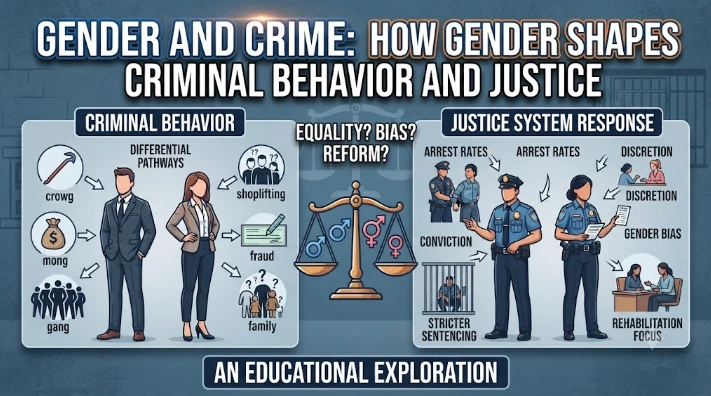
The article examines how gender influences patterns of offending, victimization, policing, sentencing, imprisonment, and professional experiences within criminal justice. Men remain far more represented in prison populations and are more commonly linked with violent and street-based offending, while women are more frequently involved in property or drug offenses connected with poverty, trauma, abuse, or survival. Women also face distinctive victimization risks, particularly intimate partner and family violence. The article discusses the Chivalry Hypothesis and Evil Woman Hypothesis to show how women may sometimes receive greater leniency but can also face harsher judgment when their behavior violates traditional gender expectations. Correctional systems designed primarily around men can fail to meet the needs of incarcerated women, especially mothers and those with trauma, mental health, or substance-use histories. Gender-responsive justice therefore requires trauma-informed policing, community-based sentencing, legal equality, family support, and appropriate treatment. The article concludes that recognizing gendered pathways can improve fairness, rehabilitation, and crime prevention without abandoning individual accountability.
Gender is one of the factors that influence most, and their misconception is also common in the landscape of modern criminology. Research and worldwide statistics indicate a complicated truth: gender does not only affect a person to commit a crime; it predetermines the whole course of the process of a person passing through the justice system, starting with the initial meeting with the police and ending with the day of the end of the prison term. This knowledge of such gendered pathways is not just important in academic research but also in the development of effective policies to combat crime, improve rehabilitation, and improve the security of the people. The world prison population is too high and overwhelming male, with about ninety three percent of all the population in prisons being men as of March . However, women are the most rapidly expanding population in most correctional systems with an emphasis on highlighting the necessity to learn their experiences, needs, and the factors that motivate them to participate in the justice system.
The trend of male and female offending is radically different and reflects more extensive social, economic and psychological processes. Males have a much higher chance of being arrested in committing violent offenses, usually in a street setting, or in relation to rivalry among their peers. Women on the other hand are more commonly engaged in what criminologists can term as crimes of survival. In state prisons, data shows women are almost two times more likely than men to be imprisoned on property or drug charges and twenty-six percent of women convicted of property or drug crimes versus twelve percent of men. To most of the women, engaging in crime is never an indication of criminality but a direct result of poverty, abuse, and trauma. Women who have participated in justice in February shows that a large percentage of women involved in justice have been sexually abused as children, have had domestic violence or other traumatic experiences over their lifespan. The use of substances can also be described as the coping mechanism in these experiences which later on may result in arrests of drug related offenses. In that regard, the entry points of women into the justice system are often linked with the structural disadvantages, missing social needs and victimization cycles that cannot be addressed within the traditional punitive paradigm.
The gendered aspects of crime are further achieved through the nature of victimization. Women are at a particular risk and especially inside the spheres that are assumed to be safe. Statistics released on 2024 indicate that an estimated fifty thousand women and girls have been killed by intimate partners or relatives averaging one woman in eleven minutes. The home, which is supposed to be a place of protection and family, in such instances, turns out to be the most unsafe place. About sixty percent of the female homicides are in the realms of the private sector, with the perpetrator being known to the victim, as opposed to eleven percent in the male counterparts. Men on the other hand tend to be more subjected to violence in the street or during a peer-related situation. These variations are important in the formulation of prevention and policing and rehabilitation philosophy. The failure of a justice system to acknowledge the different manifestations of female victimization will expose women to underprotection as well as explaining the behavior of women as a result of moral weakness instead of structural or social pressures.
Gender still continues to influence experiences after one is taken into the justice system, which is usually subtle as well as profound. Two apparently opposite effects have long been debated by criminologists the Chivalry Hypothesis and the Evil Woman Hypothesis. Chivalry Hypothesis Theorists believe that the male-dominated police forces, courts and correction systems are more lenient on women because they think they should be offered protection and not punishment. The data of reveals that two times more women compared to men are not charged or convicted of the same crime, which also reflects systematic laxity in those cases that are not seen as a threat. The Evil Woman Hypothesis, on the other hand, argues that women, when committing their crimes that are unconventional, i.e., violent assault, child neglect, and serious fraud, might be sentenced more severely compared to men. This is because the offender is considered not only to be violating the law, but also is violating the social norms of femininity, further escalating the felt magnitude of the offense. These opposing models demonstrate the inconsistency of gendered justice and instead show the protective prejudices as well as the excessive corrections, according to the type of crime and the social norms that are put into question.
There are also systemic gendered constraints against women in the criminal justice occupations and policing. Some researchers found that in March , there was still a machismo culture that inhibited the progress of female officers. Policewomen may also face a child tax, in which the process of career growth is inhibited or halted because of insufficient childcare support. Male co-workers, on the other hand, can achieve higher levels of promotion by virtue of tenure, seniority, or time-served provisions. The implications of these structural inequities extend beyond the representation of the workforce and workforce diversity to also the effectiveness of policing as the multiple viewpoints are needed to know the intricate social processes, such as the gendered channels of crime and victimization.
Even the environment of incarceration has been traditionally structured around men, which creates specific crises in case women are introduced to them. More than sixty percent of incarcerated women have children under eighteen years old and their imprisonment can be more disruptive of the family than father imprisonment. This interference often leads to the increase of foster care placement and prolonged emotional impact of the children. Female prisoners also experience much greater incidences of mental illness, histories of trauma and substance dependence than their male counterparts. Specialist trauma-informed care will be uncommon in the majority of correctional budgets in despite these requirements. These obstacles are aggravated by pretrial detention: over sixty percent of the women in local jails are awaiting trial, and in many cases, it is due to their inability to obtain even small amounts of bail. Long pretrial jail time means loss of jobs, housing instability and cascades of disastrous consequences on families, and it cycles vulnerability and social inequity.
To overcome such gendered inequalities, there is the need to move towards a responsive, sensitive, and attentive justice system that would understand the individual circumstances of women. Trauma-informed policing is the essential element that makes sure that the officers are aware of the situations when the behavior like resistance, substance use, or minor offending is based on the experiences of abuse or coercion in the past. Some of the community-based sentencing approaches, such as probation, restorative justice, and diversion programs, have an opportunity to retain non-violent women, specifically those who are primary caregivers, in their communities, retain family integrity and minimize social costs in the long term. Reforms in law are also significant. According to UN Women there is still sixty-four percent of the legal rights that women around the world enjoy as compared to men as of March . It is necessary to address the imbalance in the consent laws, property rights, equal pay, and being safeguarded against discrimination as one of the major motivators of the female involvement in crime is the economic and social marginalization.
The concept of gender and crime intersection has far reaching policy and practice consequences. A justice system that does not consider gendered pathways runs the danger of a one-size fits all approach that is inefficient and usually counterproductive. Men and women offenders have dissimilar pressures and traumatic experiences in their environment and their relations with the police, the courts and the corrections are influenced by these elements. Through appreciation of these differences, policymakers are able to develop interventions that would facilitate rehabilitation, decrease recidivism and stability of the family and community. Community supervision, including childcare, access to mental health services, education, and vocational training, could be a good example, as it could help considerably reduce reoffending in women and promote the wellbeing of their families. The same can be applied to the psychological and emotional harm which in most instances are escalated by incarceration by training correctional staff to be aware of the gender-specific needs of female inmates.
It is also significant to the wider society of gender-sensitive justice. By helping to adjust the responses to the distinct experiences of men and women, the system will have a higher chance of crime prevention, the underlying social inequalities, and the credibility of the institutions. Equity and fairness also carry with gender-sensitive policies the aspect of ensuring that people are not punished out of proportion following their breach of gender norms or they are not disregarded in cases where their vulnerability leaves them more susceptible to the criminalization. The acknowledgment of the interaction between gender, crime, and justice will allow more specific, human, and effective interventions, which would benefit not only the offender but also families, communities, and society by default.
To sum up, gender does not represent only a demographic term but also a prism through which all the criminal justice system aspects should be viewed. Gender affects the experiences, risks, and outcomes of people who are involved in justice through the patterns of offending and victimization, as well as in policing, sentencing, and imprisonment. Through considering these differences and adopting gender-responsive policies, societies will cease to rely on a purely punitive model and evolve to the one which supports rehabilitation, social safety, and the stability of families and communities. Justice does not only mean strict enforcement of laws or administering punishment but rather getting to know the person behind the case, their needs and giving them ways of transformation and reintegration. Gendered pathways to crime should be identified and addressed in as an ethical obligation and practical issues to provide the criminal justice system with equal and effective service to all members of the society.
CITE THIS ARTICLE
Das, B. C. (2025). Gender and Crime: How Gender Shapes Criminal Behavior and Justice. https://www.bikashchandra.com/article/3bcfd31b-def5-512c-8dd9-1d6c0d0fe22c
B. C. Das, “Gender and Crime: How Gender Shapes Criminal Behavior and Justice,” 2025. [Online]. Available: https://www.bikashchandra.com/article/3bcfd31b-def5-512c-8dd9-1d6c0d0fe22c
Das, B. C. (2025) ‘Gender and Crime: How Gender Shapes Criminal Behavior and Justice’. Available at: https://www.bikashchandra.com/article/3bcfd31b-def5-512c-8dd9-1d6c0d0fe22c
Das, Bikash Chandra. “Gender and Crime: How Gender Shapes Criminal Behavior and Justice.” 2025, https://www.bikashchandra.com/article/3bcfd31b-def5-512c-8dd9-1d6c0d0fe22c.
Bikash Chandra Das. “Gender and Crime: How Gender Shapes Criminal Behavior and Justice.” (2025). https://www.bikashchandra.com/article/3bcfd31b-def5-512c-8dd9-1d6c0d0fe22c.
Das BC. Gender and Crime: How Gender Shapes Criminal Behavior and Justice. 2025. https://www.bikashchandra.com/article/3bcfd31b-def5-512c-8dd9-1d6c0d0fe22c
@misc{article_3bcfd31bdef5512c8dd91d6c0d0fe22c,
  title = {Gender and Crime: How Gender Shapes Criminal Behavior and Justice},
  author = {Bikash Chandra Das},
  year = {2025},
  url = {https://www.bikashchandra.com/article/3bcfd31b-def5-512c-8dd9-1d6c0d0fe22c},
}
TY  - GEN
AU  - Bikash Chandra Das
TI  - Gender and Crime: How Gender Shapes Criminal Behavior and Justice
PY  - 2025-07-09
UR  - https://www.bikashchandra.com/article/3bcfd31b-def5-512c-8dd9-1d6c0d0fe22c
ER  -
This article explores why people volunteer in America’s national parks and how program design influences whether service remains meaningful. Volunteer motivations often overlap and include personal values, learning, social connection, career development, confidence, purpose, and attachment to place. The article uses motivational frameworks to show that volunteers are more likely to remain engaged when they experience autonomy, growing competence, respectful relationships, and a clear connection
Probation and parole are presented as essential community-based alternatives to incarceration that combine supervision, accountability, and reintegration. Probation generally allows eligible offenders to remain in the community instead of serving a prison sentence, while parole provides conditional release after part of a custodial sentence has been completed. The article explains that both approaches can preserve employment, family ties, education, and housing, all of which reduce the risk of r
This article defines the ethical boundaries that protect volunteers who support visitor safety and law-enforcement-related functions in national parks. Although volunteers can assist with information, observation, traffic support, administrative work, backcountry roves, and reporting hazards, they must not exercise powers such as arrest, detention, search, citation, evidence handling, use of force, or other commissioned enforcement duties. The article emphasizes clear position descriptions, accu