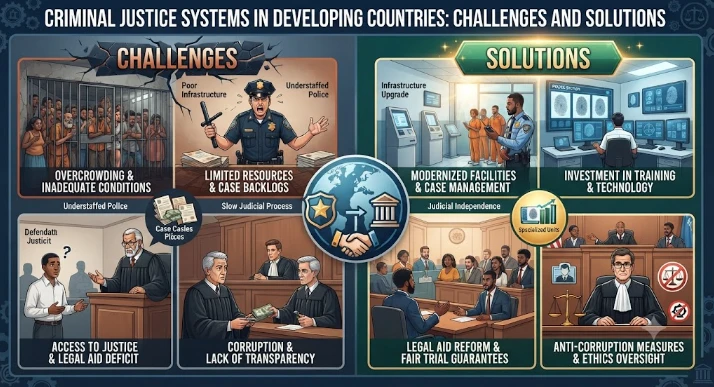
This article analyzes the major difficulties facing criminal justice systems in developing countries, using Bangladesh as a central example. It identifies limited resources, overcrowded prisons, understaffed police agencies, slow courts, corruption, political interference, outdated laws, and weak public trust as major barriers to fair and effective justice. The discussion also emphasizes how marginalized groups, including women, children, minorities, and economically disadvantaged citizens, often experience unequal access to legal protection. To address these problems, the article proposes broad institutional and legal reforms rather than isolated short-term measures. Suggested priorities include modernizing laws, strengthening judicial independence, improving professional training, expanding legal aid, increasing transparency, and creating independent oversight mechanisms to combat corruption and abuse. Community policing and stronger public engagement are also presented as ways to rebuild confidence in the justice system. Finally, the article connects criminal justice reform with wider social policies aimed at poverty, unemployment, education, and inequality, arguing that lasting improvements require both institutional reform and social development.
The criminal justice systems in developing countries are known to have a variety of challenges, which are most of the times unique to them and hence, undermine the effectiveness of the criminal justice systems and in other cases, the protection of human rights. These problems are complex and are caused by the lack of resources, corruption, political instability, inefficient legal systems, and lack of trust of people. Criminal justice system is in permanent tense in such countries as Bangladesh which is to deal with the rapid urbanization, high poverty rates, and political instability. Any justice system should want to see fairness, accountability and rule of law and in developing countries, this is not always easy to attain due to systemic problems, which may need extensive reforms. To make the society more just and support social stability, it is necessary to address these issues and identify suitable solutions.
Limited resources are also among the major obstacles to criminal justice systems in developing countries. There is a tendency to have courts, law enforcement and correctional facilities with poor budgets which results in overcrowded prisons, understaffed police departments and slow courts. In Bangladesh, the police force is in most cases under-resourced and poorly trained and equipped to cope with the rising crime rate especially in the urban centers. The judicial system, in the meantime, has an enormous backlog of cases and some people end up in pretrial detention because of time taken to hear the case. Such limitations on resources do not only influence the velocity and effectiveness of the justice system, but they also undermine the prospects of the justice system producing just and unbiased results.
Insufficiencies of resources in law enforcement, as well as the judicial system, promote the culture of impunity and corruption. The issue of corruption in the criminal justice is widespread in most of the developing nations and Bangladesh is not an exception. Judges, police officers and other authorities can be bribed or influenced by politics and economic interests and thus, biased investigations, unfair trials, and wrongful convictions are made. In Bangladesh, the bribery in law enforcement and judiciary compromises people in the system and frustrates the sense of justice. Those able to buy their way out of prosecution or those with political ties can get away with it and most vulnerable groups in society, including the poor and marginalized are treated more severely and given longer sentences.
The other critical problem is the political influence which tends to interfere with the operations of criminal justice system. In most of the developing nations, the justice system lacks independence but rather it is influenced by political forces. The politicians and political parties can utilize the legal system to fight off their rivals, intimidate their opponents, or to cushion their interests. In Bangladesh, political elite has been found to influence law enforcement and judicial system and thus there has been concern of whether the justice system is fair. As an example, political adversaries have been accused of crimes which they were not guilty of, or received unfairly severe penalties, whilst those in authority get away with their own offenses.
The lack of proper legal systems and the oldness of the laws is also a factor that contributes to the issues that criminal justice systems in developing countries have to contend with. In most instances, law systems are either undefined, and outlived or not in tandem with international standards of human rights. This is especially so in the case of such countries as Bangladesh in which criminal justice system has been perceived in some cases as a remnant of colonial era laws that have not yet been completely revised and updated to accommodate the challenges of the modern times. As an illustration, the laws on freedom of speech, assembly and political participation can be employed to repress dissent, and anyone who uses his freedom of expression to protest or criticize the government can be arrested and detained using vague or over-generalistic laws.
Moreover, the legislations of most of the developing nations do not tend to defend the rights of vulnerable groups, including women, children, and ethnic minorities. Gender-based violence is still a serious problem in Bangladesh, and women are exposed to a great level of domestic violence, sexual assault, and harassment. Although there are laws to ensure the rights of women, they are usually not very strong and victims may not report the crimes because they fear retaliation, they do not trust the system or their cultures. Equally, the minority groups such as the ethnic groups and the migrant workers can be discriminated and exploited by the justice system and thus they may find it hard to seek the services of a fair lawyer or enjoy equal protection under the law.
Besides these structural issues there is also absence of trust in the criminal justice system by the populace. In most developing nations, the justice system has been viewed as corrupt, inefficient and biased. In Bangladesh, as an example, it is widely believed that the law system is prone to money, power and political affiliation. This has rendered several individuals unwilling to report crime, seek justice and interact with the law enforcement. This distrust may result in the failure of the relationship between the citizens and the government that may cause a loop of non-engagement and detachment. The justice system cannot operate efficiently without the trust of the citizens or perform a true role.
The problems of the criminal justice systems within the developing countries cannot be solved through a single approach that emphasizes only short-term interventions, but it is necessary to approach them through the multifaceted strategy to include both the immediate improvements and the long-term structural adjustments. The enhancement of legal and institutional frameworks to provide protection of human rights and the judiciary independence is one of the most significant solutions. This is possible by reformation of the law to bring certain reformation in the old laws that have become obsolete, closing of loopholes and adhering the law to international standards on human rights. In Bangladesh, this would include the revision of laws that violate the freedom of speech and assembly and the enhancement of the rights of women and the intensification in fighting gender based violence.
It is also necessary to have institutional changes that will improve the ability of law enforcement bodies and the judiciary. This involves enhancing the training of the police officers, judges, and other legal experts to make them understand and uphold the rights of human beings, prepare them to deal with difficult cases and they are able to stand on their own and do not be affected by the political parties. In Bangladesh, the professional development programs and the law enforcement agencies should be equipped with up-to-date tools and technology, which would help them in addressing the problem of crime and investigating cases under time. Also, the increase of legal education and better resources of the public defenders and legal aid services would contribute to the access of justice to marginalized and economically disadvantaged people.
Another important issue that should be addressed is that of corruption in the criminal justice system. There should be transparency and accountability measures in place to make sure that the actions of the law enforcers and judges among other officials in the government are in check. In Bangladesh, it would be appropriate to consider creating the independent oversight institutions, including the anti-corruption commissions or an office of an ombudsman that may help to investigate the complaints and hold the corrupt officials to account. There can also be public awareness efforts and community outreach programs to make people more transparent and to report corruption, or power abuse cases.
The development of the mutual trust of the people in the criminal justice system is the slow process which should be supported by the active work of the government and law enforcement agencies in addition to non-governmental organizations. Community policing programs whereby the police officers collaborate with the local communities to establish trust and resolve grievances can also be a viable means of enhancing the relationship with the people and foster a feeling of safety and security among them. In Bangladesh, reestablishing trust will be achieved by enhancing the community outreach programs, creating more communication channels through which people can report crimes, and making the justice system sensitive to the needs of the people.
To sum up, it is necessary to attend to the socio-economic issues that are contributing to crime in order to make the society more just and equitable. In the developing world, poverty, inequality, inadequate education, and unemployment are the major causes of crime. In Bangladesh, these underlying issues can be addressed through special social and economic projects to mitigate the underlying causes of crimes. Education, healthcare, and employment opportunities to the disadvantaged communities will help not just to decrease the crime, but it will also build a healthier and more successful world.
Conclusively, criminal justice systems in third world countries have many issues including the lack of resources and corruption, political interference and ineffective laws. The solution to these problems needs an extensive reform that will fortify the legal system, enhance the law enforcement and law court ability and rebuild the confidence of the people. In Bangladesh, like in any other developing nation, these problems will be addressed only in the long-term with the commitment of the government, the civil society, and other stakeholders on the international front. Through these solutions, the developing countries will have a chance to create a more fair, open, and effective criminal justice system that would respect the rule of law and safeguard the rights of every citizen.
CITE THIS ARTICLE
Das, B. C. (2026). Criminal Justice Systems in Developing Countries: Challenges and Solutions. https://www.bikashchandra.com/article/0b37604a-9574-5399-943b-a975a74809f0
B. C. Das, “Criminal Justice Systems in Developing Countries: Challenges and Solutions,” 2026. [Online]. Available: https://www.bikashchandra.com/article/0b37604a-9574-5399-943b-a975a74809f0
Das, B. C. (2026) ‘Criminal Justice Systems in Developing Countries: Challenges and Solutions’. Available at: https://www.bikashchandra.com/article/0b37604a-9574-5399-943b-a975a74809f0
Das, Bikash Chandra. “Criminal Justice Systems in Developing Countries: Challenges and Solutions.” 2026, https://www.bikashchandra.com/article/0b37604a-9574-5399-943b-a975a74809f0.
Bikash Chandra Das. “Criminal Justice Systems in Developing Countries: Challenges and Solutions.” (2026). https://www.bikashchandra.com/article/0b37604a-9574-5399-943b-a975a74809f0.
Das BC. Criminal Justice Systems in Developing Countries: Challenges and Solutions. 2026. https://www.bikashchandra.com/article/0b37604a-9574-5399-943b-a975a74809f0
@misc{article_0b37604a95745399943ba975a74809f0,
  title = {Criminal Justice Systems in Developing Countries: Challenges and Solutions},
  author = {Bikash Chandra Das},
  year = {2026},
  url = {https://www.bikashchandra.com/article/0b37604a-9574-5399-943b-a975a74809f0},
}
TY  - GEN
AU  - Bikash Chandra Das
TI  - Criminal Justice Systems in Developing Countries: Challenges and Solutions
PY  - 2026-05-21
UR  - https://www.bikashchandra.com/article/0b37604a-9574-5399-943b-a975a74809f0
ER  -
This article explores why people volunteer in America’s national parks and how program design influences whether service remains meaningful. Volunteer motivations often overlap and include personal values, learning, social connection, career development, confidence, purpose, and attachment to place. The article uses motivational frameworks to show that volunteers are more likely to remain engaged when they experience autonomy, growing competence, respectful relationships, and a clear connection
Probation and parole are presented as essential community-based alternatives to incarceration that combine supervision, accountability, and reintegration. Probation generally allows eligible offenders to remain in the community instead of serving a prison sentence, while parole provides conditional release after part of a custodial sentence has been completed. The article explains that both approaches can preserve employment, family ties, education, and housing, all of which reduce the risk of r
This article defines the ethical boundaries that protect volunteers who support visitor safety and law-enforcement-related functions in national parks. Although volunteers can assist with information, observation, traffic support, administrative work, backcountry roves, and reporting hazards, they must not exercise powers such as arrest, detention, search, citation, evidence handling, use of force, or other commissioned enforcement duties. The article emphasizes clear position descriptions, accu