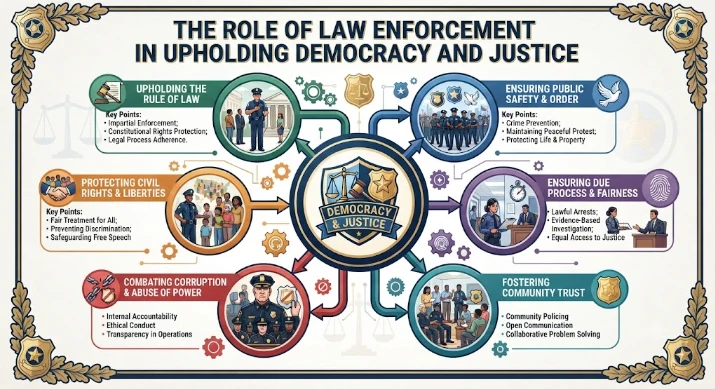
This article examines the responsibility of law enforcement agencies to protect democracy, justice, and the rule of law. It argues that policing in a democratic society extends beyond controlling crime and maintaining order; officers must also protect individual rights, ensure equal treatment, respect due process, and remain accountable to the public. Using Bangladesh as the main context, the article discusses concerns such as corruption, political influence, excessive force, discrimination, and weak public confidence. It emphasizes that policing protests and civil unrest requires careful balance between public order and citizens’ rights to peaceful expression. Law enforcement also has an important role in investigating corruption, protecting vulnerable groups, and ensuring that influential individuals are not treated as being above the law. Transparency, independent oversight, ethical standards, and professional training are presented as central to democratic policing. The article concludes that public trust depends on law enforcement operating impartially, lawfully, and responsibly while adapting to emerging challenges such as cybercrime and political violence.
The police departments of any society are very important towards maintaining democracy and justice. The work of the law enforcement in democratic countries is to ensure the safety of the population, the rights of citizens, and the rule of law. They have a greater role than mere crime control and enforced order, law enforcement officers play a critical role in ensuring that the pillars of democracy, such as fairness, equality, and accountability are upheld. The issue of law enforcement in protecting justice and democracy is especially critical in such countries as Bangladesh where the democratic values are under constant development.
Among the fundamental roles of law enforcement in a democratic system is safeguarding the rights and freedoms of every person regardless of his race, religion, sex, and social status. The state power in a democratic society belongs to the people and the law enforcement agencies are supposed to serve and hold the people under protection. This implies that the law enforcement should be given without any favor or preference to the law. A democratic justice is based on the fact that all people should be treated equally before the law. In Bangladesh and most of the developing states, respecting the rights of all citizens including marginalized groups of the society, ethnic minorities, women, and poor are crucial roles of law enforcement agencies. Misuse of authority or any discrimination by the police force may destroy the publicity in the justice system and erode the democratic society.
Enforcement of laws fairly and consistently is inherently linked with the role of law enforcement to maintain justice. Justice is not just a process of punishing the wrongdoers but also giving some dignity and respect to people in the course of law. The legal system should ensure in a democracy due process of law; this means one has a right to a just trial, right to an attorney and against being arrested at will. The law enforcement agencies have the role of ensuring that these rights are adhered to throughout the criminal justice process, both during arrest and trial, and afterward during sentencing.
The issue of due process and fair treatment of the law enforcement in Bangladesh is quite important. The nation has gone a long way in enhancing its legal and judicial systems, however there are still problems in making sure that law enforcement is not corrupted and biased. There is a question of the use of excessive force by the law enforcement, particularly in cases that are political sensitive or dealing with protests and civil unrests. The law enforcement agencies should be accountable in their activities in order to maintain democracy and justice. This may be done by external scrutinizing organs, in-house investigations, and publicity of law enforcement practice. In a democracy, there has to be a sense of trust by the public and the law enforcement agencies need to show that they are acting within the confines of the law and respect the rights of the citizens.
Corruption prevention is also part of law enforcement, as well as government institutions should be answerable to the citizens. The police in democratic society are mandated to investigate any form of corruption and keep the responsible authorities accountable in case of abusing their office. Corruption serves as a fatal disease to democracy since it compromises the trust that citizens have in the government institutions and denies citizens the needed services. In Bangladesh, where there is still a major issue on corruption, the law enforcement is important in the process of investigating and prosecuting corrupt officials. The law enforcers, the anti-corruption departments should be given the mandate to probe cases of corruption at any level of government, the local authorities and the political leaders in the country. An open and responsible law enforcing system is necessary in making sure democracy is alive and is sensitive to the needs of the people.
The other important mandate of the law enforcement in the maintenance of democracy is the preservation of peace and order in the society when there are civil unrests, protests, and demonstrations. Citizens of any given democracy are entitled to their views and push towards change in a peaceful manner. Police should strike a balance between the obligation to maintain the safety of people and the right of the citizens to protest. This must be approached quite carefully, with minimal force being used by the law enforcement and de-escalation being far more important in a conflict situation. Law enforcement agencies in Bangladesh need to be trained on how to deal with such scenarios without jeopardizing or impairing both the public order and democratic freedoms since political protest and demonstrations are common in this country. This involves explicit policies regarding the application of force, preservation of the rights of the protestors and facilitation of a dialogue between the law enforcers and organizers of the protests. Peaceful and law-abiding management of protests is also a way to assure people of the legitimacy of the democratic process and ensure that the government is accepted by the citizens.
Besides the fact that law enforcement agencies keep the order, they should also be active in defending vulnerable groups and ensuring social justice. In most societies, women, children, refugees and minority groups are more likely to be subject to violence and exploitation as a marginalized group. The law enforcement has a role of guaranteeing these categories of people are not harmed and that they enjoy equal access to justice. In Bangladesh where gender based violence and child labor are major challenges the law enforcement bodies have a role to play in curbing these vices and ensuring that victims can get legal redress. Every one of these issues can be given special coverage by specialized units, including the domestic violence or human trafficking unit. This is because the law enforcement agencies are helping in the greater cause of social justice and equality and this is achieved by protecting the rights of the vulnerable groups.
Moreover, police policing is also a crucial element in the creation of a culture of respect to the rule of law. The rule of law is one such important concept in a democracy where everyone regardless of his or her position is under the law and no one is superior to the law. Law enforcers have a duty of upholding the law without prejudice and this brings a level playing field among all the citizens. This is especially significant in societies where the influential persons or groups of people can seek to violate the law in order to gain personal advantages. Law enforcement agencies in Bangladesh have to make sure that influential people such as politicians, businesspersons, and other influential figures should not be spared to face consequences as a result of their deeds. This is essential in the maintenance of democracy and making the legal system beneficial to everyone and not the strong few.
An important aspect of the maintenance of democracy and justice is to make the law enforcement agencies self-integrity and accountable. In most developing nations such as Bangladesh, corruption in the law enforcing organizations has the potential of corrupting the justice system. It can be bribing of police so that they do not see the crimes, or there can be biased investigations based on political demands. Such form of corruption undermines the rule of law and destroys the confidence of people in the criminal justice system. Law enforcement agencies need to be transparent in their operation and answerable to their population, and should not be influenced by politics to promote democracy and justice. Regular audits, internal control institutions, and public reporting mechanisms are necessary to make law enforcement officers follow ethical standards in their work and within the law.
Furthermore, the law enforcement should also make sure that it is properly equipped to face the new threats to democracy, including cybercrime, political violence, and organized crime. With the increase in technology, criminal activities also change and the law enforcers have to keep up with the changing trends. The emergence of cybercrime and other threats on the internet is becoming a challenge to law enforcement in Bangladesh. Such crimes as hacking, online fraud, and harassment via the internet can weaken the democratic processes and damage the rights of people to privacy and freedom of expression. The police force should invest in cybersecurity and train the officers to deal with such novel forms of crime without infringing on the privacy rights of the people.
To sum up, law enforcement agencies are significant in promoting democracy and justice. They are not only involved in ensuring that people are safe, but also in upholding the rights of the people, equality before the law, resist corruption and promote social justice. Law enforcement agencies in Bangladesh have to work with integrity, transparency and accountability in order to win the trust of people and also to maintain the democracy values as well. Law enforcement can be at the forefront of enhancing democracy and building of a just society by balancing the security requirement and the human rights without prejudice to the rule of law. To achieve good democracy, law enforcement should be the keepers of justice, they should be relentless in upholding the rights and freedoms of the citizens as well as ensuring that the law is administered in a manner that is just and fair.
CITE THIS ARTICLE
Das, B. C. (2026). The Role of Law Enforcement in Upholding Democracy and Justice. https://www.bikashchandra.com/article/9c351d5d-1ff6-5506-b4f4-cee986c5f724
B. C. Das, “The Role of Law Enforcement in Upholding Democracy and Justice,” 2026. [Online]. Available: https://www.bikashchandra.com/article/9c351d5d-1ff6-5506-b4f4-cee986c5f724
Das, B. C. (2026) ‘The Role of Law Enforcement in Upholding Democracy and Justice’. Available at: https://www.bikashchandra.com/article/9c351d5d-1ff6-5506-b4f4-cee986c5f724
Das, Bikash Chandra. “The Role of Law Enforcement in Upholding Democracy and Justice.” 2026, https://www.bikashchandra.com/article/9c351d5d-1ff6-5506-b4f4-cee986c5f724.
Bikash Chandra Das. “The Role of Law Enforcement in Upholding Democracy and Justice.” (2026). https://www.bikashchandra.com/article/9c351d5d-1ff6-5506-b4f4-cee986c5f724.
Das BC. The Role of Law Enforcement in Upholding Democracy and Justice. 2026. https://www.bikashchandra.com/article/9c351d5d-1ff6-5506-b4f4-cee986c5f724
@misc{article_9c351d5d1ff65506b4f4cee986c5f724,
  title = {The Role of Law Enforcement in Upholding Democracy and Justice},
  author = {Bikash Chandra Das},
  year = {2026},
  url = {https://www.bikashchandra.com/article/9c351d5d-1ff6-5506-b4f4-cee986c5f724},
}
TY  - GEN
AU  - Bikash Chandra Das
TI  - The Role of Law Enforcement in Upholding Democracy and Justice
PY  - 2026-06-10
UR  - https://www.bikashchandra.com/article/9c351d5d-1ff6-5506-b4f4-cee986c5f724
ER  -
This article explores why people volunteer in America’s national parks and how program design influences whether service remains meaningful. Volunteer motivations often overlap and include personal values, learning, social connection, career development, confidence, purpose, and attachment to place. The article uses motivational frameworks to show that volunteers are more likely to remain engaged when they experience autonomy, growing competence, respectful relationships, and a clear connection
Probation and parole are presented as essential community-based alternatives to incarceration that combine supervision, accountability, and reintegration. Probation generally allows eligible offenders to remain in the community instead of serving a prison sentence, while parole provides conditional release after part of a custodial sentence has been completed. The article explains that both approaches can preserve employment, family ties, education, and housing, all of which reduce the risk of r
This article defines the ethical boundaries that protect volunteers who support visitor safety and law-enforcement-related functions in national parks. Although volunteers can assist with information, observation, traffic support, administrative work, backcountry roves, and reporting hazards, they must not exercise powers such as arrest, detention, search, citation, evidence handling, use of force, or other commissioned enforcement duties. The article emphasizes clear position descriptions, accu