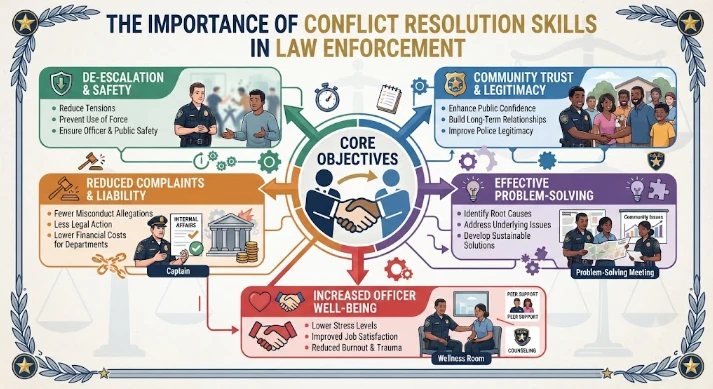
This article discusses why conflict resolution is a core professional skill for law enforcement officers. Police frequently encounter tense situations involving domestic disputes, public demonstrations, arrests, mental health crises, and other circumstances where poor communication can quickly escalate into violence. The article explains that training in de-escalation, active listening, empathy, negotiation, and problem solving can reduce unnecessary use of force while improving safety for both officers and civilians. Conflict resolution also strengthens police-community relationships, especially in settings where mistrust of law enforcement already exists. In Bangladesh, the article connects these skills to political demonstrations, domestic violence, resource constraints, and allegations of police misconduct. It also notes that conflict management is valuable within police organizations because unresolved internal disputes can damage morale, teamwork, and operational effectiveness. Effective training should therefore include emotional intelligence, cultural sensitivity, legal awareness, and realistic scenarios. Overall, the article argues that conflict resolution improves operational outcomes, protects rights, supports ethical policing, and helps build a more professional and trusted justice system.
Conflict resolution skills in law enforcement are critical towards upholding order in the society, and promoting a healthy relationship between the community and police. The situation officers face on a regular basis is when tensions are at the high level, emotions run too deep and quick decision-making is required. Their management of such conflicts may have a substantial influence on the result, both to the safety of the population and to the integrity of the justice system. Conflict management will lead to less use of force, de-escalating potentially violent crimes, and establishing trust between the police and the communities they serve. In Bangladesh, where social upheavals, political tensions, and increasing crime rates tend to create difficulties on the part of the law enforcers, the creation and use of conflict resolution skills is more important in bringing about justice and peace.
Among the most predominant reasons why learning of conflict resolution skills are relevant in law enforcement is the fact that, they substantially help in minimizing the force involved. During high stress scenarios, such as domestic quarrels, protests by people, or arrests, officers may either de-escalate the scenario through communication and problem solving strategies or escalate the situation. When policemen are being trained on how to settle disputes, they are more prepared to put down tense circumstances without the use of physical force. This does not only ensure the security of the civilians but will also assist the officers in evading the legal hassles, reduce injuries, and save the face of the involved parties.
To illustrate, a domestic violence call does not necessarily mean that an officer is to arrest the suspect and use force to separate the conflicting parties, but rather a conflict resolution trained officer can act as a mediator, enabling both parties to present their sides, changing the sources of the conflict and providing a solution, e.g., a counseling session, a referral to support services. By compromising and calming the situation, the officer will be able to avoid the further development of the situation and decrease the chances of injury. Such skills may be essential in Bangladesh where the problem of domestic violence is of major concern and the issues are to be addressed in a manner that would consider human rights and foster long-term safety.
Resolving conflicts is also important in dealing with law enforcement and the community. Law enforcement agencies in most countries such as Bangladesh may be mistrusted by some section of the society especially the marginal ones. When police officers get conflict situations wrong, be it by using aggression, being insensitive or not understanding, they affirm the negative stereotypes and therefore spread more mistrust, which makes it harder to get the community to cooperate and prevents crime. However, when the officers show empathy, active listening, and respect towards others, they contribute to establishing trust in the community, which may increase cooperation, lead to more successful investigations, and better crime prevention techniques.
Conflict resolution in Bangladesh is an important area of operation in handling demonstrations and public gatherings due to the levels of political unrest and protests. Demonstrators can be justified in their complaints, and when the police react violently to them or just do not discover the roots of the disturbances, it can only lead to tensions and cause more divisions between the police and citizens. Using the techniques of conflict resolution which include negotiation, compromise, and calm dialogue, the police officers should mitigate the threat of violence, safeguard the population, and guarantee that the right of free expression is not violated. In case the officers are proficient in conflict peaceful management, they are able to keep the society at peace, not only creating respect towards the democratic rights.
The other significance of the role of conflict resolution in the law enforcement is that it enhances the internal life within the police force itself. Police departments are typically stressful places where police officers work extended hours, have to work in hazardous areas, and are exposed to the emotional and mental consequences of their job. Disputes between officers or between various departments are likely to cause low morale, ineffective performance and even malpractices. The agencies can achieve this by encouraging conflict resolution skills among the police force to ensure they are provided with an environment that is healthy to work in where officers are free to communicate freely, settle grievances constructively and work together. This further translates to enhanced collaboration, job satisfaction and unified operations.
Resolution of conflicts will also lead to improving safety of officers. By training officers to de-escalate confrontational circumstances through communicative methods and not by use of force, the officers minimize their exposure to harm. Most of the injuries that the law enforcement officers get during line of duty are caused by encounters that become unnecessary. De-escalation and conflict resolution training will also help such officers to minimize the chances of physical confrontations that will harm not only themselves but also those they interact with. In Bangladesh, where police regularly experience problems with lack of resources, high population density in the cities, and the increasing number of civil disorders, police officers having the abilities to solve the conflict are more likely to preserve the situation and guarantee the safety of all parties involved.
The influence of the conflict resolution on the legal outcomes is another reason why this process is necessary in the law enforcement. In most cases, how an officer oficer is dealing with a situation may affect the proceedings of the court of law. To illustrate, when a police officer deals with an arrest using unjustified force, or otherwise miscommunicates with a suspect, it may result in a charge of police misconduct, lawsuits, or even dismissal of charges. Nevertheless, by using conflict resolution strategies, which include good communication, active listening, and the respect of respect of people, officers are likely to prevent misunderstandings, minimize the resistance, and attain more positive results. Integrating conflict management skills into the process of police training can assist in enhancing the legal and moral reputation of the law enforcement agencies in Bangladesh where the problem of police brutality and violations of human rights are being accused of.
Also significant is the fact that conflict resolution skills can be applied in situations involving mental health crises. It is always a case with many law enforcement interactions where they deal with people in mental health problems who might exhibit unpredictable behavior. In fact, lacking the proper training, these situations can spiral out of control and result in injuries or unnecessary and potentially damaging arrests by the officers. Such competencies as conflict resolution and the ability to identify mental health problems and apply calming methods are essential in such circumstances. In Bangladesh, in which mental health awareness and services are scarce, law enforcement officers equipped with conflict resolution training may be crucial to de-escalate mental health crises, refer people to the relevant services, and prevent the application of force.
To train law enforcement officers with conflict resolution, the broad approach that encompasses more than communication skills and includes emotional intelligence, cultural sensitivity, and knowledge of legal frameworks is needed. Officers must understand how to determine a situation, identify the indicators of the growing conflict, and decide the most reasonable approach to handling it. It includes knowing when to de-escalate them with verbal means, when to call upon involved agencies (mental health workers, social workers, etc.), and when one has to arrest them. The training must be ongoing because the conflict resolution strategies change over time depending on the changes in the social dynamics, criminal activities and emergence of new challenges in the policing environment.
In the case of Bangladesh, incorporation of conflict resolution in the police training programs can serve as a revolution in producing a more professional, responsive and ethical police force. The programs must concentrate on the situations that the officers would most likely face, e.g., domestic conflicts, protests, working with vulnerable people, etc., and teach them how to address such cases in a peaceful manner. This is not only beneficial to the officers as far as their safety and professional growth concerns but also leads to the community trusting the police force and their relative security as to their safeguarding the community without having to resort to excessive violence.
To sum up, conflict resolution skills are an essential element in law enforcement practice. They assist in minimizing force, officer and citizen safety, justice as well as ensuring trust between the police and the community. The application of conflict resolution skills in police training is very essential in Bangladesh where law enforcement has numerous challenges that are associated with political unrest, insufficient resources, and increased crime. Law enforcement agencies can avoid acts of violence and improve their effectiveness by focusing on communication, empathy, and problem-solving to make the society more just and peaceful. Conflict resolution skills are not an operational imperative in the police force, but a long-term stability and integrity investment in the justice system.
CITE THIS ARTICLE
Das, B. C. (2026). The Importance of Conflict Resolution Skills in Law Enforcement. https://www.bikashchandra.com/article/5bdcbc0b-236e-5b78-9b91-5a8e916c75b4
B. C. Das, “The Importance of Conflict Resolution Skills in Law Enforcement,” 2026. [Online]. Available: https://www.bikashchandra.com/article/5bdcbc0b-236e-5b78-9b91-5a8e916c75b4
Das, B. C. (2026) ‘The Importance of Conflict Resolution Skills in Law Enforcement’. Available at: https://www.bikashchandra.com/article/5bdcbc0b-236e-5b78-9b91-5a8e916c75b4
Das, Bikash Chandra. “The Importance of Conflict Resolution Skills in Law Enforcement.” 2026, https://www.bikashchandra.com/article/5bdcbc0b-236e-5b78-9b91-5a8e916c75b4.
Bikash Chandra Das. “The Importance of Conflict Resolution Skills in Law Enforcement.” (2026). https://www.bikashchandra.com/article/5bdcbc0b-236e-5b78-9b91-5a8e916c75b4.
Das BC. The Importance of Conflict Resolution Skills in Law Enforcement. 2026. https://www.bikashchandra.com/article/5bdcbc0b-236e-5b78-9b91-5a8e916c75b4
@misc{article_5bdcbc0b236e5b789b915a8e916c75b4,
  title = {The Importance of Conflict Resolution Skills in Law Enforcement},
  author = {Bikash Chandra Das},
  year = {2026},
  url = {https://www.bikashchandra.com/article/5bdcbc0b-236e-5b78-9b91-5a8e916c75b4},
}
TY  - GEN
AU  - Bikash Chandra Das
TI  - The Importance of Conflict Resolution Skills in Law Enforcement
PY  - 2026-06-20
UR  - https://www.bikashchandra.com/article/5bdcbc0b-236e-5b78-9b91-5a8e916c75b4
ER  -
This article explores why people volunteer in America’s national parks and how program design influences whether service remains meaningful. Volunteer motivations often overlap and include personal values, learning, social connection, career development, confidence, purpose, and attachment to place. The article uses motivational frameworks to show that volunteers are more likely to remain engaged when they experience autonomy, growing competence, respectful relationships, and a clear connection
Probation and parole are presented as essential community-based alternatives to incarceration that combine supervision, accountability, and reintegration. Probation generally allows eligible offenders to remain in the community instead of serving a prison sentence, while parole provides conditional release after part of a custodial sentence has been completed. The article explains that both approaches can preserve employment, family ties, education, and housing, all of which reduce the risk of r
This article defines the ethical boundaries that protect volunteers who support visitor safety and law-enforcement-related functions in national parks. Although volunteers can assist with information, observation, traffic support, administrative work, backcountry roves, and reporting hazards, they must not exercise powers such as arrest, detention, search, citation, evidence handling, use of force, or other commissioned enforcement duties. The article emphasizes clear position descriptions, accu