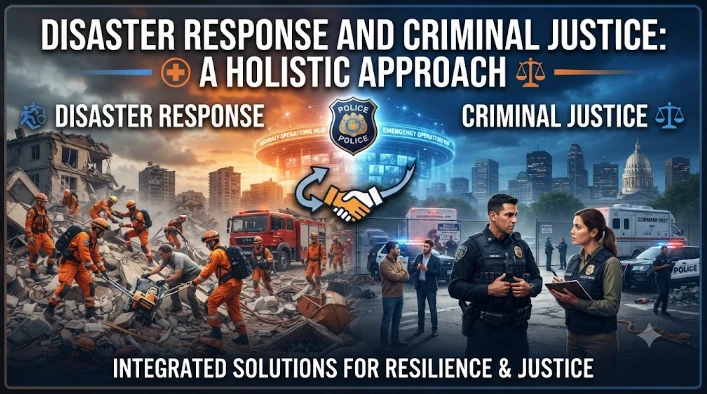
This article argues that disaster response and criminal justice must be planned together because emergencies can create new security risks while weakening normal law-enforcement and judicial capacity. Bangladesh’s recurring floods, cyclones, displacement, and infrastructure damage provide the central context. The post explains that disasters can increase theft, looting, assault, trafficking, domestic violence, and exploitation, particularly when police resources are overstretched and large populations are moved into temporary shelters. Women, children, displaced people, older adults, and people with disabilities are identified as especially vulnerable. A holistic response therefore requires law enforcement, disaster-management agencies, humanitarian organizations, NGOs, social services, and local communities to coordinate security and relief activities. The article recommends disaster-specific police training, better equipment, secure shelters, registration and tracking mechanisms, community policing, and stronger protection systems. It also emphasizes the long-term role of the criminal justice system in restoring order, protecting victims’ rights, prosecuting offenders, and supporting rehabilitation. Integrated planning is presented as essential for safe and resilient recovery.
Natural and man-made disasters are usually associated with a flood of difficulties, which overwhelms the abilities of emergency departments, police, and criminal justice institutions. The convergence of criminal justice and disaster response is a pertinent problem in Bangladesh, a country that is often affected by floods, cyclones and other catastrophes. The disaster response is not merely the issue of offering emergency help and recovery but also making sure that the criminal justice system conforms to the specifics of those crises. The disaster response and criminal justice should have a holistic approach in order to ensure that the immediate needs and future security issues are both met.
Bangladesh is a highly disaster prone nation and the country frequently experiences floods, cyclones, erosion of the rivers as well as most recently, the impacts of climate change. Such incidents can cause immense loss of lives, displacement and destruction of infrastructures, which places the communities in a tender state of secondary difficulties such as crime and lawlessness. When this happens, the criminal justice system is confronted with a daunting challenge in terms of law and order, safety, crime control with limited resources and a tensed administrative set-up.
Poverty, high population density, and insufficient infrastructure are the factors that contribute to the fact that the country is vulnerable to disasters. The most vulnerable communities who may be facing socio-economic pressures are the already marginalized communities, which tend to be the most adversely affected by disasters. The absence of the adequate disaster management systems and resources may result in setting up a climate, in which the issue of crime emerges to a higher level of awareness. Besides the direct effects of the calamities, including destruction of homes and business, in most instances, there are security challenges that are experienced in wide doses, including theft, lootings, and violence.
Ensuring that there is law and order during and after a crisis is one of the main issues in disaster response. The state is usually thrown into disarray by disasters, unless emergency services are overstretched, and law enforcers have to deal with the magnitude of the response. Faced with destruction, certain individuals or groups would be able to take opportunities to commit a crime, whether it is a petty crime or a more serious crime like assault or even human trafficking.
The pressure on law enforcement organizations may cause delays in the reaction, problems in the investigation of the crime, and an additional risk of impunity. This failure in the criminal justice system can expose the communities to additional exploitation especially when there are loopholes in the security of the most susceptible in the society including women, children, and displaced groups. The lack of the necessary coordination between the disaster response organizations and the law enforcement agencies exposes the risk of the lack of security concerns in the latter, which may compromise the efficiency of the entire disaster recovery process.
This is even more difficult in Bangladesh, where the police force is in most cases under-resourced and lacks the ability to address crises that are wide spread. In most cases, there is no solid police presence in many regions, and even the deployed police personnel to the disaster areas have not been trained and equipped to handle emergency relief as well as law and order at the same time. These issues necessitate a global approach that would see the criminal justice system well prepared to meet the security threats that would occur following a disaster.
Disasters also have the effect of causing mass displacement, where individuals are displaced and they move to temporary shelters or evacuation facilities. Such shift may provide an environment conducive to crime especially when in overcrowded shelters where the rule of law is not as enforceable. Under such conditions, women and children who form the most vulnerable groups are at a greater risk of violence, exploitation and abuse.
The risks of exploitation are extremely acute in Bangladesh where millions of citizens inhabit informal settlements, which are highly vulnerable to flooding and other natural catastrophes, e.g. in coastal regions and riverine territories. Human trafficking especially trafficking of women and children to sexually exploit them or be used as slaves can increase during a disaster where individuals are desperate and will look to other services to survive. Weakness of social structures, shortage of resources, and uninterrupted education may lead the individuals into hazardous conditions, in which they can become victims of the criminal elements.
Besides the issue of trafficking, other crimes, like domestic violence, theft, and assault, might rise to the setup of a disaster. Disintegration of community fabric, death of relatives, and financial instability are likely to provoke the increase in mental disorders, which, in turn, may lead to the influx of violent or aggressive actions. These issues can soon become extremely serious in the absence of an effective criminal justice, leading to more extensive damage to people and to the communities that are already being affected by the consequences of the calamity.
Disaster response and criminal justice is a complicated issue that needs a multifaceted approach to the problem since it requires layers of response. The idea of a holistic approach is the adoption of law enforcement, disaster management, and community-based efforts, which meet both the short-term relief objectives and the recovery objectives in the long term. This combined strategy is useful to make sure that the criminal justice system does not only react efficiently to the crimes that take place during and after a disaster, but also takes the initiative to prevent crime and secure vulnerable groups.
Another important factor in a holistic approach is enhancing capacity of the law enforcement in the event of disaster. This implies that the police and security forces should be sufficiently prepared in terms of training and equipments to respond to the challenges arising out of disasters. Empowering law enforcement officers through disaster response training, emergency management training and crisis communication training would enhance their capacity to handle both law enforcement functions and disaster management functions.
Moreover, law enforcement agencies should also be provided with the means of completing their task successfully. This can take the form of availing mobile communication devices, transport and access to disaster response technology to the officers in Bangladesh. Moreover, the government and law enforcers are expected to work with non-governmental organizations (NGOs) and international agencies to enhance the coordination and security levels are met when disaster relief works are carried out.
Community policing strategies are also essential in ensuring that there is law and order in the case of a disaster. The use of community policing has enabled the law enforcers to work together with the citizens in an area and this makes the communities feel that they are more a part of their own security. Through establishing trust and collaboration with the community leaders, police are able to know more about the needs of the displaced people, potential threats, and take proactive actions to ensure crimes are not committed.
The most vulnerable members of the society, which are women, children, the aged, and challenged individuals are the ones to bear the brunt of disasters. The holistic approach toward disaster response should also have the element of ensuring that such populations are not harmed or exploited. Police departments need to collaborate with humanitarian organizations that will help to recognize vulnerable people and offer them support and protection that they require.
As an example, safe shelters, evacuation centers where weak people can feel safe against violence and exploitation should be established as a priority during disaster response. Such facilities should also have special security guards, social workers who have been trained and also medical personnel so that the people are not only safe; they are also at liberty to access the services they need. Also, education and awareness programs may be used to create awareness about the dangers of exploitation and educate the representatives of the community about how to safeguard themselves and report cases of suspicious activities.
The government, the local NGOs and international organizations in Bangladesh can collaborate to establish systems of tracking and protection of displaced people. This may include establishing registration in the evacuation centers where individuals may be registered and tracked to discourage trafficking and exploitation. Besides, the law enforcement should collaborate with social services to assist in offering both short and long-term care to victims of abuse or exploitation in case of a disaster.
The criminal justice system is important in the rebuilding process, which takes place long-term despite the fact that in the immediate aftermath of a disaster, much attention is usually given to emergency relief and recovery. An effective and well-built legal system would be beneficial in re-establishing some order, putting culprits into check and seeing that the victim rights are not violated. In Bangladesh, the ability to increase the capacity of the justice system in dealing with crime that occurs after a disaster is an important part of the recovery efforts.
It is also significant in rehabilitating and reintegrating those people who engage in criminal activities in a disaster situation. This involves giving the offenders a chance to be reintegrated in terms of education, vocational training and psychological assistance. The criminal justice system can also assist individuals to re-enter the society and take part in community rebuilding efforts by emphasizing on rehabilitation, instead of the criminal justice system relying only on punishment.
Natural and manmade disasters are major problems to the criminal justice and law enforcers. A holistic approach involving criminal justice, disaster response, and community support is urgent in Bangladesh where the risk of disaster is high. Bangladesh can make sure that it is not just responsive to the immediate needs of the vulnerable population but also promotes the long-term recovery and resilience by making sure that law enforcement is stronger, concentrating on the protection of vulnerable population, and ensuring that the criminal justice system is ready to address the specific needs of the discussed population in the context of disaster. An integrated, cohesive strategy will aid in addressing the consequences of disasters and will build a more secure and safer environment to all communities that will be victimized by the disasters.
CITE THIS ARTICLE
Das, B. C. (2026). Disaster Response and Criminal Justice: A Holistic Approach. https://www.bikashchandra.com/article/2d85135a-3ad1-569b-b461-1d37574eef41
B. C. Das, “Disaster Response and Criminal Justice: A Holistic Approach,” 2026. [Online]. Available: https://www.bikashchandra.com/article/2d85135a-3ad1-569b-b461-1d37574eef41
Das, B. C. (2026) ‘Disaster Response and Criminal Justice: A Holistic Approach’. Available at: https://www.bikashchandra.com/article/2d85135a-3ad1-569b-b461-1d37574eef41
Das, Bikash Chandra. “Disaster Response and Criminal Justice: A Holistic Approach.” 2026, https://www.bikashchandra.com/article/2d85135a-3ad1-569b-b461-1d37574eef41.
Bikash Chandra Das. “Disaster Response and Criminal Justice: A Holistic Approach.” (2026). https://www.bikashchandra.com/article/2d85135a-3ad1-569b-b461-1d37574eef41.
Das BC. Disaster Response and Criminal Justice: A Holistic Approach. 2026. https://www.bikashchandra.com/article/2d85135a-3ad1-569b-b461-1d37574eef41
@misc{article_2d85135a3ad1569bb4611d37574eef41,
  title = {Disaster Response and Criminal Justice: A Holistic Approach},
  author = {Bikash Chandra Das},
  year = {2026},
  url = {https://www.bikashchandra.com/article/2d85135a-3ad1-569b-b461-1d37574eef41},
}
TY  - GEN
AU  - Bikash Chandra Das
TI  - Disaster Response and Criminal Justice: A Holistic Approach
PY  - 2026-05-06
UR  - https://www.bikashchandra.com/article/2d85135a-3ad1-569b-b461-1d37574eef41
ER  -
This article explores why people volunteer in America’s national parks and how program design influences whether service remains meaningful. Volunteer motivations often overlap and include personal values, learning, social connection, career development, confidence, purpose, and attachment to place. The article uses motivational frameworks to show that volunteers are more likely to remain engaged when they experience autonomy, growing competence, respectful relationships, and a clear connection
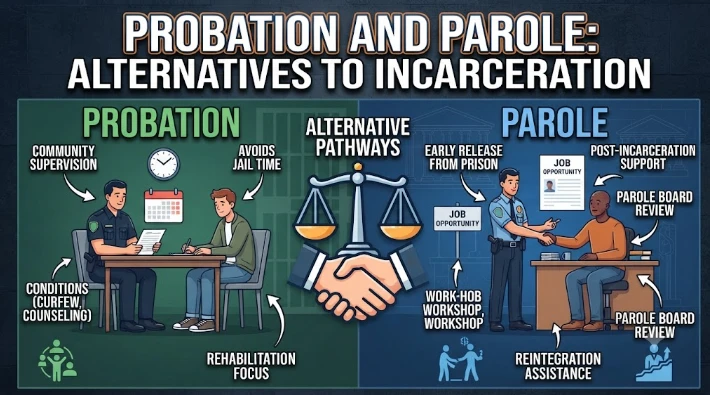
Probation and parole are presented as essential community-based alternatives to incarceration that combine supervision, accountability, and reintegration. Probation generally allows eligible offenders to remain in the community instead of serving a prison sentence, while parole provides conditional release after part of a custodial sentence has been completed. The article explains that both approaches can preserve employment, family ties, education, and housing, all of which reduce the risk of r
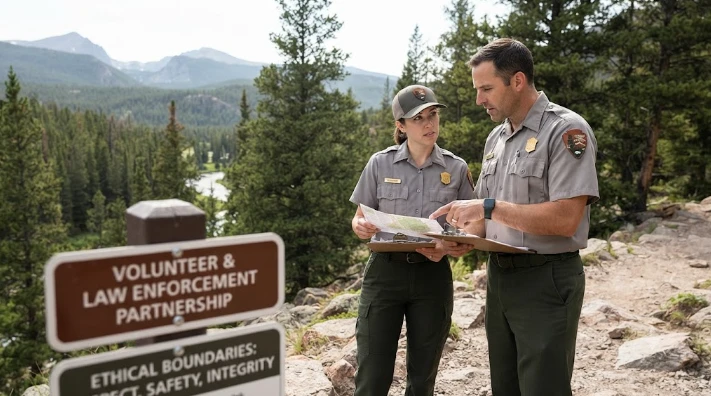
This article defines the ethical boundaries that protect volunteers who support visitor safety and law-enforcement-related functions in national parks. Although volunteers can assist with information, observation, traffic support, administrative work, backcountry roves, and reporting hazards, they must not exercise powers such as arrest, detention, search, citation, evidence handling, use of force, or other commissioned enforcement duties. The article emphasizes clear position descriptions, accu