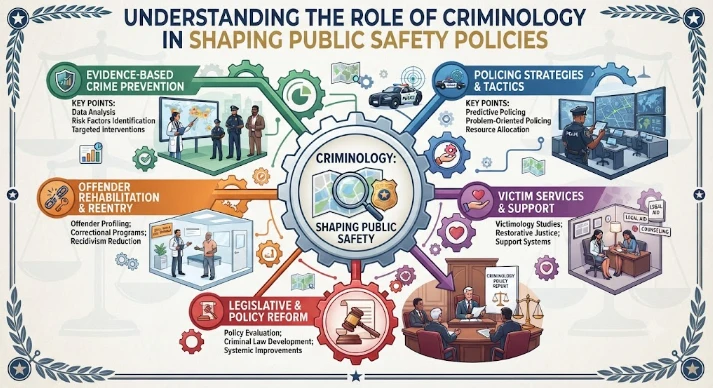
This article explains how criminology contributes to the development of evidence-based public safety policy. Rather than focusing only on criminal acts, criminology examines the social, economic, psychological, and environmental factors associated with crime, including poverty, inequality, unemployment, limited education, and social exclusion. The article shows how criminologists use crime patterns and statistical trends to identify emerging risks, high-risk locations, and populations requiring targeted intervention. In Bangladesh, this knowledge can help policymakers allocate resources more effectively and respond to organized crime, political violence, trafficking, and other public safety concerns. The article also emphasizes the role of criminology in evaluating whether crime-control policies actually work and in comparing punitive approaches with prevention, rehabilitation, restorative justice, and community-based alternatives. Criminological research can also support prison reform, reduce recidivism, improve police-community relations, and guide responses to cybercrime. Overall, the article presents criminology as an essential bridge between research and policy, helping governments design public safety strategies that are more preventive, proportionate, inclusive, and sustainable.
The scientific study of crime, criminal conduct, and the criminal justice system is known as criminology that is a significant part of the policy formulation on the concept of public safety. With the changing of society, the approaches of criminals change as well, and this is why the strategies and policies toward crime prevention and the safety of people should be constantly developed. It is important to note that criminology has been instrumental in the shaping of these policies because it can give evidence-based information on the reasons why crime occurs, its trends, and the efficacy of different prevention strategies. In some countries such as Bangladesh where there is increasingly growing concern due to rising crimes, the study of criminology can influence the formulation of appropriate policies that can be effective and also be humane such that the law enforcement and the statutes of justice is able to cope with the challenges emerging without compromising on the human rights.
The study of criminology is critical in determining the fundamental causes of crime. Criminologists do not just analyze the symptoms of criminal behavior but analyse the social, economic, psychological and environmental conditions beneath criminal behavior. Some of the elements that have been recorded due to criminologists as leading to criminal behavior include poverty, inequality, lack of education, unemployment, family dysfunction, and social exclusion, just to mention but a few. Through the research of these variables, criminologists are able to assist policymakers in explanations of why people resort to crime and how the problem of a larger society can encourage criminal conduct. An example is the case of Bangladesh, where the issues of poverty and unemployment are of great concern, and, criminologists may state that people in low-income societies tend to choose the alternative of crime more often as their survival mechanism. Knowledge of these underlying causes will allow the establishment of the public safety policy that will not only focus on the symptoms of the crime but also on its underlying causes, whether social inequality or absence of opportunities.
In addition, criminology is important in determining patterns and trends of crime. Criminologists are able to trace the crime rates over time, define the new criminal patterns, and emphasize the geographic or demographic crime patterns with the help of the statistical analysis. To illustrate, considering crime statistics, criminologists are able to discover the characteristics of the increase of particular crimes, including drug trafficking or human trafficking, within particular regions or groups. Such information is priceless to law enforcement agencies and policymakers because it enables them to devote their resources in a more efficient way and design specific interventions. In Bangladesh, where urban areas in the country are experiencing high crime and violence rates, criminology research will be useful in allowing the local governments and the law enforcement agencies to tell what areas need urgent measures and what kind of crime prevention measures will be most effective there.
Also, the role of criminology is not confined to crime as it is also crucial in determining the effectiveness of policies concerned with the social safety. Evidence-based policies are the ones that many criminal justice systems use to shape their operations. Criminologists, as well, study to determine the effectiveness of a particular crime prevention factor, i.e., community policing, tougher set of sentencing laws or rehabilitative programs, in making the neighborhoods safer and reducing crime rates. Other policies like the war on drugs or stringent anti-terrorism regulations in Bangladesh like in other nations are usually enacted as a reaction to increased crime. Nevertheless, criminological studies can assist in answering the question of whether these policies actually work or they are merely contributing to the prison overcrowding and are not penetrating the fundamental sources of crime. As an example, a study could find out that rehabilitation programs could work better to prevent recidivism than lengthy prison sentences, and as a group of policymakers, they would prefer to adopt rehabilitation programs over punishment.
Based on the knowledge of criminology, it is also possible to create more comprehensive and inclusive public safety policies. Instead of adopting a purely punitive approach, criminological knowledge would promote the application of a prevention, intervention, and rehabilitation balance approach. Such an in-depth strategy will result in crime being cut in a more sustainable manner. To illustrate, criminologists support the policy of crime prevention before it strikes, which can be exemplified by the programs educating and employing the youth, training programs, and social networks. The measures are especially critical to Bangladesh, where people are prone to criminal activities due to the high rates of unemployment and insufficient education. Criminology prevents such approaches to issues affecting social security policies by reminding people of the measures and processes that cause criminality rather than responding to the crime once committed.
With Bangladesh in particular, the importance of criminology in forming the policy that will govern the safety of the population is even more critical when the social and political specifics of the country are taken into consideration. The emergence of organized crime, drug trafficking, and political violence is a challenge facing the law enforcement and institutions of public safety. By examining the connection between the issue of political instability, corruption and crime, criminologists are able to give an insight on how the political environment can affect crime. As an example, one can mention the discussion of the increase of the criminal networks and organized crime in Bangladesh that may be connected to the political instability and violence in this country. Criminological studies can also inform decision makers on devising policies that can minimize the role of politics in crime and make law enforcers effective and fair at the same time.
Criminology also plays a crucial role in the formulation of policies in treating and rehabilitating criminals. The trend in most criminal justice systems, such as that of Bangladesh, is that there has been a realization that punitive approaches towards crime are no longer effective. A system that will help in minimizing recidivism and reintegrate offenders back into society needs rehabilitation programs, including vocational training, education and counseling. Criminological research assists in determining the most effective rehabilitation techniques by researching on the exposures of the offenders, and determining the effectiveness of the present programs. Criminology is able to achieve this balance in serving the needs of both the offender and a better chance of ensuring that the offender does not repeat his or her criminal act again upon returning to the society by concentrating on rehabilitation and preventing recidivism.
Besides, overcrowded jails and prison reforming are the issues that have to be addressed in the criminal justice system in Bangladesh. Criminologists can be critical towards lobbying non-violent offenders to alternatives to incarceration including restorative justice program or community-based sentencing. One such approach is restorative justice, which aims at restoring the damage that crime has inflicted to both the offender, victim and community through dialogue. This will not only assist offenders to realize the effects of their actions but also assist victims and reintegrate offenders to society. The criminology can shape the policy of the masses to take into consideration rehabilitation and reintegration of criminals instead of imprisoning them by offering empirical studies on the effectiveness of such alternatives.
Moreover, the key role of criminology is to help instill confidence in law enforcement agencies in the community. The society in most cases mistrusts the police and the police mistrust them particularly the marginalized communities. Criminologists have the opportunity to study the social interaction of law enforcement agencies with the community that they serve and provide recommendations on the way to establish trust and enhance cooperation. In Bangladesh where the police-community interactions are mostly in bad blood especially in rural regions, criminological knowledge can be applied to implement programs that improve community policing, transparency and accountability. When the community has trust towards law enforcement, there is likeliness that community will be cooperative with the authorities, give in on crimes and help in crime prevention. It, in its turn, will result in more and more safety of the population and a more efficient justice system.
Criminology is also applied in dealing with some new types of crimes like in Facebook crime. As technology has emerged, the criminal justice system should be able to adjust to the new trends of internet fraud, hacking, identity theft, and cyber bullying. Cybercriminologists investigate these novel threats and make suggestions on how the law enforcement agencies ought to address them. Cybercrime awareness and prevention in Bangladesh is a significant issue of concern in ensuring the safety of people, as the internet penetration in the country is increasing rapidly. The study of criminology may inform the implementation of policies on the protection of the citizens and the organization against cyber crimes to make sure the law enforcement agencies have the tools and the knowledge to counter these emerging criminal acts.
To sum up, criminology is critical in influencing the policies of this organization in relation to ensuring the safety of the people around them, as they offer a sound-evidence-based understanding of why people commit crimes, how well the implemented crime control mechanisms perform, and how to create an all-embracing approach to crime control. In Bangladesh where the rate of crime is increasing as a result of the socio-economic problems and the political instability, the criminology can be used to inform the policies to help solve the causes behind the crimes and make the law enforcement and justice system more effective. With the emphasis on rehabilitation, prevention, and community involvement, criminology will also make sure that the policies of the community regarding the public safety are not only responsive but also proactive, and will lead to the creation of a safer and fairer society to everyone.
CITE THIS ARTICLE
Das, B. C. (2026). Understanding the Role of Criminology in Shaping Public Safety Policies. https://www.bikashchandra.com/article/300fd51a-ee8e-57a7-b850-204ca7d3f829
B. C. Das, “Understanding the Role of Criminology in Shaping Public Safety Policies,” 2026. [Online]. Available: https://www.bikashchandra.com/article/300fd51a-ee8e-57a7-b850-204ca7d3f829
Das, B. C. (2026) ‘Understanding the Role of Criminology in Shaping Public Safety Policies’. Available at: https://www.bikashchandra.com/article/300fd51a-ee8e-57a7-b850-204ca7d3f829
Das, Bikash Chandra. “Understanding the Role of Criminology in Shaping Public Safety Policies.” 2026, https://www.bikashchandra.com/article/300fd51a-ee8e-57a7-b850-204ca7d3f829.
Bikash Chandra Das. “Understanding the Role of Criminology in Shaping Public Safety Policies.” (2026). https://www.bikashchandra.com/article/300fd51a-ee8e-57a7-b850-204ca7d3f829.
Das BC. Understanding the Role of Criminology in Shaping Public Safety Policies. 2026. https://www.bikashchandra.com/article/300fd51a-ee8e-57a7-b850-204ca7d3f829
@misc{article_300fd51aee8e57a7b850204ca7d3f829,
  title = {Understanding the Role of Criminology in Shaping Public Safety Policies},
  author = {Bikash Chandra Das},
  year = {2026},
  url = {https://www.bikashchandra.com/article/300fd51a-ee8e-57a7-b850-204ca7d3f829},
}
TY  - GEN
AU  - Bikash Chandra Das
TI  - Understanding the Role of Criminology in Shaping Public Safety Policies
PY  - 2026-06-15
UR  - https://www.bikashchandra.com/article/300fd51a-ee8e-57a7-b850-204ca7d3f829
ER  -
This article explores why people volunteer in America’s national parks and how program design influences whether service remains meaningful. Volunteer motivations often overlap and include personal values, learning, social connection, career development, confidence, purpose, and attachment to place. The article uses motivational frameworks to show that volunteers are more likely to remain engaged when they experience autonomy, growing competence, respectful relationships, and a clear connection
Probation and parole are presented as essential community-based alternatives to incarceration that combine supervision, accountability, and reintegration. Probation generally allows eligible offenders to remain in the community instead of serving a prison sentence, while parole provides conditional release after part of a custodial sentence has been completed. The article explains that both approaches can preserve employment, family ties, education, and housing, all of which reduce the risk of r
This article defines the ethical boundaries that protect volunteers who support visitor safety and law-enforcement-related functions in national parks. Although volunteers can assist with information, observation, traffic support, administrative work, backcountry roves, and reporting hazards, they must not exercise powers such as arrest, detention, search, citation, evidence handling, use of force, or other commissioned enforcement duties. The article emphasizes clear position descriptions, accu