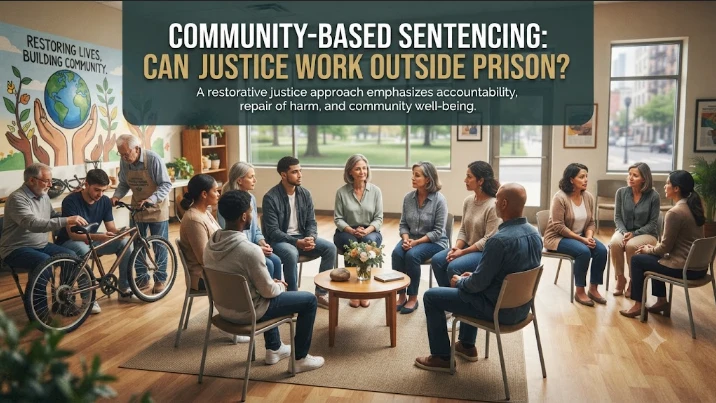
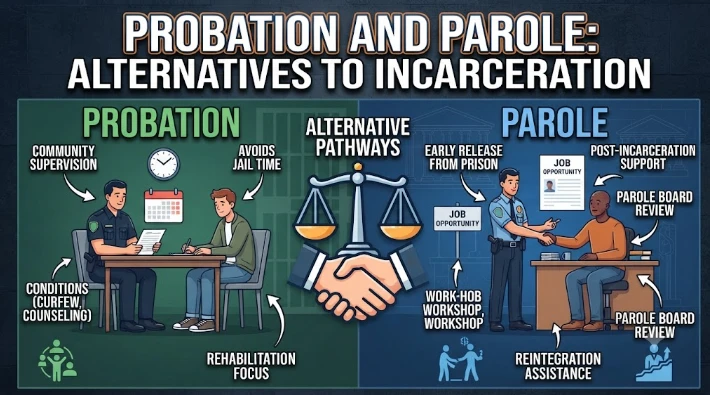
Community-based sentencing is presented as a practical alternative to incarceration for many nonviolent offenses, combining accountability with rehabilitation and continued participation in society. The article explains that prison overcrowding, high costs, and persistent recidivism have encouraged greater use of probation, community service, treatment requirements, electronic monitoring, and restorative justice. These approaches allow individuals to maintain employment, family relationships, housing, and community ties while completing structured conditions imposed by the court. Community service provides visible reparation, while treatment orders can directly address substance use, mental health needs, or other drivers of offending. Restorative justice adds dialogue and victim participation, helping offenders understand the consequences of their actions. The article also acknowledges challenges such as overworked probation staff, excessive conditions, technical violations, and political perceptions that noncustodial sentences are too lenient. Its central argument is that justice outside prison can work when supervision is properly resourced, conditions are proportionate, and interventions are individualized. Effective community sentencing can reduce recidivism, lower costs, and strengthen reintegration without abandoning public safety.
The criminal justice system in the world is undergoing a paradigm in the way society perceives sentencing as we enter . During decades, incarceration was the automatic reaction to crime, the simple assumption that throwing a person into the cage was the equivalent of responsibility and safety of the population. Nevertheless, real-time statistics in the first quarter of show an increasing crisis: in the majority of countries, prisons become overcrowded, resources are pushed to the limit, and the conventional system does not always contribute to resolving the root cause of criminal activity. The long sentences can sometimes temporarily deprive the society of its members but in most cases, they will not help in mitigating recidivism and even in some instances they contribute to the same factors that contribute to crimes. In reaction, the community-based sentencing has come out of the fringes to be a major pillar of contemporary criminal justice that focuses on integration, accountability and rehabilitation instead of confinement. Such programs are aimed at keeping them attached to the social systems on which they are attached- employment, family, support system and at the same time they are expected to be accountable to their actions in constructive, meaningful ways.
This is a two-fold pattern that can be seen in the early months of . Although the sentence on violent crimes has not been altered much, the community-based programs are making a push to direct the non-violent offenders to the community-based programs. By late 2025, the population of prisons in such countries as the United Kingdom and in some parts of the United States, reached the highest point since the 1970s, leading to emergent early-release actions and the requirement that judges should give serious thought to incarceration alternatives. Such capacity crisis has highlighted the shortcomings of prisons as a failure-mode reaction to crime, and has elevated community-based sentencing to the top of policy agenda. Restorative justice-based and other types of diversion programs have proven to be quite successful. Based on statistics, it has been found that a third of recidivism of young people can be minimized when they are diverted using restorative circles as opposed to the traditional court proceedings. On the same note, adherence to community service orders despite the staffing and supervisory issues has been found to range between sixty-three to seventy-five percent, which means that the majority of the people are ready to make a positive contribution to their communities provided they are given a chance.
Community-based sentencing includes the range of interventions which are designed to meet the requirements and the danger degree of the individual. The most widespread one is probation, which gives one an opportunity to stay in the community, provided with rather strict conditions. Probation is shifting towards electronic monitoring and GPS tagging to keep probators accountable without having to go to prison ( ). Although efficient, the National Audit Office reports a continuing strain on probation as overworked officers are unable to ensure high-quality supervision when dealing with large caseloads. Nevertheless, probation still remains an important tool of maintaining people to be involved in the constructs that allow them to act in a legal way and provide the possibility to fix the problems that may not be discussed in the in-depth manner: substance use or unstable living situations.
Another important aspect of community-based sentencing is community service or unpaid work. Offenders do some labor which physically benefits the community e.g. cleaning parks, repairing community centers or donating to charitable organizations. This will enable visible reparative justice, which will support the social contract and the feeling of responsibility. Instead of alienating persons to the society, the community service programs keep them attached to the civic life and strengthens the idea that there is a consequence to an action. In line with such responsibilities, treatment and intervention directives are focused on addressing the underlying causes of criminality. Courts are increasingly using drug rehabilitation conditions, alcohol abstinence conditions and mental health interventions with the understanding that the criminal actions of individuals are not necessarily caused by moral flaws but by treatable conditions. By treating addiction or psychological disorders in society, it is possible to have a better way of rehabilitating and minimizing future crimes by ensuring that the factors that promote crime are addressed.
The application of restorative justice has experienced a remarkable growth in especially the victim-offender dialogues. Such efforts introduce the wrongdoers and the victims in the same room whereby they negotiate on the effect of the crime and come up with a framework of reparative measures. The studies show that in addition to minimizing recidivism this strategy improves victim satisfaction and emotional recovery. Restorative justice promotes the ability to empathize, understand, and provide a behavior change opportunity by establishing a framework where accountability is combined with a reflection and dialogue, as is not possible with traditional incarceration. This procedure makes it clear that there is a paradigm change in the way justice is perceived: it is not only about punishment but about recovery and reunion and development of concrete good to the individual and the community in general.
Community-based sentencing is a push that is influenced by several factors with the economic efficiency being one of the main factors. The cost of maintaining people in prison is truly astronomical and the financial cost of recidivism is still in billions of dollars. Community-based supervision of offenders offers a radically cheaper option but without losing control of the offender and facilitating rehabilitation. Other than financial factors, social connection is also an important merit. Prison has the habit of breaking the same ties that prevent crime such as family ties, work and civic duties. Community-based interventions enable parents to be around to support their kids, persons to be employed, and those involved to go on with contributing to the community hence breaking the intergenerational justice engagement cycle and decreasing the collateral consequences of incarceration.
Another advantage that would make community based sentencing superior to incarceration is the use of individualized responsibility. Judges are able to customize orders to the needs and circumstances of the offender and mix such aspects as community service, curfews, counseling, and treatment. This is an individualized method that has been referred to as a rehabilitative cocktail and can handle the underlying causes of criminal behavior whilst simultaneously providing real meaning. As opposed to the conventional prison sentences, where an equally applied type of punishment is imposed on any offender despite his personal risk and his ability to change, community-based models enable the implementation of specific interventions that would encourage long-term behavior change.
Community-based sentencing encounters numerous challenges even with the above benefits. The problem of staff shortages is also continuing, and the rates of probation officers vacations are up to twenty-one percent in certain areas in 2025. Exhausted police officers have fewer opportunities to carry out proper evaluations, offer quality directions and achieve coherent supervision, which may undermine the safety of the population and the effectiveness of the program. Besides, the stringent conditions that come along with the community orders such as daily check-ins, drug tests and reporting can inadvertently precondition the failure of individuals. Community-based sentencing is supposed to break the cycle of the so-called revolving door and instead creates a situation where technical infractions, as opposed to the emergence of new offenses, lead to recalls to prison. Another obstacle is that in certain areas, the political discourse still equates non-custodial sentences to leniency, and thus opposes the growth of these programs even when shown to be working.
Looking further into the future with the rest of the , evidence of community-based sentencing is strong. Justice in the community is more effective than when it is delivered within the confines of the prison in a large number of offenses. Although there is still need to keep people in jail to ensure that they are out of the risk of being caught by the wrong people and also to deal with the violent crime, it is increasingly becoming apparent that overdependence on jail is not good. Through its emphasis on integration as opposed to isolation, community-based sentencing gives the framework that promotes accountability, rehabilitation, and social solidarity. Combining effective probation services, evidence-based treatment with restorative practices does not only lessen the chances of a person reoffending but also enhances the safety of the community, economic effectiveness and social stability.
The effectiveness of the community-based model in highlights a wider opportunity to the criminal justice systems across the world that punishment is not enough. Good justice must have the infrastructure that allows behavioral change, offer a chance to reintegrate into the community and meet the needs that make people act in a criminal way. Governments and communities can convert the sentencing system into a rehabilitative and social betterment instrument by investing in highly qualified probation officers, scalable treatment models and frameworks of restorative justice. This change does not only affect individuals directly related to the justice system but also the society as a whole since less recidivism would mean safer communities, healthier families and more economically viable citizens.
Finally, community-based sentencing development is a sign of philosophical redirection of justice in . It appreciates the fact that mass incarceration is not the best way to ensure the safety of the population but rather a measured accountability, selective intervention, and positive integration. It admits the weaknesses of the conventional imprisonment and uses the evidenced-based practices to decrease social, economic, and human costs of crime. As we proceed to innovate and develop these models, we are aiming at making a justice system, which does not merely punish but transforms. Through community-based strategies, the society can equip individuals with means, directions and opportunities required to alter their course so that sentences serve not just the short run but also lead to the social stability and development of individuals over a long-term. By so doing, the future of justice will shift towards the system in which accountability and support co-exist, in which communities will be safer, not because individuals are taken off them, but because justice will be administered in a manner that empowers positive change and minimizes the chances of future harm.
CITE THIS ARTICLE
Das, B. C. (2026). Community-Based Sentencing: Can Justice Work Outside Prison?. https://www.bikashchandra.com/article/3580f3bc-ef37-5229-b909-8efdd4992240
B. C. Das, “Community-Based Sentencing: Can Justice Work Outside Prison?,” 2026. [Online]. Available: https://www.bikashchandra.com/article/3580f3bc-ef37-5229-b909-8efdd4992240
Das, B. C. (2026) ‘Community-Based Sentencing: Can Justice Work Outside Prison?’. Available at: https://www.bikashchandra.com/article/3580f3bc-ef37-5229-b909-8efdd4992240
Das, Bikash Chandra. “Community-Based Sentencing: Can Justice Work Outside Prison?.” 2026, https://www.bikashchandra.com/article/3580f3bc-ef37-5229-b909-8efdd4992240.
Bikash Chandra Das. “Community-Based Sentencing: Can Justice Work Outside Prison?.” (2026). https://www.bikashchandra.com/article/3580f3bc-ef37-5229-b909-8efdd4992240.
Das BC. Community-Based Sentencing: Can Justice Work Outside Prison?. 2026. https://www.bikashchandra.com/article/3580f3bc-ef37-5229-b909-8efdd4992240
@misc{article_3580f3bcef375229b9098efdd4992240,
  title = {Community-Based Sentencing: Can Justice Work Outside Prison?},
  author = {Bikash Chandra Das},
  year = {2026},
  url = {https://www.bikashchandra.com/article/3580f3bc-ef37-5229-b909-8efdd4992240},
}
TY  - GEN
AU  - Bikash Chandra Das
TI  - Community-Based Sentencing: Can Justice Work Outside Prison?
PY  - 2026-01-14
UR  - https://www.bikashchandra.com/article/3580f3bc-ef37-5229-b909-8efdd4992240
ER  -
This article explores why people volunteer in America’s national parks and how program design influences whether service remains meaningful. Volunteer motivations often overlap and include personal values, learning, social connection, career development, confidence, purpose, and attachment to place. The article uses motivational frameworks to show that volunteers are more likely to remain engaged when they experience autonomy, growing competence, respectful relationships, and a clear connection
Probation and parole are presented as essential community-based alternatives to incarceration that combine supervision, accountability, and reintegration. Probation generally allows eligible offenders to remain in the community instead of serving a prison sentence, while parole provides conditional release after part of a custodial sentence has been completed. The article explains that both approaches can preserve employment, family ties, education, and housing, all of which reduce the risk of r
This article defines the ethical boundaries that protect volunteers who support visitor safety and law-enforcement-related functions in national parks. Although volunteers can assist with information, observation, traffic support, administrative work, backcountry roves, and reporting hazards, they must not exercise powers such as arrest, detention, search, citation, evidence handling, use of force, or other commissioned enforcement duties. The article emphasizes clear position descriptions, accu