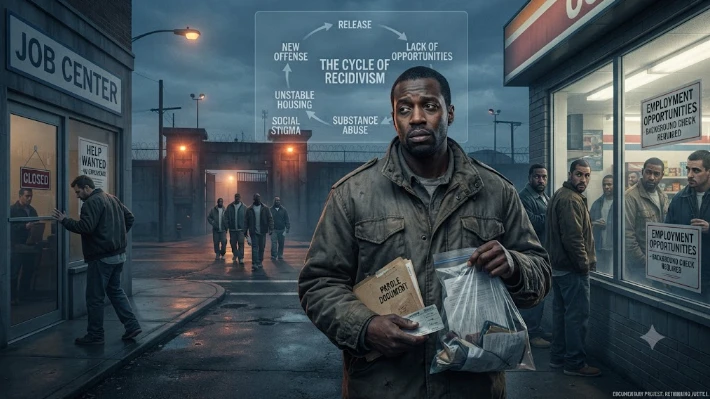
Recidivism is presented as a measure not only of individual behavior but of how effectively society supports people after release from prison. The article emphasizes the vulnerable first six to twelve months of reentry, when housing instability, unemployment, untreated mental health or substance-use problems, weak social networks, and supervision demands can combine into overwhelming stress. Stable housing is identified as a foundation for employment, treatment, and compliance, while meaningful work provides income, structure, and social identity. Behavioral health continuity is equally important because gaps in treatment can lead to relapse and renewed justice involvement. The article also criticizes technical parole violations that return people to prison without a new crime. International comparisons show lower recidivism where systems invest in normalization, community support, and structured reintegration. Effective strategies include digital literacy, healthcare continuity, Cognitive Behavioral Therapy, peer mentorship, employment support, and housing assistance. The overall argument is that repeat offending is not inevitable; it declines when reentry systems provide realistic opportunities for stability, recovery, belonging, and lawful independence.
The term revolving door has ceased to be a mere metaphor when it comes to the talks on criminal justice in ; it is a reality that demands urgent attention and facts. Even with the attempts to rehabilitate people imprisoned, even after they get out of prison, a large percentage of such people find themselves going back inside even though it is not that they are criminals by nature, rather because the systems that are meant to assist them once they leave the gates of the prison are not adequate. Recidivism, or the inclination of individuals released after incarceration to reoffend, has now become a key indicator of the effectiveness of society in managing reentry and reintegration. To find answers to the question of recidivism, it is crucial to consider not only the behavior of an individual but also the barriers to the successful re-entry into the society and the failures of the system that complicates and hinders them.
New longitudinal research and ongoing reports by the organizations like the National Institute of Corrections point to the paradigm shift in our understanding of reoffending. Instead of presenting it solely as a failure of an individual, now researchers tend to see the relevance of the reentry ecosystem. To most of them, the outside world that they are released to is more of a challenge than the prison walls. The difficulties are in finding decent housing, getting a job, being mentally healthy, and supportive social networks. In case these background factors are not established or are irregular, the probability of recidivism is extremely high, and the prison spiral continues.
One of the main lessons of studies is that the main reason of recidivism is uncontrollable stress in the reentry process. Coming out of a highly organized prison system to the complete, and often unassisted freedom results in a severe shock. People have to live in complicated social, economic, and legal requirements without the required help and support, and this confusion may lead to the restoration of old, but illegal, behavioral patterns. There is longitudinal evidence which indicates that the six to twelve months after release is a very vulnerable period. The stressors that were already present in the formerly incarcerated people without intervention compound and turn out to overwhelm coping mechanisms, and the draw back to crime seems a logical, though perhaps unfortunate, decision.
One of the most significant factors of a successful reentry is the housing. Homelessness occurs in people who do not have a stable address ten times more frequently than in the rest of the population. In , it has been recorded that the individuals who are unable to find any housing within the initial thirty days of release are seventy percent chances of being rearrested within one year. Lack of physical home in addition to financial instability not only leads to worsening of financial stability but it also affects access to social support and community-based resources. The absence of a stable foundation makes the individuals prone to relapsing in the same environment and peer groups that support the criminal behaviors, thus a vicious cycle that is hard to overcome.
Another great obstacle is employment. Although there has been a massive push in favor of Second Chance hiring, the criminal record stigma remains a barrier to accessing opportunities, particularly the higher-paying and more secure stable jobs. According to labor reports , it is found that most of the businesses are willing to hire people with criminal background but a very small percentage of them are really putting it into practice. The absence of career development opportunities and economic security may cause people to find other, sometimes illegal, ways of making a living even in case the entry-level jobs are available. Employment is not merely a question of economic need but it also gives structure, social integration and sense of purpose and all this helps in avoiding reoffending.
A third major determinant of recidivism is behavioral health. Sixty to seventy percent of the prison population in will be grappling with substance use or mental illness or both. Upon the release of these problems, when they remain unaddressed, the person tends to revert to self medication using illicit drugs and this can easily trigger into criminal behavior and re-incarceration. It must be continuous and any discontinuity in the treatment process upon release of inmates into community lives is one of the most significant systemic failure that directly leads to recidivism.
It is also determined by social capital or the absence thereof. When returning citizens rejoin the neighborhoods and social networks with which they might have been involved in criminal activities before. In the absence of pro-social role models, supportive family, and community initiatives, the force of the past relationships may be overwhelming. Criminal acts within these settings have become normal and there is limited access to positive activities. Constructive social networks have repeatedly been found to lessen recidivism, and relational and community-based interventions have been demonstrated to be essential along with individual supports.
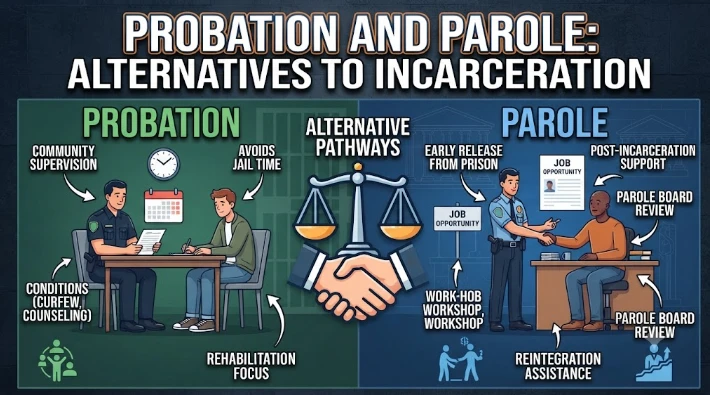
The supervision of parole and reentry may also potentially contribute to the risk of recidivism. A lot of the regulatory requirements of parole can actually amount to what may be termed as a checklist overload, whereby an individual is expected to fulfill a myriad of requirements that they must accomplish all at once, such as repaying restitution, mandatory meetings, and employment, just to contend with the practical constraints of not having a way of transportation or limited access to the internet. The statistics indicate that eighty five percent of all parole revocations occur because of technical violations instead of a new criminal offense ( ). It shows the necessity of reevaluating the organization of supervision so that the compliance needs do not have the unintentional effect of throwing people back into the criminal justice system.
The need of systemic support of reducing recidivism is supported by international comparisons. Those countries, which invest into comprehensive reintegration plans, have significantly fewer reoffending rates. To demonstrate this, Norwegians are able to sustain three-year recidivism rates of about twenty per cent by implementing normalization measures and providing intensive post release services. This same effect is attained by Japan with a recidivism rate of 25%, with focus on volunteer probation officers and community reintegration. Conversely, the United States has a national average recidivism rate of approximately sixty-four percent even though Second Chance policies have been applied in certain jurisdictions, reducing the recidivism rates to forty percent in some states. Canada is culturally sensitive in reintegrating the Indigenous populations with three years of reoffending rate standing at twenty-three percent. These comparisons demonstrate that the tangible advantages of systemic, supportive strategies over punitive or relatively lowly structured systems of reentry are clearly noticeable.
Holistic reentry continues to become the focus of evidence-based approaches to reduce recidivism in . Digital rehabilitation programs (including UN pilot programs) can instruct inmates in how to work in the digital economy, including online job applications, online banking, and remote learning. These programs help counter the technological shock that will otherwise arise when released and become frustrated and revert to crime. Coherence of healthcare has also become a critical concern; a larger number of enrollments in Medicaid before release will help to make sure that people with mental health or substance use disorders will have appointments and medications available at reentry, so they will not experience an abrupt loss of care. The programs of Cognitive Behavioral Therapy (CBT) are aimed at reframing thought patterns, regulating impulses, and developing emotional resilience. The meta-analyses carried out in show that up to twenty-five percent of recidivism can be decreased by intensive CBT. This is further complemented by peer mentorship programs that have increased results with former inmate mentors guiding, supporting and offering real-life advice during the first ninety days, which led to a thirty percent increase in successful parole completions.
The recidivism is therefore not unavoidable, but a mirror of the society ability to reabsorb the members of the society. Investments in housing, employment, digital literacy, mental health and supportive community networks are a more effective way of improving public safety than the longer sentences or the more punitive punishment. Once communities furnish the structural supports and relational structures needed to achieve successful reentry, individuals are enabled to work towards living stable lives, which are lawful hence decreasing the chances of reoffending and adding value to the society.
In the end, incarceration is ended not only by punishment but preparation, support and opportunity. When people are given viable ways of becoming independent, stable and socially accepted, then the revolving door will not keep on turning. The perception of recidivism as a systemic problem and not an individual shortcoming enables policymakers and practitioners to develop interventions that target the causes of reoffending, which would make the communities safer and society more equal.
Moving into the s, the need for rehabilitation and reintegration to become the main pillars of the criminal justice system is evident. The success of a successful transition is based on housing stability, meaningful employment, behavioral health care, mentorship, and digital literacy. When combined properly, individuals will have an opportunity to change their lives, and society will be the beneficiary of the decrease of repeat offending, increase in economic productivity, and enhancement of societal cohesion. Recidivism is not a mere statistic anymore; it is the gauge of the capacity of the society to accept restorative justice and offer channels through which individuals can reclaim their lives. The effectiveness of such endeavors will determine the long term health, equity, and effectiveness of justice systems the world over.
CITE THIS ARTICLE
Das, B. C. (2026). Recidivism and Why Some Offenders Return to Crime. https://www.bikashchandra.com/article/59dccc9b-92f9-5e25-b4d5-d9a47769a6f5
B. C. Das, “Recidivism and Why Some Offenders Return to Crime,” 2026. [Online]. Available: https://www.bikashchandra.com/article/59dccc9b-92f9-5e25-b4d5-d9a47769a6f5
Das, B. C. (2026) ‘Recidivism and Why Some Offenders Return to Crime’. Available at: https://www.bikashchandra.com/article/59dccc9b-92f9-5e25-b4d5-d9a47769a6f5
Das, Bikash Chandra. “Recidivism and Why Some Offenders Return to Crime.” 2026, https://www.bikashchandra.com/article/59dccc9b-92f9-5e25-b4d5-d9a47769a6f5.
Bikash Chandra Das. “Recidivism and Why Some Offenders Return to Crime.” (2026). https://www.bikashchandra.com/article/59dccc9b-92f9-5e25-b4d5-d9a47769a6f5.
Das BC. Recidivism and Why Some Offenders Return to Crime. 2026. https://www.bikashchandra.com/article/59dccc9b-92f9-5e25-b4d5-d9a47769a6f5
@misc{article_59dccc9b92f95e25b4d5d9a47769a6f5,
  title = {Recidivism and Why Some Offenders Return to Crime},
  author = {Bikash Chandra Das},
  year = {2026},
  url = {https://www.bikashchandra.com/article/59dccc9b-92f9-5e25-b4d5-d9a47769a6f5},
}
TY  - GEN
AU  - Bikash Chandra Das
TI  - Recidivism and Why Some Offenders Return to Crime
PY  - 2026-01-07
UR  - https://www.bikashchandra.com/article/59dccc9b-92f9-5e25-b4d5-d9a47769a6f5
ER  -
This article explores why people volunteer in America’s national parks and how program design influences whether service remains meaningful. Volunteer motivations often overlap and include personal values, learning, social connection, career development, confidence, purpose, and attachment to place. The article uses motivational frameworks to show that volunteers are more likely to remain engaged when they experience autonomy, growing competence, respectful relationships, and a clear connection
Probation and parole are presented as essential community-based alternatives to incarceration that combine supervision, accountability, and reintegration. Probation generally allows eligible offenders to remain in the community instead of serving a prison sentence, while parole provides conditional release after part of a custodial sentence has been completed. The article explains that both approaches can preserve employment, family ties, education, and housing, all of which reduce the risk of r
This article defines the ethical boundaries that protect volunteers who support visitor safety and law-enforcement-related functions in national parks. Although volunteers can assist with information, observation, traffic support, administrative work, backcountry roves, and reporting hazards, they must not exercise powers such as arrest, detention, search, citation, evidence handling, use of force, or other commissioned enforcement duties. The article emphasizes clear position descriptions, accu