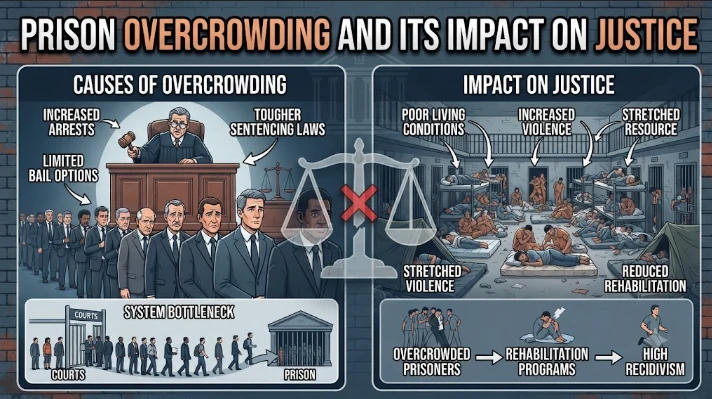
Prison overcrowding is described as a systemic justice problem that affects inmates, correctional staff, rehabilitation, and long-term public safety. The article explains that many prison systems operate beyond their intended capacity, producing cramped living conditions, poor hygiene, greater disease transmission, mental distress, violence, staff burnout, and reduced access to education or treatment. It identifies excessive pretrial detention, restrictive bail practices, drug policies, mandatory minimum sentences, and limited parole opportunities as major structural causes. Overcrowding also weakens rehabilitation because institutions under constant pressure prioritize crisis management over vocational training, mental health care, and reintegration planning. The article argues that building more prisons alone does not solve these underlying problems. Instead, it highlights alternatives such as bail reform, community service, electronic monitoring, restorative justice, open-prison models, education, vocational training, and justice reinvestment. The central message is that reducing overcrowding requires sentencing and correctional reform that protects human dignity while improving public safety through rehabilitation, reentry support, and more selective use of incarceration.
The world criminal justice system is facing an epidemic of silence in the first quarter of that is threatening to destroy the core of law, justice, and safety of the people. Overcrowding in prisons has become one of the most burning questions of the correctional systems in the world, and the given problem goes way beyond the mere logistics of space and personnel. Overcrowding is not just an operational nightmare anymore, it has become an institutional failure that jeopardizes the safety of the correctional employees, erodes the dignity of the imprisoned people, and weakens the security of communities in the long term. With the world growing more cognizant of the effects of mass incarceration, it becomes evident that to work on the issue of overcrowding, it is necessary to have the comprehensive understanding of its causes, effects, and possible ways out. Prisons are not merely about incarceration but they are also a product of societal choices, policy choices and a sense of what is more important in the society, justice versus rehabilitation and security of society.
Recent statistics of the world prison brief and United Nations office on drugs and crime depict the extent of the issue. By March , over sixty percent of nations in the world have over one hundred percent capacity within the prison systems. In places like South Asia and some areas in Africa the numbers are even worse as some of the facilities work with double or triple the designed capacity. This excessive stress causes the situation when the justice is not administered effectively, but it is managed under the stress, and in many cases, without much regard to rehabilitation, safety, and human rights. Once the facilities surpass their expected capacity, it will be experienced by all levels of the correctional system including prisoners and staff as well as by the community to which they will ultimately be released.
There is an immediate and harsh human cost of overcrowding. In the case of inmates, the loss of a sense of fundamental dignity and well-being can be seen as one of the most obvious outcomes. High-density settings are also known to have very high rates of deterioration in health and hygiene standards. Statistics on infections indicate that they are three times more rapidly transmitted in overcrowded prisons, which exposes inmates to the risk of severe disease. In most institutions, single occupant cell rooms are occupied by two or three people and in some cases inmates are required to take shifts or sleep on floor mats beside unscreened toilets. The consequence of the shortage of personal space and privacy has significant implications on mental health, which prompts to stress, anxiety, and depression. Research has found a direct relationship between low square footage per inmate and prevalence of self-harm and mental distress, and violence between inmates has risen by fifteen percent in the last two years. By overcrowding correctional facilities, prisons have turned into places of potential reform into environments of crises and trauma that are inherent.
The correctional staff is another casualty of the overcrowding and they are faced with unattainable workloads and increased likelihood of physical and psychological injury. In other facilities, one officer can have to manage over a hundred inmates, and this means that it is always a reactive management process that does not leave enough room to intervene or support the prisoners. This survival mode strategy is a contributor to alarming levels of burnout, job dissatisfaction, and turnover of correctional professionals. The Global Prison Trends report also indicated that personnel who were operating in overcrowded prisons were experiencing post-traumatic stress syndrome rates that were similar to combat veterans, which is a direct cause of twelve percent of overall resignations in various national prison services over the last year. The system safety and effectiveness is therefore undermined by the conditions within the inmates as well as the demands on those charged with the responsibility of dealing with them.
It is important to know the reasons why overcrowding exists in order to deal with it. Overcrowding is not usually the result of a sudden crime explosion, as commonly thought. Rather it is an expression of policy choices, juridical systems, and systemic trends, which have developed over decades. Too much pretrial detention is one of the biggest causes, as almost one-third of the world prison population of about 3.7 million people do not serve a sentence but await trial. The South Asian region has an even greater percentage of sixty-four percent of prisoners kept pretrial, most of them over years, in most cases, less serious crimes, and merely because they can not afford the bail.
This does not only add strain to facilities, but it also brings basic concerns on fairness and presumption of innocence. Equally, the heredity of tough-on-drug policies has kept the mass incarceration. Millions of people are kept in jails due to nonviolent drug offenses, a policy strategy that, by now, is being seen by many criminologists as not only morally but also economically unsustainable. There are also mandatory minimum sentencing, truth-in-sentencing legislation, and limited parole opportunities, which worsen the situation, as people are entering prisons at an accelerated rate than they can be leaving them and sentences are being imposed that longer than what would be required to provide safety to the people.
The effects of overcrowding do not only extend to logistics and ethics to affect the functional effectiveness of the correctional system. The rates of incarceration and lack of rehabilitative tools create high recidivism rates that compromise on the very purpose of the prisons which is to guide the population towards a secure environment. Re-imprisonment rates are high especially in those with property offences with recurrence rates almost reaching seventy-eight percent within a period of 5 years. According to criminologists, the very experience of prison can be criminogenic: without an opportunity to obtain education, a vocational training program, mental health services, and trauma-informed care, people leaving prison tend to be more vulnerable, less skilled and more firmly integrated into criminal networks than they were before. Differently stated, conventional incarceration without any effective intervention can contribute to crime perpetuation instead of halting the process.
Correctional systems in are responding to these challenges by considering more and more rehabilitative and reentry-oriented approaches. Education together with vocational training has been the most efficient interventions because it provides individuals with both mental tools and skills of practical use to assist their legal employment after release. A study carried out in January indicates that this two-program solution minimizes the chances to reoffend substantially as compared to interventions that are single-focus. Education develops problem-solving, self-confidence, and critical thinking, whereas vocational training offers a way of becoming more economically able, eliminating the economic incentives that tend to lead to recidivism. Through the combination of these programs, it is possible to convert the time of imprisonment to a time of personal growth and community reentry in the correctional facilities.
International comparisons also demonstrate how rehabilitative models could work out. The open prison system in Norway is an example that shows how the philosophy of correction can transform results. They have facilities that are like university dormitories instead of the usual penitentiaries and their sentences are not very long, the average being six months. It focuses on normalizing life, developing responsibility, and readiness of the inmates to reenter the society. The low recidivism in Norway suggests that rehabilitation and social reintegration should be used in preference to punitive containment and yield real social benefits to the people. Likewise, in the United Kingdom and Australia, experimental open-prison facilities are able to provide labor to local communities during the day, minimizing the institutional presence and encouraging potential real-life skills that enable the successful reintegration.
Another new response is the justice reinvestment initiatives. By re-allocating the resources that were required to build and maintain new prisons to community-based programs, including housing assistance, education, mental health and drug treatment, the jurisdictions will combat the causes of crime and at the same time decrease the dependency on incarceration. Riches of the areas where justice reinvestment has been put into practice have been quantifiable, with an average crime rate reduction of thirty-eight percent in some cases and ten percent reduction in recidivism rates after a few years. This solution reiterates the idea that, the best way to promote a community to the safety of the masses is to invest resources into safety prevention and intervention, as well as the empowerment of the people instead of just increasing the ability to lock them up.
Decarceration is also becoming popular. Community service, house arrest, electronic monitoring and fines on minor crimes are proven to be effective in lessening the instantaneous withdrawal into prison and keeping these individuals connected to relatives, work, and community associations. The bail reform that involved the removal of cash bail on minor offenses has been discovered to reduce the number of people in pretrial detentions by twenty to forty percent, without negatively affecting the safety of society. Restorative justice, focusing on the causes harm and bringing accountability to both victims and offenders, is also associated with a decrease in recidivism and an increased community participation. All these strategies are pointers to a transformation of a punitive and reactive model to a proactive and rehabilitative as well as a socially integrated corrections model.
Overcrowding in prisons and its remedy does not start and stop behind the prison walls. Crowded institutions undermine the credibility of the criminal justice system, mistrusting the citizens and bringing them back to the crime circles. Staff burnout, institutional inefficiency and increase in violence undermine the ability to assure the safety of the inmates as well as the society in general. On the other hand, proper correctional approaches that are aimed towards rehabilitation, skill development and reintegration create a safer community, minimize long term expenditures and human dignity of the parties involved. Changing the system of mass incarceration to the system of meaningful correction is not only a moral issue but a practical one.
It is evident that construction of more prisons is no longer sustainable as approaches. Real justice entails the audacity to adopt alternatives which minimize dependency on confinement, human development and respond to social, economic and psychological aspects that lead to criminal activity. Through rehabilitation, reentry support, justice reinvestment and restorative practices, the correctional systems have the opportunity to transform them into crisis management into prevention, thus making the overcrowding threat that has been lurking in the system, an avenue of systemic change. By so doing, corrections would become dynamic and responsive as a means of control to achieve a proactive human restoration, social stability and safety of the people. By addressing overcrowding, changing the policy and investing in the people instead of only in the walls, the society can develop a model correction that really can be used to serve justice and the human-kind.
CITE THIS ARTICLE
Das, B. C. (2025). Prison Overcrowding and Its Impact on Justice. https://www.bikashchandra.com/article/8a7497ba-9efd-5eed-9334-c04d061c06de
B. C. Das, “Prison Overcrowding and Its Impact on Justice,” 2025. [Online]. Available: https://www.bikashchandra.com/article/8a7497ba-9efd-5eed-9334-c04d061c06de
Das, B. C. (2025) ‘Prison Overcrowding and Its Impact on Justice’. Available at: https://www.bikashchandra.com/article/8a7497ba-9efd-5eed-9334-c04d061c06de
Das, Bikash Chandra. “Prison Overcrowding and Its Impact on Justice.” 2025, https://www.bikashchandra.com/article/8a7497ba-9efd-5eed-9334-c04d061c06de.
Bikash Chandra Das. “Prison Overcrowding and Its Impact on Justice.” (2025). https://www.bikashchandra.com/article/8a7497ba-9efd-5eed-9334-c04d061c06de.
Das BC. Prison Overcrowding and Its Impact on Justice. 2025. https://www.bikashchandra.com/article/8a7497ba-9efd-5eed-9334-c04d061c06de
@misc{article_8a7497ba9efd5eed9334c04d061c06de,
  title = {Prison Overcrowding and Its Impact on Justice},
  author = {Bikash Chandra Das},
  year = {2025},
  url = {https://www.bikashchandra.com/article/8a7497ba-9efd-5eed-9334-c04d061c06de},
}
TY  - GEN
AU  - Bikash Chandra Das
TI  - Prison Overcrowding and Its Impact on Justice
PY  - 2025-06-25
UR  - https://www.bikashchandra.com/article/8a7497ba-9efd-5eed-9334-c04d061c06de
ER  -
This article explores why people volunteer in America’s national parks and how program design influences whether service remains meaningful. Volunteer motivations often overlap and include personal values, learning, social connection, career development, confidence, purpose, and attachment to place. The article uses motivational frameworks to show that volunteers are more likely to remain engaged when they experience autonomy, growing competence, respectful relationships, and a clear connection
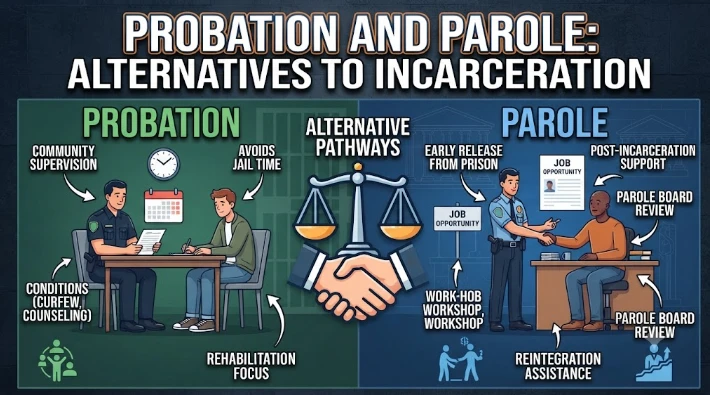
Probation and parole are presented as essential community-based alternatives to incarceration that combine supervision, accountability, and reintegration. Probation generally allows eligible offenders to remain in the community instead of serving a prison sentence, while parole provides conditional release after part of a custodial sentence has been completed. The article explains that both approaches can preserve employment, family ties, education, and housing, all of which reduce the risk of r
This article defines the ethical boundaries that protect volunteers who support visitor safety and law-enforcement-related functions in national parks. Although volunteers can assist with information, observation, traffic support, administrative work, backcountry roves, and reporting hazards, they must not exercise powers such as arrest, detention, search, citation, evidence handling, use of force, or other commissioned enforcement duties. The article emphasizes clear position descriptions, accu