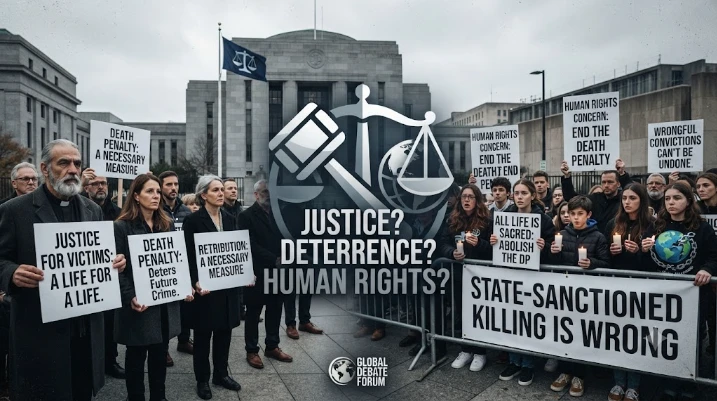
The death penalty is examined through the competing ideas of justice, deterrence, retribution, human rights, and the risk of irreversible error. The article notes that some countries continue or expand executions while others move toward restriction or abolition, creating a sharply divided global picture. Supporters often argue that capital punishment provides moral retribution and deters severe crime, but the article emphasizes research questioning whether executions deter homicide more effectively than life imprisonment. Wrongful conviction is presented as the most serious concern because an execution cannot be reversed after new evidence emerges. The discussion also raises issues of racial, economic, and legal inequality, as well as controversy over execution methods and international human rights standards. Public opinion is shown to be changing in some jurisdictions, with growing support for alternatives such as life imprisonment. Overall, the article frames the death penalty as a test of how justice systems balance accountability with human dignity, accuracy, fairness, and the limits of state power when punishment becomes irreversible.
By the year , the discussion about death penalty has become a fever in the world, which has rekindled the interest of the policymakers, human rights activists, and ordinary people. The long-term historical trend has been toward a progressive elimination of capital punishment, but in the past year and a half the alarming news has been the revival of the executions in a few retentionist countries. The current trend has sparked an age-old debate on whether the death penalty is a necessary tool of justice, or whether it is a retrogressive and ethically irdefensible infringement of the basic human rights. The dialogue has ceased being a mere theoretical discussion because it is based on facts, personal experiences, and the moral dilemma of contemporary governance.
The recent statistics of the United Nations and the Amnesty International paint a different picture that is grim. In 2025, some nations recorded unprecedented death penalty numbers, by turning decades of decreasing tendencies of death by the state. In the United States, as an example, the number of executions in is forty-seven, which is the highest in sixteen years, and is mainly led by the states of Florida and Texas. In the same time, Iran had indicated more than fifteen hundred executions indicating a severe growth in state-approved capital punishment. At least 356 people were executed in Saudi Arabia, the highest numbers in history, and countries like Zimbabwe and Vietnam were heading the other way, with the former eliminating the death penalty in regular crimes at the end of 2024 and the latter limiting the capital crimes. These conflicting tendencies highlight the international division of this problem, showing the world in which the use of ultimate punishment is extremely unequal, being conditioned by the culture, politics, and the priorities of society.
The debate revolves around the issue of deterrence. Those who argue that the death penalty is the best form of punishment have always said that the ultimate punishment is a strong deterrent and would instill fear on those who are likely to commit a homicide in future. Nonetheless, modern studies disprove this supposition. A series of studies published in early by the Death Penalty Information Center support one of the long-standing criminologist-wide points of view: No evidence exists that death penalty is more effective in deterring crime than life imprisonment. Eighty-eight percent of the top criminologists in the world who are surveyed this year testify that the fear of death does not have a relationship with reduced homicide rates. In the United States, comparative data is also quite informative. States which have eliminated the death penalty are always known to have lower murder rates as compared to those which are engaging in executions implying that deterrence is greatly affected by social, economic and policing environment than by the existence of the death penalty. The belief that the death penalty is an effective crime deterrent is becoming untenable, even in spite of the emotional appeal that it has in the political arena.
The most enduring argument in support of capital punishment is retribution especially in countries that are retributive. To most, death penalty is a concept of moral balance, the notion that there are some crimes that are so evil to the extent that the perpetrator has been permanently denied the right of life. This eye-for-an-eye view is much closer to parts of the population and executions are presented as a way of restoring justice and reasserting societal standards. This reasoning remains the basis of popular and legal backing of nations like the United States, Iran, and Saudi Arabia in , despite the admonition by legal scholars that justice by vengeance is questionable. Though the need to be morally recompensed is agreeable, the imposition of the said recompense in the form of the death penalty, which is administered by the state, begs deeper ethical and philosophical issues, especially when compared to the chances of committing an error and the value of human life.
The greatest scariest point that can be made against the death penalty is the wrongful conviction. The irreversibility of execution means that there can never be a second chance, and actual data emphasizes the price. Over two hundred people have been cleared in the United States alone since 1973 after being sent to death row, which points at a hugeness of how inaccurate the system is. This can be seen in the case of Elwood Jones who was freed in after decades of his waiting to be executed due to a crime he had not done. It has been proved statistically that out of every eight people who are executed in the modern age, at least one of the death row detainees is proved innocent. This reality check ratio throws light on the moral hazard of capital punishment because the system has a possibility of making an irreversible mistake in the name of punitive justice. The information that there is even a single-digit percentage of innocent individuals who are being executed is causing an alarm and it is putting into question the validity of holding on to such a heavy hammer.
The issues of human rights have taken a more central role in the discussion, particularly with the states trying out different ways to execute the death penalty. The ongoing denial of the pharmaceutical firms in supplying lethal injection drugs has compelled some of the states in the U.S to resort to highly questionable methods, such as nitrogen hypoxia. It was initially applied in Alabama in 2024 and gradually expanded in 2025, but this approach has been criticized by international authorities as having the potential to be torturous, and reports show prisoners fighting and choking as it is performed. These developments underscore the conflict between the machinery of implementation and the modern principles of human decency, which is subject to criticism on the part of human rights groups and the international community. Also, cases of the infringement of the international law are still witnessed, especially in the countries, which use the death penalty in cases of non-lethal crimes including the use of drugs in Iran and Saudi Arabia, which is generally condemned as a clear violation of international standards.
There is a paradoxical situation with public opinion in . Although the number of executions recently has spiked, the support of the death penalty in most democratic countries has declined to its lowest levels in 50 years. The generational changes can be seen, as most of the citizens aged below fifty five opposed the death sentence. Jury behavior also indicates this alteration: by 2025, more than half of American juries dealing with cases involving the death penalty voted to impose no sentence at all but life imprisonment without parole. These trends indicate that even though the political actors might urge the involvement of more punitive approaches, those citizens who work directly with the justice system, namely jury duty and civic participation, show growing unreadiness to sanction the execution. This contrast of political rhetoric and the populace in decision making highlights the reconsideration of the values, morals and the place of the state power in meting out ultimate punishments on the whole.
The other dimension of the debate that is critical is the effectiveness and the fairness of the capital punishment in the international context. As much as there are countries that believe that executions are imperative to prevent organized crimes, terrorist or other heinous acts of violence, the empirical evidence keeps on contradicting these arguments. Cross-national studies have shown no solid relationship between the rates of execution and decreases in homicide or violent crime, which refuted the claim that capital punishment is a better method of crime control. Moreover, the biased and random dispersion of the death penalty, based on socio-economic status, ethnicity, and the political environment, increases the issues of the systemic bias. It has been documented that the marginalized groups, especially people of color and those with limited access to the services of an attorney are disproportionately likely to be sentenced to death, which begs the question of inequity, impartiality, and the potential of abuse.
The current technological change in the mode of execution has not eroded ethical issues. States that are trying new methods, such as nitrogen hypoxia to other forms of electrocution, face the modernity paradox: although the innovations are meant to ease physical pain, they tend to bring uncertainty and procedural mistakes, as well as different kinds of psychological trauma. The ethical and legal consequences of the adoption of such approaches without complete international regulation are still not resolved and are a highly disputable issue among the ethicists, legal experts and human rights activists. Moreover, the fact that death penalty is still used as a political tool by some countries cripples the confidence of people and erodes the credibility of the institutions of law, stressing the point that executions never are a neutral tool of justice.
Importantly, the death penalty discourse in will be touching upon the general trends in criminal justice reform, global human rights movement, and the social perception of punishment. Proponents of abolition claim that rehabilitation, restorative justice, and community-based alternatives would give similar results in terms of their effects on the security of the populace without exposing them to irreversible error or engaging in anti-human-dignity activity. These arguments are supported by empirical studies that demonstrate life imprisonment without parole combined with specific rehabilitation and supervision can provide order in society and prevent serious crime and reduce the number of ethical dilemmas. On the other hand, the retentionist countries still use the death penalty, which demonstrates the unwillingness to accept such new evidence-based practices and reveals the contradiction between conservative retributive justice and new human rights principles.
To sum up, death penalty in is at a crossroad of justice, deterrence, human right and accountability of ethics. It is an instrument that certain states use to exercise power, repress violent actions, and fulfill the community call to revenge whereas other countries are taking decisive steps towards abolition as per the standards of international human rights. The evidence is conclusive: it has no substantive evidence that execution is a better deterrent, the possibility of wrongful conviction is morally unacceptable and the social and psychological impact of government-approved killing is immense. With the world community discussing the future of capital punishment, the question still remains as to whether a justice system that cherishes life, equity and accuracy can justifiably morally with a sentence that cannot be retracted and is ethically questionable and could be abused.
The development of indicates that even though death penalty will remain in some parts of the world, it is also possible that the world will move towards a path of restraint, abolition and the world will think of justice in a new way that does not emphasize revenge over human dignity. The question facing the policymakers, the legal institutions and the society in general is how to strike a balance between the demands of the society and the good of law, taking into account that justice should be served without endangering the primary human rights on which the legitimacy of the law is founded.
CITE THIS ARTICLE
Das, B. C. (2025). The Death Penalty: Justice, Deterrence, or Human Rights Concern?. https://www.bikashchandra.com/article/3b61272c-ec75-5c8b-9cfd-a0c8911ab2a2
B. C. Das, “The Death Penalty: Justice, Deterrence, or Human Rights Concern?,” 2025. [Online]. Available: https://www.bikashchandra.com/article/3b61272c-ec75-5c8b-9cfd-a0c8911ab2a2
Das, B. C. (2025) ‘The Death Penalty: Justice, Deterrence, or Human Rights Concern?’. Available at: https://www.bikashchandra.com/article/3b61272c-ec75-5c8b-9cfd-a0c8911ab2a2
Das, Bikash Chandra. “The Death Penalty: Justice, Deterrence, or Human Rights Concern?.” 2025, https://www.bikashchandra.com/article/3b61272c-ec75-5c8b-9cfd-a0c8911ab2a2.
Bikash Chandra Das. “The Death Penalty: Justice, Deterrence, or Human Rights Concern?.” (2025). https://www.bikashchandra.com/article/3b61272c-ec75-5c8b-9cfd-a0c8911ab2a2.
Das BC. The Death Penalty: Justice, Deterrence, or Human Rights Concern?. 2025. https://www.bikashchandra.com/article/3b61272c-ec75-5c8b-9cfd-a0c8911ab2a2
@misc{article_3b61272cec755c8b9cfda0c8911ab2a2,
  title = {The Death Penalty: Justice, Deterrence, or Human Rights Concern?},
  author = {Bikash Chandra Das},
  year = {2025},
  url = {https://www.bikashchandra.com/article/3b61272c-ec75-5c8b-9cfd-a0c8911ab2a2},
}
TY  - GEN
AU  - Bikash Chandra Das
TI  - The Death Penalty: Justice, Deterrence, or Human Rights Concern?
PY  - 2025-12-24
UR  - https://www.bikashchandra.com/article/3b61272c-ec75-5c8b-9cfd-a0c8911ab2a2
ER  -
This article explores why people volunteer in America’s national parks and how program design influences whether service remains meaningful. Volunteer motivations often overlap and include personal values, learning, social connection, career development, confidence, purpose, and attachment to place. The article uses motivational frameworks to show that volunteers are more likely to remain engaged when they experience autonomy, growing competence, respectful relationships, and a clear connection
Probation and parole are presented as essential community-based alternatives to incarceration that combine supervision, accountability, and reintegration. Probation generally allows eligible offenders to remain in the community instead of serving a prison sentence, while parole provides conditional release after part of a custodial sentence has been completed. The article explains that both approaches can preserve employment, family ties, education, and housing, all of which reduce the risk of r
This article defines the ethical boundaries that protect volunteers who support visitor safety and law-enforcement-related functions in national parks. Although volunteers can assist with information, observation, traffic support, administrative work, backcountry roves, and reporting hazards, they must not exercise powers such as arrest, detention, search, citation, evidence handling, use of force, or other commissioned enforcement duties. The article emphasizes clear position descriptions, accu