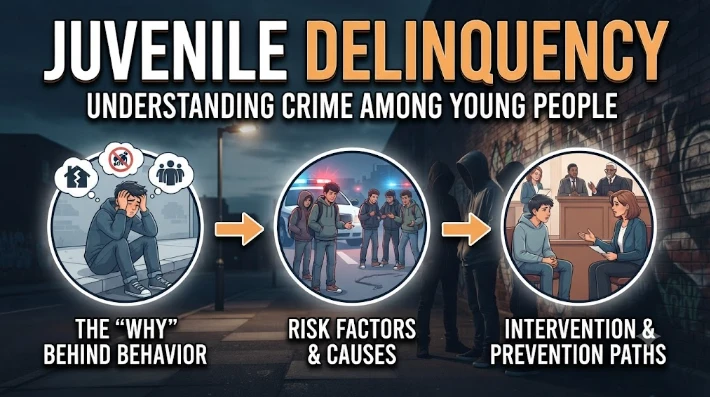
The problem of juvenile delinquency is one of the most pressing and emotionally heated problems of modern criminology as it is missed by the law, family life, education, poverty, psychology, and public policy. There is hardly a subject that creates so much tension between the fear and hope. On the one hand, there is a social panic regarding the problem of youth violence, gang culture, cybercrimes, and recidivism. On the other side, there is increasing evidence of the argument that a good number of young perpetrators are themselves the products of instability, neglect, exclusion, trauma, and social failure. This tension has been sharpened with the world going through the year. The question that societies all over the world have to grapple with is; do we primarily punish children and adolescents that break the law, or is it time that the justice system should pay more attention to prevention, rehabilitation, and reintegration? The response is important as how a society reacts to youth offending tells much about how the society views childhood, responsibility, risk and change. More to the point, it defines a turning point or a label when it comes to the first misstep made by a teenager.
The debate on juvenile delinquency has evolved due to the shift in the evidence. During several decades, the most popular political instinct in most nations was to seem tough on crime. Such a tactic frequently resulted in increased policing, harsher sentencing, increased detention, and less second chances. It was quite categorical and to some of the voters it was comforting. However, research and the results of practical activity in time revealed the weaknesses of that model. The high rate of incarceration was not dependable to produce safer communities over time among the youths. It complicated the problem in most instances. Detention of youth tended to disrupt the education process, strengthen criminal identities, expose children to multiple hardened offenders, and ruin future workplace and social opportunities. In addition to not stopping the cycle, punitive systems usually solidified it. It is due to this that by, more criminologists, policymakers, and child rights advocates are calling in favor of a more evidence-based model that does not merely regard juvenile offending as a simple legal matter, but a symptom of larger scale social failures that require a larger social solution.
It is a complex international picture as the state of youth crime in can be described by a mixture of trends, not a single one. In other countries, and areas, there has been some evidence of a reduction or at least a plateauation in such traditional types of offending by the youth as street theft, vandalism, and some types of violent crime. In some, certain types of juvenile delinquency are increasing, particularly in areas with social turmoil, a lack of community support, financial strain, or digital susceptibility. In the current world estimates by UNICEF about 259,000 children were detained in the world as of today. Although this is a significant improvement to what was the case in the past few years, the number is still disturbing since it indicates the number of children who are still being placed in custodial services rather than being offered early assistance.
The imbalance of the region is even higher. South Asia has the greatest number of detained children of approximately 111,000 and hence it is one of the most illustrative cases when young justice can be caught up in poverty, poor institutions, over-crowded legal systems and lack of social protection. Such numbers do not represent criminal activities. They are a reflection of policy decisions as well. They expose the places where the governments are still using the concept of confinement rather than investing in prevention, social work, mental health care, education and family support.
The case of Bangladesh presents this complication in an uncharacteristically clear way. The official police statistics related to revealed that overall criminal incidence had increased sharply exceeding 181,700 cases, with crimes against women and children taking a significant rise. Cases of abduction increased by 71 percent and snatching cases increased by 37 percent. Not all are the cases of juvenile criminals, of course, yet these trends are significant since young people are in the middle of it as victims, perpetrators, witnesses or recruits. Youth populations are at a high risk especially during periods of political uncertainty, economic strain and social instabilities. Peer group, street networks, local power, and online manipulation of adolescents is more evident. Young people tend to be the first and most affected when institutions turn weak and families are put in a condition of strain and when the level of public trust gets shaken. They can leave school, lose discipline, experience domestic violence, or get involved in minor crimes which get perpetuated more with time. In that respect, the increase in youth-related offending is hardly ever about poor choices made by bad children. It is rather a red flag waving before the society.
Another major transformation in the new environment is the fact that juvenile delinquency is no longer physical, and that is, it does not exist within a physical address like a neighborhood, school, transport centre or street corner. It has moved online. Cyber-delinquency now emerges as a characteristic of crime in the digital era among young people. There are increased number of young people who are engaging in online frauds, identity theft, hacking, harassment, extortion, revenge sharing, and online scams. Others of these are spontaneous and not clearly comprehended by the juvenile delinquents themselves. Others are systematic, tactical and economic driven. The digital transformation is relevant in that it alters the character of offending as well as the instruments needed to react to it.
The conservative policing systems tend to lag behind the residences of harm on the web. The warning signs may not be identified by parents and schools. The victims can fail to report cases particularly in situations where shame, confusion and lack of confidence with the enforcement comes into the picture. This is establishing a dark figure of youth-related digital crime that is probably very big than what the official statistics indicate. The juvenile delinquency image, which was only gang fights and stolen phones, seems to be no longer relevant. The teenager on the screen is as pertinent to the criminology of as the teenager on the street.
In order to get the explanation to why a number of the youth become delinquents, the moral judgments would have to be looked beyond. Teenagers do not commit crime in isolation. Environments, relationships, institutions and pressures shape their behavior. Criminologists always identify a group of criminogenic factors that increase the chances of delivering juvenile offending, and criminogenic factors hardly act in isolation. One of the strongest factors is family instability. The first environment that children gain the knowledge about trust, discipline, empathy, and boundaries, and belonging is the family. When such an environment is broken by the domestic violence and continued rivalry, negligence, parental substance abuse, or emotional deficiency, youth have frequently been raised in a condition of non-stability, without the stability required to develop well. Some experience trauma. Other people suffer the softer version of abandonment as they lack simple supervision, affection or guidance. Here delinquent peer groups are able to initiate what the family did not provide identity, loyalty, protection, recognition and status. That alternative belonging may be so strong, particularly when one is at the age of adolescence, when social acceptance has a colossal weight of psychology.
The other significant stressor is peer influence, and the strength of it should never be underdone. Adolescence is a period in life when there is a passion of approval, acceptance and identity development. Youth tend to be bargaining over their identity, position, as well as what respects them. Delinquent behavior may start to feel normal instead of deviant in case their circle of peers promotes stealing, violence, drug abuse, harassment in the online world, or gang membership. Delinquent peer association has long been among the most dynamic risk factors in youth offending as identified by the Australian Institute of Criminology and other research organizations. This is not to say that all teenagers who have risky friends turn into offenders but it does imply that behavior was social. Group dynamics have the capacity to diminish guilt levels, enhance bravado, and cause the illusion that rules are not mandatory or that punishment is not probable. Numerous juvenile delinquents do not start with some strongly criminal intentions. They start by the desire to fit in. This is what makes peer influence such a threat and such a significant aspect in prevention.
Poverty still remains the focal point of the juvenile delinquency debate not due to the fact that poverty is a predisposing factor to crime but because it sets the stage where the risk is compounded. Financial struggle focuses decisions. It may imply inadequately crowded housing, schools without adequate funding, insecure neighborhoods, nutritional deficiency, family tension, and lack of recreational facilities and access to the few legitimate avenues of success. In such places, crime may start to appear feasible instead of being appalling. An adolescent who finds no realistic means to achieve success in education or in a job market might consider a fast cash because of theft, sale of drugs, or committing fraud as the logical solution, although it is a long-term-destructive behavior. Protective factors are also undermined by poverty. Financially stressed families might not have the time, energy, and emotional ability to closely monitor children. Poor schools might have no counselors, support personnel, and extracurricular activities that assist in keeping the youth on the move. This way, poverty is not an excuse to offend but a factor that contributes to the fact that some children are more vulnerable to it as opposed to others.
Another aspect that constitutes the picture is school failure and disengagement. Chronic absenteeism, suspension, exclusion, academic struggle and subsequent involvement of a person in the justice system are well interrelated. This has been referred to as school-to-prison pipeline and the title is not mere rhetoric. When students fail again and again, when they are branded as hard kids, when they are marginalized or ousted out of school or college, they are deprived of one of the best protective institutions in their life. School is not all about learning facts. It will offer routine, adult supervision, social organization, hopes and availability of support. As soon as a youngster loses touch with such an environment, the risks grow exponentially. Idle time expands. Frustration grows. Self-worth declines. Exposure to delinquent individuals increases. By , the focus on inclusive education, trauma-centered classrooms, behavioral support, mentoring, and alternative pathways to help vulnerable youth remain engaged in learning instead of letting them slide down the path to criminalization is increasing in number of experts. A failing child in school may not necessarily be lazy and rebellious. Other times, that child is some kind of signaling out the unmet needs that the system has not given serious consideration.
Another aspect that should be noted is the issue of trauma and mental health and its contribution to juvenile offending. Most of the youths who get into the justice system had a history of abuse, neglect, violence, grief, displacement, or a long history of insecurity. Others are existing in the survival mode way before they commit any crime. They may be unresolved pain rather than calculated malice manifested by their aggressiveness, impulsivity, lying or breaking of rules. Powerful ways of influencing behavior can also be through mental health struggles like depression, anxiety, conduct disorder, substance dependency and untreated neurodevelopmental problems. A justice system that does not put into consideration these realities will read the child before it wrongly. It will make punitive the symptoms, and leave unpunished the causes. That is one of the reasons why so many youth justice reformers today tend to say that rehabilitation is not softness. It is precision. In case the system is interested in safer results, it must address the true risk drivers.
The traditional dependence on custodial punishment is becoming more and more debatable both on the moral and practical grounds. The cost of detention is high and disruptive as well as ineffective in cases of overuse. In Australia, the spending on youth justice was approximately 1.7 billion in 2025, and approximately 66 percent of the spending was allocated to detention. That is a statistic that speaks volumes. Governments still spend colossal amounts of money incarcerating children when it has been shown that community-based responses tend to have better results at reduced long-term social expenditure. Detention should only be the default option in a few severe instances, particularly where the population is in danger, but not as a first-line measure. Confinement can reinforce a identity of a criminal, subject the children to violence, destroy the mental health, and diminish future opportunities when it has become a common practice. A delinquent network is not preparing a teenager to reform him on the basis of less education, more stigma, and greater attachment to delinquent networks. They are returned to the society poorer equipped and with more scars.
This is the reason why prevention and early intervention have become the focus of the current youth justice thought. It is inefficient and inhuman to wait until a young person becomes arrested multiple times. It is more important to detect risk and react before the patterns become solid. The programs have been very promising when applied to children aged between five to ten years and those that exhibit continued behavioral challenges, exclusion at school, family fragmentation, or emotional disturbance. The social-emotional learning in schools is considered as one of the most essential tools in this field as it educates in self-control, empathy, dispute resolution, decision-making, and emotional intelligence. These are not soft extras. These are the basic skills to legal and secure social functioning. Such interventions can greatly diminish recidivism in future and enhance long-term adjustment and it is increasingly becoming evident. The sooner the help, the cheaper, both in terms of money and the society. In other words, it is more affordable and prudent to assist a troubling ten-year-old than a criminalized sixteen-year-old.
There has also been the evolution of rehabilitation. The Risk, Need, Responsivity model is one of the most powerful frameworks commonly abbreviated as RNR. It is powerful in that it is practical. It starts by the assumption that not every young offender is identical and must not be subjected to the same intervention. Risk implies the determination of the most likely criminal individuals to reoffend and, thus, need more serious assistance. Need refers to the actual causes of the behavior, be it substance abuse, incompetence, traumas, family discord, school dropout, or peer pressure. Responsivity refers to customizing interventions to the learning style and developmental stage as well as the motivation of an individual as well as his or her culture and context. That is, there is no generic good rehabilitation. It is targeted. A teenage fraudster who contributes to Internet fraud does not require the same treatment as a teenage violent street offender. The same approach cannot help a child already with learning problems and a history of trauma as a highly impulsive and socially supported youth. The RNR approach is important as it honors complexity, and the juvenile delinquency is not something, but a complex one.
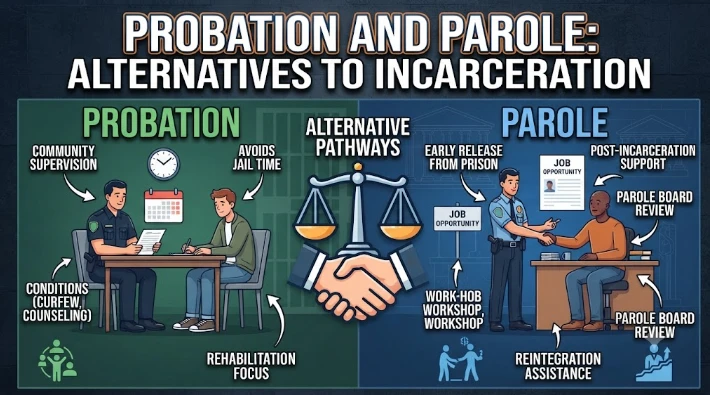
Another big pillar of successful response is community-based support systems. Diversion programs provide young offenders with an opportunity to stay with their communities to undertake a course of structured supervision, education, counseling, restorative justice, community service or family-centered intervention. These programs are important since they do not generate the labeling effect that is usually created by formal detention. Being made a criminal in front of the crowd, this label can stick to the young person. Teachers see it. Employers see it. The young person sees it too. In the course of time they might even start living into that identity. Diversion is an attempt to break that process. It keeps the youths responsible yet does not isolate them to school, family, and normal community living. It understands that relationship is frequently a part of the healing. Specifically, restorative justice circles can be effective as they allow young offenders to face the actual human aspects of their actions as well as provide victims with the voice and the way to recognition. In that model, justice is not just about sanction. It is also about repair.
Systemic reform is also crucial since single programs will fail to work in a fractured organization. The minimum age of criminal responsibility is one of the largest international controversies of this nature. Increasing numbers of nations are also reconsidering the idea that children as young as that ought to be subject to criminal proceedings whatsoever. The neuroscience has also made the case of reform stronger because it demonstrated that the adolescent brain is still under development, particularly that related to the impulse control, emotional reactions, danger evaluation, and long-term plans. This does not imply that young people are not responsible. It implies that they are not little adults. The expected reaction of the law should be guided by their immaturity. More and more, reformers are demanding that children who are in conflict with the law should be regarded as children, rather than as first and foremost criminals. The wording is important since it represents another moral ground. It changes the system towards retribution to development, protection and capacity-building.
Juvenile delinquency is not, therefore, a mere legal issue which is to be handled by the courts and the detention centers. It is a social problem based on the ways that societies nurture children, allocate opportunity, handle inequality, react to trauma and create institutions. Youth crime should not merely instill fear when it increases. It should provoke diagnosis. What is going on in the families? What is happening in schools? What is going on in neighborhoods, in cyberspace, in the labor market, in politics? Young people cannot be arrested out of dislocation. It must construct better ladders when children start falling. It involves investing in parents, mental health, and inclusive education, youth mentoring, safe recreation, digital literacy as well as equal economic opportunity. It involves looking at delinquency as a signal, but not as a punishable offense.
It is at least partially up to the societies to modify their attitudes towards vulnerable youth, including by ceasing to perceive these individuals through the prism of perennial suspicion. Majority of juvenile offenders are not hopeless. A vast number of them are still very receptive to treatment, counseling, regulations, and substantive assistance. The distinction between a recidivist offender and a redirected young adult is not always a type of unclear character defect. The question is on whether the right intervention was done at the right time. Evidence in will be flowing in one direction only, namely prevention, rehabilitation, and reintegration is preferable to reflexive punishment when it comes to long-term public safety.
When the aim is a safer society then the actual job is begun way before the courtroom. It begins at home, at school, in the community and at policy making that resolves whether the children are left to perish or to possibility. Juvenile crime is severe, and society should not be subjected to victimization. Protection is greatest when the systems not only punish but also do more. It is most powerful as they see the need to make young people offend, act early, act intelligently and leave open the possibility that whatever a child has made as the worst choice of his life does not have to be the story of his life.