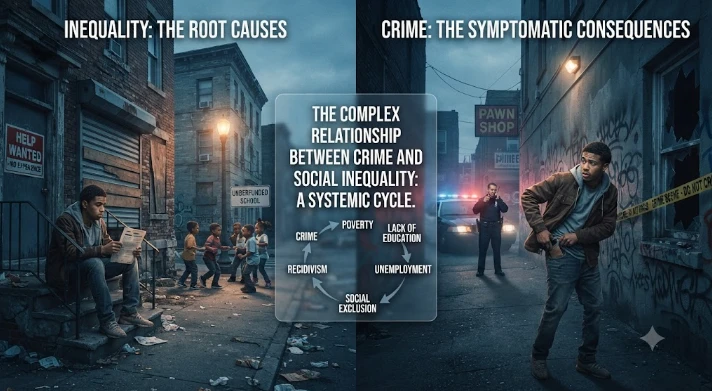
The article examines the relationship between crime and social inequality, arguing that public safety cannot be separated from access to opportunity, housing, education, employment, and social resources. Relative inequality is emphasized as particularly important because large gaps between groups can intensify frustration, exclusion, and perceptions that legitimate success is unavailable. Crime also tends to concentrate in neighborhoods marked by unemployment, underfunded institutions, unstable housing, environmental neglect, and weak social support. Inequality affects victimization as well as offending, because poorer households and marginalized groups often face greater exposure to violence while having fewer resources for protection, recovery, or legal assistance. Youth unemployment, educational exclusion, and limited digital access can further increase vulnerability to gangs or informal economies. The article supports social protection, Housing First programs, educational investment, employment access, digital inclusion, and community-based violence interruption. Its central message is that reducing inequality is not separate from crime prevention; broader access to dignity, stability, and legitimate opportunity can strengthen social cohesion and reduce both offending and victimization.
Towards the beginning of the year, the discourse surrounding the topic of public safety is changing in a fundamental manner on a global scale. The conventional reaction to crime over decades was, in large measure, reactive: cracking down on crime by putting more police on the street, constructing more jails, and imposing more draconian sentencing. Nevertheless, the current statistics of World Inequality Report, as well as the data provided by United Nations, indicate that there is no possible separation of the crime and social environment. Criminal acts are not just isolated cases anymore, but they should be perceived as manifestations of a broken social contract. As the communities are continuously living in poverty, ostracized, and deprived of any chance, both perpetrating and victimizing can thrive. In this respect, the most effective safety plans in are not only more punitive but also have a significant connection with the social policy, education, and economic equity.
The latest studies have pointed out that structural inequality is more of a predictive of crime than absolute poverty itself. Relative inequality is the gap between the haves and the have-nots and it affects perceptions, behaviors, and opportunities in a way that leads to offending. A historic 2025 analysis of thirty-six of the richest countries globally showed a shocking trend: an increase in economic development minimizes crime as long as this rise is coupled with a decrease in the income disparity. In places with the concentration of wealth at the top, violent crime rates tend to rise with GDP as the marginal groups feel locked out of the good times. The social message is evident in that in the case that the opportunity is concentrated on the few, the majority has structural incentives to make illegal activity an act of rational, but undesirable survival.
The cities serve as a good example of these dynamics. Such cities as London, Chicago, and Dhaka reveal how crime will be hyper-localized in . In these neighborhoods, a tiny proportion of streets, which are often typified by clustered disadvantage, substandard housing and unemployment, contribute to more than fifty percent of the violent occurrences in a city. The inhabitants of such zones are not necessarily more predisposed to crime, but rather, they are working in a terrain in which legal opportunities are low, social sources are weak and environmental messages are signaling negligence and disorder. In the case of people who are forced to live under such circumstances, petty theft, informal vending or other survival crimes may be the only way to satisfy the basic needs, and this leads to a feedback effect where economic marginalization leads to involvement in the illegal activity.
Inequality has not only the effect of offending but also victimization. Individuals who have the minimal resources are disproportionately exposed to crime. According to victim surveys at the beginning of the poorest ten percent of households are much more likely to be subject to violent crime and burglary than their wealthier counterparts. Such households frequently live in those areas where police response time is slower and access to personal security or insurance is limited, increasing the vulnerability and trauma in the long term. The informal workers, migrants, and ethnic minorities are especially disadvantaged and often fail to report a crime as marginalized groups often lack systems of inclusion or trust to the authorities. The recent UN statistics indicate that under ten percent of women in low-income settings who reported violence requested help of formal institutions, which underscores the compounding risks of inequality on crime and its aftermath.
The nexus of crime and inequality revolves around youth and educational inequalities. Statistics dated January show that those who drop out of school without any basic qualifications are prone to criminal justice system at 3.5 times higher. Education is not merely about knowledge acquisition but, social capital, development of critical thinking and ability of the youth to deal with intricate social and economic environments. When youths are not given access to good education or digital literacy chances, the perceived and actual opportunity cost of joining the criminal activity reduces, and there are high chances of them joining the informal or illegal economies. In underfunded schools and communities in the city, the existence of unemployed youth may also increase gang involvement or involvement in street level crime, which strengthens violence and marginalization cycles.
The correlation between inequality and crime is further determined by employment and access to labor markets. When unemployment rates among the young population reach above 25 percent, gangs and informal networks turn out to be the main providers of money and, in a certain way, legalize crime. Underground economy is used in these situations instead of formal employment, which provides not only financial means but also social identity. A risk-reward calculus of unlawful conduct is radically distorted without the possibility to find decent, lawful employment. Although there are policies that promote the idea of a Second Chance in the society, such systemic barriers as the stigma of criminal record or the inability to work in the controlled profession restrict upward mobility and make the idea of crime be repeated.
Environmental injustice also has a significant role to play. Sub-par housing, industrial belts and undeveloped civil areas can not only reduce the quality of life but provide an unspoken message about the social desertion. The absence of green areas, inadequate lighting, and the poor state of infrastructure indicate to the residents and criminals that social control is lax, which strengthens social disorganization and weakens the informal social control. The tendency among criminologists is that in , the role of environmental cues, including broken streetlights, untidy public spaces, and empty buildings, play a direct role in the spatial concentration of crime due to the interaction between inequality and opportunity structures.
To tackle the human cost of these structural conditions, the victimization patterns should be taken into consideration. Systemic deprivation brings to those who are already affected increased exposure to crime and makes it a vicious circle of vulnerability. Economic disadvantage is a barrier to the recovery of victimization, justice, or support systems. The marginalized populations tend to be both more offenders and more victims, which is a reflection of how inequality is a force multiplier in the crime cycle. The combined impact of such conditions is the distrust in the community, social isolation, and long-term damage that goes beyond the crime incident itself.
In , the response of the policy becomes more directed at these causes of problems than purely punitive actions. Progressive approaches also focus on the merging of social policy and crime prevention, and show that less inequality leads to less crime. The universal social protection programs that offer a safety net against economic shocks have grown in Asia and some sections of the European Union providing a level of assurance that averts crimes carried out in a bid to survive. The Housing-first programs which have been implemented in more than fifty cities across the world have resulted in quantifiable decreases in nuisance arrests and petty crimes indicating that a stable shelter has a direct effect on the security of the population. Technology access and equity initiatives are becoming considered key solutions to reducing opportunity gaps among youths in economically disadvantaged neighborhoods in the digital age so that they can have access to the labor market and digital economy in .
Another intervention that has become visible is community-based interventions. Programs involving the use of local credible messengers to mediate conflict, and prevent retaliatory violence and offer mentorship have been shown to reduce interpersonal harm and gang recruitment by a significant margin. These approaches are indicative of a more comprehensive realization that crime prevention cannot be foisted on to people only at the top down; it has to be a product of trusted, internal actors that are aware of the social dynamics of their respective communities. The community-based violence interruption efforts have also achieved unprecedented levels of funding and implementation in , as the community starts to recognize that crime reduction also needs social intervention along with law.
Finally, the correlation between crime and social inequality highlights the fact that social opportunity is inseparable with the concept of social safety. Criminal activities are not just against the law, but also the signs of the system failure, where societies lack education, jobs, housing, and social capital. The best plans to lower crime in will take into account that in most cases, the underlying disparities will produce many more sustainable results than prisons by themselves. A justice system that is purely punitive and never provides remedy continues to perpetuate cycles of marginalization and policies that allow more people to access education, decent housing, jobs and digital literacy open possibilities to engage in lawful productive activities within the society.
Justice, then, cannot be only quantified in terms of crime lessening, but as the availability of the opportunity, inclusion, and equity. When we observe the city and countryside scenery of , we find that the strongest societies are the ones that will face structural inequalities directly and give the inhabitants of these places an opportunity to make meaningful decisions that render safe, legal, and productive lives achievable. It is through this process of redefining crime as a symptom and a social signal that policymakers, community leaders and social planners can shift to interventions aimed at correcting the underlying factors of offending, victimization and enhancing social cohesion. It is evident that the task of is to lessen crime by lessening inequality, establishing inclusive institutions, and ensuring each citizen, irrespective of his or her origins, has access to the resources that will allow them to live securely and well.
In the event of reduced social inequality, the pressures to commit crimes are lessened, victimization is lessened and societies prosper. In this respect, however, public safety does not just mean the lack of crime; it means the existence of opportunity, dignity and structural capability of people to engage themselves in full participation in the society. By instilling equity in the criminal justice policy structure, countries can no longer be reactive in their enforcement of the law but be proactive in their approach to addressing issues through social means that are both safer and more fair to all people and communities of people as a whole hence a holistic approach to crime as an intersectional phenomenon is achieved.
By , it will no longer be an option, but rather a guideline on how to advance the very fabric of the crime-free and just society.
CITE THIS ARTICLE
Das, B. C. (2026). The Relationship Between Crime and Social Inequality. https://www.bikashchandra.com/article/7381943a-8997-5fd2-b5f0-3b03737bc602
B. C. Das, “The Relationship Between Crime and Social Inequality,” 2026. [Online]. Available: https://www.bikashchandra.com/article/7381943a-8997-5fd2-b5f0-3b03737bc602
Das, B. C. (2026) ‘The Relationship Between Crime and Social Inequality’. Available at: https://www.bikashchandra.com/article/7381943a-8997-5fd2-b5f0-3b03737bc602
Das, Bikash Chandra. “The Relationship Between Crime and Social Inequality.” 2026, https://www.bikashchandra.com/article/7381943a-8997-5fd2-b5f0-3b03737bc602.
Bikash Chandra Das. “The Relationship Between Crime and Social Inequality.” (2026). https://www.bikashchandra.com/article/7381943a-8997-5fd2-b5f0-3b03737bc602.
Das BC. The Relationship Between Crime and Social Inequality. 2026. https://www.bikashchandra.com/article/7381943a-8997-5fd2-b5f0-3b03737bc602
@misc{article_7381943a89975fd2b5f03b03737bc602,
  title = {The Relationship Between Crime and Social Inequality},
  author = {Bikash Chandra Das},
  year = {2026},
  url = {https://www.bikashchandra.com/article/7381943a-8997-5fd2-b5f0-3b03737bc602},
}
TY  - GEN
AU  - Bikash Chandra Das
TI  - The Relationship Between Crime and Social Inequality
PY  - 2026-02-11
UR  - https://www.bikashchandra.com/article/7381943a-8997-5fd2-b5f0-3b03737bc602
ER  -
This article explores why people volunteer in America’s national parks and how program design influences whether service remains meaningful. Volunteer motivations often overlap and include personal values, learning, social connection, career development, confidence, purpose, and attachment to place. The article uses motivational frameworks to show that volunteers are more likely to remain engaged when they experience autonomy, growing competence, respectful relationships, and a clear connection
Probation and parole are presented as essential community-based alternatives to incarceration that combine supervision, accountability, and reintegration. Probation generally allows eligible offenders to remain in the community instead of serving a prison sentence, while parole provides conditional release after part of a custodial sentence has been completed. The article explains that both approaches can preserve employment, family ties, education, and housing, all of which reduce the risk of r
This article defines the ethical boundaries that protect volunteers who support visitor safety and law-enforcement-related functions in national parks. Although volunteers can assist with information, observation, traffic support, administrative work, backcountry roves, and reporting hazards, they must not exercise powers such as arrest, detention, search, citation, evidence handling, use of force, or other commissioned enforcement duties. The article emphasizes clear position descriptions, accu