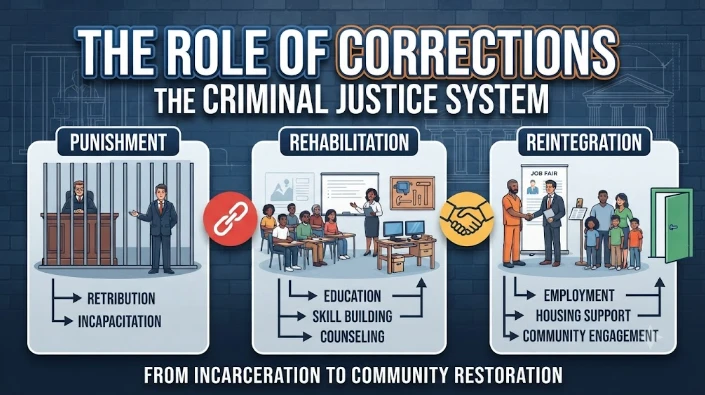
Corrections is presented as a major but often misunderstood part of the criminal justice system, extending far beyond imprisonment. The article distinguishes institutional corrections, such as jails and prisons, from community corrections, including probation and parole. It explains that modern correctional systems face serious pressures from overcrowding, staff shortages, high costs, violence, and persistent recidivism. When prisons focus mainly on containment, people may leave with disrupted education, weaker employment prospects, untreated trauma, and stronger connections to criminal networks. The article therefore emphasizes rehabilitation, vocational training, education, mental health support, and structured reentry as essential correctional functions. International examples, particularly Norway, are used to show how humane conditions and preparation for reintegration can reduce repeat offending. Justice reinvestment is also presented as a way to redirect resources toward housing, employment, treatment, and community prevention. The overall argument is that corrections should be judged not by how long people are confined, but by how effectively it prepares them to return to society safely and productively.
Popular imagination tends to see the criminal justice system as a series of melodramatic investigations, trials in the court, and convictions. However, it is also the next level that is probably the most essential and least comprehended, which is the corrections that follow the gavel drop. This part of the system is charged with the responsibility of dealing with people who have been convicted of crimes and by , corrections all over the world is experiencing a crisis never seen before and is also experiencing a time of change. However, instead of simply being a matter of incarceration, modern corrections is a complex network of institutions, community supervision programs, and rehabilitative programs, all of which are meant to improve the security of the people by decreasing the chances of their committing another crime. The problems are massive, but the rewards are bigger, since the treatment of the lawbreakers by the community is a reference to its values, priorities, and perspective of justice.
Corrections is a branch that works on two major levels, institutional and community-based. It is the role of institutional corrections, including jails and prisons, to incapacitate, meaning deprive members of the community to ensure that they do not do any more damage. The magnitude of this is really international. As reported in the World Prison Brief, there are about 11.7 million individuals in prison globally and this data serves to highlight the enormous footprint of society at this stage of justice. The incarceration is effective: it will avoid the additional immediate injuries and will indicate to society that illegal actions are disapproved. Nonetheless, it has major challenges, as well. Staffing, underfunding, and overcrowding have become critical in most areas to such a degree that the goals of punishment, rehabilitation, and public safety are in conflict. The outcome of the facilities that are functioning at a higher capacity than they can handle is a series of social, psychological, and operational impacts that spread across the entire correctional system.
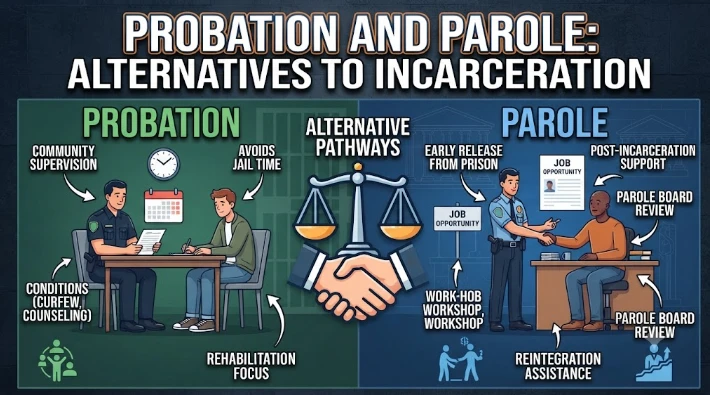
In most countries, a larger number of the supervised population is community corrections that encompasses parole and probation. Probation is the court-imposed supervision in the community as an alternative to imprisonment, when people are allowed to live in society and their conditions are controlled. Parole, conversely, is conditional release of those who have already been in part of their jail term, where the further release will be limited on the condition that they follow certain stipulated conditions. In the United States, alone, by July 2025, the number of adults under community supervision of some sort is approximately 3.77 million. Such a tendency is commonly referred to as mass supervision and it demonstrates the fact that the power of corrections is stretched much further than the actual walls of jails and prisons. In certain western nations, the size of the probation or parole community can even be five times the imprisoned population, which represents the volume and magnitude of corrections as an institution in society. The community supervision is designed to assist with reintegration, minimize recidivism and ensure public safety, but is usually under resource limitations, on heavy caseloads and inconsistent supervision, negating its efficacy.
The issue of overcrowding in corrections is one of the most urgent ones in because it has become the rule and not the exception. In the United Kingdom, as an example, in March the Public Accounts Committee had reported that adult male prisons were already operating at 99.7 percent capacity with forecasts that by early there would be virtually no empty space to take in new prisoners. The overcrowding is an event that has a trickle effect on safety and rehabilitation. The statistics of show that there is a clear connection between high-density facilities and institutional violence, and the rate of fights between inmates and attacks on staff is rising by up to 14 to 19 percent in the densest places. In addition to the direct physical dangers, overpopulation contributes to inhuman conditions, making several people share the space intended to be occupied by one person, thereby undermining the hygiene and mental wellbeing of people, as well as basic human dignity. Once keeping the sand at bay under such tensioned circumstances is the main priority of a system, the first activity to be terminated is the key rehabilitative programs, which include education, vocational training, substance abuse treatment, and the mental health care, which reduces the long-term ability of a system to curb crime.
Recidivism gives a clear cut evaluation of the research effectiveness of the correctional system. The final issue is do corrections make people safer through the lowered future crime rate and the experience indicates that the conventional punitive method often cannot do it. Although certain jurisdictions have experienced small decreases in returns to prison the rates still are alarming among some groups (as high as 50 percent to approximately 39 percent in three years of North America). Those that commit property offences such as those are rearrested close to 78 percent within a period of five years. According to experts, even the prison experience is criminogenic. Being exposed to the trauma, emphasizing criminal identity, inaccessibility to skill training, and enhanced connection to illegal networks are all factors that increase the risk of recidivism. Incarceration may inadvertently act as a breeding ground to future criminal activity and not a reformative method unless it is undertaken to a full extent.
The evidence that is emerging points to corrections systems needing to shift towards rehabilitative and reentry oriented models in order to make low crime returns. A study of early supports the usefulness of programs that incorporate educational and vocational elements. Education improves cognitive abilities, creates confidence, and personal growth whereas vocational training provides persons with practical abilities required to acquire lawful jobs. When such interventions are used in combination, they yield a quantifiable reduction of recidivism, which is better than programs that are single-focused. These results indicate that the period spent in the correctional system should be planned so that it would equip them to be reintegrated, and not a time of incarceration.
This strategy is further enforced by international examples. The example of Norway has come up with an open prison system where the institutions are designed like university accommodations and not like traditional penitentiaries and the sentences are relatively short, average six months. They emphasize normalizing daily life, instilling responsibility in them, and readiness of the inmates to reintegrate into society. Consequently, the recidivism rates in Norway are among the lowest in the world, which proves that the human, supportive, and skill-oriented correctional settings can achieve superior long-term results compared to punitive ones. This model points out that 95 percent. of prisoners will eventually go back to their communities; hence, the success of corrections should not be measured by the duration of confinement but rather by the success of providing safe and constructive reintegration to the prisoners.
The other potential solution is the concept of justice reinvestment, which involves redirection of prison construction and maintenance funds to community prevention and support programs. The problem of maintenance that is estimated as being 2.8 billion in the United Kingdom is a testament to the fact that the maintenance cost of continuously growing the prison system is unsustainable. Those jurisdictions that have adopted justice reinvestment strategies have channeled those resources to housing, employment programs, mental health services, and educational opportunities. The statistics on the states using this model show that the reduction in crime rate and recidivism decreases by an average of 38 and 10 percent, respectively, during multiple years. Such a strategy represents the idea that the long-term safety of people is based on proactive support and opportunity instead of only reactive containment.
The larger implications of a rehabilitative corrections model are enormous. The ability to provide social, psychological and economic assistance to those who have committed offenses enables society to curb the recidivism of crime, decrease the taxation on the judicial and penal system and foster community unity. The holistic rehabilitation is a process that makes people have a stable home, healthcare and mental health services, work opportunities, and education opportunities. With the corrections systems put in a position to focus on these aspects, the corrections system moves away towards focusing on transformation rather than focusing on punishment, with safer communities, less recidivism, and fewer operational costs supporting each other in a feedback loop.
Corrections also plays a very important part in creating a conception of justice and legitimacy. Any form of system that seems to be purely punitive may lead to aloofness of the masses, loss of faith and recreation of crime and marginalization patterns. On the other hand, a correction system that focuses on reform, training, and reentering the community sends a very strong signal to the society: justice is accountable, opportunity, and human dignity. It acknowledges that offenders can change, that the damage can be restored, and the security of the communities is the ultimate benefit of turning the ex-offenders into valuable and productive members of the society.
Corrections is at a cross road as approaches. The conventional model that is characterized by overcrowded prisons, recidivism and lack of rehabilitative resources is becoming unsustainable. The new model, which is education and vocational training based, with humane care and organized reintegration, provides evidence-based solutions to safer communities, more efficient use of social resources, and transformative results of individuals. The physical size of prison population and the harshness of punitive action do not ensure true public safety: instead, it is a matter of carefully planned, humane, and organized training of persons to live after being in prison. Through holistic rehabilitation, the community-oriented supervision, and human development and safety, unveiling the secrets of recidivism as the key to the social revitalization, corrections can transform the so-called system of containment into a system of restoration.
This broad-based perspective of corrections in notes that reforms are urgent and the way forward. It illustrates that the role of corrections is much broader than imprisonment, can involve the task of making lives change, avoiding crimes in the future, and regaining trust in communities. With rehabilitation, reintegration and evidence-based approaches, societies can completely redefine the meaning of corrections, which produces a justice system that is safer, fairer and more effective to all stakeholders. The decisions that are taken today will not only determine the experiences of the people involved in the correctional system but also the safety, stability and resilience of the entire society in a matter of decades to come.
CITE THIS ARTICLE
Das, B. C. (2025). The Role of Corrections in the Criminal Justice System. https://www.bikashchandra.com/article/7b4baa47-7dd5-50be-9012-c994764113b7
B. C. Das, “The Role of Corrections in the Criminal Justice System,” 2025. [Online]. Available: https://www.bikashchandra.com/article/7b4baa47-7dd5-50be-9012-c994764113b7
Das, B. C. (2025) ‘The Role of Corrections in the Criminal Justice System’. Available at: https://www.bikashchandra.com/article/7b4baa47-7dd5-50be-9012-c994764113b7
Das, Bikash Chandra. “The Role of Corrections in the Criminal Justice System.” 2025, https://www.bikashchandra.com/article/7b4baa47-7dd5-50be-9012-c994764113b7.
Bikash Chandra Das. “The Role of Corrections in the Criminal Justice System.” (2025). https://www.bikashchandra.com/article/7b4baa47-7dd5-50be-9012-c994764113b7.
Das BC. The Role of Corrections in the Criminal Justice System. 2025. https://www.bikashchandra.com/article/7b4baa47-7dd5-50be-9012-c994764113b7
@misc{article_7b4baa477dd550be9012c994764113b7,
  title = {The Role of Corrections in the Criminal Justice System},
  author = {Bikash Chandra Das},
  year = {2025},
  url = {https://www.bikashchandra.com/article/7b4baa47-7dd5-50be-9012-c994764113b7},
}
TY  - GEN
AU  - Bikash Chandra Das
TI  - The Role of Corrections in the Criminal Justice System
PY  - 2025-06-18
UR  - https://www.bikashchandra.com/article/7b4baa47-7dd5-50be-9012-c994764113b7
ER  -
This article explores why people volunteer in America’s national parks and how program design influences whether service remains meaningful. Volunteer motivations often overlap and include personal values, learning, social connection, career development, confidence, purpose, and attachment to place. The article uses motivational frameworks to show that volunteers are more likely to remain engaged when they experience autonomy, growing competence, respectful relationships, and a clear connection
Probation and parole are presented as essential community-based alternatives to incarceration that combine supervision, accountability, and reintegration. Probation generally allows eligible offenders to remain in the community instead of serving a prison sentence, while parole provides conditional release after part of a custodial sentence has been completed. The article explains that both approaches can preserve employment, family ties, education, and housing, all of which reduce the risk of r
This article defines the ethical boundaries that protect volunteers who support visitor safety and law-enforcement-related functions in national parks. Although volunteers can assist with information, observation, traffic support, administrative work, backcountry roves, and reporting hazards, they must not exercise powers such as arrest, detention, search, citation, evidence handling, use of force, or other commissioned enforcement duties. The article emphasizes clear position descriptions, accu