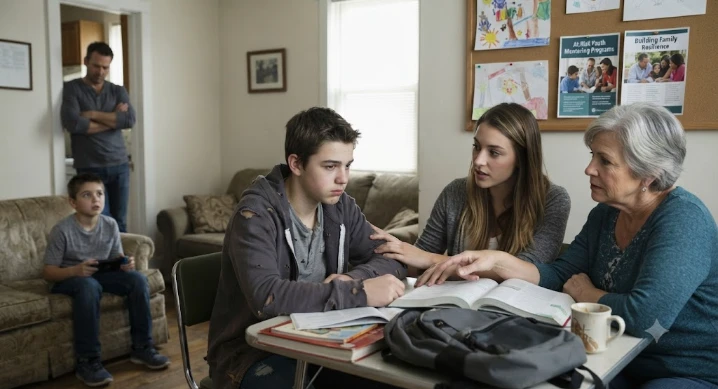
As we proceed to the year , the narrative of crime and delinquency is being redefined in a location that hardly features in the headlines: the family. Before a young person finds himself in front of the police, a courtroom, or a program of correction, he or she is subjected to the routine, feelings, limits, and interactions of home. Criminologists have known since times immemorial, that the family is the earliest and most influential socializing agent in the life of a child. It is the place, where children are introduced to the first signs of authority, conflict management, fairness of rules, and experiences of love, control, trust and discipline in practice.
The present research environment has however taken this knowledge to the next level. In , the question will not be whether a child is brought up in so-called broken or intact home. That ancient carpentry is too rude and too deceitful. The actual problem is the quality of family life per se: the depth of emotional attachment, the regularity of supervision, the existence or lack thereof of safety, and the response of adults to stress, conflict and responsibility. Family effects on crime and delinquency are not predetermined, mechanical or simplistic. It is also dynamic, stratified and closely connected with the type of daily atmosphere children are brought up breathing in.
The family is so important in that it is the initial filter where almost all the other influences pass through. The effects of poverty, peer pressure, school stress, digital exposure, neighborhood disorder, social inequality, etc, all do not exist in a vacuum and do not occur in isolation. Home life is understood through them. A child brought up in an emotionally sensitive family can be exposed to external pressures and come out with good internal controls. A child born in a chaotic or neglected or fearful environment may have very limited resources of emotion and morals to meet the demands set on them. That is why the influence of family is the focus of the current criminology. This is not due to the fact that families are attributed to all social problems. The reason is that families determine the tools that children take to the world. Such tools are self-control, empathy, frustration tolerance, trust, conscience and judging risk. When these tools are constructed thoughtfully, then the family is a barrier. In the case they are broken, damaged, or lost, the family may turn out to be an unwanted bridge to delinquency.
Among the most evident conclusions of the recent studies, there is the fact that the presence of strong emotional bonds in the family is one of the best protective factors preventing offending. When a child has a real attachment towards a parent or a caregiver, a child would not do any behavior that would endanger the relationship between the child and the parent or a guardian. This is not merely in fear of punishment. It is concerned with care and loyalty and not to spoil a valuable relationship. A youth who perceives he or she is noticed, appreciated and emotionally attached at home tends to have more to lose by falling into delinquency. They have a higher chance of absorbing family demands and lower chances of trying to find a place to belong in toxic environments. The protection bonds are not subjected to perfection. Structurally nontraditional, imperfect families of all kinds can offer potent protection to their members, even when they are financially stressed. The thing is to understand whether the child feels that home is emotionally available to her and fundamentally reliable.
This involves communication to a significant extent. By late and early , it continued to be found that the quality and frequency of communication between children and parents is related to lower amounts of adolescent risk-taking. The most important thing is the high-quality. This does not imply talking and lecturing a child and watching every sentence he/she talks. It is actual concentration. It is being there when you are not distracted, listening without immediately yelling at the child, and making the room in which children can feel comfortable telling the truth. An hour of concentrated daily communication can accomplish more than several hours of distraught living together. Once a child realizes that he or she is free to speak frankly without being automatically dismissed, taunted, and bursting at once, there is a higher tendency that he/she will carry the problems home instead of covering them up outside. Such a change is critical. Delinquency tends to develop in darkness. Communication breaks that secrecy before it turns into the deception and dangerous behavior.
Another significant protective factor is supervision, which is misinterpreted. Good supervision is not equated to harsh controls and authoritarian parenting. It does not have to do with transforming the house into a surveillance state. Instead, researchers always refer to parental monitoring. That entails knowing where the children are, with whom they associate with, what they are doing online and off-line and how they are coping with the demands that surround them. Surveillance works effectively where it is based on relationship and not fear. A child who has the trust in his/her parents is more inclined to give information voluntarily. Only when a child feels only suspicion he may only become more skilled at disguising things. This difference has gained even greater significance in since the peer influence and the digital influence are now more intertwined than ever and are more difficult to trace. By keeping a constant vigil of the life of their child, parents provide a sort of protective canopy. Such a canopy will not remove the risk, but will help to diminish the strength of delinquent peers, grooming in the virtual world, and hasty judgment on unguarded grounds.
The most poorly recognized aspect of family influence may be moral modeling. Children do not pick values by the things that parents say. They know much more about what parents do repeatedly. An environment in which adults lie, threaten, insult, explode, or manipulate imparts one kind of lesson. Another is taught in a home in which adults mend their quarrels, establish equitable boundaries, confess, and control anger. In that regard, discipline does not merely mean to control the child. It is also about uncovering the moral grammar of the family. Children get to learn that aggression is not the language of power when their parents address frustration without being violent. Children who are subjected to rules with fairness and consistency by their parents learn that authority need not be arbitrary. With parents who are empathetic, patient and accountable, children start perceiving them as role models to influence their actions even when their parents are not around. It is essential that internalization be critical. It is families that help to form inner brakes that will eventually influence decisions in school, the street, and the Internet.
Naturally, it is not always protective family influence. In case of persistent strife, neglect, apprehension, and instability or emotional deficiencies in the home environment, the probability of future delinquency increases exponentially. The idea of cumulative adversity is one of the most valuable in . Childhood victimization is hardly a discrete, clean experience. And more frequently it occurs in groups. The areas of domestic violence, parental substance misuse, emotional neglect, instability, humiliation, inconsistent care giving and poverty tend to overlap. The outcome is not sadness or short-term stress. It has the ability to modify development itself. Trauma exposure and subsequent involvement in justice are found to have a dose-response relationship, as remains shown by researchers studying adverse childhood experiences, sometimes referred to as ACEs. The more serious adversities a child has been exposed to, the higher the chance of becoming a behavioral problem, victimized, abusing substances, and committing crimes. This is not to imply that trauma is a certainty to commit crime. It implies that the trauma can stack the deck immensely against healthy development unless something alters the course.
Both physical and emotional neglect are particularly harmful as they strike at the most fundamental level of the child, and the sense of his or her value and belonging. A child that is not given proper attention lacks not only food, supervision, medical attention or emotional support. They are also educated, in a way that is hardly spoken, that their needs are insignificant to a level that they can be addressed. Such a lesson can be heartbreaking. The neglected children can find out the belonging, structure, and provision elsewhere. This vulnerability is often perceived much better by the street groups, abusive older peers, gangs, and abusive romantic partners than by formal institutions. They provide what the child needs to starve: attention, status, protection, money, identity or a feeling of family. On the surface, this may be in the form of poor decisions. On the inside, it usually seems like one has been picked at last. This is why neglect is an influential predictor of delinquency at an early age. It does not only eliminate guidance. It leaves an emotional vacuum that destructive networks are excited to fill.
Conflict in the family also has far reaching consequences. A child brought up in a high-conflict house is not just a witness to fights. They are shown an example of how human problems are resolved. In case shouting, intimidation, threats, humiliation, and violence become usual patterns within the family, children can start to accept the patterns as the normal way of expressing frustration. This can be referred to as intergenerational transmission of violence as put forward by criminologists. It is not a simple concept that children imitate everything they observe. It is that constant experience of violent confrontation transforms what is familiar, anticipated, and present during stressful situations. A child who lives in such an environment can turn hypervigilant, impulsive, emotionally unstable, or dead to violence. Others make later outward aggression. Others turn it back in upon themselves in self-destruction. In any case, their perception of power, fear and conflict is already heavily churned out in the home environment.
It is also through the rate and character of the modern life in that has provided some newer manifestations of family risk which are not as visible yet are important. One of them is what some researchers currently refer to as digital desertion. This does not imply that parents are not at home in their traditional context. It implies that they live physically but not relationally as the focus is preoccupied with gadgets, unceasing work pressures and disjointed digital habits. A parent may be sitting in the same room as a child and be unavailable in all the practical sense. This is important since supervision, emotional sensitivity, and communication require actual presence, as opposed to being close to each other. When children are left to explore the internet, social media, online gaming platforms, and peer messaging without any meaningful interaction with adults, they are more prone to grooming, radicalization, fraud, sexual exploitation and development of unhealthy identities. The gap of supervision is not eliminated in the contemporary families. It has merely taken new shapes in most instances.
Out-of-home care is one of the most extreme spheres of family influence and system failure. Statistics provided by various countries have consistently demonstrated that the criminal justice system has a high rate of overrepresentation of children in foster care or residential care. This is not to say that foster carers are the culprits. The more serious problem is instability. A variety of placements, interrupted attachments, school changes, rotating professionals and repeated experiences of loss make the ability of children to develop what researchers have termed as a master bond difficult to stable, caring adult. In the absence of such a connection, the child loses interest in conformity. Rules start to become imposed as opposed to relational. Faith is weakened. It makes belonging temporary. When an individual begins to anticipate crashing relationships, then the desire to invest into the future may collapse together with the relationships. The foster-to-prison pathway, in that regard, is not as individual-household-based but rather it concerns repetitive disruption of attachment in systems that were expected to care.
Nevertheless, among the most promising outcomes in the current research is the fact that family influence can be used in both ways. When detrimental family relationships have the power to raise the delinquency risk, the healthier family functioning can decrease it significantly. This is the reason family-based prevention has been one of the most robust points in the crime prevention policy. Behavioral parent training programs are still exhibiting good results as the caregivers are able to establish clear boundaries, be consistent and lessen dependency on extreme physical punishment. Such programs are important since most parents are not mean and uncaring; they are just exhausted, unhelped and practicing the same discipline pattern they have inherited. Practical skills can be taught. The families do not require the abstract lecturing concerning the values. They also usually require bedtime battle, school refusal, lying, sibling aggression, emotional meltdown and screen boundaries management without transforming any obstacle into a war zone.
The multi-systemic therapy has also received an extended approval since the issues with serious youth behavior do not often sit with the child alone. They live in a system comprising family, peers, school and neighborhood pressure. They may find it much more effective working with the entire family in their natural environment than isolating the child in an office and making them the sole issue in the room. This is also the reason why home-visiting programs performed at an early age are so useful. The services provided to parents during the first few years of raising a child can enhance bonding, decrease neglect, enhance emotional sensitivity, and detect risk factors before they become embedded in chronic crisis. Prevention is most effective when it is done before delinquency is identity.
The general idea is that family cannot be turned into a moral platitude. Rather than glorifying strong families in the abstract without considering the issue of housing insecurity, parental burnout, untreated addiction, domestic violence, childcare gaps, and economic strain, it is necessary to do it. Families do not exist independently of society. They take in the strains of inequality, labour insecurity, information overload, and social disintegration. Societies need to support families both materially and emotionally in case they desire them to serve as protective institutions. A parent with multiple jobs who has no childcare and no mental health care can love his or her child and at the same time not be able to give the kind of supervision or consistency described by the researchers. The influence of the family exists, however, so do structural conditions which define what families are able to do in reality.
This is the reason why the role of the family in prevention of crime should be interpreted both in intimate and in systemic level. On the close level, children require warmth, limits, constancy, security, and one adult, who cares about their future and is emotionally involved with them. In the systemic level, families require financial stability, education, mental health, domestic violence services, parenting, and communities that would not abandon them. The concept of public safety starts way before the initial crime. It starts with whether a child is secure, whether a parent can remain emotionally stable in circumstances of stress, whether any conflict within the family is a lesson in fear or repair, and whether a sense of belonging is sufficiently strong to counteract the lure of the negative external influence.
That fact is more obvious in . Family is still the center of the greater good on all matters of public safety not because it dictates all but because it molds most of what follows. It is here that most children first get to know about whether power is just, whether feelings can be controlled, whether war can be resolved in mend or bloodshed, and whether they too are worthy of protection. Families that provide connection, structure, and emotional security can help to diminish the attractiveness of delinquency in very strong ways. In cases where neglect, instability, and harm are characteristic of families, they may expose the children to criminal journeys even before anybody labels them as criminal journeys.
Laws, surveillance, and more severe punishment are therefore not necessarily the most effective crime prevention strategy. It can be encountered in helping families before it turns into criminalization. It exists in assisting parents to develop secure routines, enhance communication, interrupt violence, treat trauma, and ensuring that no child is left to grow up without an effective guardian, who is concerned with what becomes of them. When cultures invest in the well-being of the family, they do not just minimize offending. They bring up healthier children, secure societies and a kinder world. Ultimately, control of behavior is not the only way of crime prevention. It is regarding construction of the types of houses where health behavior stands a real opportunity to establish.