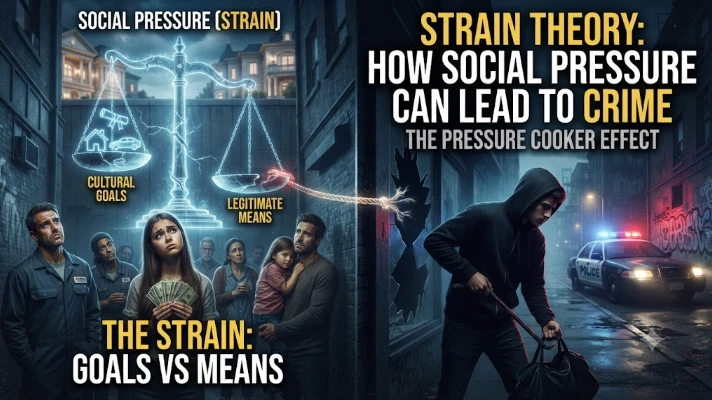
Strain Theory explains crime as a possible response to the gap between socially valued goals and the legitimate opportunities available to achieve them. The article begins with Robert Merton’s model, describing conformity, innovation, ritualism, retreatism, and rebellion as different adaptations to social pressure. Criminal behavior becomes most relevant where individuals accept goals such as wealth or status but feel blocked from lawful routes to success. The discussion then expands through General Strain Theory, which includes emotional and relational pressures such as job loss, family breakdown, bullying, violence, and repeated frustration. Modern inequality, insecure employment, social media comparison, and relative deprivation can intensify these pressures. The article argues that punishment alone does not remove the conditions that produce strain. More effective prevention includes educational access, vocational training, stable employment, affordable housing, mental health support, mentoring, and resilience-building. Overall, Strain Theory reframes crime as partly shaped by structural and emotional pressures, showing why opportunity and social support are central to long-term prevention.
During the first months of , the stresses of contemporary life have never been stronger. The images of affluence, prestigious professions, and immediate success are constantly aired on all screens and make society foster a constant perception that people have to attain all this to be considered successful. To millions of people, these aspirations are beyond structure and economic reach. Strain Theory also offers a vital perspective through which people can view the process by which, under the influence of social and economic pressure, certain individuals resort to crime as a means of responding to it. Criminal behavior can arise as a logical response to the disillusionment of failing to be able to fulfill culturally established objectives by the legitimate means.
The urgency of this point of view is described in global economic statistics in . As the GDP growth progressed in most of the areas, income inequality has stuck with the same obstinacy and, in fact, it has grown in several of the richest countries of the world. The distribution of wealth and opportunity is not even and many segments of the population do not have access to good education, secure jobs and social mobility. The mismatch between the expectations of society and individual ability leads to what criminologists call strain, a stressor that may result in creative, ritualistic, withdrawing, or even traitorous action when people have no effective ways to accomplish success.
The original theory formulated by Robert K. Merton identifies five different adaptive reactions to this strain and demonstrates that crime is not the only possible result of the conflict between social pressure and structural limitations. Conformists believe in the societal aspirations and the methods available to achieve them through legal channels; they tend to cling on low paying jobs or dead ends jobs hoping that they will progress gradually. Those who innovate acknowledge the ambitions but they refuse to follow the traditional routes, and in some cases they might even engage in cyber-fraud, drug trafficking, or other unlawful to get rich or famous. Ritualists give up the aspirational ambitions, but still adhere to the societal rules by undertaking the minimum possible in unfulfilling roles.
Retreatists also shun the ends and the ways and recede into the society by abusing substances, becoming chronic homeless, or disengaged. Rebels also want to change the current structures in society completely, which is why they will be part of the political or social movements that disrupt the current norms. Both adaptations show that crime is not a single action but a reaction to more general forces in the society, which uncovers the vulnerabilities in the system that encourages crime.
The Strain Theory has changed in to include more aspects other than economic inequality. In his General Strain Theory, Robert Agnew has extended the theory by adding emotional and relational stressors that produce negative affect which may trigger criminal activities. The strain is also not caused by unfulfilled economic opportunities alone but also when one cannot fulfill other things of importance like success in school, relationships with partners, or being admired by others. The frustration and the anger can be sharpened by the withdrawal of positive stimuli like loss of a job, a home, or a loved one and in the process, lead to impulsive or illegal actions as an escape mechanism. In the same way, being exposed to chronic negative stimuli such as bullying, domestic violence or residing in a high-dense urban area imposes constantly on social and emotional resources, leading to the decrease of those and predisposing a person to criminal adjustment. This subtle point of understanding highlights the idea that crime is not only caused by want or lack of ethics, but rather an intricate interplay of the demands of the surrounding social environment, circumstances in the individual, and internal struggles.
The economic systems of are an extreme illustration of how Strain Theory is relevant in modern times. The legitimate ways of achieving success seem to be far and inaccessible to young people living in communities where schools, job availability, and living standards are underfunded and low. The socio-economic trap is a force behind the decision of taking to informal or illegal economies. A college degree is too expensive, and stable employment does not seem to be an option, so committing cybercrime, a shoddy business, or dealing in drugs may seem an understandable, even though unlawful, way of responding to structural limitations. This strain is further increased by the phenomenon of relative deprivation. Now, in the age of social media in the world, people can compare themselves not only to their neighbors but to the richest and most successful individuals in the world. Such a continuous exposure to some idealized standard leads to increased perceptions of inequality, which a study in has shown to be a better predictor of violent crime compared to absolute poverty. The perception of not being treated fairly is exacerbated by the absence of supportive institutions, such as the mental health centers, mentoring programs, or community organizations, which increases the likelihood of the so-called criminal coping, when individual decides to illegally earn recognition, money, or prestige.
There are policy implications stressing that it is important to reduce strain instead of merely increasing the enforcement. There is a complex solution based on educational equity, economic empowerment, and social support to blocked opportunities. Increased access to vocational training, eliminating economic barriers to higher education, and investing in mentorship programs can guarantee that the legitimate path to success is accessible to a larger group of the population. Ensuring housing availability, stable employment, and reasonable wages as the basis of a specific labor policy will lower the desire to turn illegal, which would make it a more realistic way to achieve financial freedom. It is also critical to pay attention to mental health and resilience training, specifically among youth. Once considered the domain of mental health professionals, schools and community centers are providing more and more programs in emotional regulation, stress management, and trauma-informed care, to teach young people the resources to overcome their setbacks without using aggression or crime. Through structural opportunity and the capacity-building of individuals, the societies can reduce the pressures that usually lead to the illegal conduct.
Strain Theory also sheds light on the general social impacts of crime. Crimes do not occur as a rare phenomenon, it is a symptom of problems in the system that deteriorate trust, social unity, and economic security. Societies with a lot of strain usually have ripple effect effects: neighborhood disorder, decreased civic participation, and acceptance of illegality. The reduction of the causes of strain can therefore generate both immediate cutbacks in crime and indirect enhancements in the welfare of the community. An example of such interventions includes strengthening schools, economic opportunity creation, and the development of social support networks so as to prevent both individual crime acts as well as to develop resilient communities that can effectively self-regulate and generate collective efficacy.
The Strain Theory outlook has emphasized the fact that the crime is a grave part of the social and economic fabric. Punitive strategies based on only apprehension and punishment would not be able to treat the cause of the problem but would actually contribute to the repetition of the offending cycle. Policymakers and criminologists can prevent crime by identifying structural inequalities, blocked opportunity, and chronic social pressure as the major causes of crime and, as a result, come up with interventions that are both preventive and rehabilitative. The combination of social, economic and psychological support systems ensures channels of legal success, and minimizes the apparent need to be creative in crime. Opportunity, supporting communities, and resilience give people a real opportunity to realize their goals in the society without necessarily committing a crime.
The Strain Theory also interferes with the traditional discourses of criminal conduct which simply blames individual morality. Rather, it emphasizes the role of the context and shows that as the demands of society surpass the available resources, crime becomes a foreseeable, although rather unfortunate, solution. In this respect, crime may be seen as a signal and a symptom at the same time: a symptom of structural inequality and unmet human needs, as well as a signal that the social environment is not providing the legitimate avenues to success. The theory forces people to change their thinking and focus on the idea that the effective prevention of crime should be based not only on law enforcement but also social reformation, investment in education, and empowering society.
The applicability of Strain Theory in the face of the global trends in is enhanced by the technological and social changes. The sources of relative deprivation are exacerbated by digital economies, social media manipulation, and internationalized ideals of achievement, and the experience of strain is more stressful to vulnerable groups. Simultaneously, the possibility of creative intervention has been expanded: online vocational training, virtual mentoring programs, and telehealth mental health services can also enable communities to create structural and emotional barriers in new ways that were not possible before. These instruments offer scalable, as well as specific mechanisms to lessen the forces shaping criminal adjustment, showing that a thorough and data-driven approach can help adjust the long-term aims of society to the achievable possibilities.
To conclude, Strain Theory is a critical perspective of understanding crime in the contemporary world. It does not put the blame on people but it explores the social and economic frameworks that impose pressure, frustration and inequality. The theory is more applicable than ever in when the inequality of the world, expectations on social media, and unequal opportunity access remain relevant in shaping behavior. The issue concerning the effective crime prevention is not simply a policing issue but the issue of building the society whereby legal means of success are made available to everyone, where emotional and social support networks are well-developed, and where criminal temptations are reduced to a minimum. Justice here does not merely imply application of the law but development of fair grounds within which people are able to prosper without resisting to the law. The opportunity to reduce crime in its structural and emotional causes will result in safer, strong communities, which will show that the real test of justice is the possibility of everyone to fulfill his or her objectives with the help of the lawful and constructive channels.
CITE THIS ARTICLE
Das, B. C. (2025). Strain Theory: How Social Pressure Can Lead to Crime. https://www.bikashchandra.com/article/a5e1d2af-0c15-532c-8f85-154e799fced0
B. C. Das, “Strain Theory: How Social Pressure Can Lead to Crime,” 2025. [Online]. Available: https://www.bikashchandra.com/article/a5e1d2af-0c15-532c-8f85-154e799fced0
Das, B. C. (2025) ‘Strain Theory: How Social Pressure Can Lead to Crime’. Available at: https://www.bikashchandra.com/article/a5e1d2af-0c15-532c-8f85-154e799fced0
Das, Bikash Chandra. “Strain Theory: How Social Pressure Can Lead to Crime.” 2025, https://www.bikashchandra.com/article/a5e1d2af-0c15-532c-8f85-154e799fced0.
Bikash Chandra Das. “Strain Theory: How Social Pressure Can Lead to Crime.” (2025). https://www.bikashchandra.com/article/a5e1d2af-0c15-532c-8f85-154e799fced0.
Das BC. Strain Theory: How Social Pressure Can Lead to Crime. 2025. https://www.bikashchandra.com/article/a5e1d2af-0c15-532c-8f85-154e799fced0
@misc{article_a5e1d2af0c15532c8f85154e799fced0,
  title = {Strain Theory: How Social Pressure Can Lead to Crime},
  author = {Bikash Chandra Das},
  year = {2025},
  url = {https://www.bikashchandra.com/article/a5e1d2af-0c15-532c-8f85-154e799fced0},
}
TY  - GEN
AU  - Bikash Chandra Das
TI  - Strain Theory: How Social Pressure Can Lead to Crime
PY  - 2025-10-15
UR  - https://www.bikashchandra.com/article/a5e1d2af-0c15-532c-8f85-154e799fced0
ER  -
This article explores why people volunteer in America’s national parks and how program design influences whether service remains meaningful. Volunteer motivations often overlap and include personal values, learning, social connection, career development, confidence, purpose, and attachment to place. The article uses motivational frameworks to show that volunteers are more likely to remain engaged when they experience autonomy, growing competence, respectful relationships, and a clear connection
Probation and parole are presented as essential community-based alternatives to incarceration that combine supervision, accountability, and reintegration. Probation generally allows eligible offenders to remain in the community instead of serving a prison sentence, while parole provides conditional release after part of a custodial sentence has been completed. The article explains that both approaches can preserve employment, family ties, education, and housing, all of which reduce the risk of r
This article defines the ethical boundaries that protect volunteers who support visitor safety and law-enforcement-related functions in national parks. Although volunteers can assist with information, observation, traffic support, administrative work, backcountry roves, and reporting hazards, they must not exercise powers such as arrest, detention, search, citation, evidence handling, use of force, or other commissioned enforcement duties. The article emphasizes clear position descriptions, accu