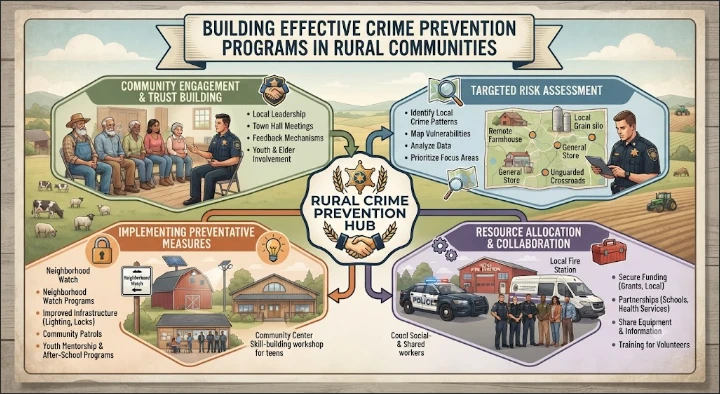
This article focuses on how crime prevention programs should be designed for rural communities, where social conditions, policing capacity, and available services often differ from urban areas. Using Bangladesh as the main context, it identifies poverty, unemployment, limited education, weak infrastructure, scarce police presence, domestic violence, substance abuse, trafficking, and land-related disputes as important rural safety concerns. The article argues that effective programs must address both immediate crime risks and the social conditions that contribute to offending. Community-based participation is presented as essential because local residents possess knowledge about local problems and can help create culturally appropriate solutions. Community policing, stronger relationships between officers and residents, and partnerships with local leaders, NGOs, youth groups, and faith-based organizations are emphasized. Economic opportunities, vocational training, counseling, victim support, and public awareness are also recommended. The article concludes that rural crime prevention requires sustained investment and locally grounded cooperation, rather than relying only on patrols or enforcement, to build safer and more resilient communities.
The development of effective crime prevention initiatives within rural settings will take a specific approach to crime prevention programs that will take the special problems of these regions into account. There are usually varied social, economic, and cultural forces in rural community than what exists in an urban environment and this has to be considered when making crime prevention strategies. In Bangladesh, where the rural population comprises a large percentage, it is vital to learn the needs and conditions of these people to be able to tackle crime in Bangladesh. Although the crime rate in the rural areas can be lower than that in the urban settlements, the rural areas are not impervious to crime and the absence of infrastructure, police force and social amenities can contribute to their weaknesses. Thus, it is extremely important to devise crime prevention initiatives that are sustainable, locally based and attentive to the needs of rural population to enhance safety of the community and make them more robust and resilient.
The identification of the underlying causes of crime in the rural communities is one of the major elements in constructing effective crime prevention programs in the rural areas. In Bangladesh, poverty, unemployment and inaccessibility to education are important issues in most of its rural areas that cause criminal activities. Poverty and scarcity of resource is a condition that tends to make individuals desperate enough to get involved in illegal acts as a survival mechanism. An example of this is in certain rural regions where workers in agriculture as petty thieves or drug dealers because of meager salaries and absence of alternative sources of employment. In addition, lack of educational and vocational training opportunities in most villages restrains the accessibility of youths to secure and well-paying employment thus exposing them to more vulnerability to criminal activities.
Furthermore, the law enforcers are sometimes less apparent in the rural areas and therefore criminals become courageous and hard to control the safety of people. The rural police can be understaffed, ill-equipped, or untrained and leave their communities at the mercy of land grabbing, domestic violence, theft, and trafficking. Police response is also a problem due to the geographic remoteness of most of the rural communities, and this makes the problem of establishing effective crime prevention even more difficult. In other cases, the rural communities can be more dependent on the traditional modes of justice like the community councils or informal networks, but they are not generally in a position to deal with more complex or severe crimes.
Other essential aspects of crime in the rural environment are the social structure of the community. In small communities, neighborliness and family relations are important as they influence the dynamics of the community. There are instances where community connections may serve as an effective means of crime prevention because the people living in the area would tend to interfere or report whenever they suspect something is wrong in their lines. There are however other cases where such intimate relationships may facilitate crime especially when social tolerance or lack of concern to a given crime is experienced. As an example, on the territories where illegal practices like gambling, drug use, or smuggling have become standard practices, crime prevention efforts can be opposed or uncooperative among the residents.
In order to deal with these issues, the crime prevention programs in the rural communities should be multifaceted, comprehensive and context-based. The community-based initiatives where the local residents can participate in the process of ensuring the safety of the community is one of the most effective methods of crime prevention in rural areas. Engaging the members of the community in crime prevention activities enables programs to leverage on local knowledge and resources, and to also make sure that the solutions to crime are culturally-appropriate and more highly-bought into by the population.
One of the approaches to rural crime prevention is to enhance the economic prospects and eliminate the existing socio-economic conditions that create the environment where crime takes place. Rural poverty is a major issue in Bangladesh, and the influence on eventual reduction of crime can be directly related to the attempts to lower poverty rates and to raise the economic standards. Efforts to ensure sustainable livelihoods including small business assistance, rural entrepreneurship enhancement, and microfinance can be used to mitigate the motivation to engage in crime. Moreover, young people can be invested in education and vocational training programs to equip them with skills that will help them to secure stable and legal employment that will limit their susceptibility to joining the crime.
Crime prevention is also an important task of law enforcement, but in rural regions, the emphasis should be made on community policing, instead of basing on the traditional and top-down methods only. The community policing approach promotes the cooperation between the police and community members to establish crime threats, avert crimes, and trust. In Bangladesh, the police forces operating in the rural regions should be developed to interact with the communities effectively and closely cooperate with the community leaders, local organizations and the youth groups in order to establish positive relationships. In addition to enhancing the safety of the people this strategy also fosters the rapport between the police and the society, making it a culture of cooperation and not fear and hatred.
An effective community policing model in rural communities would mean that the officers are integrated into the neighborhood they are serving with gaining knowledge of the local problems and developing a relationship with the locals. Besides the common functions of the rural police officer in law enforcement, the police officer may also act as a mentor, counselor and solver of problems in the rural area, such as land conflicts, domestic violence, and drug abuse. With the collaboration of local residents, law enforcement officers might help to stop minor issues at the stage of their development into major criminal cases and be able to avoid conflicts and mediate them before ending in violence and other criminal actions.
The other key attribute in establishing effective crime prevention programs within the rural communities is social problems, including domestic violence, substance abuse, and child protection that may lead to criminal activities. Social services, as well as mental health are scarce in most rural locations and people with addiction issues, mental health problems or traumas can resort to crime as a coping mechanism. Such underlying social factors like counseling services, substance abuse treatment, and support of domestic violence victims should be incorporated in crime prevention programs. Moreover, stigmatization of such problems can be diminished by conducting campaigns and educational activities in the general population to make people seek assistance and report offenses.
NGOs, community organizations and faith based groups also should be partnered with in developing holistic crime prevention plans. These groups are also usually rooted in the rural areas and can be useful in crime prevention activities. The collaboration between the law enforcement systems and the community institutions could offer comprehensive solutions to crime that extend beyond the law enforcement sector. As an illustration, NGOs can offer youth programs, which educate young people, train them in work and leisure activities so that they do not fall into association with criminals. On the same note, faith based organizations could be used to enhance social cohesion, offer care to the vulnerable and preaching of peace and justice amidst their communities.
Crime prevention in the rural setting has to be a long-term commitment and investment. Although in the short-term, the solutions to crime can be effective, e.g. police patrols can be more frequent or the security facilities can be enhanced, in the long-term, the problem of crime must be solved on its systemic level. These involve enhancing education, economic opportunities, developing trust between society and the police, and resolving social problems like addiction and family abuse. Through an integrated, community-based strategy to crime prevention, the rural communities in Bangladesh and other areas can develop safer and stronger communities where individuals are granted a sense of responsibility to their safety and wellbeing.
To sum up, the development of useful crime prevention programs in rural areas necessitates a complex solution that will tackle the specifics of the situation in these areas. Crime prevention can be more effective and sustainable by addressing social issues, further enhancing the economic opportunities, working on community policing and community engagement. A comprehensive, community-based solution to the problem of crime is necessary in Bangladesh where the rural population faces severe socio-economic issues and lacks access to necessary resources, which can be achieved through an interventions-based approach to community security. Rural communities can decrease criminal activities and enhance quality of life by empowering the local communities, encouraging partners between the police and local communities, and investing in solutions that yield in the long term.
CITE THIS ARTICLE
Das, B. C. (2026). Building Effective Crime Prevention Programs in Rural Communities. https://www.bikashchandra.com/article/b29d3278-c509-5a79-aa8e-6cacf6526f6d
B. C. Das, “Building Effective Crime Prevention Programs in Rural Communities,” 2026. [Online]. Available: https://www.bikashchandra.com/article/b29d3278-c509-5a79-aa8e-6cacf6526f6d
Das, B. C. (2026) ‘Building Effective Crime Prevention Programs in Rural Communities’. Available at: https://www.bikashchandra.com/article/b29d3278-c509-5a79-aa8e-6cacf6526f6d
Das BC. Building Effective Crime Prevention Programs in Rural Communities. 2026. https://www.bikashchandra.com/article/b29d3278-c509-5a79-aa8e-6cacf6526f6d
@misc{article_b29d3278c5095a79aa8e6cacf6526f6d,
  title = {Building Effective Crime Prevention Programs in Rural Communities},
  author = {Bikash Chandra Das},
  year = {2026},
  url = {https://www.bikashchandra.com/article/b29d3278-c509-5a79-aa8e-6cacf6526f6d},
}
TY  - GEN
AU  - Bikash Chandra Das
TI  - Building Effective Crime Prevention Programs in Rural Communities
PY  - 2026-05-31
UR  - https://www.bikashchandra.com/article/b29d3278-c509-5a79-aa8e-6cacf6526f6d
ER  -
This article explores why people volunteer in America’s national parks and how program design influences whether service remains meaningful. Volunteer motivations often overlap and include personal values, learning, social connection, career development, confidence, purpose, and attachment to place. The article uses motivational frameworks to show that volunteers are more likely to remain engaged when they experience autonomy, growing competence, respectful relationships, and a clear connection
Probation and parole are presented as essential community-based alternatives to incarceration that combine supervision, accountability, and reintegration. Probation generally allows eligible offenders to remain in the community instead of serving a prison sentence, while parole provides conditional release after part of a custodial sentence has been completed. The article explains that both approaches can preserve employment, family ties, education, and housing, all of which reduce the risk of r
This article defines the ethical boundaries that protect volunteers who support visitor safety and law-enforcement-related functions in national parks. Although volunteers can assist with information, observation, traffic support, administrative work, backcountry roves, and reporting hazards, they must not exercise powers such as arrest, detention, search, citation, evidence handling, use of force, or other commissioned enforcement duties. The article emphasizes clear position descriptions, accu