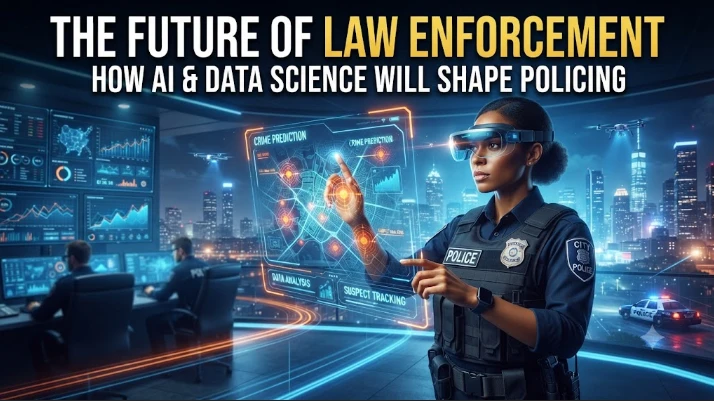
This article explores how artificial intelligence and data science are changing the future of policing. It discusses predictive policing, automated analysis, facial recognition, digital evidence processing, and data-driven accountability as technologies that could improve crime prevention and investigative efficiency. In Bangladesh, where police agencies often operate with limited resources and growing workloads, AI could help identify crime hotspots, analyze large datasets, automate administrative tasks, review surveillance footage, and support cybercrime investigations. The article also explains how data analysis can reveal patterns in police conduct and help agencies evaluate the use of force or other operational practices. However, these technologies introduce significant ethical concerns. AI systems trained on biased historical data can reproduce unfair outcomes, while facial recognition and surveillance may threaten privacy when used without adequate safeguards. The article therefore emphasizes transparent rules, continuous oversight, fairness testing, privacy protection, officer training, and infrastructure investment. Overall, AI and data science are presented as powerful policing tools whose value depends on responsible, accountable, and ethically governed implementation.
The innovative developments in the field of artificial intelligence (AI) and data science are radically transforming the future of law enforcement. Due to the fast growing nature of technology, AI and data science are changing the manner of operations within police departments, the manner in which they process crime data, and even the ways in which they predict and forestall crimes. Such technologies present great possibilities of augmenting the safety of the people, making the law enforcing process more efficient and ensuring the delivery of justice more efficiently. But, similarly to any technological innovation, there are also serious ethical issues associated with the implementation of AI and data science in policing, especially the issue of privacy, prejudice, and responsibility. In those nations where police can be characterized by limited resources and high crime rates, e.g., Bangladesh, AI and data science may be a transformative factor in enhancing the performance of the police as well as generating some critical questions regarding the future of policing.
Predictive policing is one of the most promising approaches where AI and data science are making law enforcement more like a vision of the future. Predictive policing is the application of algorithms, and past crime data to make predictions of the place and most likely offender of the crime. Using crime data trends, AI can assist criminal justice organizations with better resource allocation, officers to patrol an area with more crime potential, and criminal suspects before they commit a crime. Predictive policing may be a game changer in Bangladesh whereby urbanization is growing so fast and some neighborhoods are more likely to experience crime than others. With prediction of crime hotspots through artificial intelligence, police departments will be able to tackle possible problems and prevent crimes in their early stages long before they occur but not to respond to and handle them when they occur.
The predictive tools based on AI have the ability to work with huge volumes of data, and it may reveal trends that human officers can overlook. As an example, the AI algorithms can be used to search through the years of crime history, social media and public records to find out the correlations between environment, social behaviors and criminal action. This will enable the police departments to create more evidence-based interventions and strategies instead of basing them on intuition. In Bangladesh, law enforcement resources are usually limited, and AI can assist law enforcement officers during their decision-making processes to determine where their attention should be paid to optimize their efficiency and effectiveness in crime prevention.
The other important field in which AI and data science will influence policing is the automation of routine processes and optimization of the police work processes. Report filing, evidence management, and surveillance footage analysis can be automated with AI, which will enable officers to engage in active law enforcement activities more. As an example, AI-driven systems will be able to sort hours of video footage on a body camera or a camera on a public street, having detected suspicious behavior or criminal activity without human intervention. This can also save time as well as make investigations more accurate and comprehensive. The automation of the administration processes in Bangladesh, where police officers are commonly overworked with the administration duties, may significantly decrease the workload of the latter and enable the officers to concentrate on responding to the incidents and interacting with the community.
Another fast-evolving and changing tool that is altering the law enforcement practices is the facial recognition technology, a type of AI. In surveillance systems, police departments are able to identify the suspects using facial recognition quickly and correctly, through photographs or surveillance footage. The technology has already been applied in most regions of the world with the aim of identifying those who engage in crimes, tracking missing people, and performing real time tracking of suspects. Facial recognition can significantly increase the efficiency of the investigation and allow law enforcement agencies to locate criminals faster in Bangladesh, where it is not always easy to identify the suspect and detect the crime because of the lack of resources. Nonetheless, facial recognition has some worries on privacy and its misuse especially when the technology is adopted to spy on the innocent citizens unchecked. The increased incorporation of AI technologies into the law enforcement practice will make it essential to introduce the proper guidelines and regulations that the governments will rely on to ensure the privacy of citizens.
The use of data science and AI to make police decisions better and increase transparency in law enforcement activities is also possible. Analyzing vast volumes of information, AI will be able to make insights into the trends of policing conduct, uncover possible cases of misconduct, and offer the way to improve the policies and practices. As an example, the use of data science could help the departments review the ways officers utilize force in different circumstances and determine whether de-escalation training is required in a specific area or whether the use of force policy should be updated. In Bangladesh, where police brutality and corruption have been an issue of concern due to police corruption, data-driven analysis can be used to address the problem areas, enhance accountability, as well as build trust in the police. With AI analyzing the actions of the police and the consequences, the police can hold the officers responsible to their actions, make the police practices lawful to the human rights standards, and increase the trust in the police.
Moreover, AI may contribute to the accuracy and efficiency of a criminal investigation greatly. The AI-driven applications can process vast amounts of electronic evidence, including emails, text messages, and Internet activity, to reveal criminal networks, monitor traffic, and find the hidden linkages. This is especially true in the digital age whereby such crimes as cybercrime, human trafficking and online fraud are increasing. In Bangladesh, where the digital crime is becoming a new menace, the AI tools can be used to assist the law enforcement agencies to address cybercrime more efficiently. AI can help solve cases more quickly and more precisely by automating data analysis and revealing patterns that are impossible to identify and require significant time to be identified by human investigators. As an example, it is possible to discuss the analysis of electronic trails left by cybercriminals with the help of AI, which can be used to trace their actions on various online platforms and understand who has the potential to be a perpetrator.
The AI and data science integration in law enforcement is not free of troubles regardless of the possible advantages. The possibility of AI algorithm bias is one of the most important issues. The training of AI systems is based on past information and when past information is biased, then AI models may reproduce and even enhance the biasing information. To illustrate this, the AI algorithms can discriminate against specific groups, meaning that their results may be biased against them due to the presence of racial or socio-economic biases in historical crime data, thereby creating unequal outcomes of arrests or convictions. Bangladesh is one of the countries where the problem of inequality and discrimination is widespread, so it is crucial to make sure that AI systems are designed and tested in a manner that reduces bias and facilitates fairness. It will involve monitoring, openness, and control of AI systems to act ethically and not to support the well-established inequities in society.
There are also privacy issues that require to be looked at when applying AI in law enforcement. Surveillance technologies (including facial recognition) have the potential to cause severe privacy concerns, in particular, when the individuals are surveyed against their will, or when they do not know how their data is utilized, and such use harms their rights. Policymakers in Bangladesh, where the privacy laws are not yet at the high stage, should set out obvious norms of how the AI technologies are to be applied in law enforcement as well as safeguard the right of the population to their privacy. It is important in providing transparency in the data collection, storage and use in order to gain public confidence and prevent any form of abuse of power.
Besides, AI technologies in law enforcement demand high training and resource investment. The police departments should make sure that their staff is trained to operate AI applications and knows the moral part of the problem of applying these technologies. The implementation of AI-powered systems in Bangladesh can lead to significant investments in the training and infrastructures since the law enforcement agencies in this country are typically either underfunded and understaffed. It is a matter of trying to strike the right balance between the possible advantages of these technologies and the financial and logistical limitations of most law enforcement agencies.
To summarize it all, it is evident that the future of law enforcement is bound to numerous developments in the field of AI and data science. These technologies promise to provide remarkable opportunities to enhance the safety of the population, to increase efficiency, and to make the work of law enforcement easier. Nonetheless, in the context of AI entering the policing sphere, the ethical issues of privacy, prejudice, and responsibility must be discussed. The considered use of AI in Bangladesh, where the rates of crime are increasing, and law enforcement organizations have to grapple with various difficulties, can be used to address the new threats such as cybercrime and enhance the efficiency of criminal investigation. With the right balance between innovation and moral values, the law enforcement agencies can explore the full capabilities of AI to make safer and fairer societies.
CITE THIS ARTICLE
Das, B. C. (2026). The Future of Law Enforcement: How AI and Data Science Will Shape Policing. https://www.bikashchandra.com/article/b74acffe-d258-5773-88f3-86c8c8ef0a8c
B. C. Das, “The Future of Law Enforcement: How AI and Data Science Will Shape Policing,” 2026. [Online]. Available: https://www.bikashchandra.com/article/b74acffe-d258-5773-88f3-86c8c8ef0a8c
Das, B. C. (2026) ‘The Future of Law Enforcement: How AI and Data Science Will Shape Policing’. Available at: https://www.bikashchandra.com/article/b74acffe-d258-5773-88f3-86c8c8ef0a8c
Das, Bikash Chandra. “The Future of Law Enforcement: How AI and Data Science Will Shape Policing.” 2026, https://www.bikashchandra.com/article/b74acffe-d258-5773-88f3-86c8c8ef0a8c.
Bikash Chandra Das. “The Future of Law Enforcement: How AI and Data Science Will Shape Policing.” (2026). https://www.bikashchandra.com/article/b74acffe-d258-5773-88f3-86c8c8ef0a8c.
Das BC. The Future of Law Enforcement: How AI and Data Science Will Shape Policing. 2026. https://www.bikashchandra.com/article/b74acffe-d258-5773-88f3-86c8c8ef0a8c
@misc{article_b74acffed258577388f386c8c8ef0a8c,
  title = {The Future of Law Enforcement: How AI and Data Science Will Shape Policing},
  author = {Bikash Chandra Das},
  year = {2026},
  url = {https://www.bikashchandra.com/article/b74acffe-d258-5773-88f3-86c8c8ef0a8c},
}
TY  - GEN
AU  - Bikash Chandra Das
TI  - The Future of Law Enforcement: How AI and Data Science Will Shape Policing
PY  - 2026-07-10
UR  - https://www.bikashchandra.com/article/b74acffe-d258-5773-88f3-86c8c8ef0a8c
ER  -
This article explores why people volunteer in America’s national parks and how program design influences whether service remains meaningful. Volunteer motivations often overlap and include personal values, learning, social connection, career development, confidence, purpose, and attachment to place. The article uses motivational frameworks to show that volunteers are more likely to remain engaged when they experience autonomy, growing competence, respectful relationships, and a clear connection
Probation and parole are presented as essential community-based alternatives to incarceration that combine supervision, accountability, and reintegration. Probation generally allows eligible offenders to remain in the community instead of serving a prison sentence, while parole provides conditional release after part of a custodial sentence has been completed. The article explains that both approaches can preserve employment, family ties, education, and housing, all of which reduce the risk of r
This article defines the ethical boundaries that protect volunteers who support visitor safety and law-enforcement-related functions in national parks. Although volunteers can assist with information, observation, traffic support, administrative work, backcountry roves, and reporting hazards, they must not exercise powers such as arrest, detention, search, citation, evidence handling, use of force, or other commissioned enforcement duties. The article emphasizes clear position descriptions, accu