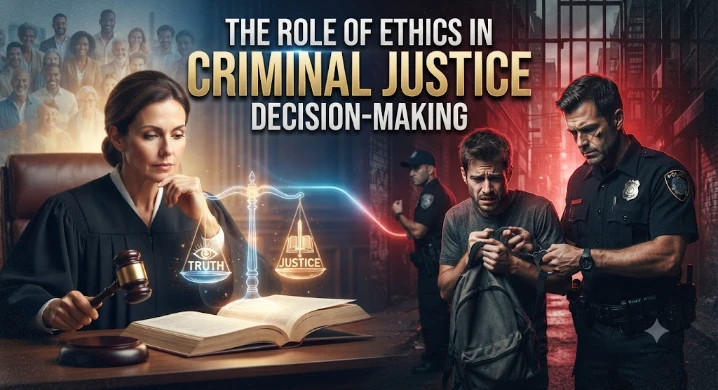
Ethics is presented as the foundation of legitimate criminal justice decision-making, especially as policing, prosecution, courts, and corrections become more technologically complex. The article identifies professional integrity, accountability, transparency, and respect for human dignity as central ethical principles. Police discretion, prosecutorial choices, plea bargaining, sentencing, correctional treatment, surveillance, and the use of artificial intelligence all create situations where lawful authority can still be exercised unfairly. Examples include noble-cause corruption, suppression of exculpatory evidence, biased algorithmic risk assessment, excessive surveillance, and inhumane prison conditions. The article argues that technology does not automatically produce ethical outcomes; body cameras, predictive systems, biometric tools, and data analytics require clear policies, independent oversight, and human judgment. Whistleblower protection, civilian review, scenario-based ethics training, and a duty to intervene are highlighted as important safeguards. Ultimately, ethical justice strengthens public trust and institutional legitimacy by ensuring that efficiency never takes priority over fairness, truth, accountability, due process, and the dignity of victims, suspects, offenders, and communities.
The criminal justice system in the fast changing world is going to be challenged more than ever before, in its complexity, technology, and expectations of the people come together. Although it is true that biometric surveillance, AI-controlled predictive policing, and advanced data analytics will make the system more efficient, they also increase the need to base justice on ethics. Ethics is an unspoken architect that acts to define whether a system is beneficial to the people or it is an exercise of power. Lacking a pledge of honesty, responsibility and honoring a people with human dignity, even the most sophisticated systems of laws will become a weapon of subjugation as opposed to acting as a respondent of justice. With the passage of the year, it is evident that the human factor in decision-making might be the most crucial thing as any technological development to determine the legitimacy as well as the effectiveness of law enforcement, prosecution, and corrections.
The world is still not convinced of the justice institutions. According to statistics provided by the Edelman Trust Barometer, although there have been improvements in technical efficiency of crime solving in parts of the regions, the perception of fairness by the people has stagnated or continued to deteriorate. This lack of connection illustrates one basic principle: one justice system can be effective and not credible. Making ethical choices is not a choice; it is a necessity so as to sustain confidence in the society. Ethics in criminology and law go beyond mere concepts of what is right and wrong, serving as a strict professional standard, which is present at all levels of the justice system. According to four main pillars are outlined as the ethical decision-making, including professional integrity, accountability, transparency, and human dignity respect. Professional integrity requires an uncompromising adherence to truth even in cases where it makes the investigation or prosecution tedious. Responsibility also needs internal and external controls to avoid power abuse. Transparency means that the decision-making process is transparent and can be seen by and comprehended by people. Human dignity ensures that all individuals, victim, witness, or offender are not treated as a case file or statistic, but as a person that has his/her own rights.
The criminal case life cycle poses ethical dilemmas which do not cease with the policing and investigations. The discretionary powers of police officers are enormous and they frequently find themselves making ethical judgment in situations of high-stress, where they have little or no information. Such a corruptive act as a noble cause corruption is one of the most widespread ethical issues, where law enforcers can violate or ignore legal norms believing that the end-result, the removal of a harmful individual off of the streets, is rightful. Studies by point out that such an attitude remains entrenched in different jurisdictions, and ethics education that focuses more on due process and procedural integrity as opposed to expediency is necessary. Body-worn cameras are now a transparency tool, and are now part of large police departments in ninety two percent of police departments worldwide. Nevertheless, there are ethical issues of who owns the footage and what is the use of such footage. The focus on the editing or even concealing of the recording can destroy the sense of accountability and trust of people that technology alone cannot ensure ethical policing; it should be supported by the strong policies and control.
Even prosecutors have immense ethical obligations. They do not have to win at all costs but pursue justice and make sure that the outcomes are equitable, balanced, and evidence-based. Oppression of exculpatory evidence, also referred to as Brady violations, remains a significant moral flaw in most jurisdictions. Although open-file discovery, which allows the defense counsel to access all pertinent information, has now become the standard of ethical practice, it is solely practiced in sixty percent of jurisdictions worldwide as of . Ethical risks are increased by plea bargaining that solves ninety five percent of cases. Exploiting defendants by overcharging them to force them accept plea bargains is not only unfair but it can also be a perpetuation of injustices in the system especially when it comes to the marginalized population who might not have the means to defend themselves properly. Prosecutorial discretion has thus become an essential element in ethical control as a way of averting miscarriages of justice and trust in the legal system.
Another field where ethics is essential is sentencing and corrections. The fairness and bias have been questioned as AI-based risk assessment tools are introduced in . Although these algorithms may help predict recidivism and make sentencing-related decisions, ethicists caution that most of them tend to reflect past biases, especially towards racial minorities and those who are economically disadvantaged. It is important that they are helpful and not decisive, and all these tools must be auditable and transparent to maintain human judgement and responsibility. In addition to the fact that algorithms are considered, the handling of inmates imparts to the ethical values of the society. Crowding, poor health care, and insufficiency of mental health care undermine the human dignity and increase the recidivism thus showing that the morality of failures in the corrections has both the ethical and practical implications. Jurisdictions can address the ethical accountability of crime reduction by focusing on rehabilitating communities and imposing humane treatment by giving importance to rehabilitative resources to achieve this (Geary, 2008).
Lack of ethics has much farther standing than a case. Societies that believe or assume that their police, prosecutors and courts are biased or corrupt turn less to them to report crime, cooperate in investigation and act as witnesses. This loss of trust is what leaves security gaps that are exploited by organized crime and violent gangs. Economic burdens only add to the social costs of unethical behavior since wrongful convictions, civil rights abuses and malpractice suits tend to incur large monetary compensation awards. In 2025, civil misconduct settlements by the police in major cities in the world were higher than 1.4 billion. These numbers make a significant contribution to the fact that ethical justice system is not only a duty of morality; it is also economically efficient and essential to the stability of the society.
Systemic protections that go beyond individual morality are being developed in criminal justice institutions to create resilience in . Misconduct in the police and prosecutors is checked by independent oversight entities, which in most cases are civilian in nature and have the power to subpoena. Whistle protections safeguard employees who report the corruption within the organization, and this breaks the blue wall of silence and creates a culture of openness. Ethics education, which remains scenario-based and adapts to new technologies like AI and digital evidence, is the way forward to ensure that professionals stay prepared to handle the complicated ethical dilemmas. Policies involving the need to intervene in the event that the colleagues are involved in unethical or excessive behavior transfer responsibility to the team, and instill ethical responsibility at all levels of the organizational culture. The text of these systemic measures supports the idea that ethics is not a situational or optional aspect but has to be embedded on all levels of criminal justice operations.
Ethics can be observed as being a crucial aspect of criminal justice even in the latest technologies that are rapidly changing the way of policing, prosecuting, and correcting. Predictive policing based on AI has the potential to make the process more efficient, yet it should be implemented with responsible limitations to not contribute to institutional biases. The use of biometric surveillance, facial recognition, and data analytics provides valuable tools of investigation, but to avoid the breach of privacy, civil liberties, and human dignity, such tools must be regulated ethically. To make sure that these tools are used in the best interest of the people, they should be characterized by transparent government, independent auditing, and accountability to the people. In a world where technology has the ability to move more quickly than human cognition, the ethical frameworks are what offer the moral compass to determine the use of innovation in justice.
The culture of the system is another aspect of ethics which forms the culture and expectations of the people who work in the system. The concepts of professional integrity are supported by internalizing the values of fairness, transparency, and human rights respect among the officers, prosecutors, and corrections personnel. Individual accountability is further complemented by accountability mechanisms as well as civilian review boards and external monitoring into misconduct to ensure that misconduct is not dealt with occasionally, but in a systematic manner. Training programs are increasingly focusing on the balance between legal compliance and moral reasoning and personnel are now taught to make decisions that promotes both the letter and spirit of the law. With the growing social attention and shifting community demands, ethical competence is one of the primary indicators of institutional legitimacy.
Finally, ethics in decision-making in criminal justice is a cornerstone to the system credibility, efficacy, and humanity. Lacking a coherent social life and multi-layered legal systems, in ethical oversight will be more significant than ever due to high-tech enforcement issues. When a justice system is focused on efficiency rather than fairness, it has the risk of alienating the population, recidivism, and social cooperation. On the other hand, a system that is based on professional integrity, accountability, transparency, and dignity to human dignity foster trust, increase compliance, and reinforce the social contract. The historical experience integrated with new technologies and data-driven activities has shown that ethics is not an idealistic concept but a practical phenomenon that allows justice to not only be done but also be perceived.
The question of how to integrate ethics into the very structure of criminal justice is the challenge in front of all the researchers, policymakers, officers, and administrators as the rest of is going on. It involves the questioning of the judgments at the point of policing, the discretion at the prosecutorial offices, and the treatment of people in the correctional facilities. It also involves keeping a close eye on the emerging technologies and being ready to impose on institutions when some lapses in ethics are identified. A criminal justice system that is unethical is simply a means of control; one that is very concerned with making ethical decisions is a guarantee of freedom, justice, and human dignity. With transparency, honesty, and respect on all levels, we will be able to make sure that the criminal justice of the will not only solve the cases but also be able to defend the society, at the same time maintaining the principles of the moral and legal order that is the backbone of the civilization.
CITE THIS ARTICLE
Das, B. C. (2025). The Role of Ethics in Criminal Justice Decision-Making. https://www.bikashchandra.com/article/c04674fa-e58a-5b3a-a144-967b47c46167
B. C. Das, “The Role of Ethics in Criminal Justice Decision-Making,” 2025. [Online]. Available: https://www.bikashchandra.com/article/c04674fa-e58a-5b3a-a144-967b47c46167
Das, B. C. (2025) ‘The Role of Ethics in Criminal Justice Decision-Making’. Available at: https://www.bikashchandra.com/article/c04674fa-e58a-5b3a-a144-967b47c46167
Das, Bikash Chandra. “The Role of Ethics in Criminal Justice Decision-Making.” 2025, https://www.bikashchandra.com/article/c04674fa-e58a-5b3a-a144-967b47c46167.
Bikash Chandra Das. “The Role of Ethics in Criminal Justice Decision-Making.” (2025). https://www.bikashchandra.com/article/c04674fa-e58a-5b3a-a144-967b47c46167.
Das BC. The Role of Ethics in Criminal Justice Decision-Making. 2025. https://www.bikashchandra.com/article/c04674fa-e58a-5b3a-a144-967b47c46167
@misc{article_c04674fae58a5b3aa144967b47c46167,
  title = {The Role of Ethics in Criminal Justice Decision-Making},
  author = {Bikash Chandra Das},
  year = {2025},
  url = {https://www.bikashchandra.com/article/c04674fa-e58a-5b3a-a144-967b47c46167},
}
TY  - GEN
AU  - Bikash Chandra Das
TI  - The Role of Ethics in Criminal Justice Decision-Making
PY  - 2025-09-17
UR  - https://www.bikashchandra.com/article/c04674fa-e58a-5b3a-a144-967b47c46167
ER  -
This article explores why people volunteer in America’s national parks and how program design influences whether service remains meaningful. Volunteer motivations often overlap and include personal values, learning, social connection, career development, confidence, purpose, and attachment to place. The article uses motivational frameworks to show that volunteers are more likely to remain engaged when they experience autonomy, growing competence, respectful relationships, and a clear connection
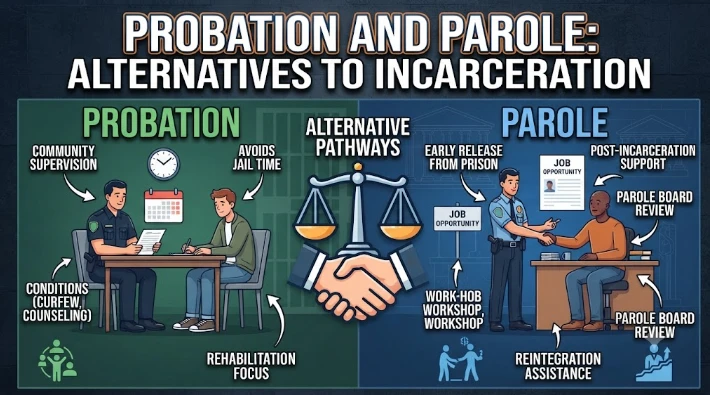
Probation and parole are presented as essential community-based alternatives to incarceration that combine supervision, accountability, and reintegration. Probation generally allows eligible offenders to remain in the community instead of serving a prison sentence, while parole provides conditional release after part of a custodial sentence has been completed. The article explains that both approaches can preserve employment, family ties, education, and housing, all of which reduce the risk of r
This article defines the ethical boundaries that protect volunteers who support visitor safety and law-enforcement-related functions in national parks. Although volunteers can assist with information, observation, traffic support, administrative work, backcountry roves, and reporting hazards, they must not exercise powers such as arrest, detention, search, citation, evidence handling, use of force, or other commissioned enforcement duties. The article emphasizes clear position descriptions, accu