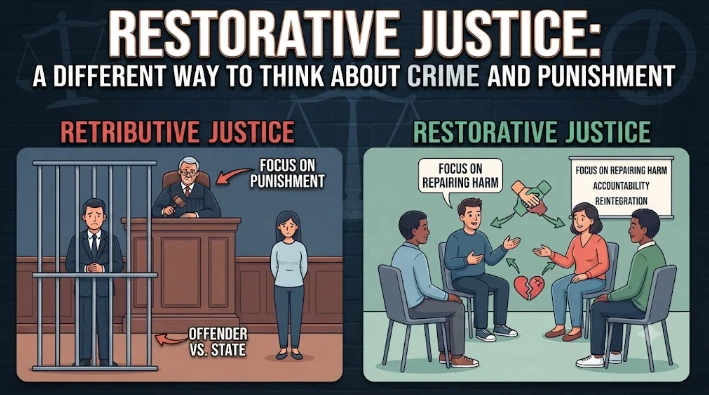
Restorative justice offers an alternative way of responding to crime by focusing on harm, accountability, dialogue, and repair rather than punishment alone. The article explains that traditional retributive systems often center on the violation of law and the sanction imposed on the offender, while victims may remain unheard and communities may gain little opportunity for healing. Restorative processes such as victim-offender mediation, conferencing, and circles bring together those harmed, those responsible, and relevant community members. Victims can describe the impact of the offense, while offenders are required to confront the human consequences of their actions. The article links restorative practices with lower recidivism, higher victim satisfaction, and reduced justice costs, while also showing their use in schools and workplaces. However, successful implementation depends on voluntariness, fairness, professional facilitation, and genuine offender accountability. Overall, restorative justice reframes justice as a process of repairing relationships, rebuilding trust, encouraging responsibility, and preventing future harm without eliminating the need for proportionate legal consequences.
In the year , when societies struggle to find balance by juggling justice, the concept of crime, punishment, and accountability is experiencing a major change. Over decades, legal systems have been led by a retributive paradigm which focused on the breach of the law and punishment where the main question is always answered by what is the law and how do we punish the offender. Such a strategy puts the priority on causing consequences over the comprehension of harm, tends to make victims silent, isolate criminals and ignore the scope of social and emotional consequences of crime. However, over the last few years, there is a growing literature and experience on the shortcomings of a purely punitive style. The high recidivism rates, overflowing prisons, and aggravated victims have heightened the realization that punishment cannot be effective. Restorative justice has responded by presenting itself as a actively rigorous, evidence based alternative that aims at repairing the harm, developing responsibility, and healing the communities instead of emphasizing on retribution. It does not give offenders an easy way out but it is a disciplined method that involves active participation, contemplation and change.
Fundamentally, restorative justice is based on principles of the so-called Encounter, which is a formal communication between the persons who were harmed, the perpetrators, and the wider society. In contrast to the traditional court proceedings, which are adversarial and usually emotionally detrimental to victims, restorative justice focuses more on human contact, understanding, and communication. As victims, they receive an opportunity and a stage to explain the aftermath of the crime on their lives, feelings and relationships. It obliges the offenders to directly face the consequences of their actions, and it leads to empathy, self-awareness, and a better insight into personal responsibility. According to the latest reports of the organizations, including the United Nations Office on Drugs and Crime and Penal Reform International, restorative justice practices, victim-offender mediation, conferencing, and circles are becoming the elements of the contemporary rehabilitative approaches. The strategy underlines the fact that crime is essentially a derailment of human relations and not just the violation of legal codes, that perpetrators are under obligation to remedy the damages they inflict and that the community is key in the process of ensuring accountability and facilitation.
The examples of restorative justice in and indicate that it provides quantifiable results in various areas. Its impact on recidivism is one of the most strong indicators. According to meta-analyses done in the recent years, restorative programs have shown a reduction in recidivism by about 14-20 percent in comparison with traditional legal processes. A good example of how a system that is highly restorative in scale can be deployed is Norway, where recidivism rates among people in the system are about 20 percent, one of the lowest in the world. These statistics are especially remarkable since they indicate that transformative human interaction can be more effective than punitive actions, even in the area where the conventional incarceration traditionally prevailed. The advantages go beyond the offenders to the victims who usually have an in-depth satisfaction when their voices are heard and confirmed. According to surveys, 85 percent of those who have participated in face-to-face restorative sessions express satisfaction with the process, which stands sharply to an approximation of 57 percent of participants being content with the proceedings in the conventional court systems. This result is important not only in terms of ethics, but it can also be linked to the increased trust in institutions of law, more crimes reporting and the better social cohesion.
Restorative justice is also important by its economic implications. Restorative practices are also a high payoff investment in justice systems because they can reduce recidivism and minimize the use of expensive incarceration. In each dollar used to aid a restorative session, studies have proposed that up to eight dollars will be saved in terms of crime-related expenses, diminished prison numbers, and decreased court infrastructure dependency. To discuss it further, in a report on youth justice initiatives in Australia ( ) the authors have determined that restorative conferencing has saved over one hundred million dollars in a five-year period. Such savings are not only financial but also in terms of less social cost of victimization, family interruption, and community traumas. Such data come at the right time when the general budgets in communities are tight and prisons are still in a state of overcrowding.
Restorative principles are also spreading out of formal legal systems, to schools, workplaces, and other social institutions. Restorative circles and programs aimed at conflict resolution are being used to substitute the traditional punitive approaches in educational settings, particularly suspensions and expulsions. Schools that adopt such practices record significant behavioral incidences, bullying and absenteeism. Changing the emphasis of punishment towards knowing helps teachers to make students aware of the impact of their actions on the other students, their teachers, and the educational institution. The change focuses on relational repair and social accountability, which teaches young people that responsibility has a relationship with the wellbeing of others. On the same note, workplaces are also adopting the concept of restorative methods in addressing interpersonal conflicts, harassment cases, and performance problems. Human resources departments are trying out facilitated conversations, mediated regrets, and behaviorally-oriented interventions that have cultural mending over simple dismissment of employees. These uses illustrate that restorative justice can be implemented as not only a legal instrument but also as a model of developing a sense of accountability, empathy, and overall wellbeing of the community in any context of harm.
Even though restorative justice has been proven to have a positive effect, it has challenges and limitations. It is more dependent on voluntariness because the victims and the criminal have to be willing to engage in it to make it meaningful. Coercion defeats trust, credibility and the possibility of true responsibility. Social-level inequalities are also an impediment. According to the data of , the minority youth and marginalized groups remain underrepresented in restorative programs, which represent the differences in accessing diversionary justice, resources, and professional facilitation. This asymmetry explains the necessity to intentionally undertake policy measures that would provide fair access and avoid the cases when restorative practices would reproduce the old biases in criminal justice system. The other consideration is suitability. Although restorative justice may be used to address a wide set of crimes, including high-profile crimes, it involves the offenders being held entirely accountable to their deeds. Devoid of sincere recognition of damage, the process may appear superficial and it will not bring actual knowledge, healing, or change. Such constraints do not disregard the concept of restorative justice, but emphasize the need to implement it carefully, constantly monitor it, and supervise it by the professional.
The humanization of crime is one of the most significant restorative justice strengths. Victims receive a voice where they share their personal impacts of the crimes, question and answer sessions, which they would never receive in a typical court setting. This involvement empowers the individuals, reinstates their agency, and de-escalates aspects of helplessness that are usually associated with victimization. To criminals, witnessing the human consequences of their deeds may be an eye-opener, a painful experience, and may lead to permanent behavioral reform. Such accountability is more transformative and is often more visible, emotional and direct than standard punishment. Restorative justice is encouraging because it establishes an environment where empathy and dialogue and responsibility can be achieved even in the case when the damage is of a serious nature.
In the future, the introduction of restorative principles into the justice system can be seen as the transition to the more healing-focused approach to social governance. It is not aimed at eliminating the traditional system but completing it so that the punitive measures should be laid down with an equal balance of the possibility of repairing the offense, reconciliation, and development. Restorative justice does not imply that the crime is not to be punished or the rights of the victims are not to be overlooked. Instead, it re-askes the question of justice: rather than asking only how to make guilty evil wrong, it asks how to recover balance, heal relationships and avert future injuries. This paradigm shift demonstrates a more profound knowledge of human behavior, society and the spill over of crime. It understands the fact that we can never reverse the past but we can shape our future by behaving, ethically and positively.
In practice, there needs to be systemic investment in training, facilitation, infrastructure, and evaluation to develop restorative justice. Justice practitioners, instructors, and workplace leaders need to be empowered to lead such processes, arbitrage delicate conversation, and make the restorative endeavors to be safe, fair, and willful. Technology can also facilitate this, especially in increasing restorative conferencing, observing adherence, and continuity in complex or geographically spread communities. Nevertheless, the nature of restorative justice is essentially human: involvement of minds, hearts, and social responsibility. By this, its effectiveness depends not only on procedural efficiency but also on the desire of communities to accept dialogue, empathy and accountability as the core of safety and justice.
The extension of restorative justice is more than the reduction of crimes in the short term. Restorative models are able to enhance social cohesion, enhance trust in institutional bodies and help foster a culture in which accountability is perceived as relational and not necessarily punitive by focusing on human experience. With increased jurisdictions in the experimentation of restorative conferencing, victim-offender mediation and community-based strategies, increasing evidence suggests that societies who embrace these ideals have not only reduced recidivism, but also stronger communities and empowered citizens. The spill over effects are immense: when the harm is dealt with at the grassroots, when victims get listened to, when offenders are steered in the directions of constructive responsibility, there is a possibility of culture of justice that emphasizes repair instead of vengeance, education instead of blame and prevention instead of punishment.
Finally, restorative justice is a revolutionary change of societal perceptions of crime and punishment, as well as social accountability. It makes us remember that law does not only consist of penalties but it is the structure of human relations and moral responsibility. Restorative practices offer an alternative model of justice that is fairer than just and demonstrably safer by remedying the issues through repair, dialogue, and community intervention. By and further on, it will be necessary to keep incorporating these principles into law, schools, workplaces and communities so that the reaction to harm is considered considerate, commensurate, and truly restorative. In this way, societies will be able to leave behind the constraints of retributive systems and create a future in which justice is not equated with pain but with harm that is resolved, relationships that are repaired and trust that is regained. Restorative justice is not an experiment in policy but rather a moral and practical avenue to safer and more humane world and its values could eventually change the nature of living in the world where accountability, empathy and collective responsibility are the standards and values of living.
CITE THIS ARTICLE
Das, B. C. (2025). Restorative Justice: A Different Way to Think About Crime and Punishment. https://www.bikashchandra.com/article/d099f374-ac77-5d87-8b3f-a9cab204c2d9
B. C. Das, “Restorative Justice: A Different Way to Think About Crime and Punishment,” 2025. [Online]. Available: https://www.bikashchandra.com/article/d099f374-ac77-5d87-8b3f-a9cab204c2d9
Das, B. C. (2025) ‘Restorative Justice: A Different Way to Think About Crime and Punishment’. Available at: https://www.bikashchandra.com/article/d099f374-ac77-5d87-8b3f-a9cab204c2d9
Das, Bikash Chandra. “Restorative Justice: A Different Way to Think About Crime and Punishment.” 2025, https://www.bikashchandra.com/article/d099f374-ac77-5d87-8b3f-a9cab204c2d9.
Bikash Chandra Das. “Restorative Justice: A Different Way to Think About Crime and Punishment.” (2025). https://www.bikashchandra.com/article/d099f374-ac77-5d87-8b3f-a9cab204c2d9.
Das BC. Restorative Justice: A Different Way to Think About Crime and Punishment. 2025. https://www.bikashchandra.com/article/d099f374-ac77-5d87-8b3f-a9cab204c2d9
@misc{article_d099f374ac775d878b3fa9cab204c2d9,
  title = {Restorative Justice: A Different Way to Think About Crime and Punishment},
  author = {Bikash Chandra Das},
  year = {2025},
  url = {https://www.bikashchandra.com/article/d099f374-ac77-5d87-8b3f-a9cab204c2d9},
}
TY  - GEN
AU  - Bikash Chandra Das
TI  - Restorative Justice: A Different Way to Think About Crime and Punishment
PY  - 2025-06-11
UR  - https://www.bikashchandra.com/article/d099f374-ac77-5d87-8b3f-a9cab204c2d9
ER  -
This article explores why people volunteer in America’s national parks and how program design influences whether service remains meaningful. Volunteer motivations often overlap and include personal values, learning, social connection, career development, confidence, purpose, and attachment to place. The article uses motivational frameworks to show that volunteers are more likely to remain engaged when they experience autonomy, growing competence, respectful relationships, and a clear connection
Probation and parole are presented as essential community-based alternatives to incarceration that combine supervision, accountability, and reintegration. Probation generally allows eligible offenders to remain in the community instead of serving a prison sentence, while parole provides conditional release after part of a custodial sentence has been completed. The article explains that both approaches can preserve employment, family ties, education, and housing, all of which reduce the risk of r
This article defines the ethical boundaries that protect volunteers who support visitor safety and law-enforcement-related functions in national parks. Although volunteers can assist with information, observation, traffic support, administrative work, backcountry roves, and reporting hazards, they must not exercise powers such as arrest, detention, search, citation, evidence handling, use of force, or other commissioned enforcement duties. The article emphasizes clear position descriptions, accu