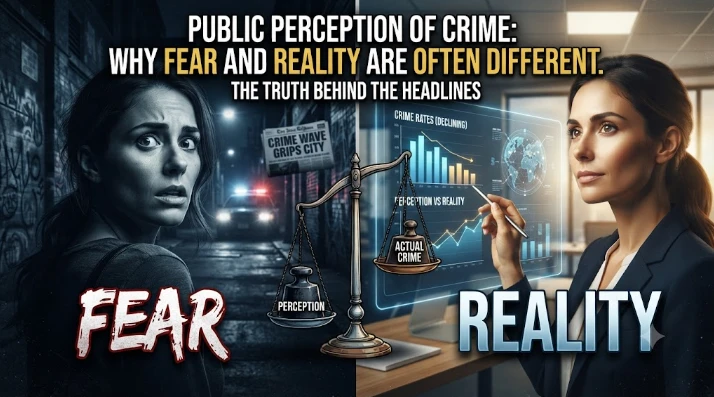
Public fear of crime often differs sharply from measured crime patterns, and the article explores why perception can remain high even when some forms of crime are stable or declining. Media coverage, social media algorithms, emotionally powerful “signal crimes,” neighborhood alerts, and repeated exposure to sensational incidents can make rare events feel common. Psychological processes such as the availability heuristic also cause people to judge risk based on vivid examples rather than statistical probability. The article notes that visible social disorder, homelessness, and public mental health crises may be interpreted as signs of serious crime even when they are not direct indicators of violent offending. At the same time, less visible digital victimization may be underestimated despite its frequency. Misperceptions can influence elections, policing strategies, sentencing policy, neighborhood investment, and social trust. The article therefore supports transparent crime data, victimization surveys, community policing, media literacy, and evidence-based public communication. Closing the gap between fear and reality can help communities allocate resources more rationally while maintaining informed vigilance.
Looking at the social media feeds or local news channels in March , one might assume that the society is in the middle of the crime wave which has never been witnessed before. The warnings about increasing retail theft, automated frauds, and urban decay are highlighted in bold, and it makes people always feel the threat of something serious. However, when analyzing the raw data presented by national statistical agencies and international criminological institutes, the picture can much more likely be defined as quite different. The situation in most parts has seen crime rates go either stable or even falling showing a continued misalignment between perception and reality. It is one of the most urgent issues of contemporary criminology as people are becoming more and more afraid of harm than the reality, making policies, city planning, and social cohesion in a manner that can only contribute to more harm instead of minimizing it.
As the data shows, the concern of the population regarding crime has skyrocketed, but objective data on crime many times tells a more complicated story. In such surveys as the Gallup Crime Poll and the Lloyds Register Foundation World Risk Poll, it is observed that even in those areas in which the reduction in violent crime (4-7 percent over the past two years) has been realized, more than two-thirds of people feel less safe now than they were three years ago. This paradox brings out an important fact that crime perception by the populace is not necessarily a responsive factor according to the occurrences, but a socially and psychologically constructed factor which is shaped by media, anecdotal and environmental stimuli. The fact that this fear continues to exist even as crime indicators are changing towards better numbers speaks to the necessity of evidence-based communication to the general populace and the careful planning of criminal justice measures that not only confront reality but also perception.
Signal crimes are one of the key determinants of the fear of the people. The criminologists refer to signal crimes as certain high-profile or emotionally charged incidents that are overly represented in the perception of the community. A carjacking or an act of violence as captured on camera can spread out the neighborhoods and social circles just in a single daylight, giving the appearance of an act of complete anarchy. The amplification of such events in is compounded by social media where videos and posts can be watched by millions of people in a few hours and the areas served are far beyond the immediate area. Such materials are circulated constantly, a fact which leads to the increased alertness level, distorting the perception of real risk and instilling anxiety in the mass consciousness. Even in situations with low statistical risk, such signal crimes act as mental shortcuts, creating the discourse of safety and threat in our daily lives.
Digital victimization is another source of an addition to the perception-reality gap. Statistics show that by , one is likely to become a victim of cybercrime (financial scams, identity theft, phishing attacks, etc.) about twenty times as often than a person will be attacked by someone in the street. Although there are a greater number of digital crimes in the world, they are almost impossible to see with the naked eye and do not have the direct emotional response that a violent crime can instill. The outcome is a discrepancy between perceived and actual risk, with the former focused on the rare and highly visible crimes and the latter underestimated because of its frequency. This disparity makes the development of a public policy and community planning more difficult because the actions that are implemented to reduce fear might not be similar to the actions that can reduce an actual damage.
A number of social and environmental pressures exaggerate the danger. The psychological effect of being bombarded with media news of crime and violence all the time was initially referred to as the Mean World Syndrome by communications scholars. The influence is amplified in , with the 24-hour news cycle, and social media algorithms, which give preference to the sensational content. The platforms prioritize high-arousal posts and this forms a feedback mechanism where individual events have been magnified to seem systemic. The neighborhood applications like Nextdoor or Citizen are a part of this cycle since they send micro-level notifications to broadcast each reported suspicious individual or petty crime as a community event. The residents undergo a constant flow of stimuli which support vigilance and anxiety, although objective risk may be low.
Perceptions are also influenced by the physical and social environment. Broken windows theory initially concerned with minor physical disorder has changed in the modern society to include social disorder. Homelessness, mental health crisis, and intoxication in the streets are the visible manifestation of homelessness that the communities tend to understand as signals of violent crime. By , the intersection of social vulnerability and criminality has also enhanced fear in urban centers which are characterized by stigmatization, over-policing, and policy actions that are not necessarily aligned to the real harm patterns. Human reactions to the environment are not those of the objective observer but of the players within socially mediated discourse of danger and perpetuate cycles of anxiety and avoidance.
Heuristics in psychology are very significant. Human beings use cognitive shortcuts when evaluating risks, and availability heuristic affects them especially. One bright experience or anecdote, such as the theft of a neighborhood car, a mugging incident near a local school, would have a greater effect than all the statistical data gathered that the neighborhood is a relatively safe place to live. Such a mental shorthand makes people exaggerate the occurrences and probability of unfavorable occurrences, further enhancing the perception-reality gap. This is multiplied in , with social media, where the news is not only memorable, but shared, commented on, and algorithmically amplified repeatedly, increasing the perception of an ever-present threat.
The effects of excessive popular panic are immense. In the case of misperception of reality, the course of action by the policy makers is usually a direction characterized by panic and not evidence. In order to alleviate the anxiety that rises, politicians react with very visible yet possibly futile actions, more policing, tougher sentencing, and no-tolerance stances. The and statistics also suggest that this type of reactive actions often redirects funds into other unproven measures like community mental health, early youth involvement, and crime prevention efforts. Such misplaced priorities may long-term affect the safety of the citizens and their social trust adversely.
Implications on the economy are also important. The perceived risk is a behavior driver of acts like urban flight whereby people and companies move out of areas that are deemed unsafe. Such migration lowers the domestic tax base, decreases investment and, ironically enough, makes the same conditions that lead to social disarray even more serious. The problem of decline in the economies of areas may lead to a rise in crime not because of a burst of crime but as a side-effect of not investing there, with falling levels of social cohesion, and the weak informal social controls. This is enhanced by social isolation that fear does not encourage the residents to interact with each other in the community, keep watch of their neighborhoods, and support one another. Ironically, fear in itself can establish such weak points that crime prevention strategies are meant to seal.
Criminologists in , in turn, support the importance of open and evidence-based communication. Victimization surveys are used to supplement the conventional police statistics which identify the incidents that go undetected or otherwise elusive to the formal police reporting frameworks. Communities can now get current data on the crime within their neighborhoods through the real-time transparency dashboards, reducing the impact of misinformation and anxiety based on rumors. The purpose of these tools is to bring the public understanding closer to the real risk so as to give the citizens context and perspective as well as enabling them to be constructive in their interaction with the law enforcement. This is further consolidated by community policing tactics, which officers are actively involved in the creation of trust and social cohesion by providing non-confrontational interactions, which creates informal social controls that may avert crime before it becomes a problem.
The issue of perception and reality is a key insight into criminal justice in , and it is important to remember that fear is a social construct and a policy variable of the people. Although actual crime bears a real threat, its image, created by the media, surroundings and personal experience, might have just as strong ramifications upon social behavior, resource distribution, and social structure. The problem of perception-reality gap cannot be resolved merely as an academic exercise; it is an actual demand in the development of effective policy and fair allocation of resources and the preservation of public confidence.
After all, the criminal on the street is not the only threat to the overall safety of the people but rather the fear that has transformed our perception of the community safety. To reduce the perception-reality point in , the holistic approach that consolidates transparent information, evidence-based communication, community involvement, and media literacy will be used. Through the identification of the social, psychological and structural factors that propagate fear; the policymakers, law enforcement agencies and citizens are in a position to create a society that is safe and well informed. The societal crime perception should not be perceived as a true reflection of the reality, but as a prism that can be influenced by so many forces, each with the ability to increase anxiety, or become more resilient. An open system of justice, one that values transparency, context, and a critical awareness can contribute to ensuring that safety is not a panicked response but an evidence based one and that communities are enabled to respond rationally to issues as opposed to an emotional response. This way the society can change this culture of fear to that of informed vigilance where allocation of resources is done in a wise manner, trusts in institutions are enhanced and citizens can confidently and clearly engage themselves in protection of the society.
CITE THIS ARTICLE
Das, B. C. (2025). Public Perception of Crime: Why Fear and Reality Are Often Different. https://www.bikashchandra.com/article/edaaf2a8-30b7-5979-847f-7e2b6a81a863
B. C. Das, “Public Perception of Crime: Why Fear and Reality Are Often Different,” 2025. [Online]. Available: https://www.bikashchandra.com/article/edaaf2a8-30b7-5979-847f-7e2b6a81a863
Das, B. C. (2025) ‘Public Perception of Crime: Why Fear and Reality Are Often Different’. Available at: https://www.bikashchandra.com/article/edaaf2a8-30b7-5979-847f-7e2b6a81a863
Das, Bikash Chandra. “Public Perception of Crime: Why Fear and Reality Are Often Different.” 2025, https://www.bikashchandra.com/article/edaaf2a8-30b7-5979-847f-7e2b6a81a863.
Bikash Chandra Das. “Public Perception of Crime: Why Fear and Reality Are Often Different.” (2025). https://www.bikashchandra.com/article/edaaf2a8-30b7-5979-847f-7e2b6a81a863.
Das BC. Public Perception of Crime: Why Fear and Reality Are Often Different. 2025. https://www.bikashchandra.com/article/edaaf2a8-30b7-5979-847f-7e2b6a81a863
@misc{article_edaaf2a830b75979847f7e2b6a81a863,
  title = {Public Perception of Crime: Why Fear and Reality Are Often Different},
  author = {Bikash Chandra Das},
  year = {2025},
  url = {https://www.bikashchandra.com/article/edaaf2a8-30b7-5979-847f-7e2b6a81a863},
}
TY  - GEN
AU  - Bikash Chandra Das
TI  - Public Perception of Crime: Why Fear and Reality Are Often Different
PY  - 2025-10-01
UR  - https://www.bikashchandra.com/article/edaaf2a8-30b7-5979-847f-7e2b6a81a863
ER  -
This article explores why people volunteer in America’s national parks and how program design influences whether service remains meaningful. Volunteer motivations often overlap and include personal values, learning, social connection, career development, confidence, purpose, and attachment to place. The article uses motivational frameworks to show that volunteers are more likely to remain engaged when they experience autonomy, growing competence, respectful relationships, and a clear connection
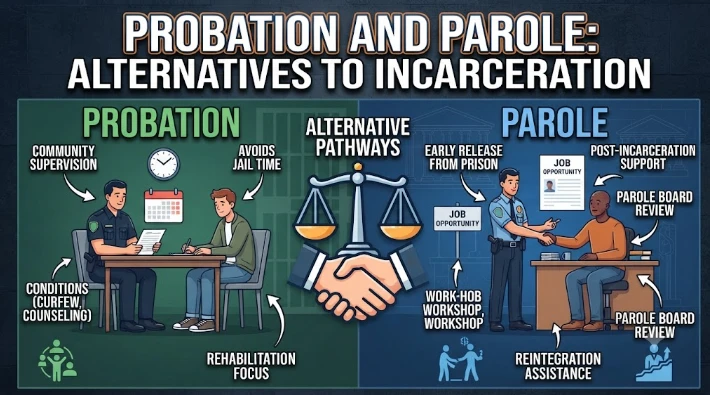
Probation and parole are presented as essential community-based alternatives to incarceration that combine supervision, accountability, and reintegration. Probation generally allows eligible offenders to remain in the community instead of serving a prison sentence, while parole provides conditional release after part of a custodial sentence has been completed. The article explains that both approaches can preserve employment, family ties, education, and housing, all of which reduce the risk of r
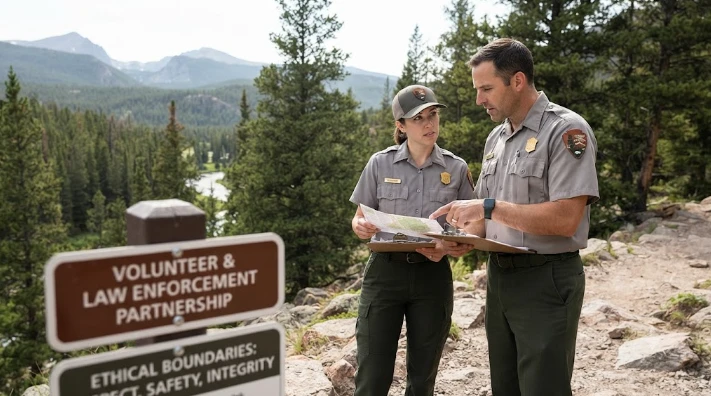
This article defines the ethical boundaries that protect volunteers who support visitor safety and law-enforcement-related functions in national parks. Although volunteers can assist with information, observation, traffic support, administrative work, backcountry roves, and reporting hazards, they must not exercise powers such as arrest, detention, search, citation, evidence handling, use of force, or other commissioned enforcement duties. The article emphasizes clear position descriptions, accu