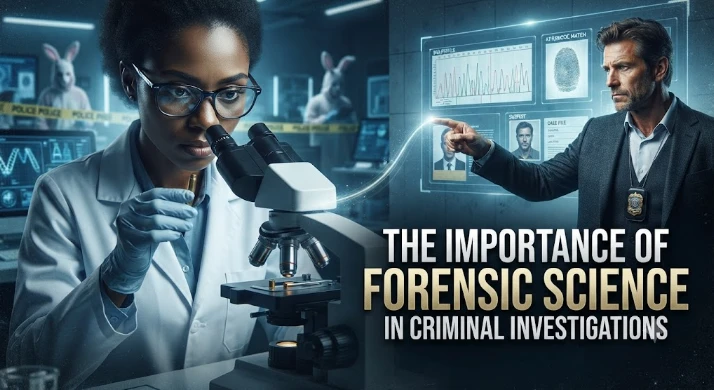
Forensic science is described as a central bridge between crime scenes, investigations, and courtroom decision-making. The article covers DNA analysis, next-generation sequencing, rapid DNA technology, fingerprints, biometrics, trace evidence, ballistics, digital forensics, and techniques for identifying manipulated media. These methods allow investigators to connect people, objects, locations, and digital activity with greater speed and precision than traditional investigation alone. Mobile devices and wearable technologies are especially important because they can provide communication, location, and biometric information relevant to criminal events. However, the article also stresses that forensic evidence is not automatically infallible. Human error, cognitive bias, laboratory backlogs, weak chain-of-custody procedures, and overstated conclusions can undermine reliability. Public expectations created by crime television may also encourage jurors to assume that scientific evidence is always available or conclusive. Responsible forensic practice therefore requires validated methods, quality control, blind testing, ethical standards, specialized training, and careful interpretation. Used properly, forensic science can identify offenders, exclude innocent suspects, reconstruct events, and strengthen the fairness of criminal investigations.
The fight against crime is frequently won in the silent laboratories, high-tech clean rooms, and field units of also before a criminal is ever interviewed or a jury is ever assembled. Forensic science the use of scientific procedures in cases of law has become the mute witness of the justice system that offers objective mediating factor between the anarchy of a crime scene in comparison to the order of a courtroom. It has massively grown to be beyond the gathering of physical evidence, with the incorporation of molecular biology, digital analytics, and advanced imaging to serve law enforcement purposes and guarantee the integrity of the judicial process. The global forensic technology market is expected to amount to about twenty six billion dollars in the early year with the market growth rate exceeding twelve percent per annum. The cause of this expansion is a technological revolution that has brought the processing time down to zero in many cases and created new possibilities in analyzing evidence. Once-weeks-long lab work can now be done in hours and traces once left digitally on smartphones, computers and wearable devices can be re-assembled with a precision previously in uncharted territory, providing an evidentiary assurance that would have been considered unfathomable just ten years prior.
The cornerstone of forensic science is that everything that touches leaves a trace and in the developments, the investigators are now able to trace the traces at the molecular level. The gold standard of individual identification is still DNA analysis, although the discipline has reached the period of Next-Generation Sequencing whereby high-complexity or damaged samples can be read with impressive accuracy by the laboratory. The use of portable rapid DNA units is now a common practice at the crime scene and they are able to create genetic profiles within less than ninety minutes and offer leads in real-time that might have taken days or weeks to provide leads. Organizations like the National Institute of Standards and Technology have developed new reference materials and protocols of interpretation to assist forensic analysts in making sense of samples that may have been destroyed due to environmental influence or be in a complicated mixture of DNA of more than two people. These developments have transformed the consistency of forensic evidence with a significant increase in speed in the timeline of the investigations as well as empower the police to move swiftly in current investigations.
Other traditional forensic methods like fingerprinting and biometrics have been revived as well. Now it is possible to scan millions of records within seconds with the help of Automated Fingerprint Identification Systems and the artificial intelligence provides better opportunity to capture partial prints, smudge, and patterns that human analysts could have missed. Not limited to fingerprints, biometric analysis has also extended to iris scanning, gait scanning and even the microbial cloud that individuals leave behind in the indoor setting. These microscopic identities have the ability to implicate a suspect to a place with an exceptional level of precision offering a many dimensional method of identification that incorporates both traditional and contemporary sciences. This biological, physical, and biometric convergence is the embodiment of how forensic science in will go beyond the visible and tangible to identify patterns and connections that cannot be otherwise seen by human eye.
Digital aspect of forensic science is the most rapidly increasing and most important segment of evidence gathering. With almost seven billion people on earth having access to smartphones, mobile forensics has become the lead in the investigations in more than eighty percent of criminal cases. Wearable devices have now enabled investigators to recover deleted messages, geolocation data, and biometric information including heart rate or sleep patterns that allow them to gain a level of insight into the actions and movement of victims as well as their suspects like never before. Simultaneously, the emergence of AI-generated media has brought new issues to the task of forensic professionals. The use of deepfake has also posed the threat of fake videos and audio clips to be used to distort research or corrupt the mind of people. Boundary artifacts, pixel anomalies, and other indicative features that can be used to point to the fact that evidence is being manipulated are now being identified using specialized algorithms that enable forensic analysts to identify genuine evidence and a high-quality forgery. This digital forensic has become an essential part of the world where crime is increasingly becoming more technologically entangled and where conventional methods of investigations cannot guide investigators through complicated web networks.
Trace evidence has been a cornerstone of forensic science, which provides essentials in the study of microscopic objects like hair, fiber, glass, soil and pollen. The study of pollen and spores or forensic palynology has been valuable in proving that a suspect was present at a certain place. A case, which is a notable case, involved soil found on the shoes of a suspect that had a rare pollen grain that could only have been in one park, which supported the leads of the investigation and placed the suspect on the crime scene despite contradicting claims of alibi. Ballistics has also developed with three dimensional pictures and high-speed photography meaning that detectives can match bullets to certain weapons with an essentially flawless degree of precision by examining the distinctive striations that are left on each bullet. These methods offer an empirical and scientifically based procedure of connecting individuals and objects with criminal behavior, which increases the credibility of prosecution evidence and improves the effectiveness of the integrity of the judicial system as a whole.
Nevertheless, forensic science is not the most powerful despite its remarkable strength. Analysts are humans themselves, and there is always a possibility of inaccuracy due to inaccuracy of human error, bias, and misinterpretation. The private perception has also been impacted by the so-called CSI Effect which has developed unrealistic expectations among the jurors who believe that the forensic evidence is naturally available and conclusive. Most crime scenes in the real world provide no useful DNA, fingerprints, or digital evidence, and even interpretation of trace evidence is a subjective process. Most forensic evidence does not give an absolute certainty other than that evidence is consistent with a suspect or a scenario except in the case of DNA. These are further aggravated by backlogs in forensic laboratories. The cost of high-tech equipment is also high, and staffing issues, in combination with the increase in the number of cases, triggered the delays in testing, and some DNA kits take more than a year to be analyzed. These restrictions remind of the importance of the careful communication, strict quality control and professional development to guarantee the sustainability of the credibility and effectiveness of the forensic investigations.
The ethical and training aspects of this responsible use of forensic science are of central focus. Evidence integrity is based on the careful care of the chain of custody, and any lapse in the documentation can make evidence inadmissible before the judge. The other issue that has significant concerns is cognitive bias because analysts who know the record of a suspect can subconsciously interpret ambiguous evidence and lead to the confirmation of previously held assumptions. In order to reduce these risks, contemporary forensic laboratories use blind testing methods, and analysts are not informed of the details of the case, which may impair their thinking. Moreover, AI and next-generation sequencing have increased the need to find specialized competencies in data science, bioinformatics and digital analysis. It is hard to overestimate the sophistication and interdisciplinary complexity of modern forensic work, and the result is that the field of forensic professionals with advanced technical skills has been swelling by over forty percent in the past year alone.
The significance of forensic science is not limited to the cases of criminal justice but also to the overall operation of the criminal justice systems. Data that has been objectively and scientifically proven adds to the effectiveness of investigations and increases the credibility of prosecutors, as well as the fair trial end result. It is able to clear the innocent, determine those who are repeat offenders, and also give invaluable information based on criminal behavior patterns that will be used to prevent crimes. By , biological, physical and digital evidence will be integrated to enable law enforcement to create all purpose multi-dimensional profiles that will aid in both reactive and proactive crime prevention efforts. In complicated cases, including cybercrime, organized networks, or multi-jurisdictional crimes, the scientific method is especially essential because conventional investigation tools are not enough to determine accountability, or even track crime.
As a scientist, the future of forensic science in the field of criminal justice is both threatening and very promising. The technological advances will further increase the accuracy of the analytical results, decrease the time required, and increase the diversity of the possible evidence that can be retrieved and analyzed. Meanwhile, ethical, legal and operational issues will still be of high concern. Labs should be of high standards, access to technology should be just, and professionals should still be trained on the scientific approach, and the ethical needs that should follow the management of delicate evidences. Expectation management through education of the public is also necessary so that the people can know what the forensic science can do and what it can not do so that there is no over dependence on the technology to the detriment of detailed investigative procedures.
In summary, forensic science in has turned out to serve as the seeker of truth of the criminal justice system. The scientific witnesses, whether at the scene of crime or the evidence, whether it is a single strand of hair or intricate digital evidence, are the voices of the silent, and provide the answer between the disorder of the crime scene and the clarity needed to bring about justice. As a whole, DNA, fingerprints, biometrical signatures, traces, and digital artifacts offer a powerful platform to define the culprits, create a timeline, and support the hypotheses of the investigation. Nonetheless, the effectiveness of these instruments can be either highly effective or completely ineffective depending on the integrity, training, and moral sense of the professionals using them. Science may help to enlighten facts and reveal concealed relationships, yet justice is reached only when the use of forensic evidence is done in a rigorous, fair, and responsible way. In , forensic science will not be an appendix to law enforcing, but a core of the modern criminal justice as societies seek the truth, responsibility and justice in an era of more elaborate and more complex crime.
CITE THIS ARTICLE
Das, B. C. (2025). The Importance of Forensic Science in Criminal Investigations. https://www.bikashchandra.com/article/01d15c8b-234b-5c1e-8181-4896ab6822ea
B. C. Das, “The Importance of Forensic Science in Criminal Investigations,” 2025. [Online]. Available: https://www.bikashchandra.com/article/01d15c8b-234b-5c1e-8181-4896ab6822ea
Das, B. C. (2025) ‘The Importance of Forensic Science in Criminal Investigations’. Available at: https://www.bikashchandra.com/article/01d15c8b-234b-5c1e-8181-4896ab6822ea
Das, Bikash Chandra. “The Importance of Forensic Science in Criminal Investigations.” 2025, https://www.bikashchandra.com/article/01d15c8b-234b-5c1e-8181-4896ab6822ea.
Bikash Chandra Das. “The Importance of Forensic Science in Criminal Investigations.” (2025). https://www.bikashchandra.com/article/01d15c8b-234b-5c1e-8181-4896ab6822ea.
Das BC. The Importance of Forensic Science in Criminal Investigations. 2025. https://www.bikashchandra.com/article/01d15c8b-234b-5c1e-8181-4896ab6822ea
@misc{article_01d15c8b234b5c1e81814896ab6822ea,
  title = {The Importance of Forensic Science in Criminal Investigations},
  author = {Bikash Chandra Das},
  year = {2025},
  url = {https://www.bikashchandra.com/article/01d15c8b-234b-5c1e-8181-4896ab6822ea},
}
TY  - GEN
AU  - Bikash Chandra Das
TI  - The Importance of Forensic Science in Criminal Investigations
PY  - 2025-08-13
UR  - https://www.bikashchandra.com/article/01d15c8b-234b-5c1e-8181-4896ab6822ea
ER  -
This article explores why people volunteer in America’s national parks and how program design influences whether service remains meaningful. Volunteer motivations often overlap and include personal values, learning, social connection, career development, confidence, purpose, and attachment to place. The article uses motivational frameworks to show that volunteers are more likely to remain engaged when they experience autonomy, growing competence, respectful relationships, and a clear connection
Probation and parole are presented as essential community-based alternatives to incarceration that combine supervision, accountability, and reintegration. Probation generally allows eligible offenders to remain in the community instead of serving a prison sentence, while parole provides conditional release after part of a custodial sentence has been completed. The article explains that both approaches can preserve employment, family ties, education, and housing, all of which reduce the risk of r
This article defines the ethical boundaries that protect volunteers who support visitor safety and law-enforcement-related functions in national parks. Although volunteers can assist with information, observation, traffic support, administrative work, backcountry roves, and reporting hazards, they must not exercise powers such as arrest, detention, search, citation, evidence handling, use of force, or other commissioned enforcement duties. The article emphasizes clear position descriptions, accu