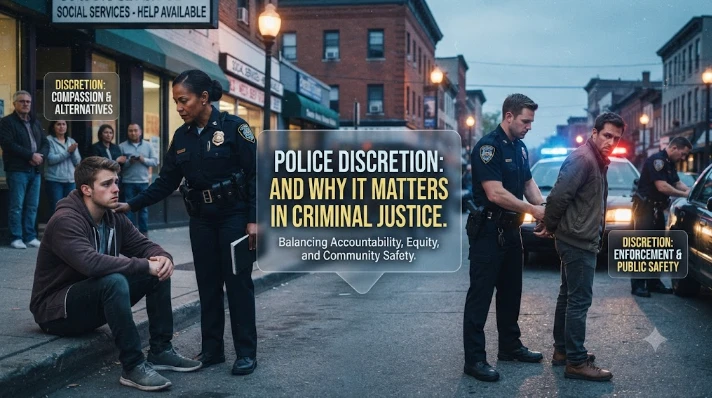
Police discretion refers to the judgment officers use when deciding how to respond to real-world situations that cannot be fully controlled by rigid rules. The article explains that discretion affects whether an officer gives a warning, makes an arrest, refers someone to services, uses force, or chooses de-escalation. Properly exercised, discretion allows policing to account for context, proportionality, vulnerability, and community needs. It can prevent unnecessary arrests and direct people experiencing homelessness, mental health crises, or minor offending toward support. However, discretion also carries risks because implicit bias, neighborhood differences, and unequal assumptions can produce inconsistent outcomes. Technology adds another layer through body-worn cameras, predictive analytics, and algorithmic risk tools, which can increase transparency but also reproduce historical bias. The article therefore emphasizes procedural justice, civilian oversight, duty-to-intervene policies, ethical training, community feedback, and data-based review. Overall, police discretion is portrayed as neither a privilege nor a weakness, but a public trust that must be exercised consistently, transparently, proportionately, and with accountability.
The discretion of an officer in the high-stakes environment of policing in is the most powerful weapon they can wield, despite the fact that a gun, badge, and radio are not the weapons they have been packing. Discretion refers to the act of making judgments, the subtle act of making a decision that directs the reaction of an officer to a complicated situation. It dictates the usage of warning or citation, arrest or referral to social services, the use of force or seeking de-escalation. Real-time policing data indicate that in the first months of , crime rates in most urban centers have leveled off, but still, people cannot trust the police and their decisions are considered to be the crucial factor determining the attitude to fairness, legitimacy, and bias in the community. The actions, moment-by-moment, of officers determine not just the results of a particular event, but also the overall connection between law enforcement and society. It has never been more important to exercise judgment and be impartial.
Police discretion has ever been a two sided sword. On the one hand, it gives the justice system a chance to breath, where human judgment is required to take into consideration the context, empathy and circumstance which cannot be predicted only by strict statutes. Conversely, discretion is risky in nature. The authority which enables officers to exercise mercy can also be abused either deliberately or inadvertently, which causes inequities and distrust. This strain can be observed in in cities, suburbs, and even on the rural setting, which proves that the human component of law enforcement is both essential and fragile. Discretion, without careful advice, may also support structural bias, regional inequity or even blatant power abuse. Meanwhile, a properly practiced discretionary system can humanize policing, create a sense of trust in the community, and decrease conflict in the long-term.
The advantages of discretion are clear when officers use the discretion in regard to the severity, situation, and social consequences. The strict application of all the laws would overload the courts, congest the prisons and estrange the population. Discretion also enables the officers to divert resources to violent crimes without over-penalising minor offences. In , one can find numerous instances in which discretion can save the life of people but diminish unnecessary fights. Officers have an option of referring a homeless person who commits a low-level survival-based crime to a Mobile Crisis Team instead of arresting them as a means of providing a platform to services that help solve the root cause of the problem. Likewise, the de-escalation policies are becoming more supportive of police officers not arresting in the cases when the negotiation or mediation would maintain long-term peace and stability in the neighborhood. In a number of ways, discretion is the process that has changed policing into something more than a hard and fast system of enforcement and made it an adaptive, responsive process that is sensitive to the lived experience of the communities it serves.
But discretion also has the weakness of the human factor. There is a constant issue of implicit bias. A study conducted in March emphasizes that even conscious officers can discriminate people unconsciously depending on their race, gender, socioeconomic status, or neighborhood background. Geographic disparity or the so-called postal code variable may result in utterly different results of the identical offense in accordance with the region where it is committed. One petty offense could attract a citation in an affluent suburban area and an arrest in a low-serving urban area. In the absence of guardrails, discretion may easily degenerate into intimidation, discrimination, or overtargeting of vulnerable groups, which will serve to discredit the discretion itself. This fact makes it clear that constant monitoring, uniform training, and open accountability systems must be introduced.
The exercise of discretion is being transformed by technology in both in positive and adverse ways. The use of body-worn cameras, which are currently used in more than 80 percent of the largest police departments, have altered the way officers explain their decisions. Although cameras do not necessarily change the behavioral aspect, it compels the officers to explain why they took such actions in real time, and this gives the supervisors, civilian oversight boards, and the community an understanding of how officers make discretionary decisions. These videos bring a sense of openness that has never been established before but they also come with new pressures as officers have to balance between being ethical and providing records of their actions to scrutinize their choices.
At the same time, algorithmic nudges are gaining more and more control over discretionary decision-making. Risk assessment systems, predictive analytics, and real-time data feeds will give officers an operational profile of potential threats, which will guide them to either arrest or apply some other measure. Although these systems are intended to make the decision-making process more consistent and objective, they can also involve the danger of introducing historical biases to predictive systems and strengthening the existing disparities inadvertently. The robotization of guidance is viewed with great hesitation by the population; people tend to trust human decisions more especially when dealing with sensitive and high-stakes contact in their societies. In , the issue will be how to strike a balance between technological support and human intuition to make justice not only fair and responsive.
The accountability of discretional policing has transformed into being reactive based on punishment to being proactive based on stewardship. There are also record levels of civilian oversight boards, which guarantees that the values held by community members rather than internal policy determine the boundaries of reasonable discretionary action. Training on procedural justice also highlights that the way people are handled during discretionary stops has a longer-term effect on the level of trust in the police than the outcome of the enforcement itself. As a duty to intervene policy, now enacted into law by more than forty states, officers are required to intervene when their colleagues are acting unethically, establishing a culture in which discretion has become a shared duty rather than an individual right. According to reports of the Public Policy Institute of California in early , even though racial disparities in the number of stops have been reduced by almost 60 percent since the outbreak of the pandemic, intrusive measures like searches and handcuffing continue to affect Black and Latino inhabitants disproportionately, which underscores the significance of tracking discretionary practices.
The antecedents of discretionary choice go well beyond the on-the-spot experience. All decisions put in or take away of the trust bank of the community. In a way that is exercised fairly, openly and contextually, discretion serves to enhance the social contract and enforce legitimacy of law enforcement. Its inappropriate implementation may promote the feeling of injustice, undermine the trust of the population, and increase the social tensions. In , the police discretion will not be discussed as a privilege, but it will become a liability, a tricky cornerstone between power and accountability, which directly affects social safety and social harmony.
Ethics, continuous professional development and training are key in protecting discretion in a democratic society. In the year , the officers will be better trained in situational awareness, cultural competency and bias mitigation, so that discretion is used wisely and fairly. The leadership programs are focused on mentoring, ethical decision-making models, and reflective practices enabling the officers to evaluate the effects of their decisions. By making such practices part of the day-to-day business, the agencies have the goal of establishing a culture in which discretion is authorized, as well as limited by ideals of justice.
Also, by incorporating the data-based control systems, it is possible to make sure that the discretionary decision-making process will be regarded as objective without eliminating the human factor. Pattern analysis, community feedback, and internal audits can assist in pointing out trends of inconsistency or bias which can be corrected ahead of time. Such measures ensure not only that people are not put in risk, but also contribute to building trust because it shows that there is discretion that is being carried within transparent, accountable and standardized parameters.
Practically, the policing environment in depicts that discretion is a dynamic force in the criminal justice system. The officers have to deal with complicated situations when the correct decision is not necessary defined by the law but is morally and socially correct. Discretion can also avert unnecessary arrests, curb the increasing conflict and facilitation of rehabilitative solutions to those who are going through personal crisis. The further evolution of systems, balancing freedoms and control is a guarantee of such decisions to be informed, deliberate and representative of the law and the community values.
Citizen involvement is still one of the keystones to successful discretionary policing. Community feedback, participatory governance and transparent reporting are some of the new practices that are being integrated by agencies into their models. Police departments enhance mutual understanding, awareness of context, and legitimacy, minimizing chances of confrontations because of perceived unfairness, by encouraging a process of dialogue between the officers and residents. Measuring the effectiveness of discretion in will not necessarily be by the rate of enforcing the law but the quality of the social bonds, the trust developed through the various interactions, and the perceived fairness of the justice system.
Finally, police discretion in is a pillar of democratic policing that exists between the absolute statutes and subtle realities of the human world. It enables officers to operate in a flexible, morally, and proportionate manner without jeopardizing the safety of the population and the cohesion of society. It is difficult to guarantee that discretion should not be a weapon of prejudice or an instrument of injustice. With help of strict training, ethical principles, technological assistance, and open accountability, the contemporary justice system is able to utilize the power of discretion in a responsible manner.
In the remaining part of , the policing vision is simple; discretion should not be regarded as a privilege to exercise, but as a trust to be held by the people. Each of the decisions that are taken in the field has an impact that spread across the communities and affect the views of fairness, legitimacy, and justice. The officers who act with discretion not just in a careful manner but also through facts, morals and strong sense of the social setting can also be of help in the law enforcement as well as the building of trust, compassion and strength in the society. The future of good and human policing in this dynamic world will depend on the gentle balance between authority and accountability so that discretion granted to the officers can reinforce the social fabric as opposed to weakening it.
CITE THIS ARTICLE
Das, B. C. (2026). Police Discretion and Why It Matters in Criminal Justice. https://www.bikashchandra.com/article/20c3f507-1502-5fd1-bd97-abc61189c0c9
B. C. Das, “Police Discretion and Why It Matters in Criminal Justice,” 2026. [Online]. Available: https://www.bikashchandra.com/article/20c3f507-1502-5fd1-bd97-abc61189c0c9
Das, B. C. (2026) ‘Police Discretion and Why It Matters in Criminal Justice’. Available at: https://www.bikashchandra.com/article/20c3f507-1502-5fd1-bd97-abc61189c0c9
Das, Bikash Chandra. “Police Discretion and Why It Matters in Criminal Justice.” 2026, https://www.bikashchandra.com/article/20c3f507-1502-5fd1-bd97-abc61189c0c9.
Bikash Chandra Das. “Police Discretion and Why It Matters in Criminal Justice.” (2026). https://www.bikashchandra.com/article/20c3f507-1502-5fd1-bd97-abc61189c0c9.
Das BC. Police Discretion and Why It Matters in Criminal Justice. 2026. https://www.bikashchandra.com/article/20c3f507-1502-5fd1-bd97-abc61189c0c9
@misc{article_20c3f50715025fd1bd97abc61189c0c9,
  title = {Police Discretion and Why It Matters in Criminal Justice},
  author = {Bikash Chandra Das},
  year = {2026},
  url = {https://www.bikashchandra.com/article/20c3f507-1502-5fd1-bd97-abc61189c0c9},
}
TY  - GEN
AU  - Bikash Chandra Das
TI  - Police Discretion and Why It Matters in Criminal Justice
PY  - 2026-02-04
UR  - https://www.bikashchandra.com/article/20c3f507-1502-5fd1-bd97-abc61189c0c9
ER  -
This article explores why people volunteer in America’s national parks and how program design influences whether service remains meaningful. Volunteer motivations often overlap and include personal values, learning, social connection, career development, confidence, purpose, and attachment to place. The article uses motivational frameworks to show that volunteers are more likely to remain engaged when they experience autonomy, growing competence, respectful relationships, and a clear connection
Probation and parole are presented as essential community-based alternatives to incarceration that combine supervision, accountability, and reintegration. Probation generally allows eligible offenders to remain in the community instead of serving a prison sentence, while parole provides conditional release after part of a custodial sentence has been completed. The article explains that both approaches can preserve employment, family ties, education, and housing, all of which reduce the risk of r
This article defines the ethical boundaries that protect volunteers who support visitor safety and law-enforcement-related functions in national parks. Although volunteers can assist with information, observation, traffic support, administrative work, backcountry roves, and reporting hazards, they must not exercise powers such as arrest, detention, search, citation, evidence handling, use of force, or other commissioned enforcement duties. The article emphasizes clear position descriptions, accu