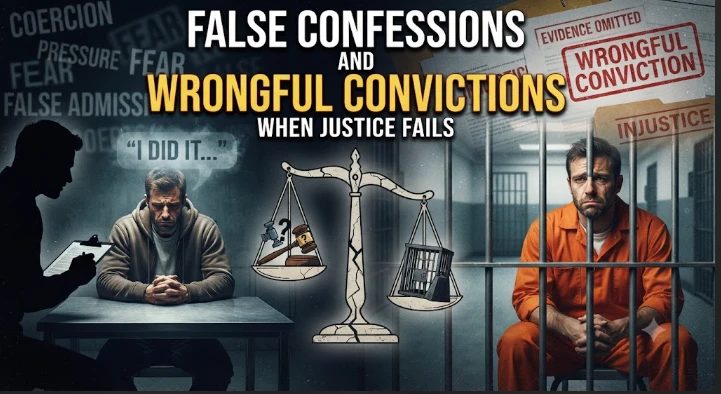
False confessions and wrongful convictions are presented as serious failures of justice because they punish innocent people while allowing the actual offender to remain free. The article explains that wrongful convictions usually result from multiple interacting weaknesses rather than a single mistake. False confessions can arise from lengthy, accusatorial, or coercive interrogations, particularly when suspects are exhausted, frightened, young, or psychologically vulnerable. Eyewitness misidentification is another major source of error because human memory is reconstructive and influenced by stress, suggestion, and lineup procedures. The article also warns that some forensic techniques may be overstated or applied without sufficient scientific validation. Wrongful convictions cause long-term psychological, family, social, and economic damage, while undermining trust in courts and law enforcement. Recommended safeguards include recording interrogations, using blind lineup procedures, protecting juveniles during questioning, improving evidence disclosure, and strengthening forensic standards. The overall message is that criminal justice must prioritize accuracy and procedural fairness over speed, conviction rates, or institutional convenience.
Wrongful convictions are one of the biggest failures of any criminal justice system, it is a two-fold tragedy where one innocent person is deprived of his/her freedom, or in some instances his/her life, as the real offender is kept at large and threatens the society continuously. With the installing, new information is still being revealed on how these miscarriages of justice happen due to the vulnerabilities in the system. The Innocence Project indicates that since February 11, , all their clients have served over 4,078 years in prison, not to mention the other inmates that were wrongfully incarcerated. These are not cases of one or two mistakes of judgment; they tend to be the expected results of an incorrect method of interrogation, unreliable evidence and systemic prejudice. Every false conviction is a snowball of failures that roll continuously and cause damage to families, communities, and even the reputation of the justice system itself.
The processes that cause wrong conviction are complex, and do not occur in most cases as a result of one act. The presence of false confessions is among the most counter-intuitive contributors. It appears that it is impossible to imagine that someone should confess in the crime that he/she has never committed, but the research proves it wrong every time. An article published in the Journal of Criminal Justice in March points to the fact that the strategies of accusatorial interrogation, which involve techniques to obtain a confession instead of developing correct information, perform much higher rates of false confessions. Of the DNA exoneration cases, about twenty-nine percent of these cases are characterized by false confessions or admissions. The social pressures involved in the extended interrogations, the lack of sleep, the forceful interrogations, and the false statements about the presence of incriminating evidence will press the buttons of an innocent suspect. It is also in several cases that people do confide not out of guilt but as a last resort to get out of a situation that cannot be tolerated anymore, the instability of the human psychology when in extreme stress.
Misidentification by eyewitnesses is also another significant process that leads to wrong conviction. Human memory is not an error-free recorder, but it is elastic and can be easily influenced, suggesting and being under the impact of stress, fear, and social pressure. The studies of the last ten years have demonstrated that the primary cause of wrong conviction is eyewitness error that contributes to about sixty-two percent of overturned cases. Such factors as weapon focus, cross-racial identification difficulties, and suggestive lineups play a major role in misidentification. The witnesses can easily name a suspect using their fragmented or deformed memories, which makes it look like there is certainty in the courtroom though in the real picture, this is not the case by a very big margin. The outcomes of such mistakes go way beyond the particular case, as innocent persons get to spend lengthy periods in prison as the offenders go scot-free undermining the strength of the law enforcing side as well as the results of the court.
However, beneficial as it is, forensic science is no exception when it comes to misuse. Though DNA evidence is still the gold standard of proving guilt, other forensic fields are not always rigorously scientifically proved. Such techniques as the bite-mark analysis, hair microscopy, or the comparison of shoe-prints are often abused or overemphasized in the court. Research shows that half of the cases of false conviction contain mistakes made by a forensic expert or a witness that is larger than the relative extent of scientific evidence. Applied science can be misused to give an impression of certainty that will influence a jury to make a conviction based on probabilistic and not definite evidence. These systemic vulnerabilities underscore the fact that there is urgent need to keep assessing, authenticating and standardizing forensic disciplines to prevent the miscarriage of justice.
Humanity pays a tremendous price when it comes to wrongful convictions. The average exoneree is twenty-seven when convicted and forty-five when exonerated and loses the precious years of his productive life. Families get broken, intimate relationships become strained or shattered, and the psychological health is greatly affected. Most of the exonerees experience enduring post-traumatic stress disorder, depression, and anxiety that are exacerbated by the stigma attached by society to the state of incarceration. This effect is not limited to the wrongfully convicted but the victims of the crime that occurred in the first place tend to be re-traumatized by the fact that the actual criminals still continue to roam freely which undermines the feeling of justice and closure they were assured. In addition, the state of trust between the criminal justice system and the people is diminished with each exoneration. The loss of trust is experienced by communities of color, who are disproportionately impacted by wrongful convictions; this is seen through the statistics of fifty-eight percent of exonerated by the Innocence Project being Black, which reflects other underlying systemic injustices prevalent in policing, prosecution, and criminal trials.
To address these hurdles, major changes have been adopted in order to protect against wrong conviction. Policies like recording all interrogations are also becoming common and this makes sure that the totality of the custodial questioning is captured. Video recording defends against manipulation, abuse, and the distortion of confessions, which offers an objective description of the relationships between suspects and law enforcement. In many jurisdictions, blind lineup procedures (where the officer conducting the identification does not know who the suspect is) have become the norm, limiting unconscious influence and bias on identifying the subjects of the identification process. The law of youth interrogation also became available, as minors have a right to be accompanied by attorney or guardian, as the minors are more vulnerable, and may be easily forced. Discovery reforms also provide that police reports and evidence are fully disclosed to defense counsel, the exculpatory information is not suppressed, and the burden of justice is not necessarily on the accused, but on the prosecution to present a clear and complete evidence.
These measures notwithstanding, there remain challenges. The effectiveness of protective measures can be affected by systemic forces to obtain rapid convictions, biases in cultures, and resource constraints. The courts, even as they get more conscious of the danger of mistaken convictions, usually work within a system that is built to be efficient and not all-encompassing. It is a hard task to balance the rights of the accused, the interest of the victims, and the practicality of law enforcers and courts. However, the introduction of evidence-based procedural changes, along with the increased awareness of the psychological susceptibility, is an essential move towards ensuring that the number of preventable mistakes in the justice system is kept to a minimum.
False confessions and false conviction unearth the essential contradictions between the psychology of men and the protection of the process in the procedure, and the imperatives of the institution. The mental stress of the forceful interrogations, the manipulation of memory and the abuse of forensic science come together to create both expectable and catastrophic results. The ripple effect of every innocent person who was wrongfully convicted includes an effect on personal lives, families, communities, and the levels of trust the population has on the rule of law. The technological solutions that include recording devices and blind procedures are not enough and cannot solve these failures; a comprehensive change in culture, heavy training of the law enforcement agency, legal practitioners, and an effort to value accuracy and justice above speed and expediency is needed.
The sudden increase in exoneration in due to the power of DNA analysis, legal representation, and investigative reporting may not be the evidence of abrupt growth of wrongful convictions. Instead, it indicates the progress in the processes of identifying mistakes and increasing the readiness of organizations to address inconvenient truths. It is no longer concerned with reactionary solutions but rather proactive prevention by providing procedural protection, transparency, and awareness of the human vulnerability in the justice process. The analysis of reasons and effects of false confessions and misidentifications will help criminal justice systems to develop better interrogation methods, increase the effectiveness of forensic activities, and the effectiveness of the judicial system in such a way that these issues would result in significantly lower chances of wrongful convictions.
In the end a justice system where speed and finality supersede thoroughness and accuracy is a doomed system. What it takes to have true justice is not only to get convictions but a strict adherence to the truth even at the expense of making prosecutions more difficult or in the case of confronting institutional realities. The defense of the innocent, the administrative responsibility of the guilty and ensuring the popular faith in the rule of law are all inseparable. The current research, technological advances, and legislative changes of the years and demonstrate that the protection of justice is a dynamic and thus changing process which has to be approached with vigilance, ethical dedication, and flexibility in the system.
The wrongful conviction is a close call to keep in mind that justice is a human undertaking, which may go wrong, be prejudiced, and moved by the influence of the institutional needs. Simultaneously, they also prove that the system of corrective mechanisms will be able to reinstate the equity and trust of the system when properly applied. Recording of interrogations, use of blind line ups, protections of juveniles and total discovery reforms all solutions that have demonstrated in stopping unnecessary miscarriage of justice. Further growth and development of these solutions combined with the development of forensic science, studies in psychology and legal training will also play a critical role in minimizing the occurrence of false confessions and miscarriages of justice in the coming years.
To sum up, false confessions and wrongful convictions in the year point to the frailty of criminal justice in the present and the possible strength that it offers to the system. They are a very strong constant reminder that justice does not only hinge on convicting and closing cases in a short period of time but a firm adherence to the truth, fairness and upholding of human rights. The lawful rule is based on the principle that a system in which expediency is prioritised over accuracy, coercion over voluntary and informed testimony, is disastrous to the principle of lawful governance. Learnings of are that patient justice is diligent and institutional in nature, a readiness to admit mistakes, safeguard them, and place the quality of outcomes in the first place. By instilling these principles throughout the whole legal process, including investigation and interrogation, trial and post-conviction investigation, the societies can eliminate the chances of wrongful convictions, preserve innocent people, maintain the trust of the population, and make the justice achieve its purpose both literally and in spirit.
CITE THIS ARTICLE
Das, B. C. (2025). False Confessions and Wrongful Convictions: When Justice Fails. https://www.bikashchandra.com/article/f2f31895-85f2-56e3-8c26-4f9f315a0bd2
B. C. Das, “False Confessions and Wrongful Convictions: When Justice Fails,” 2025. [Online]. Available: https://www.bikashchandra.com/article/f2f31895-85f2-56e3-8c26-4f9f315a0bd2
Das, B. C. (2025) ‘False Confessions and Wrongful Convictions: When Justice Fails’. Available at: https://www.bikashchandra.com/article/f2f31895-85f2-56e3-8c26-4f9f315a0bd2
Das, Bikash Chandra. “False Confessions and Wrongful Convictions: When Justice Fails.” 2025, https://www.bikashchandra.com/article/f2f31895-85f2-56e3-8c26-4f9f315a0bd2.
Bikash Chandra Das. “False Confessions and Wrongful Convictions: When Justice Fails.” (2025). https://www.bikashchandra.com/article/f2f31895-85f2-56e3-8c26-4f9f315a0bd2.
Das BC. False Confessions and Wrongful Convictions: When Justice Fails. 2025. https://www.bikashchandra.com/article/f2f31895-85f2-56e3-8c26-4f9f315a0bd2
@misc{article_f2f3189585f256e38c264f9f315a0bd2,
  title = {False Confessions and Wrongful Convictions: When Justice Fails},
  author = {Bikash Chandra Das},
  year = {2025},
  url = {https://www.bikashchandra.com/article/f2f31895-85f2-56e3-8c26-4f9f315a0bd2},
}
TY  - GEN
AU  - Bikash Chandra Das
TI  - False Confessions and Wrongful Convictions: When Justice Fails
PY  - 2025-08-20
UR  - https://www.bikashchandra.com/article/f2f31895-85f2-56e3-8c26-4f9f315a0bd2
ER  -
This article explores why people volunteer in America’s national parks and how program design influences whether service remains meaningful. Volunteer motivations often overlap and include personal values, learning, social connection, career development, confidence, purpose, and attachment to place. The article uses motivational frameworks to show that volunteers are more likely to remain engaged when they experience autonomy, growing competence, respectful relationships, and a clear connection
Probation and parole are presented as essential community-based alternatives to incarceration that combine supervision, accountability, and reintegration. Probation generally allows eligible offenders to remain in the community instead of serving a prison sentence, while parole provides conditional release after part of a custodial sentence has been completed. The article explains that both approaches can preserve employment, family ties, education, and housing, all of which reduce the risk of r
This article defines the ethical boundaries that protect volunteers who support visitor safety and law-enforcement-related functions in national parks. Although volunteers can assist with information, observation, traffic support, administrative work, backcountry roves, and reporting hazards, they must not exercise powers such as arrest, detention, search, citation, evidence handling, use of force, or other commissioned enforcement duties. The article emphasizes clear position descriptions, accu