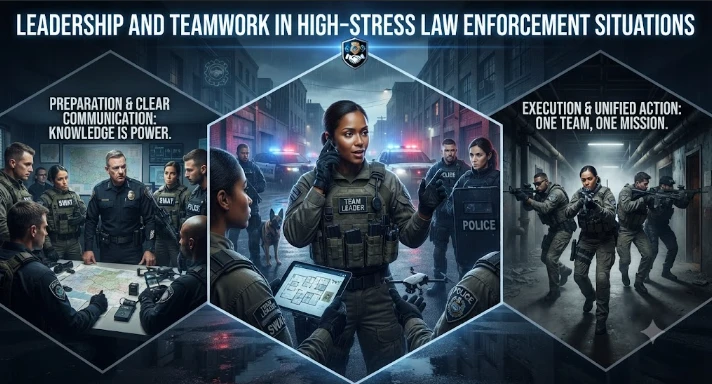
This article examines the importance of leadership and teamwork when law enforcement officers operate under intense pressure. It explains that high-stress situations such as hostage incidents, counterterrorism operations, violent disorder, and other fast-moving emergencies require leaders who remain calm, decisive, adaptable, and clear in their communication. Strong leadership helps officers understand priorities, allocate resources, and adjust tactics as conditions change. The article also emphasizes teamwork built on trust, mutual respect, role clarity, and reliable communication. Officers must be able to depend on one another and understand their specific responsibilities when mistakes can have serious consequences. Debriefing after operations is presented as an important way to identify lessons, improve coordination, and strengthen future performance. In the Bangladesh context, limited resources, political tensions, rapid urbanization, and complex security challenges make effective leadership even more important. The article concludes that realistic training, continuous learning, supportive team culture, and disciplined coordination are essential for safe and successful law enforcement operations.
In any law enforcement scenario that involves a lot of stress, leadership and teamwork is a vital element. In the situations when the decisions are to be made quickly and the stakes are extremely high, the capability to lead the team by the leaders and the teams to collaborate can be what makes the difference between the success and failure. The importance of effective leadership and collaboration cannot be overestimated in law enforcement, where police officers have to confront life-threatening scenarios on a regular basis, such as hostage rescue, counterterrorism responses, active shooters, and high-speed chases. This is more so in places such as Bangladesh where law enforcers are usually not adequately resourced and also are working under complicated and hostile circumstances.
The first important factor as a leader in high stress law enforcement scenario is calmness under pressure. The leaders should lead by example. Calm, composed, and decisive leaders give their employees the feeling of stability and confidence. Officers can count on their leaders to be the source of direction, critical decisions, and overall strategy of the operation. When there is extreme pressure, leaders who become panicky or display indicators of indecision may lead to confusion, demoralization, and compromise of success of the mission. Good leaders are capable of remaining focused, evaluating the situation fast, and leading their teams in the state of chaos.
The leaders must be very adaptable as well in high-stress law enforcement circumstances. There is no crisis that is identical and it is critical to have the capability to shift tactics, plans, and strategies as they become apparent. Risk evaluation should be an ongoing activity of the leader who should assess the resources available and predict possible results. Such flexibility in switching gears and changing the strategy plays a crucial role in the situation when the threat is continually changing, like in the case of active shootings or the protest that can result in a riot. As an illustration, when a terrorist threat or a hostage situation is occurring, the leader might be required to change the tactics quickly depending on the information on the ground and still maintain control of the operation without losing his or her grip.
In addition, high stress law enforcement scenarios include effective communication of leadership. When a crisis strikes, it is a matter of time, and the circulation of the information among the team members can spell the difference between the successful and unsuccessful operation. An effective leader makes sure that the channels of communication are open, straightforward, and effective. They also make sure that information is communicated openly and in real-time in order to have all team members updated with the most recent information. Improper communication or ambiguity may cause errors, misunderstandings and worst of all casualties. Thus, the heads of law enforcement teams have to master the skill to share essential information, give unambiguous orders, and sustain a sense of cohesiveness within the group.
Teamwork is also critical during the high-stress law enforcement scenarios because law enforcement officers need to depend on each other to complete complicated tasks, and such functioning is subject to severe stress. Teamwork that can be successful in such a case is based on the principles of trust, mutual respect, and clearly defined roles. In a high-stress environment, officers need each other to be able to rely on their fellow officers to perform their allocated duties well, be it in protecting an area, offering support, or being involved in negotiations. Having the knowledge that their fellow officers are competent, trustworthy and dedicated to the operation will allow them to work efficiently towards the mission without any doubts which will make the whole operation successful.
Role clarity is an important feature of teamwork. In high-stress law enforcement operations, duties can be extremely specialized, and every officer should realize what is expected of him and his duties. As an illustration, at a hostage rescue, a single officer can be assigned to negotiate with the perpetrator, another officer may in charge of the tactic and other officers may offer security of the perimeter. Individual roles of each team member are supposed to be a clear understanding, and their leaders should make sure that it is done without interruption and confusion. By doing so, the team will operate efficiently and coordinate their efforts to reach their goal with maximum efficiency and lowest risk.
One of the most crucial aspects of a successful teamwork in the law enforcement is the capacity to collaborate even when stressed. Officers are also under constant life-threatening circumstances where they need to believe in their comrades. The inability to work as a team may lead to the absence of opportunities, errors, and even death. In the event that teamwork is emphasized, the officers will assist each other in the execution of their duties so that none of them will feel alone or unassisted when performing an operation. This team effort makes the team stronger as a whole and officers can count on one another even in the most unresponsible or unsafe situation.
Moreover, leaders should promote the culture of support and friendship in the team. Stressful law enforcement conditions may cause physical and emotional burnout, and employees must feel professionally and personally supported. Team climate will be supportive and can aid the morale of the officers and ensure that they work at a higher level. Leaders who recognize the pressure suffered by their teams, encourage them, and make them feel that they belong, aid in keeping the motivation at a high level, which is crucial to successful results.
The next major point in regard to the teamwork in the high stress law enforcement operations is that of debriefing and learning out of every mission. The team should then unite after a high-pressure situation, during which time the team will review the operation, what they did well, and what they need to improve. Debriefing can be used to share the experience, give a chance to discuss all the appeared issues and learn about the successes and failures of the team. As an example, in Bangladesh, where law enforcement agencies can experience specific issues due to under-investment or insufficient training facilities, the teams should consider what they did and communicate their experience to each other to improve their further work. This process of continuous learning enhances team building as skills, communication and coordination are improved in the process.
The situation in Bangladesh worsens the law enforcement issues due to the fast urbanization of the country, the high rate of crime, and political instability. Effective leadership and teamwork is even more important to law enforcement officers who have to perform their duties in such settings. Officers have to work under excessive pressure and usually have to deal with intricate situations that evolve quickly e.g. massive protests, organized crime, and terrorism. The leaders have to be tactically and strategically sharp and at the same time culturally aware and sensitive to the political situation so that their actions do not contribute to the escalation of tensions and infringement on the rights of citizens.
Furthermore, since most law enforcement agencies in Bangladesh operate under resource constraints, the high-level leadership and staff must operate effectively and utilize the resources they have to the best of their ability. The leaders should be concerned with the safety and well being of their teams as well as ensuring that the goals of the team are achieved. Within these resource-limited settings, creativity in problem solving, flexibility and efficient communication are even more vital in solving operational problems.
Another important role is training in the development of a good leadership and team work. In Bangladesh, like in many third world countries, law enforcement agents do not always get the training that they are supposed to receive to manage high-stress situations or other complication cases. Realistic training exercises that simulate scenarios of high pressure should be conducted regularly to enable teams to train on how to work as a team, instill confidence, and enhance communication when in stressful situations. Through continuous training, the law enforcement agencies are likely to produce leaders and officers who are not only professional in their respective duties but also talented in cooperating among themselves in a coordinated fashion.
Finally, leadership and good teamwork are the keys to coping with high stress law enforcement situations. The leaders should have the skills to lead their teams in a manner that is clear, flexible, and decisive, but in a calm way despite the confusion in life. Members of a group, in their turn, should collaborate, trust each other, and help in the role of each other. The fact that law enforcement agencies in countries such as Bangladesh are characterized by significant issues renders effective and efficient collaboration essential in terms of keeping the officers and citizens safe. By training, support, and good leadership, teams in law enforcement are able to rise to the occasion of high-stress situations and thus see justice done and safety enforced on the people.
CITE THIS ARTICLE
Das, B. C. (2026). Leadership and Teamwork in High-Stress Law Enforcement Situations. https://www.bikashchandra.com/article/01f383c7-2e95-56dd-b57a-0563fc18cc85
B. C. Das, “Leadership and Teamwork in High-Stress Law Enforcement Situations,” 2026. [Online]. Available: https://www.bikashchandra.com/article/01f383c7-2e95-56dd-b57a-0563fc18cc85
Das, B. C. (2026) ‘Leadership and Teamwork in High-Stress Law Enforcement Situations’. Available at: https://www.bikashchandra.com/article/01f383c7-2e95-56dd-b57a-0563fc18cc85
Das, Bikash Chandra. “Leadership and Teamwork in High-Stress Law Enforcement Situations.” 2026, https://www.bikashchandra.com/article/01f383c7-2e95-56dd-b57a-0563fc18cc85.
Bikash Chandra Das. “Leadership and Teamwork in High-Stress Law Enforcement Situations.” (2026). https://www.bikashchandra.com/article/01f383c7-2e95-56dd-b57a-0563fc18cc85.
Das BC. Leadership and Teamwork in High-Stress Law Enforcement Situations. 2026. https://www.bikashchandra.com/article/01f383c7-2e95-56dd-b57a-0563fc18cc85
@misc{article_01f383c72e9556ddb57a0563fc18cc85,
  title = {Leadership and Teamwork in High-Stress Law Enforcement Situations},
  author = {Bikash Chandra Das},
  year = {2026},
  url = {https://www.bikashchandra.com/article/01f383c7-2e95-56dd-b57a-0563fc18cc85},
}
TY  - GEN
AU  - Bikash Chandra Das
TI  - Leadership and Teamwork in High-Stress Law Enforcement Situations
PY  - 2026-05-26
UR  - https://www.bikashchandra.com/article/01f383c7-2e95-56dd-b57a-0563fc18cc85
ER  -
This article explores why people volunteer in America’s national parks and how program design influences whether service remains meaningful. Volunteer motivations often overlap and include personal values, learning, social connection, career development, confidence, purpose, and attachment to place. The article uses motivational frameworks to show that volunteers are more likely to remain engaged when they experience autonomy, growing competence, respectful relationships, and a clear connection
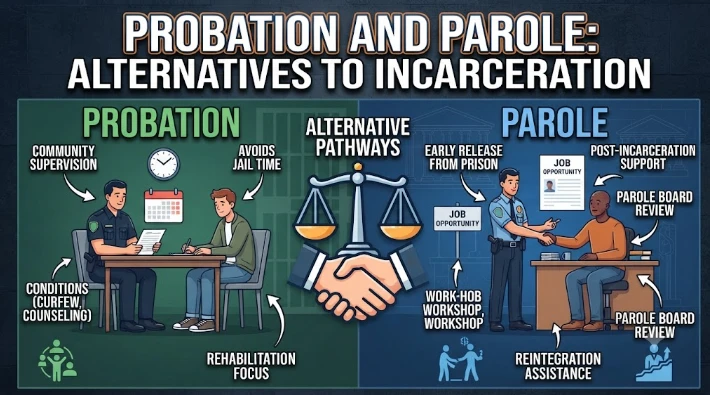
Probation and parole are presented as essential community-based alternatives to incarceration that combine supervision, accountability, and reintegration. Probation generally allows eligible offenders to remain in the community instead of serving a prison sentence, while parole provides conditional release after part of a custodial sentence has been completed. The article explains that both approaches can preserve employment, family ties, education, and housing, all of which reduce the risk of r
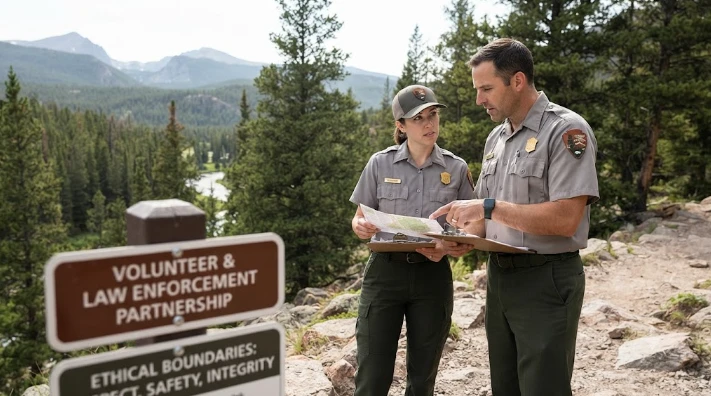
This article defines the ethical boundaries that protect volunteers who support visitor safety and law-enforcement-related functions in national parks. Although volunteers can assist with information, observation, traffic support, administrative work, backcountry roves, and reporting hazards, they must not exercise powers such as arrest, detention, search, citation, evidence handling, use of force, or other commissioned enforcement duties. The article emphasizes clear position descriptions, accu