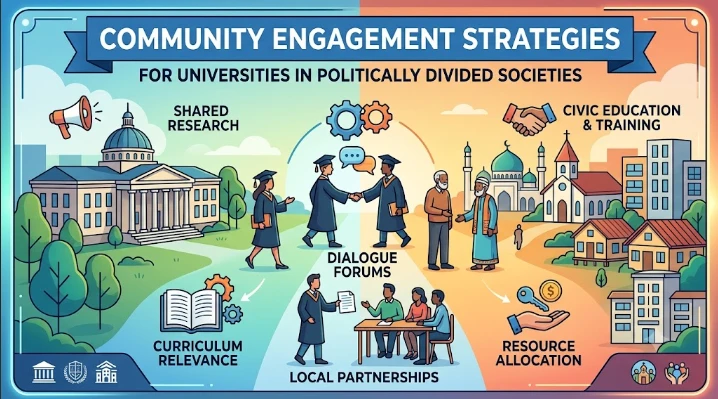
This article outlines practical strategies for university engagement in politically divided societies, where campus activities can become symbols in wider conflicts over identity, power, history, and belonging. It recommends beginning with structured listening across neighborhoods, faith groups, schools, unions, businesses, media, and advocacy networks before designing programs. Reciprocity, trusted intermediaries, transparent political boundaries, skilled facilitation, and action-oriented questions are presented as essential for building credible engagement. Universities are encouraged to create deliberative forums, protect academic freedom, include diverse ideological and social groups, prepare students carefully, and recognize the time required for long-term relationship work. The article also addresses digital participation, funding transparency, internal campus disagreement, power imbalances, data practices, conflict resolution, and institutional memory. Evaluation should examine trust, perceived respect, responsiveness, inclusion, continued participation, and neighborhood differences rather than attendance alone. The article concludes that universities cannot eliminate political division, but they can strengthen civic infrastructure by defending inquiry, widening participation, supporting fair disagreement, and maintaining accountable relationships through controversy.
University engagement is transformed with political change. A public lecture, research survey, or campus statement can become a symbol in a wider struggle over identity, authority, and belonging. The conflicts that occurred in the past with regard to land, policing, admissions, public spending or cultural representation often shape the perception of an institution from the point of view of the community. University invitations will only be successful if they embrace the fact that they fall into a pre-existing history.
The first solution is to listen firstly in the institution, and then to program. Campus leaders should have well-structured dialogue with neighborhood groups, local leaders, faith communities, the media, schools, unions, business and advocacy networks. Listening sessions are most effective when facilitators engage in asking questions of unresolved harms and trusted messengers, practical needs and acceptable forms of partnership. Its aim is not consensus but a diagram of relationships and tensions, and where entry points might be present.
It is helpful to have a standard to use when deciding on reciprocity. Carnegie's definition of collaboration is the exchange of knowledge and resources that is mutually beneficial. Thus a university should not see local communities as its audience, research site, or as a source of free labour. For each project, the project must have an understanding of what each partner brings, receives, decides and controls.
Care has to be taken in the definition of political neutrality. A university can take no position on academic freedom, on participation in what is legally defined as academic activity, on human dignity, or on the proper use of evidence. Meanwhile, engagement becomes a party, faction or candidate's participatory tool when it is institutionalized. All rules establishing a distinction between civic principles and endorsement of candidates or campaigns ensure that all voices are given a platform, but do not create false choices.
Senior titles sometimes aren't the most important, but trusted intermediaries are. Groups that do not want to go through official campus channels can be approached by a respected member of the library, the school, the community, a local journalist, or an extension officer. The universities should look to find these connectors, and engage them early, including in the agenda setting and recruitment process. Relational skills are valuable ones and their worth can be conveyed through compensation and public recognition.
Dialogue design is more precise than an invitation to speak in general. It is rare for politically-divided groups to sit together with the same self-confidence, information and social protection. Skilled facilitators establish common ground rules, establish a balance on who talks, and establish guidelines on recognizing differences between personal experience and factual claims, as well as establish pathways for giving personal feedback. Small group discussions are often more honest than big group applause or in front of audience.
Questions that allow for action are a good starting process. Speech topics can be vague and not have any action goals, for example: democracy, polarization, or social unity. Common objects of inquiry are specific questions regarding school transport, flood preparations, housing access and safety, park safety, local history, or public data. Shared work involves making contact on the decisions, not as a prerequisite to agreement.
Visible stewardship is evidence that is needed. Participants must be aware of who has been invited to be experts, who has influenced the briefing documents, how uncertainty was dealt with, and how ‘contested claims' were cross-checked. You don't need to have equal amounts of space for unsupported statements in a balanced panel. It needs clear standards which are applied in the same way by speakers and from viewpoints.
Deliberative forums can be built up in the university that are a blend of information, reflection and recommendation. Citizens assemblies and public problem laboratories, as well as facilitated policy juries, provide for a higher degree of participation than a single time for comments. Participants are provided with easy-to-understand background information, get answers from experts, make comparisons, and come up with a documented decision. Even if recommendations are not implemented, the official and campus leaders must respond publicly.
The capacity can be expanded and broadened by incorporating the students, but it must be carefully prepared. Students must be trained in areas of confidentiality, local history, interviewing in a respectful manner, political sensitivity and realistic project boundaries. Do not have community partners teach repeatedly in one class the same basic context, each semester. Archives are shared, transition notes are used, staff are coordinated and there are multi-year sequences of courses which help to maintain continuity.
Quality of faculty engagement drives faculty incentives. Projects designed to extract information that are rapid in their grant cycle and publish quickly are favored by short grant cycles and publication pressures, which do not allow for the development of relationships. Public scholarship, partnership assessment, easy-to-access products and partnerships over the long term must be recognized in promotion systems. How to recognize without support for workload is symbolic, as it takes time to meet, to revise, to manage conflict, and to follow-up.
The division within the university should be tackled, but it is not the only issue to deal with when faced with external conflict. There are significant differences among staff, faculty and students in their views on institutional statements, invited speakers, protest, donor influence, or public partnerships. Internal civic processes can be a model to the surrounding community for the same standards that are offered to them. Outward engagement is more believable when there are transparent procedures, consistent rules and there are opportunities for reasoned dissent.
Digital participation is an opportunity to reach more people but also presents new challenges. People who are not able to attend evening events, disabled people, people in rural areas and caregivers can be included in online forums. However, outrage can be rewarded by platform design, and participants can be exposed to harassment; platform design, can exclude households with poor connectivity. All digital processes should be designed to incorporate the factors of moderation, protection of privacy, accessible formats and offline alternatives.
In times of controversy, the first step in communication is to start before the crisis. Decisions on the authority to make, how they will be reviewed, funding mechanisms, data practices and complaint avenues should be explained to the public at universities. Nothing is worse than silence, allowing rumors to thrive, or defensive messaging which can only reinforce suspicions. There should be regular, non-technical updates which can be easily understood and challenged by the institutional members.
There is a need for an ideological and social width within partnership portfolios. Frequent contact with other groups with campus culture can lead to comfort and emphasize public sense of exclusion. Engagement teams should review and explore neighborhoods, political traditions, age groups, income level, and language communities that are missing. Meeting times, transport support, child care, translation, venue, and patient recruitment are all examples of aspects of inclusion which are different.
Treatment of power imbalances is a direct treatment. The budget, legal review, media access, research methods and publication can be controlled by Universities. Community partners have the legitimacy, lived knowledge, networks, and implementation capacity in the community, but these resources can be underestimated. Governance agreements should be in writing and include decision-making authority on questions, spend, data, authorship, public release and dispute resolution.
Failure doesn't always mean conflict. When a partnership emerges with conflict, unresolved issues and imbalances can emerge. The key issue is that of what is done to manage conflict fairly, keep information accurate and ensures that there is no form of retaliation involved. When the engagement is durable, it allows for revision, dissent and partial agreement – and not for its public image.
There is a need for both relational and practical measures of evaluation. Attendance rates reveal reach, not trust, learning, influence and fairness. Surveys can measure a sense of respect, political efficacy, institutional responsiveness, and willingness to work together in the future. Interviews, observation, network analysis and follow-up reviews can help to account for the reasons for some groups' continued participation, and some groups' withdrawal.
The ability to learn from past setbacks, or manage without them, is based on institutional memory. A central engagement office can document commitments, keep track of engagement history, facilitate a risk review process and avoid having multiple departments targeting the same partner. Community advisory bodies must be truly weighted and be made up of rotating members. Early relationship work can be supported by stable seed funding prior to the determination of the agenda by a large grant.
Consultation with communities can help to strengthen the sense of legitimacy for the research design. Surveying is quantitative and highlights general trends; while interviews and small group discussions highlight fear, exclusion and changes in perceptions. By comparing data among neighborhoods, inequities in campus access can be identified. Longitudinal tracking is important because it is one good thing and one bad thing does not form lasting trust.
The way the funding is set up should be subject to public scrutiny. Much like a donor, a government entity, or a private entity, donors can influence timelines, language and acceptable outcomes without interfering directly. Universities should make public any special sponsor(s) involved, ensure academic freedom and allocate resources for community priorities. A diversified funding base makes the partnerships less vulnerable to the dependence on one political actor and provides them with more space for existing cooperation in case of change of government or controversy.
The conflict politics of divided societies will be hard for universities to overcome, and too early to say that a university is united may come across as disingenuous. A more convincing role would be to defend inquiry and broaden participation, develop good public reason and facilitate collective action on real issues. Trust is built when there is no controversy in the commitment, a fair distribution of benefits, and no end to disagreement in contacts. When institutions are open to knowledge and are open to relationships, they become community engagement as infrastructure.
CITE THIS ARTICLE
Das, B. C. (2025). Community Engagement Strategies for Universities Operating in Politically Divided Societies. https://www.bikashchandra.com/article/048bf1f6-ef47-5518-a413-d76f228a8b3e
B. C. Das, “Community Engagement Strategies for Universities Operating in Politically Divided Societies,” 2025. [Online]. Available: https://www.bikashchandra.com/article/048bf1f6-ef47-5518-a413-d76f228a8b3e
Das, B. C. (2025) ‘Community Engagement Strategies for Universities Operating in Politically Divided Societies’. Available at: https://www.bikashchandra.com/article/048bf1f6-ef47-5518-a413-d76f228a8b3e
Das, Bikash Chandra. “Community Engagement Strategies for Universities Operating in Politically Divided Societies.” 2025, https://www.bikashchandra.com/article/048bf1f6-ef47-5518-a413-d76f228a8b3e.
Bikash Chandra Das. “Community Engagement Strategies for Universities Operating in Politically Divided Societies.” (2025). https://www.bikashchandra.com/article/048bf1f6-ef47-5518-a413-d76f228a8b3e.
Das BC. Community Engagement Strategies for Universities Operating in Politically Divided Societies. 2025. https://www.bikashchandra.com/article/048bf1f6-ef47-5518-a413-d76f228a8b3e
@misc{article_048bf1f6ef475518a413d76f228a8b3e,
  title = {Community Engagement Strategies for Universities Operating in Politically Divided Societies},
  author = {Bikash Chandra Das},
  year = {2025},
  url = {https://www.bikashchandra.com/article/048bf1f6-ef47-5518-a413-d76f228a8b3e},
}
TY  - GEN
AU  - Bikash Chandra Das
TI  - Community Engagement Strategies for Universities Operating in Politically Divided Societies
PY  - 2025-02-05
UR  - https://www.bikashchandra.com/article/048bf1f6-ef47-5518-a413-d76f228a8b3e
ER  -
This article explores why people volunteer in America’s national parks and how program design influences whether service remains meaningful. Volunteer motivations often overlap and include personal values, learning, social connection, career development, confidence, purpose, and attachment to place. The article uses motivational frameworks to show that volunteers are more likely to remain engaged when they experience autonomy, growing competence, respectful relationships, and a clear connection
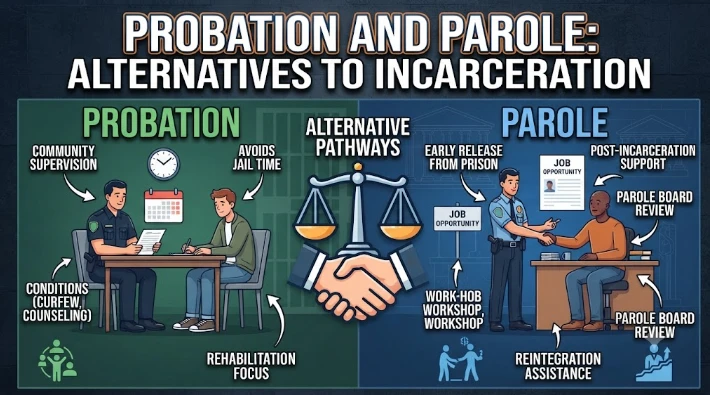
Probation and parole are presented as essential community-based alternatives to incarceration that combine supervision, accountability, and reintegration. Probation generally allows eligible offenders to remain in the community instead of serving a prison sentence, while parole provides conditional release after part of a custodial sentence has been completed. The article explains that both approaches can preserve employment, family ties, education, and housing, all of which reduce the risk of r
This article defines the ethical boundaries that protect volunteers who support visitor safety and law-enforcement-related functions in national parks. Although volunteers can assist with information, observation, traffic support, administrative work, backcountry roves, and reporting hazards, they must not exercise powers such as arrest, detention, search, citation, evidence handling, use of force, or other commissioned enforcement duties. The article emphasizes clear position descriptions, accu