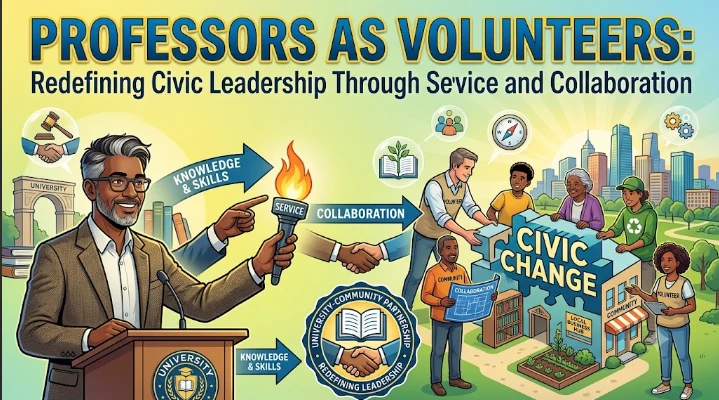
This article explores how professors can contribute to civic leadership by volunteering their knowledge, time, and professional skills for community causes. It distinguishes voluntary public service from routine university committee work and shows how faculty expertise in areas such as evaluation, law, planning, curriculum, research, and communication can strengthen organizations that cannot afford commercial support. Effective service begins with listening, understanding local needs, and selecting roles that build community capacity rather than academic visibility. The article also addresses professional boundaries, confidentiality, political clarity, workload equity, student supervision, research consent, and the risk of burnout. Universities are encouraged to recognize civic service through workload support, small grants, coordinated partnership offices, and promotion systems that value public contribution alongside publications. Impact should be assessed using practical outcomes, partner feedback, organizational learning, trust, and sustained capacity. The central argument is that professors demonstrate civic leadership most effectively when service is reciprocal, ethical, reliable, collaborative, and designed to leave community organizations stronger and more independent.
The work of a professor can be expressed in terms of his teaching, research and institutional service, but volunteer work can interweave all three with the needs of the community. Know-how can be provided to a nonprofit organization to evaluate a program, lead a neighborhood survey, maintain local history, train public servants or enhance environmental monitoring and so on, but without charging a commercial fee. The use of authority to increase the capacity of the collective becomes civic leadership when it is done in this way. Service is the most distinguishing characteristic, it's about serving others, not influencing others.
Volunteering is not typical committee responsibilities assigned by a university. Requires a voluntary donation of time, information or work to a public or community cause. The process of inquiry and service can generate academic knowledge; there is overlap between engaged scholarship and volunteering in which the two activities create academic knowledge, but not all volunteering activities require a publication. Civic value may be in patient mentoring, in the regular attendance at a board, but not in a journal, in technical assistance.
National statistics indicate that organised volunteering is still an important aspect of the public life. Many Americans voluntarily through an organization during the 12-month period ending in September 2023, with a significant recovery from pandemic effects, according to an AmeriCorps report released in 2024. Formal organisations were not the only ones that were involved in helping, informal helping was also being done, for instance, assisting neighbours. This broader civic context provides faculty service with a larger context.
Thomas Andrew Bryer's research on national service and volunteerism draws the spotlight to the impact on volunteers, beneficiaries, institutions and whole communities. This framing is important as it shows that volunteer time doesn't tell much about public value. An hour's bad match can be a source of confusion and an hour's good design can break a deadlock in a decision. It is important to remember that the purpose of assessment is not to make the volunteer feel good about himself, but to get to the problem.
Professors are a valuable resource for many community organizations that can't buy them. There are high market costs for conducting statistical analysis, evaluating grants, interpreting the law, designing curriculum, conducting archival research, communicating with the public, engineering review, and strategic planning. Skill-based volunteering takes some of that capacity and brings it to the aid of organizations that don't have as much funding. The contribution is enhanced when technical work is accompanied by explaining and training, instead of delivering a product that is not accompanied by the transfer of knowledge.
The first step to civic leadership is to listen. While the faculty member might assume he or she has an awareness of the issue, there may be more to learn by listening to the local organizations and learning from their experience, knowledge of people, history, constraints, and prior efforts. Helpful Volunteer: What do you need, what decisions need to be made and what risks are there in this task? Relevance and trust are two things that are guarded by Humility.
Often the best role isn't the one that is most publicized. A professor may be asked to facilitate a challenging meeting, to review a survey instrument, coach a new director, help to link two organizations, or help volunteers to document procedures. These can help to reinforce infrastructure without putting emphasis on the academic. The collaborative nature of civic leadership emerges when credit is given for civic work not as an institution.
The volunteer service can contribute to democratic life if it is able to broaden the access to expertise. Technical information that is not easily understood by residents and small organizations, is frequently a part of a public decision. Volunteers from the faculty can translate, discuss uncertainty, and help to develop opportunities with other groups to explore options in tandem. Options should be explained, but not imposed on community judgements.
Boundaries continue to be vital since roles as volunteers can overlap with professional roles. Regulated professional advice must be differentiated from general education by a physician, lawyer, engineer, psychologist or social worker. There are issues of conflict, confidentiality, safeguarding and liability which need to be considered. There can be no excuse for failing to have moral responsibilities when you have a special skill.
There is a need for political activity to be as clear as possible. While professorial status does not mean that professors are exempt from enjoying the rights of citizens, it can make personal advocacy appear to be a university endorsement. Avoid ambiguity of roles, as it can cause legal and reputation problems for volunteer organizations. Representations, media relations, data sharing and public comments are written expectations that benefit all partners. Transparency facilitates participation without requiring and enforcing political silence.
Time is another not so apparent moral question. The number of hours worked varies widely among faculty, by contract, rank, discipline, care-giving status, and institutional resources available to faculty. The labor of mentoring and inclusion of mentoring can be spread unevenly amongst women scholars and minority scholars, local faculty or staff already doing heavy mentoring and inclusion labor, or any of these groups. In celebrating service, without considering workload, civic commitment can be a means of inequity.
Such systems of rewards at university often exacerbate the situation. Traditionally, the reward is given to peer-reviewed publications and grants over community work. Then faculty undertake civic involvement in the evenings or on weekends and continue to report a civic impact at the institution. In addition to academic outputs, partnership relationships and quality of partnership, public products, capacity development, and partnership testimony should be taken into account.
Community knowledge can be brought into the classroom with permission and care to enhance the impact of the teaching. Concrete can be found where abstract concepts become real administrative problems, environmental issues, constraints of non-profit organizations, or public communications. Confidential information should be kept confidential and communities shouldn't be story fodder for educational entertainment. Reflection needs to focus on the power, responsibility and uncertainty, not rescue.
There are also many opportunities for students to become involved in faculty-sponsored service projects, which provide opportunities for faculty-student mentorship both on campus and in the community. With shorter academic calendars, preparation is important as it can lead to inconsistent performance and repeated orientation for partner organizations. Before assigning students to volunteer work, a professor should set up supervision, establish definite tasks, set up continuity records, and set realistic expectations. The learning design should be developed with the support of partner feedback.
Service to create research questions – consent needs to be brought to the forefront when service transforms to scholarship. Information which is shared in a trusted relationship between volunteer and client is not automatically research information. Interviews, records or observations must be reviewed, approved and the freedom to refuse before entering a study. Pressures are reduced on partners in the community when the service and recruitment are differentiated.
Expertise can be shared and collaboration established. Staff training, documentation, development of reusable templates, etc. and mentoring local leaders can help minimize reliance on one professor. Inter-agency linkages can help increase the number of supports. A good volunteer leaves a greater capacity than he or she had before.
Individual effort can be augmented by institutional brokerage, without becoming a bureaucracy. Requests can be matched to appropriate expertise in a campus office; risks can be screened; the history of a partnership is maintained; and multiple departments can work together to avoid multiple requests to the same organization. Coordination speeds a communities' ability to get to the right person. It also ensures that faculty do not take on work that they are not skilled or able to do.
There needs to be a congruence between impact measure and the purpose of service. Some quantitative measures can be the number of funds secured, number of errors reduced, number of participants reached, processing time changed, or the number of volunteers retained. There are also qualitative pieces of evidence that can be used to explore the focus areas of confidence, trust, decision quality, organizational learning and perceived respect. Comparisons before and after the project is implemented can be helpful, but context is important as there are many factors beyond a project that can affect community outcomes.
Success should be determined with the community partners and faculty volunteers. A neat and tidy report that no staff member can use is of little or no help, whereas a simple instrument can make a huge difference to day-to-day work. Timekeeping and providing service in an appropriate manner can be discerned by the following: short interviews, reflective meetings, contribution logs, and partner ratings. The burden of the evaluation should include not just the burden of benefits claimed.
Professor burnout can impact professors as well as organizations. Limits, shared responsibility and permission to pause when capacity is lower is the key to reliable service. Recognition of civic volunteering work, small grants, transportation, insurance, training and coordinated partnership offices are all ways that universities can help students get involved in civic volunteering. This support can mitigate private sacrifice and help to increase commitment.
Professors as Volunteers Remodel Civic Leadership by making knowledge a part of reciprocal relationships. Leadership is evident when you listen, make ethical decisions, when you are reliable in your movement and when you invest in another organisation's strength. Specialist capacity is made available to communities, and experience to the academics enhances teaching and enquiry. Service is at its best when cooperation is stronger than acknowledgment and is more enduring in terms of the number of people who are able to participate in civic engagement.
CITE THIS ARTICLE
Das, B. C. (2025). Professors as Volunteers: Redefining Civic Leadership Through Service and Collaboration. https://www.bikashchandra.com/article/5fb3afa9-2135-5caa-9702-7f16dff2e2ee
B. C. Das, “Professors as Volunteers: Redefining Civic Leadership Through Service and Collaboration,” 2025. [Online]. Available: https://www.bikashchandra.com/article/5fb3afa9-2135-5caa-9702-7f16dff2e2ee
Das, B. C. (2025) ‘Professors as Volunteers: Redefining Civic Leadership Through Service and Collaboration’. Available at: https://www.bikashchandra.com/article/5fb3afa9-2135-5caa-9702-7f16dff2e2ee
Das, Bikash Chandra. “Professors as Volunteers: Redefining Civic Leadership Through Service and Collaboration.” 2025, https://www.bikashchandra.com/article/5fb3afa9-2135-5caa-9702-7f16dff2e2ee.
Bikash Chandra Das. “Professors as Volunteers: Redefining Civic Leadership Through Service and Collaboration.” (2025). https://www.bikashchandra.com/article/5fb3afa9-2135-5caa-9702-7f16dff2e2ee.
Das BC. Professors as Volunteers: Redefining Civic Leadership Through Service and Collaboration. 2025. https://www.bikashchandra.com/article/5fb3afa9-2135-5caa-9702-7f16dff2e2ee
@misc{article_5fb3afa921355caa97027f16dff2e2ee,
  title = {Professors as Volunteers: Redefining Civic Leadership Through Service and Collaboration},
  author = {Bikash Chandra Das},
  year = {2025},
  url = {https://www.bikashchandra.com/article/5fb3afa9-2135-5caa-9702-7f16dff2e2ee},
}
TY  - GEN
AU  - Bikash Chandra Das
TI  - Professors as Volunteers: Redefining Civic Leadership Through Service and Collaboration
PY  - 2025-01-15
UR  - https://www.bikashchandra.com/article/5fb3afa9-2135-5caa-9702-7f16dff2e2ee
ER  -
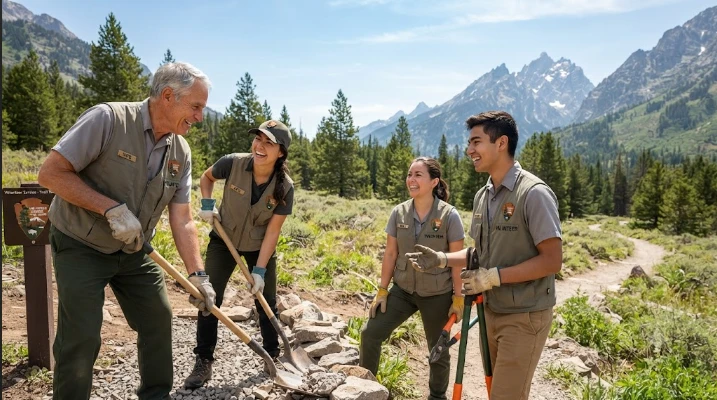
This article explores why people volunteer in America’s national parks and how program design influences whether service remains meaningful. Volunteer motivations often overlap and include personal values, learning, social connection, career development, confidence, purpose, and attachment to place. The article uses motivational frameworks to show that volunteers are more likely to remain engaged when they experience autonomy, growing competence, respectful relationships, and a clear connection
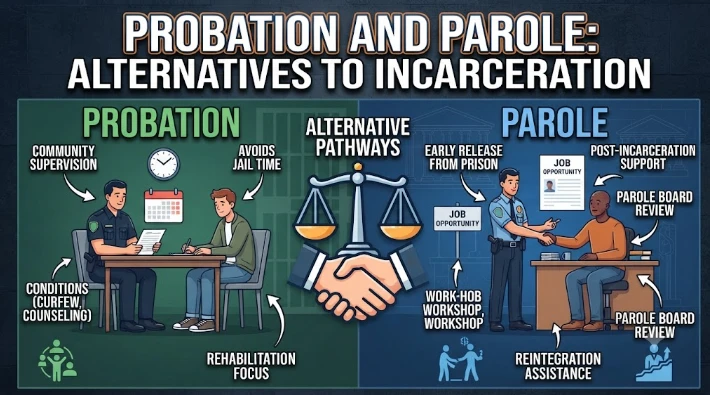
Probation and parole are presented as essential community-based alternatives to incarceration that combine supervision, accountability, and reintegration. Probation generally allows eligible offenders to remain in the community instead of serving a prison sentence, while parole provides conditional release after part of a custodial sentence has been completed. The article explains that both approaches can preserve employment, family ties, education, and housing, all of which reduce the risk of r
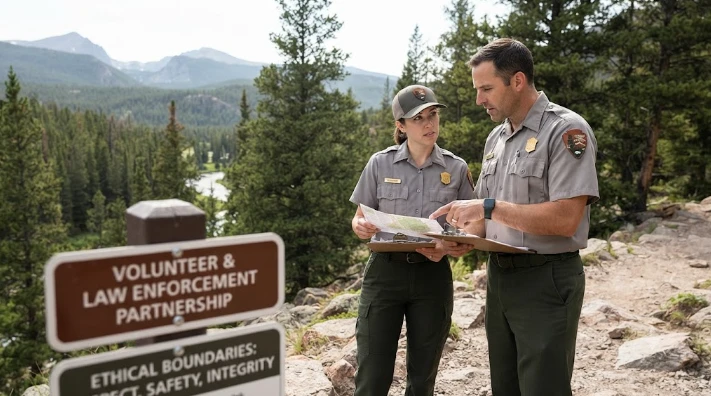
This article defines the ethical boundaries that protect volunteers who support visitor safety and law-enforcement-related functions in national parks. Although volunteers can assist with information, observation, traffic support, administrative work, backcountry roves, and reporting hazards, they must not exercise powers such as arrest, detention, search, citation, evidence handling, use of force, or other commissioned enforcement duties. The article emphasizes clear position descriptions, accu