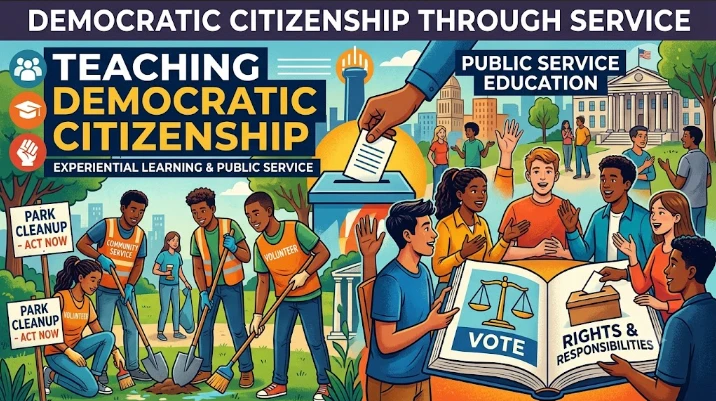
This article argues that democratic citizenship is learned most effectively through experience, not through definitions alone. Public service education can help students practice listening, deliberation, ethical reasoning, shared authority, and responsible decision-making in situations that resemble real public problems. The article reviews experiential approaches including service learning, simulations, public deliberation, community research, participatory mapping, policy labs, and field placements. Strong projects connect academic learning with genuine community needs while providing preparation, supervision, reflection, and partner feedback. Community members are treated as educators whose experience can challenge student assumptions and improve the practical relevance of learning. The article also emphasizes confidentiality, consent, nonpartisanship, accessibility, equitable participation, and the need to avoid turning communities into unpaid training sites. Assessment should go beyond satisfaction and include civic knowledge, public service motivation, perspective taking, deliberative confidence, ethical reasoning, and partner evaluations. The article concludes that experiential public service education strengthens democratic practice when institutions support faculty, protect community relationships, and connect classroom learning to accountable civic action.
Definitions are not enough to impart democratic citizenship. Students have the possibility to learn constitutional structures, administrative rules and procedures of elections without learning how to listen in disagreement, consider evidence, share authority and take responsibility for a public decision. These capacities are embedded in action in experiential learning. Public service education is a place where democracy is lived as it's taught.
This is important because public administrators are having encounters with citizens in the course of their day. Budget staff, planners, emergency managers, nonprofit leaders, police administrators, health officials and program analysts turn ideas into action at the practical level of the law. It's still very much about the technical skills, but efficiency alone can foster suspicion. Democratic education challenges the future professionals to think of work carried out with citizens instead of for citizens.
Thomas Andrew Bryer and Timothy Shaffer's 2023 book on teaching democratic ideals explores how to incorporate governing with citizens in courses on public administration and public policy. Participants experimented with various classroom designs and gave consideration to practical issues related to democratic principles. Deliberation, engagement seem to be part of the decoration rather than the professional preparation. The book is an approach to teaching as a journey to trust, confidence, mutual respect and shared responsibility.
The modes of experiential learning range from service learning to simulations, to public deliberation to community research, to participative mapping to policy labs and collaborative problem solving. There is no learning without experience. Examine institutions, inequality, or civic responsibility is a process that can be achieved by a student to earn numerous volunteer hours. Activity into education with Purpose, Preparation, Reflection, and Feedback.
The best service-learning projects happen when the service and learning aspects are tied together in the same project driven by a community need or goal and an academic need or goal. A class dedicated to public budgeting could help a nonprofit look at the cost of its programs, and a planning course could benefit residents, who want to consider pedestrian safety. Helpful work is done for the community and students are faced with constraints not found in textbook cases. By avoiding the creation of unpaid training sites, reciprocity helps prevent partner organizations from becoming unpaid training sites.
There are other skills that are developed in deliberative exercises. Students can look at a public debate over a topic and explore evidence and values, as well as tradeoffs, and find common ground on what they can do in a way that is acceptable to everyone. The idea is not to be consensual. Learning is an aspect of democratic judgment, learning how when there is disagreement.
Simulations can uncover the pressures which are linked to administrative decision. A classroom activity that allocates a disaster, or consults the public, or issues a permit for disaster could make the students competing roles with incomplete information. Negotiation, justification and revision are required for decisions. Debriefing should tie in emotional response, strategy, and ethical, legal, and public responsibility.
Although students gain first-hand experience in agencies and communities in field placements, the quality of the experience is not consistent. It is more important to have meaningful work, supervision, responsibilities and processes for making decisions, than to be in an office. An organization's reality can be learned through the normal clerical activities, but not when the whole placement is made up of low value work. The university faculty member and the host partner(s) should determine expectations in education and service.
Critical reflection connects experience to the democratic meaning. Students should be given the opportunity to deepen their understanding and to be able to draw conclusions as a group about who was included, who had been excluded, how power is exercised, and whether a response focused on causes or symptoms. Journals and dialogue, analytic essays or public presentations may be used as means of reflection. Self-reflection involves a recognition of failure, discomfort and uncertainty, not polished tales of personal virtue.
Community partners are encouraged to be community educators. Agency staff, residents, organizers, and service users can provide context, debunk assumptions made by students, and make a valid judgment about the feasibility of solutions proposed. When there is a significant amount of work involved, their contribution should be prepared, respected and compensated. Shared teaching authority is an example of the democratic principle of expertise outside the campus.
All community experiences should be conducted in an ethical manner. Pupils require training in terms of confidentiality, consent, safeguarding, cultural sensitivity, data protection and boundaries. Students should not gather personal stories or photographs as a course assignment for any use. Members of the community need to have some say in what they do and how they are visible in the community.
Democratic education should not be partisan education. Students can learn to apply standards to evidence, respectful dialogue, constitutional principles, human dignity, and transparent reasoning and can be taught to apply these standards without a party preference. There is a need to protect the diversity of views, but unbacked-up statements need to be questioned. An educator learns to find freedom in his or her mind by seeking knowledge, not avoiding difficult issues.
Public Reasoning is a key learning outcome. Students need to provide an explanation for a suggestion using language that is understandable, acknowledge uncertainty, react to criticism, and alter a stance when evidence is found to be inconclusive. These are different skills to those of debating, and they are even more important in today's world. Its goal is a decision-making process that is comprehensible and subject to challenge, even if it is an unpopular decision.
Data on civic participation can be used to put things in perspective, but shouldn't be the only measure of civic education. In the 2020 U.S. presidential election, the National Study of Learning, Voting, and Engagement found that 66 percent of the students at the participating institutions voted in the election, compared with 52 percent in 2016. Voting is a vital action, but so are other actions related to democratic citizenship such as service, dialogue, organization, watching institutions, and solving problems together. Students should be prepared for this wider civic life via schooling.
Evidence of community-based and civic engagement in the context of higher education shows positive impacts on personal, social, academic, and civic areas; however, results are not guaranteed. A previous research project with public administration students did not report any increase or improvement in civic involvement as a result of a single service-learning event. This is mixed evidence that is useful as it makes ceremonial programming less likely. Results can be influenced by design quality, length of design, reflection, student choice, and community relationship.
The gap between form and practice of participation may be revealed in observation of real public meetings. Students can follow the time spent speaking, controlling the agenda, making it accessible, using evidence and providing responses. Patterns of the institutions are revealed when multiple meetings are compared. They can then be linked in a subsequent class discussion to suggestions for more equitable participation.
Satisfaction is not enough for measurement in assessment. The instruments used before and after the course can assess: civic knowledge, political efficacy, public service motivation, tolerance for ambiguity, perspective taking and confidence in deliberation. Use, ethical reasoning, listening, and justification can be assessed using rubrics. Reliability, respect and practical value can be uncovered through community partner assessments.
Qualitative evidence complements those measures. Interviews, focus groups, reflective writing, observations, and analysis of students' choices can demonstrate phenomena of learning. Comparative designs can be used to compare and contrast teaching models or course sequences. A longitudinal follow-up may be used to determine if civic habits and practices remain after leaving the academy.
Deliberate design is required for access as it can be difficult for working students, caregivers, disabled students or those living in a distant area to access a placement or get to campus if they are successful in securing a placement. The costs of attending can be reduced by stipends, flexibility in scheduling, providing transportation, providing easy access to the site, and remote options. The importance of equity in education is that it can impact learning if it excludes a wide swath from the learning process. No financial penalty may be placed on any student for the selection of civic learning.
Digital tools can facilitate cross-regional deliberation, virtual internships, public data analysis, and engage in dialogue with distant communities. Technology can extend access capability, but also present issues of surveillance, unequal access to technology, hostile communication and unengaged participation. Online activity should be clearly facilitated and have rules regarding privacy. Don't forget to build relationships; it's not all about digital convenience.
There is a need to support faculty to teach this way. Courses in the community require coordination, risk management, reflection design as well as partnership development and quick response to changing projects. Institutions should support staff in their capacity, offer small project funds, offer ethical support and recognition in workload and promotion. However, no one can rely completely on invisible labour as a means of sustainable civic education.
Educating democratic citizenship through experience equips public servants to deal with people as citizens in their governance rather than as passive citizens. Students are made aware that there are conflicting values in public problems, incomplete evidence, institutional constraints and lived consequences in public problems. HABIT 4: Practice Listening, Explaining, Joint Investigating and Responsible Decision Making. Educating for public service is an integral part of the infrastructure of democracy when classroom practices are linked to and grounded in these habits of ethical community work.
CITE THIS ARTICLE
Das, B. C. (2025). Teaching Democratic Citizenship Through Experiential Learning and Public Service Education. https://www.bikashchandra.com/article/c6d8e100-5e27-5ddd-8cfa-5abb82af3ca3
B. C. Das, “Teaching Democratic Citizenship Through Experiential Learning and Public Service Education,” 2025. [Online]. Available: https://www.bikashchandra.com/article/c6d8e100-5e27-5ddd-8cfa-5abb82af3ca3
Das, B. C. (2025) ‘Teaching Democratic Citizenship Through Experiential Learning and Public Service Education’. Available at: https://www.bikashchandra.com/article/c6d8e100-5e27-5ddd-8cfa-5abb82af3ca3
Das, Bikash Chandra. “Teaching Democratic Citizenship Through Experiential Learning and Public Service Education.” 2025, https://www.bikashchandra.com/article/c6d8e100-5e27-5ddd-8cfa-5abb82af3ca3.
Bikash Chandra Das. “Teaching Democratic Citizenship Through Experiential Learning and Public Service Education.” (2025). https://www.bikashchandra.com/article/c6d8e100-5e27-5ddd-8cfa-5abb82af3ca3.
Das BC. Teaching Democratic Citizenship Through Experiential Learning and Public Service Education. 2025. https://www.bikashchandra.com/article/c6d8e100-5e27-5ddd-8cfa-5abb82af3ca3
@misc{article_c6d8e1005e275ddd8cfa5abb82af3ca3,
  title = {Teaching Democratic Citizenship Through Experiential Learning and Public Service Education},
  author = {Bikash Chandra Das},
  year = {2025},
  url = {https://www.bikashchandra.com/article/c6d8e100-5e27-5ddd-8cfa-5abb82af3ca3},
}
TY  - GEN
AU  - Bikash Chandra Das
TI  - Teaching Democratic Citizenship Through Experiential Learning and Public Service Education
PY  - 2025-01-29
UR  - https://www.bikashchandra.com/article/c6d8e100-5e27-5ddd-8cfa-5abb82af3ca3
ER  -
This article explores why people volunteer in America’s national parks and how program design influences whether service remains meaningful. Volunteer motivations often overlap and include personal values, learning, social connection, career development, confidence, purpose, and attachment to place. The article uses motivational frameworks to show that volunteers are more likely to remain engaged when they experience autonomy, growing competence, respectful relationships, and a clear connection
Probation and parole are presented as essential community-based alternatives to incarceration that combine supervision, accountability, and reintegration. Probation generally allows eligible offenders to remain in the community instead of serving a prison sentence, while parole provides conditional release after part of a custodial sentence has been completed. The article explains that both approaches can preserve employment, family ties, education, and housing, all of which reduce the risk of r
This article defines the ethical boundaries that protect volunteers who support visitor safety and law-enforcement-related functions in national parks. Although volunteers can assist with information, observation, traffic support, administrative work, backcountry roves, and reporting hazards, they must not exercise powers such as arrest, detention, search, citation, evidence handling, use of force, or other commissioned enforcement duties. The article emphasizes clear position descriptions, accu