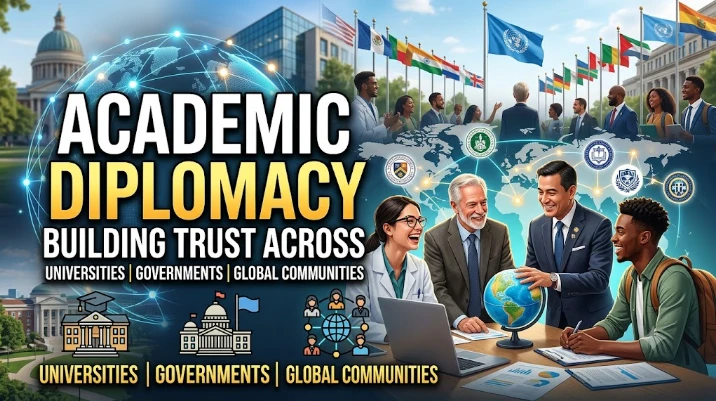
Diplomacy seems to be a part of embassies, treaties and formal negotiations, but every day universities are engaged in a more subtle kind of relationship building. Contact points can be established across political borders prior to formal agreements through a laboratory partnership, visiting fellowship, joint classroom or community research project. Academic work typically involves multiple meetings, problems and evidence which need to be subjected to scrutiny and that is of value in such contact. The more that is done and the more dependable and cooperative, the more people trust.
Academic diplomacy is defined as academic activities, such as education, research, innovation and scholarly exchanges, that serve to foster relations between institutions, governments and communities. It is similar to knowledge diplomacy which stresses reciprocity and mutual benefits, rather than exerting influence. Soft power is about appeal and advantage, academic diplomacy is best done when all actors remain with dignity, respect and benefit. One difference is significant because the act of collaboration when offered as a gift can re-create hierarchy.
There are several attributes that make it possible to have trust within universities, particularly when facing a fragile context. The discipline languages and professional standards, although the national political ones vary widely, are shared by scholars. Students bring in curiosity which can help to break down inherited assumptions, and administrators develop lasting avenues for mobility, combined degrees and research assistance. These features are not about conflict resolution, but rather offer practical frameworks to work with conflict.
A good example of academic exchange, predicated on mutual understanding, is the Fulbright Program. The program was founded in 1946 for the purposes of study, teaching, research and professional exchange in over 160 countries. It has been designed as a combination of public sponsorship with institutional partnerships, and personal relations are put on par with foreign policy. These exchanges are important as the individuals involved frequently bring their working relationships with them to the university, civil society, business, and public agencies for a long time after a grant has concluded.
The extent of contact that has already been taking place through international student mobility is evident. 1,126,690 international students enrolled in the United States colleges and universities in 2023-24 were recorded in the report Open Doors 2024. Over half of those studied science, technology, engineering or mathematics related subjects, which were correlated with mobility and research capacity and innovation. If there is no movement, there are no opportunities for continued intercultural interactions, but with this movement there are millions of opportunities.
The collaboration with researchers adds another layer in that there are few problems that don't cross borders. A range of regional and interdisciplinary knowledge is needed to address issues of climate hazards, public health threats, migration, food insecurity, digital regulation and energy transitions. By using a joint project, universities, ministries, local government, nonprofit organizations and communities affected by a project can be united in a tangible project. The best partnerships use local knowledge as a tool they use, not something they add to.
Academic diplomats do the job of translating between systems. A professor can translate scientific uncertainty to a ministry, help the ministry understand the scientific constraints, and assist community groups to articulate priorities to institutions. Translation is a language matter, but also an incentive, time, legal, and ideas matter. The key to getting past misunderstandings is to communicate about them prior to budgets and deliverables.
Visas, research funds, recognition of qualifications, and data permit rules are all factors in every international partnership, and continue to be an important element of government support. In 2023, the Global Convention on the Recognition of Qualifications was adopted by UNESCO which sets the principles for recognising qualifications fairly and for academic mobility. Such terms of agreement help to minimize conflicts, but it is important to keep the universities autonomous. If the use of scholarship becomes a political instrument in the process of cooperation, it loses its credibility.
Communities should have a direct role in academic diplomacy particularly in the area of research on the land, health, heritage, poverty or public services. Rectors and ministers can meet to create great photos, and leave residents out of the discussion. Community organizations can find commonalities and blind spots in institutional leaders that can go unnoticed as well as potential practical risks and cultural barriers. Involving local actors in the design process will make them become partners instead of 'audience'.
One of the most challenging tests of equity is presented. The rich institutions can provide travel grants, lab facilities, legal support, administrative support, the poor institutions can provide access, context, languages and relationships. Balanced partnership acknowledges all contributions and equally distributes the power on issues, processes, data, authorship and communication to public. Equal respect is not equal provision, but equal decision making.
There exist numerous examples of extractive practice in the past literature, both at international and national levels. Outside groups have invaded communities, gathered data, then reported back to the outside, and provided little benefit to people within the communities or local institutions. That pattern has an additional side effect which is to destroy the level of trust that is needed beyond a single project as the next researcher is handed the suspicion in the future. In order to ensure academic diplomacy, the following agreements are required: the ownership of the results, the credit of people involved, capacity building, translation and access to results.
There's another tricky line to navigate which is academic freedom. Scholars must be able to challenge official versions and explore taboo ideas and report on uncomfortable findings. Security, public order and the national interest are vital concerns for the government of course, but to much control would turn whatever exchange into a performance. When challenging questions get sidestepped, partners recognize one another's lack of willingness to disagree and fall into the trap of ‘not following the rules'.There is a point when partners start to recognize when challenging questions are not being asked, and they are caught by the ‘not following the rules'.
In recent years, data governance has become a key element of cross-border research. Information about health, the environment, genetics, satellites, and digital behaviour are examples of information which can be used for public good, but at the same time, could be used to harm people or communities. Other rules with regard to consent, storage, access, reuse, deletion, and commercial applications need to be set by partners. Technical safeguards are important but legitimacy is based on common sense of what is acceptable.
Academic relationships often are put to a political test. Travel comes to a halt; funds are frozen; and public discourse becomes risky. Communication can be retained through respectful work over the years that can create networks that continue it beyond the formal channels. It is all right to have continuity, but not to the extent of committing injustice, but it can help in safeguarding knowledge, people and future opportunities for fixing.
Only signed memoranda are not enough to measure the trust. A number of agreements sit dormant, while small projects build good relationships as a result of regular project delivery. Signs of useful collaboration include repeated collaboration, shared authorship, reciprocal mobility, shared funding choices, satisfaction with the collaboration, mediation and resolution of conflicts, and ongoing interaction after the grants are completed. The visible outputs along with the quality of the relationships should be assessed.
These exchanges, co-authored publications, funding relations, mobility of students and the longevity of networks can all be mapped using quantitative evidence. Respect, exclusion, changed perceptions and explanations for the breakdown of partnerships can be discovered through qualitative interviews. Comparative case studies can reveal the reasons for the success or failure of a model in one political context as compared to another. Trust is built over a long period of time and can be broken within a short time; that is why evidence that is longitudinal is particularly valuable.
The impact of academic diplomacy is in its implementation, which depends on the leadership practice. Institutions require foreign personnel who have been trained, seed money, an ethics review, language services, risk planning, and faculty recognition of work. Building relationships should be included as part of a promotion system and be as important as traditional publication. Otherwise, vital relationships are based on volunteer work and cease to exist when staffs change.
Digital exchange has contributed to reaching international classrooms and research meetings particularly since the pandemic. While Internet access and time zones are potential barriers, virtual collaboration also saves on travel expenses and enables more people to participate, but outcomes are influenced by unequal access to the Internet, time zones, concerns about surveillance, and screen fatigue. Online and offline can sometimes be blended together and used in combination, especially for a limited number of sessions. The design should be based on the needs of relationships and not driven by technology.
The public media must be given equal importance. International partnerships usually come into the community or to the taxpayers in a celebratory fashion or through controversy. Where there is an information gap, clear explanations of goals, costs, benefits, uncertainties and safeguards can help to prevent suspicion filling this. This is especially critical when the project involves sensitive data, foreign funding and politically sensitive topics.
Academic diplomacy is successful when knowledge is shared, and is a practice of shared responsibility. The universities bring in their expertise and convening power, the government sets up the enabling conditions and the community gives the basis to partnership, making it real. Trust comes from reciprocity, transparency of the rules, freedom of thought and when commitments are made, they endure inconvenience. In a divided world, this kind of patient institutional cooperation provide a practical approach to cooperation, but without denying that there is still conflict.