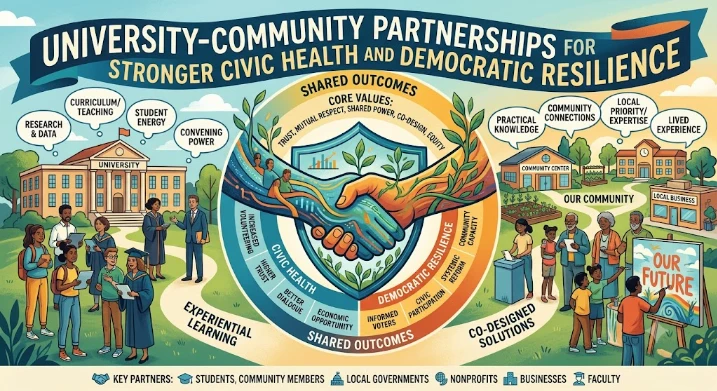
This article examines how university–community partnerships can strengthen civic health and democratic resilience by building trust, participation, information access, social connection, and collective problem-solving capacity. Universities are presented as long-term civic institutions with knowledge, facilities, networks, and convening power, while communities contribute lived experience, legitimacy, and practical judgment. Strong partnerships therefore depend on reciprocity, shared governance, and early community involvement in defining problems and decisions. The article discusses collaborative work in public health, planning, local information, service learning, crisis response, and civic education, while warning against institutional visibility replacing genuine community benefit. It also addresses land development, political neutrality, equity, student continuity, and the hidden costs that community partners often absorb. Evaluation should measure trust, participation, network strength, service access, policy change, distributional effects, and whether gains survive leadership or funding changes. Overall, the article argues that democratic resilience grows when universities and communities repeatedly work together, manage disagreement fairly, share authority, and create durable structures for cooperation before crises occur.
Civic health refers to the state of relationships, participation, trust, information, and community problem solving of public health in a community. As with physical health, there is no single symptom that can be used to take a measurement of it. Voting is important, but so is group membership, neighborly assistance, public meeting attendance, access to trusted information and trust in institutions. There is no correlation between a high proportion of the population voting and social integration. There is no correlation between a high level of electoral participation and level of social inclusion.
There are several civic health frameworks that look at services, civic action, civic engagement, civic connections, civic information and civic trust. These measures indicate if residents have opportunities and relationships for public action. They also show disparities by income, race, age, geographic location, disability, or level of education. Before a crisis, it is the civic capacity of the people that gives the Dems the chance to be resilient.
Universities have the capacity to enhance this capability as they bring together people, knowledge, facilities, professional networks, and have a long-term horizon. A campus tends not to move away from one area like a short project or an election campaign, and can continue to be tied to that area for years. The permanence can be a tool for patient partnership. It can also exacerbate damage in the event of a failure to be sensitive to local priorities, growing without accountability, or using neighboring areas as test beds.
The Carnegie definition’s emphasis is on reciprocity as the driving force of university community engagement. Knowledge and resources should flow in two ways, providing benefit to campus and community partners. This is contrary to the idea of a simple charity model under which Universities come to the rescue. The starting point of a strong partnership is to have a common purpose, a common voice and acknowledge the local knowledge that may not be found in academic databases.
Thomas Andrew Bryer and partners studied civic health in university community partnerships in various regions of the world. A comparison of their work included civic involvement of university leaders, students, faculty, staff, and community members and revealed that civic involvement can manifest in many different ways depending on social and institutional settings. There is no universal program developed for the central lesson. It's the desire for connecting themes of civic mission, autonomy, risk, contestation, impact, and engagement with students.
Civic health can be enhanced through a partnership's hands on work around a local issue. Exposure monitoring can be done in partnership with neighborhood groups via public health research. Planning departments can help the community identify unsafe streets through a residents' mapping process. Business schools can support co-operatives and public affairs programs can support agencies to create an accessible participation. The issue offers a rationale for those who normally don't work together to develop a working relationship.
This work becomes democratic if the residents have a more than influence on implementation. Community partners need to, in collaboration with the group, outline the problem, select evidence, analyze the results and determine next steps. Participation after big decisions is done - consultation. Shared governance allows for disagreement to be made visible, and provides a realistic pathway for partner to alter decisions.
In the polarization, universities can be a convenor as they have a space, facilitation skills and traditions of inquiry. Consensus does not have to be forced; nor does all information presented in a meeting have to be supported. It involves setting up an environment that allows for diverse views to be expressed, tested and selected in a thoughtful manner. With a little assistance from a good facilitator, the participants can help themselves to uncover values, compromises and zones of viable collaboration.
Democratic resilience depends on connecting across difference – it does not depend on communication among similar groups. Partnerships can foster bridging relationships between neighborhood associations, faith communities, public agencies, youth groups, businesses and advocacy groups or coalitions with shared work. Experience can help to reduce stereotypes with repeated cooperation. An individual conversation doesn't have the same impact as a project that is co-created.
Local information systems are a component of civic infrastructure, as well. Residents should have credible reporting, public records, readily available data, libraries, broadband, and trusted messengers to facilitate understanding of decisions. Access to local news, broadband Internet, and public libraries has been identified as civic infrastructure in the 2024 County Health Rankings national report. Universities can help enhance access to local journalism, support data interpretation, access to archives, and media literacy without taking control of the public discourse.
Students have opportunities to engage with the community through service learning, internships, community research, public history, legal clinics, and voter engagement. These activities should be based on partners' needs and incorporate structured reflective activities that are structured. Short semesters bring risks if projects finish or are prematurely terminated before the work in the community can be completed. Multi-year courses, shared documentation and staff co-ordination can help to promote continuity from one cohort to the next.
In times of crisis, individuals may see how strong the relationships were in the past. Established partnerships facilitate the shareability of information and resources in a public health emergency or other disaster event such as a flood, fire, economic shock or displacement, due to the nature of pre-established contacts. It can't be made during an Emergency Alert. Regular partnership is the relational reserve required when uncertainty and fear increase.
The important message from the Universities is that they must be wary of making community benefit a substitute for institutional visibility. A partnership can also provide press exposure, income, and student placements – and can shift the hidden costs to local organizations. Staff can be spending hours training students, fixing things, arranging access, etc., or at campus meetings. Such burdens are apparent in fair budgets, compensation, and review by partners.
Special care needs to be taken for land and development, as they are sometimes large property owners. Expanding a campus may lead to greater job creation, help to accommodate more amenities, and lead to displacement, or to rents being higher, or to neighborhood control being reduced. No matter what the language, there is material harm, which does not excuse. Planning should be transparent, community benefit agreements where appropriate, and meaningful participation in democratic partnership should occur before irreversible decisions.
Another less clear-cut statement is that of political neutrality. A university need not endorse a party or a candidate, nor become engaged in any partisan campaigning. Civic commitments are commitments to fair procedures, wide access to information, fair and accurate information, lawful participation, academic freedom and respectful disagreement, not partisan results. Often it's more comfortable for institutions to avoid any of the issues that are contested by people, which may weaken the public relevance of the institution.
There should be a clear theory of change that should be used for evaluation. A partnership may aspire to enhanced trust, increased engagement, better services, more connected networks, more effective policy and more conflict management capacity. There should be appropriate evidence for each outcome as well as a realistic timeframe. Counting meetings doesn't give any indication of power shifting or of a better relationship. Evidence of civic change is not lost in favour of pretty activity counts because of baseline measures and agreed-upon benchmarks.
Quantitative data can monitor participation, network, service access, policy adoption, response time and voter registration, volunteer activity, or distribution of benefits. Indicators of trust, belonging, efficacy, and perceived responsiveness are some areas that can be explored in a survey. Qualitative interviews and observation can provide insight into who made the decision and the reasons for groups backing out. Longitudinal designs can demonstrate if gains persist in the presence of either a change in leadership or the loss of funding.
Equity analysis is critical as it can mask the growing inequalities. A new public forum could be more inclusive of more people, but also exclude shift workers, caregivers, people who live in rural areas, people with disabilities, or speakers of a minority language. Such patterns can be found in the disaggregated data. Community interpretation can help fill in gaps in administrative interpretation that would otherwise remain unknown.
Partnerships are not dependent on one enthusiastic Professor or Community leader with institutionalization. Campuses require consistent offices, easily available contact, minimal amounts of funding, ethical direction, guidelines for data sharing, promotion, and a dispute resolution process. Community partners require jobs in oversight and not advisory roles. Memory is formed with durable structure when people change.
Preserving all institutions as they are does not mean that they are resilient. Resilient communities can withstand shocks, make necessary corrections when something fails, incorporate excluded voices, and adjust public installations and practices without leaving aside the legality of working together. University partnerships help when they increase the capacity to perform this adaptation, in terms of skills, relationships, and information. They go astray when institutional reputation becomes more salient than shared accountability.
A foundation of civic health is built when people repeatedly engage in civic activities that they find meaningful. Knowledge and space, continuity and convening power, lived expertise and legitimacy and practical judgment are all areas that communities and universities have to offer. But reciprocity converts those assets into shared capacity. Democratic resilience builds as people learn to disagree, learn, decide, and act together before it becomes crisis; and partnerships are crucial to that process. This attitude fosters confidence in collective action in the face of differences.
CITE THIS ARTICLE
Das, B. C. (2025). University Community Partnerships for Stronger Civic Health and Democratic Resilience. https://www.bikashchandra.com/article/c8965152-5989-55d8-860d-4454c3faa290
B. C. Das, “University Community Partnerships for Stronger Civic Health and Democratic Resilience,” 2025. [Online]. Available: https://www.bikashchandra.com/article/c8965152-5989-55d8-860d-4454c3faa290
Das, B. C. (2025) ‘University Community Partnerships for Stronger Civic Health and Democratic Resilience’. Available at: https://www.bikashchandra.com/article/c8965152-5989-55d8-860d-4454c3faa290
Das, Bikash Chandra. “University Community Partnerships for Stronger Civic Health and Democratic Resilience.” 2025, https://www.bikashchandra.com/article/c8965152-5989-55d8-860d-4454c3faa290.
Bikash Chandra Das. “University Community Partnerships for Stronger Civic Health and Democratic Resilience.” (2025). https://www.bikashchandra.com/article/c8965152-5989-55d8-860d-4454c3faa290.
Das BC. University Community Partnerships for Stronger Civic Health and Democratic Resilience. 2025. https://www.bikashchandra.com/article/c8965152-5989-55d8-860d-4454c3faa290
@misc{article_c8965152598955d8860d4454c3faa290,
  title = {University Community Partnerships for Stronger Civic Health and Democratic Resilience},
  author = {Bikash Chandra Das},
  year = {2025},
  url = {https://www.bikashchandra.com/article/c8965152-5989-55d8-860d-4454c3faa290},
}
TY  - GEN
AU  - Bikash Chandra Das
TI  - University Community Partnerships for Stronger Civic Health and Democratic Resilience
PY  - 2025-01-22
UR  - https://www.bikashchandra.com/article/c8965152-5989-55d8-860d-4454c3faa290
ER  -
This article explores why people volunteer in America’s national parks and how program design influences whether service remains meaningful. Volunteer motivations often overlap and include personal values, learning, social connection, career development, confidence, purpose, and attachment to place. The article uses motivational frameworks to show that volunteers are more likely to remain engaged when they experience autonomy, growing competence, respectful relationships, and a clear connection
Probation and parole are presented as essential community-based alternatives to incarceration that combine supervision, accountability, and reintegration. Probation generally allows eligible offenders to remain in the community instead of serving a prison sentence, while parole provides conditional release after part of a custodial sentence has been completed. The article explains that both approaches can preserve employment, family ties, education, and housing, all of which reduce the risk of r
This article defines the ethical boundaries that protect volunteers who support visitor safety and law-enforcement-related functions in national parks. Although volunteers can assist with information, observation, traffic support, administrative work, backcountry roves, and reporting hazards, they must not exercise powers such as arrest, detention, search, citation, evidence handling, use of force, or other commissioned enforcement duties. The article emphasizes clear position descriptions, accu