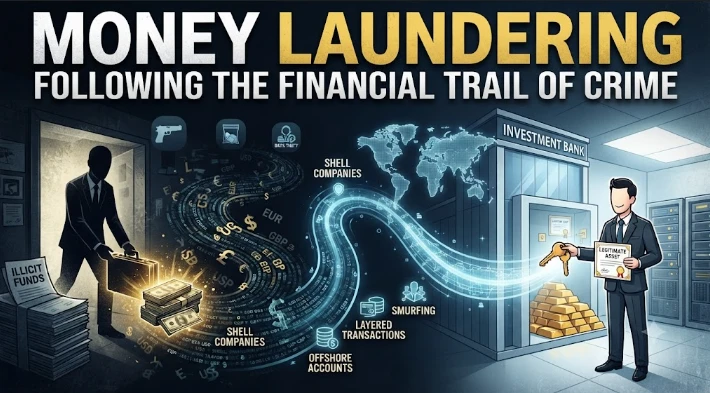
Money laundering is described as the financial process that allows criminal proceeds to enter and circulate through legitimate economic systems. The article explains the traditional stages of placement, layering, and integration, showing how illicit funds are first introduced into financial channels, then moved through complex transactions to hide their origin, and finally converted into apparently legitimate assets. Modern laundering increasingly uses cryptocurrencies, stablecoins, shell companies, trade-based schemes, encrypted communication, and cross-border payment systems. These methods make tracing criminal money more difficult and enable organized crime, corruption, trafficking, fraud, and other serious offenses to expand. The article also discusses weaknesses in conventional anti-money-laundering systems, particularly high false-positive rates that overwhelm compliance teams. Artificial intelligence, transaction analytics, centralized regulatory frameworks, and information-sharing requirements are presented as emerging solutions. Ultimately, following the financial trail allows authorities to identify criminal networks, professional facilitators, and illicit assets. The article argues that effective anti-money-laundering enforcement is essential for protecting financial integrity, reducing criminal profitability, and limiting the power of organized crime.
Money laundering is the grease in an elaborate crime machine that gives illegal activities enough space to succeed and go mostly undetected. It is the way in which dirty money, which is mostly as a result of drug trafficking, human smuggling, corruption, or intricate fraud, gets washed of its criminal roots and returned to the legitimate financial systems. In the absence of such a mechanism, organized crime would be limited such that they could not convert cash flow into physical assets, purchase real estate, or invest in legitimate business without raising red flags. By the year , money laundering scale and sophistication has grown exponentially as a measure of the creativity of criminal organizations and the difficulty of enforcement agencies in monitoring and disrupting illegal movement of funds. According to recent reports issued by the Financial Action Task Force as well as the United Nations Office on Drugs and Crime, money laundering is not a peripheral issue anymore; it is a focal point of organized crime and the influence of money laundering cuts across all tiers of economic and social infrastructure.
The size of illegal financial transactions is unbelievable. The latest estimates of and early show that money laundering now extracts about 5.5 trillion U.S. dollars of the global economy, which is an equivalent of about five percent of the global economy through GDP. Such funds do not exist as virtual figures; they become the source of corruption, support transnational criminal networks, and corrupt normal economic activity. Although regulatory structures are now stronger than ever, governments have historically recovered less than one percent of international illegal flows, which poses an astronomical recovery gap with the largest part of criminal proceeds remaining to be invested back into the criminal system. The statistics are also distressing in the national level. In America, laundering almost seven hundred and thirty billion dollars is done annually and it represents about 2.5 percent of the GDP. In the high-risk areas like Brazil, the number reaches up to eight percent of GDP and highlights how financial crime may lead to the increase in economic instability, investor confidence and destabilize whole countries. The magnitude of these flows depicts that money laundering is not some white-collar inconvenience; it is a systematic risk to the economic welfare and social justice worldwide.
Mechanics Money laundering is still based on a traditional three-step process, but the technologies and techniques used in money laundering have changed radically. Placement entails depositing illegal funds to the financial system, by various means such as smurfing, where big amounts of money are subdivided into smaller less obvious deposits, or cash-heavy stores such as laundromats, casinos, or high turnover retail outlets. The second stage is layering; the most complicated stage, which entails the transfer of money in a circuitry of transactions across borders, asset categories, and financial instruments to conceal the source of money. Criminals use globalized financial systems, shell companies, trade-related schemes, and digital resources to develop a fog that makes it difficult to detect any criminal activity. The last step is integration, which happens when illegal money is brought back into the legitimate market, usually through some luxurious real estate purchases, luxury goods, or even investing in seemingly legitimate enterprises. This is where the cycle is closed, and criminal gains are transformed into assets that can be spent in public and the obvious linkage to illegal activity is lost.
The digital transformation of has changed the nature of money laundering, and cryptocurrencies, stablecoins, and cross-border digital payment systems have become the railroad of choice by criminals in their laundering activities. In the year 2025, the percentage of crypto-linked illicit transactions amounted to a record of 158 billion in the world, showing the astronomic increase in virtual assets as instruments of criminal businesses. The most prevalent type of illicit crypto transactions has been stablecoins, including USDT, where eighty-four percent of all transactions are laundered. It is in their ability to mix the speed and transparency of blockchain with the relative stability of the price of traditional currencies, and enable criminals to transport substantial amounts without the volatility that used to make digital versions of laundering difficult.
In , the ruble-pegged stablecoin A7A5 will be introduced, introduced in early and transacting more than $100 billion in its first year of operation. Mostly using it to circumvent Western sanctions, it has enabled extensive underground banking, as an example of how state-affiliated or territorially dominant digital property may also overlap with illegal finance. Moreover, more complex Chinese Money Laundering Networks, or CMLNs, are known as service oriented Laundering-as-a-Service providers, transferring billions of dollars by encrypted messaging networks and layers of wallets, proving that money laundering has become an expert and service based business that can sustain global criminal activities.
In these challenges, law enforcement and regulatory authorities are pulling out all the best technologies and multi-agency coordination in the anti-money laundering efforts. Conventional AML systems have long been characterized by very high false-positive rates, typically in the ninety-five percent range, that overwhelms compliance departments with noise on false-positives and leaves advanced laundering unchecked. By , generative artificial intelligence has been put into practice and it transforms the world. These artificial intelligence applications are capable of identifying intricate trends in transaction data, finding abnormalities that indicate layering or obfuscation, and ranking situations to be reviewed by humans. Analysts project that AI-based AML systems will conserve firms around $183 billion of compliance costs each year in addition to enhancing the detection accuracy and efficiency. These tools can be viewed as a paradigm shift, where the financial institutions can now proactively respond to complex laundering schemes instead of reacting on threshold-based alerts or regulatory prompts.
Improvements in legislation and institutions have been made to augment technological improvements. The move towards centralized regulatory frameworks, where fragmented national rules are substituted by a single rulebook across high-risk financial institutions, is a big step in this direction, the EU Anti-Money Laundering Authority, which comes into effect on January 1, . Such harmonization decreases regulatory arbitrage, and it has become far more challenging to get criminal networks to take advantage of differences across jurisdictions. International regulation has also been enhanced at the international level with enforcing the Travel Rule on the virtual asset service providers by the Financial Action Task Force. The Travel Rule, by obligating the disclosure of originator and beneficiary data on transfers of all crypto assets, aligns the digital asset transfer model with the traditional banking model, which proposes that digital transactions are traceable and responsible and gives investigative bodies with essential intelligence to detect and intercept illicit flows.
The financial system is well out of the money laundering stakes. It is the blood of countless criminal activities, including the sale of fentanyl and human trafficking, as well as large-scale cybercrime and conspiracy. A single dollar that is successfully laundered allows perpetuating the harm, either by bribing the officials, getting weapons, or taking advantage of the vulnerable groups. In this regard, money laundering is not the fringe benefit of the economic crime; rather, it is a pillar that facilitates the growth and development of global criminal networks in that they are able to grow, innovate, and become part of the legitimate economic and political systems.
The challenge of money laundering in should be handled in a multi-dimensional international approach. The alternative is intelligence sharing among countries, tracking transactions in real time, collaboration with the business community, and adoption of AI and machine learning, which is vital in identifying and disrupting illegal flows. Banks need to be active contributors to detection of suspicious activity, and the regulators need to make regulatory frameworks flexible to the new technologies and the criminal methods. By tracing the money trail, law enforcement agencies will be able to bring down the whole criminal organization, attack professional facilitators who help to give credibility to illegal money, and seize money that would otherwise be used to finance future crime. The role of the public awareness and education is also critical because the higher the transparency and reporting, the more pressure the society has over the corruption and illegal money.
The future of money laundering in underscores the dynamism of the technological, regulatory and criminal innovation. Criminal actors are more advanced and can now use digital assets, stablecoins, cross-border payment systems, and professional laundering services to increase their operations with a high degree of minimized risk. Nevertheless, the development of AI, the existence of centralized regulation, and collaboration among the countries prove that financial crime is not unstoppable. Through technological innovation and the harmonisation and proactive implementation of policies, the international community can make illicit activity less profitable, interrupt the operational capacity of criminal networks and safeguard the integrity of financial systems on the global scale.
To sum it up, money laundering is much more than a hypothetical economic offense. It is the key artery where the money of almost all major criminal activities passes including the synthetic drugs and human trafficking as well as the major fraud and corruption cases. The magnitude of criminal financial transactions by more than five trillion dollars worldwide reflects the boldness of criminal organizations and the urgency of the need to have strong, dynamic, and technologically superior enforcement systems. The goal is now apparent: to make crime unprofitable, minimize systemic damage, and have the financial systems, which support the global business, resilient, transparent and safe, as regulators, law enforcement, financial institutions, and international organizations keep perfecting their detection, disruption, and recovery measures. Through financial intelligence, cooperation, and technological discipline, the world will be able to start closing the shadow economy and regain trust in the rule of law.
CITE THIS ARTICLE
Das, B. C. (2025). Money Laundering: Following the Financial Trail of Crime. https://www.bikashchandra.com/article/1482dccc-1e59-5b8c-80f9-0b1c880bab3c
B. C. Das, “Money Laundering: Following the Financial Trail of Crime,” 2025. [Online]. Available: https://www.bikashchandra.com/article/1482dccc-1e59-5b8c-80f9-0b1c880bab3c
Das, B. C. (2025) ‘Money Laundering: Following the Financial Trail of Crime’. Available at: https://www.bikashchandra.com/article/1482dccc-1e59-5b8c-80f9-0b1c880bab3c
Das, Bikash Chandra. “Money Laundering: Following the Financial Trail of Crime.” 2025, https://www.bikashchandra.com/article/1482dccc-1e59-5b8c-80f9-0b1c880bab3c.
Bikash Chandra Das. “Money Laundering: Following the Financial Trail of Crime.” (2025). https://www.bikashchandra.com/article/1482dccc-1e59-5b8c-80f9-0b1c880bab3c.
Das BC. Money Laundering: Following the Financial Trail of Crime. 2025. https://www.bikashchandra.com/article/1482dccc-1e59-5b8c-80f9-0b1c880bab3c
@misc{article_1482dccc1e595b8c80f90b1c880bab3c,
  title = {Money Laundering: Following the Financial Trail of Crime},
  author = {Bikash Chandra Das},
  year = {2025},
  url = {https://www.bikashchandra.com/article/1482dccc-1e59-5b8c-80f9-0b1c880bab3c},
}
TY  - GEN
AU  - Bikash Chandra Das
TI  - Money Laundering: Following the Financial Trail of Crime
PY  - 2025-09-03
UR  - https://www.bikashchandra.com/article/1482dccc-1e59-5b8c-80f9-0b1c880bab3c
ER  -
This article explores why people volunteer in America’s national parks and how program design influences whether service remains meaningful. Volunteer motivations often overlap and include personal values, learning, social connection, career development, confidence, purpose, and attachment to place. The article uses motivational frameworks to show that volunteers are more likely to remain engaged when they experience autonomy, growing competence, respectful relationships, and a clear connection
Probation and parole are presented as essential community-based alternatives to incarceration that combine supervision, accountability, and reintegration. Probation generally allows eligible offenders to remain in the community instead of serving a prison sentence, while parole provides conditional release after part of a custodial sentence has been completed. The article explains that both approaches can preserve employment, family ties, education, and housing, all of which reduce the risk of r
This article defines the ethical boundaries that protect volunteers who support visitor safety and law-enforcement-related functions in national parks. Although volunteers can assist with information, observation, traffic support, administrative work, backcountry roves, and reporting hazards, they must not exercise powers such as arrest, detention, search, citation, evidence handling, use of force, or other commissioned enforcement duties. The article emphasizes clear position descriptions, accu