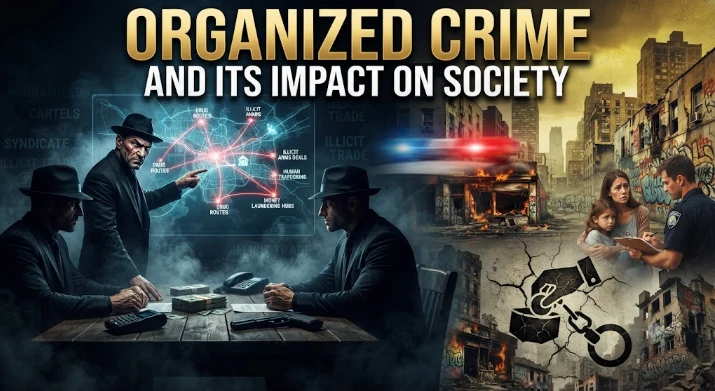
Organized crime is portrayed as a technologically sophisticated, globally connected business that operates across borders, industries, and illegal markets. Modern criminal networks engage simultaneously in money laundering, drug trafficking, human trafficking, cyber fraud, extortion, illegal resource extraction, and other profitable activities, a pattern described as polycriminality. The article explains that these groups increasingly resemble multinational corporations in their ability to diversify, manage logistics, use technology, and exploit regulatory differences between countries. Artificial intelligence, encrypted communication, digital payments, and professional facilitators have expanded their reach and reduced traditional enforcement advantages. Organized crime also damages society by corrupting public institutions, distorting markets, financing violence, weakening public trust, and infiltrating legitimate supply chains. Effective responses therefore require international intelligence sharing, financial investigation, asset recovery, public-private cooperation, cyber-forensics, anti-corruption measures, and stronger oversight of professional enablers. The article concludes that arresting low-level actors is insufficient; authorities must disrupt the financial, technological, logistical, and institutional infrastructure that allows organized criminal networks to operate and regenerate.
Organized crime in the environment in has changed to an entirely different form past the cliched images of darkened figures settling deals in smoke rooms. It is currently an industrialized, technologically advanced and globally connected business that is as agile as multinational corporations. The Global Organized Crime Index and INTERPOL and the United Nations Office on Drugs and Crime briefings are a sobering read, as organized criminal organizations have become, in fact, geopolitical actors, with economic, logistical and political power that is comparable to what most nation-states can offer. These networks take advantage of the globalized nature of finance, trade, and digital technology, forming a network of criminal activities that are highly complex, transnational, and trans-industrial (that is, cuts across borders, industries, and jurisdictions). Their activities are not limited to local areas and national boundaries anymore; they belong to a complex global ecosystem of crime that harms security, governance, and economical and social costs are enormous.
It is still difficult to measure the magnitude of organized crime, given that it is a secretive phenomenon, but the figures concerning the same in are shocking. There are organized criminal activities such as money laundering, human trafficking, cyber fraud, and extortion, which is estimated to contribute between three and four percent of the global GDP, which is over four trillion dollars yearly. This is because of the economic scale that it is not merely a law enforcement issue; but a security issue on the global front that is undermining integrity in institutions, destabilizing communities, and robbing them of much needed resources that could be put in the provision of basic services. The omnipresent nature of these networks is creeping into the legitimate spheres and misrepresenting the markets and the rule of law that carry far-reaching consequences in economic growth, societal harmony, and integrity of democratic institutions.
Polycriminality, a policy to diversify a criminal network in a variety of illegal markets, is one of the key traits of contemporary organized crime and is used to optimize profit and minimize operational risk. Some of the most highly developed ones in act similarly to tech startups and move effortlessly between cybercrime, narcotics trafficking, human exploitation, and financial fraud. Though the industrialization of fraud has been noticeable in the last two years, the emergence of so-called scam centers in Southeast Asia and in some parts of Africa, in particular, has been especially significant. Such centers usually depend on trafficked persons where they are compelled to carry out online investment programs, romance hoaxes or other financial scams activities. Their efficiency and profitability have risen exponentially as artificial intelligence has been integrated into these operations as the so-called AI multiplier. The AI-powered systems have the ability to fully coordinate the process of the campaign, starting with first-contact and ending with the ransom, and these processes are likely to provide revenues calculated at a rate that is more than four times more profitable than previous approaches to fraud. The legal and moral issues of these technologies are enormous, and law enforcement cannot keep up with speed, sophistication, and anonymity of these online operations.
There is also a structural change in the world drug trade. Although plant-derived narcotics are not to be ignored, the market of the is controlled by a duopoly of synthetic opioids, including fentanyl and nitazenes, and cocaine. These drugs are simpler to produce, hide, and smuggle as compared to the traditional drugs, and organized criminal organizations can capitalize on the global logistic systems to sell products with minimal risks of detection. The profitability of synthetics, in conjunction with the magnitude of international demand, has prompted criminal organizations to incorporate production, trafficking, and distribution into vertical structured operations, which resemble legitimate supply networks. This juxtaposition of advanced technology and logistics efficiency allows criminal participants to make colossal incomes and complicates their attempts to be noticed, and the old methods of policing are becoming ineffective.
Forced labor and sexual exploitation of human trafficking are still a significant source of money of organized crime rings. Traffickers use structural gaps in political systems, law enforcement agencies, and economies to steal billions of dollars of the victims across the world. Simultaneously, the organized groups have grown into the extortion market, attacking the legitimate industry, i.e., mining and extraction of natural resources. In other countries such as Brazil and Indonesia, the networks of crime have penetrated the gold and nickel supply chains whereby violence, corruption and coercion are used to take over whole portions of production. These actions depict the expansiveness of the impact of organized crime as the criminal activities go beyond the known criminal acts into another field that was deemed secure or legal and compromised economic integrity and labor safety.
The social and economic damages of organized crime are far-reaching and very deep. Social contract is destroyed when criminal networks infiltrate the actors that are embedded within the state and the confidence of the people is destroyed. According to the OECD Integrity Outlook, the annexation of an implementation gap in anti-corruption technologies has led to the fact that organized criminal groups have penetrated the sphere of public procurement and are able to drain billions in taxpayer funds through it. The violence linked to these organizations is a major contributor to the homicide statistics all over the world, at close to a quarter of all murders, and in some areas of Latin America, where cartel wars are a regular occurrence, close to half of the total. In addition, money laundering and the circulation of illegal financial resources corrupt local markets, overinflate real estate prices, and favor criminal companies against law-abiding ones, which further destabilize the economies and undercut the rule of law.
Conventional methodologies of law enforcement will be heavily constrained in dealing with organized crime in . Jurisdictional arbitrage enables crime networks to take advantage of regulatory arbitrages, committing crimes in one jurisdiction but working out of a safe haven in another, typically by way of sophisticated digital systems. Mostly financial and cyber-dependent crimes are not noticeable and do not leave traces physically or quickly disrupt the life of a society, despite their enormous economic effects. These activities are frequently identified by the private sector first, but in , only one-third of financial institutions would be using sophisticated AI-monitors that can detect more advanced threats, which will further increase the disparity between a criminal capacity and institutional protection.
The multi-layered, intelligence-led approach to fighting organized crime during this age needs to be globally coordinated. The most important is international cooperation since criminal networks are transnational and can easily escape justice through the law fragmentation. Programs such as the I-GRIP, which is a cross-border asset recovery program, run by INTERPOL have already allowed the recovery of more than a billion dollars in stolen money and that is the value of cross border sharing of intelligence. There is also need to have public- private partnerships. There is need to integrate bank, technology companies and law enforcement agencies in a closed loop system where financial data, digital behavior, and operational intelligence are exchanged and used to dismantle criminal networks. Such collaborations do not only increase enforcement, but they also form systemic deterrents to limit the freedom of operation of organized crime groups. Moreover, it is essential to target those in the profession, who provide legitimacy to illegitimate wealth, such as lawyers, accountants, and real estate agents, and dismantle networks on the level of the top to kill the networks at the same time as it would be impossible to defeat the networks without the infrastructure.
Some of the problems that organized crime might bring in are intricate and demand a reconsideration of the usual approaches to law enforcement. The raid of low-level agents or the obstruction of single operations cannot be effective in instances where networks are planned, resourced and flexible like multinational business. In a successful response, intelligence-based policing should be put in place which incorporates forensic accounting, cyber-investigation and enhanced analytics to predict criminal behavior and intercept it before it occurs. Enhancing institutional integrity, fostering transparency, and entrenching anti-corruption protection provisions both in the public and the private system is also critical to curbing weaknesses that organized criminal groups take advantage of. The other factor is education and public awareness campaigns, educating the citizens and businesses about the signs of polycriminal behavior and the significance of reporting suspicious conduct.
Besides this, technology serves two purposes in the facilitation and disruption of organized crime. As criminals are using AI, encrypted communications, and digital payment systems to conduct their activities more than ever before, law enforcement agencies are, in turn, turning to sophisticated algorithms, machine learning, as well as predictive analytics to establish patterns, trace bad activity, and map out criminal networks in real time. Cyber-forensics and data analytics as well as blocktracking have become essential instruments that help investigators generate transparency and accountability in systems that have been previously used by criminals without prosecution. With an advantage over technological advancement, criminal justice agencies will be able to seal the distance between criminal capability and institutional defense such that organized crime will no longer be able to transverse the borders and industry with impunity.
Finally, organized crime in is a threat of a high level of sophistication and suitability of a corporation, which reflects the weaknesses of an overly interconnected and globalized society. It operates in both traditional and online markets, plays off economic and political systems, and makes enormous illegal profits that erode both security and social trust. This should be matched by the response: it should be intelligence-enabled, globally integrated, technologically empowered and institutionally resilient. Although arrests, prosecutions and seizure of assets are essential, they work best when they are part of a larger plan that also encompasses the involvement of the public and the state as well as cooperation with other nations, systematic anti-corruption actions, and community involvement. The justice of the globalized, AI enhanced era of crime needs more than handcuffs, it needs a smarter more rapid and more coordinated reaction, one that will counter the structural, technological and social aspects that enable the existence of organized criminal networks.
CITE THIS ARTICLE
Das, B. C. (2025). Organized Crime and Its Impact on Society. https://www.bikashchandra.com/article/82027adb-4dc0-52b7-9d01-71bc037b3e48
B. C. Das, “Organized Crime and Its Impact on Society,” 2025. [Online]. Available: https://www.bikashchandra.com/article/82027adb-4dc0-52b7-9d01-71bc037b3e48
Das, B. C. (2025) ‘Organized Crime and Its Impact on Society’. Available at: https://www.bikashchandra.com/article/82027adb-4dc0-52b7-9d01-71bc037b3e48
Das, Bikash Chandra. “Organized Crime and Its Impact on Society.” 2025, https://www.bikashchandra.com/article/82027adb-4dc0-52b7-9d01-71bc037b3e48.
Bikash Chandra Das. “Organized Crime and Its Impact on Society.” (2025). https://www.bikashchandra.com/article/82027adb-4dc0-52b7-9d01-71bc037b3e48.
Das BC. Organized Crime and Its Impact on Society. 2025. https://www.bikashchandra.com/article/82027adb-4dc0-52b7-9d01-71bc037b3e48
@misc{article_82027adb4dc052b79d0171bc037b3e48,
  title = {Organized Crime and Its Impact on Society},
  author = {Bikash Chandra Das},
  year = {2025},
  url = {https://www.bikashchandra.com/article/82027adb-4dc0-52b7-9d01-71bc037b3e48},
}
TY  - GEN
AU  - Bikash Chandra Das
TI  - Organized Crime and Its Impact on Society
PY  - 2025-08-27
UR  - https://www.bikashchandra.com/article/82027adb-4dc0-52b7-9d01-71bc037b3e48
ER  -
This article explores why people volunteer in America’s national parks and how program design influences whether service remains meaningful. Volunteer motivations often overlap and include personal values, learning, social connection, career development, confidence, purpose, and attachment to place. The article uses motivational frameworks to show that volunteers are more likely to remain engaged when they experience autonomy, growing competence, respectful relationships, and a clear connection
Probation and parole are presented as essential community-based alternatives to incarceration that combine supervision, accountability, and reintegration. Probation generally allows eligible offenders to remain in the community instead of serving a prison sentence, while parole provides conditional release after part of a custodial sentence has been completed. The article explains that both approaches can preserve employment, family ties, education, and housing, all of which reduce the risk of r
This article defines the ethical boundaries that protect volunteers who support visitor safety and law-enforcement-related functions in national parks. Although volunteers can assist with information, observation, traffic support, administrative work, backcountry roves, and reporting hazards, they must not exercise powers such as arrest, detention, search, citation, evidence handling, use of force, or other commissioned enforcement duties. The article emphasizes clear position descriptions, accu