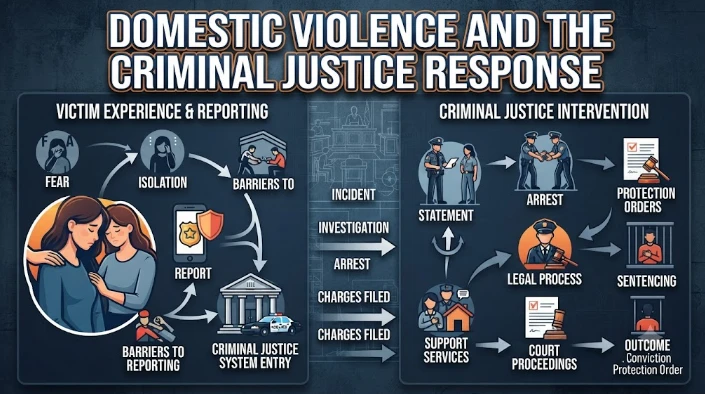
Domestic violence is presented as a widespread but heavily underreported form of crime rooted in power, control, social inequality, and intimate relationships. The article explains that victims often hesitate to seek help because of fear, shame, economic dependence, social pressure, distrust of authorities, and the heightened danger that can occur when leaving an abusive relationship. It also highlights emerging technology-facilitated abuse through stalkerware, smart devices, and manipulated digital content. Effective criminal justice responses therefore require more than arrest alone. The article discusses trauma-informed policing, lethality assessment tools, protection orders, specialized domestic violence courts, and coordinated community responses involving police, healthcare providers, courts, shelters, and support services. These mechanisms are designed to improve safety, collect evidence, reduce delays, and connect survivors with practical assistance. Long-term prevention also requires economic empowerment, public education, offender accountability, and cultural change. Overall, the article argues that justice must protect victim autonomy and safety while holding perpetrators accountable through a coordinated, survivor-centered system.
Domestic violence sometimes known as intimate partner violence is one of the most universal yet intractably undocumented forms of crime in international justice. By the year , it is evident that the legislation has enhanced in most nations, yet there is still a problem of ensuring that the law on paper is translated into reality on the ground. Domestic violence is not an issue but a deep-seated societal, social, and safety epidemic costing millions of people, families, and communities. Nevertheless, even after decades of awareness-building, scientific work, and legislative changes, the disparity between awareness and effective protection is still large not only due to the structural flaws in the justice system but also because of the firmly established social norms that encourage silence and victimization.
Domestic violence is a worrisome prevalence throughout the population of the globe. According to the report by UN Women 2025 , it was noted that almost one out of three women worldwide has been physically or sexually assaulted by an intimate partner at some point of her life. The figures stand incomplete as far as the story is concerned. Several cases go unreported and victims often end up silent through fear, shame or simply because of inaccessibility to support. It is estimated that only forty percent of the women who fall victim to violence seek any kind of assistance, and less than ten percent of these women report the crime to the law enforcers. This massive reporting discrepancy is an indicator of the difficulties which are presented in the detection and response to domestic violence and the shortcomings of the traditional justice systems which were not usually structured to deal with visible and public crimes but persistent and coercive abuse which takes place behind closed doors.
These difficulties can be illustrated in a tangible manner by the situation in Bangladesh. Domestic violence has been identified to be one of the dominant causes of injuries among women, with provisions of the law often being slow to take effect according to statistics. The Domestic Violence (Prevention and Protection) Act offers a legal structure to protect the victims, but in most cases the protection orders are not implemented in time due to court backlogs. Weeks or months of delay exposes the victims to persistence threats leaving them and their children in high risks. The law can be just on paper, but in practise, this is not the case and systemic reform is needed that places more emphasis on speed, accessibility and victim-driven processes. To make the situation worse, the emergence of technology-related gender-based violence is leading to the development of new types of abuse. Attackers are also turning more and more to digital tools such as stalkerware, smart-home devices, and deep fake media to dominate, track and threaten victims. These tools extend the scope of abuse to physical locations and pose a problem to traditional policing that finds it hard to define, trace and prosecute such crimes.
Reporting barriers are still too powerful and multidimensional. To most victims, it is dangerous and risky to call the law enforcement. The so-called separation paradox depicts a very dangerous situation: the threat of deadly violence usually is the greatest right after the victim begins to exit an abusive relationship or call the police. The dependency also poses a problem on making economic decisions. In cases where the abuser is the main provider, arrest would cause an immediate housing instability or financial precarity to the victim and the dependent children. Silence is also caused by social and cultural pressures when many societies continue to construct domestic violence as an issue of family honor or domestic disgrace. Often, the victims are pressured (implicitly or explicitly) into taking back complaints in order to save face or prevent social disfavor. Mistrust of the system exacerbates these barriers; very often victims are afraid that the police will not believe them, the investigation will drag on, and the legal process will be traumatizing and ineffective. The consequence is that domestic violence is in the deepest shadow, even at this extent of prevalence and severity, which involves cyclical harm, which transcends generations.
Even in , policing is the initial response in the criminal justice system, and now more work is being done to implement trauma-informed practice. In most jurisdictions, mandatory arrest policies have been established to relieve the victim of the burden of choice. The officers must make an arrest when they have probable cause of a domestic assault. This intervention is used to ensure that offenders do not manipulate victims into taking no action as well as to ensure that the offense is serious. Nevertheless, there are no challenges to mandatory arrest policies. Dual arrests may arise in cases where victims are taking self-defense which may lead to more trauma and deter reporting. Lethality assessment protocols have been developed as an adjunctive intervention to inform officers of the priorities in intervention. These are evidence-based screenings that pose specific questions involving risk factors that include access to guns, past experiences with choking or danger of serious injuries. The studies reveal that the administration of the lethality test greatly enhances the chances that a victim accesses support services by up to sixty percent, so the use of data-driven policing is crucial to preserving lives and saving risk.
Protections that are beyond the arrest process are also important. Both, civil and criminal protection orders, ban offenders who are not to be contacted or approached by the victim. Digital protection orders are also being used in many countries in , providing the opportunity to enforce and monitor the use of encrypted applications. These inventions speed up the service and shorten the period of vulnerability to the victims. Specialty domestic violence courts have proved to be effective as well. With trained judges, prosecutors and social workers, these courts are able to deal with cases in a sensitive and prompt manner through the concentration of judicial expertise on intimate partner violence cases. Studies point towards the fact that specialized courts lead to a twenty-five percent higher conviction rate and better performance in terms of safety outcome among victims, which highlights the importance of expert and focused interventions as opposed to generalized and overloaded judicial interventions.
An integrated community response is a crucial part of a successful response to justice. Domestic violence cannot be tackled in one agency only. The most effective plans in are inclusion of law enforcement, support services, healthcare, and the judiciary into a network. Immediate safety and collection of evidence is found in law enforcement, emergency shelter, counseling, and legal advocacy are found in support services. Health services cure physical injuries and record forensic evidence. The courts see to it that protection orders are promptly tried and implemented. Once these elements communicate efficiently and share resources, loopholes that expose the victims are reduced to create a closed-loop network that takes care of both short-term and long term recovery. This integrative strategy acknowledges the fact that domestic violence is not a one off event but a multifaceted process that need multi-sectoral partnership to reduce its physical, emotional, and social effects.
The highly systemic aspect of domestic violence also demands interventions that are not limited to direct measures of law. It is essential to solve the root causes of power relations, economic reliance and social injustice that propagate abuse in the future to stop violence. The legal interventions are complemented with economic empowerment programs, social support, rights education, and community awareness campaigns, which offer a long-term blueprint in limiting victimization. Simultaneously, offender rehabilitation and accountability schemes including counseling, behavioral change and supervised reintegration will aid in interruption of the violent cycle and decrease recidivism. Holistic approach considers punishment and prevention in a holistic manner, where justice is taken to meet the needs of the victims, at the same time, promoting social stability within the wider context.
The crime of domestic violence is based on power, control and systemic inequality. Criminal justice response that aims at punitive actions only to neglect the safety, autonomy, and well-being of the victim is not likely to be successful. Effective accountability needs a strong legal intervention as well as effective support mechanisms that would enable victims to break out of the abusive environments safely, ensure economic self-sufficiency, and restart their lives again. With the ethical application of technology, there must be a means of monitoring the offenders, a fast method of protection and a means of connecting the victims with the necessary resources and this must be done in a manner where the technology used is integrated well into a humanized form where the technology is not being used to spy on the victims or even collect data without their consent.
In a prospective view, the aim of criminal justice systems in Bangladesh and the rest of the world should be twofold, namely to ensure that the offenders are accountable and victims be empowered. The legal systems cannot be there, yet they are not enough without prompt measures, special training, integration of activities, and support systems in the community. The cycle of domestic violence requires multidimensional interventions (both short-term and long-term) to end, such as gender equality, economic empowerment, education, and cultural transformation. The societies can only shift to a stage where homes are safe havens and not a place of continuous destruction by dealing with both the symptoms and the underlying cause.
To sum up, the problem of domestic violence in is a burning issue that needs a complex and multi-tiered solution. Since the initial police call to the court proceedings, protection orders, and community support, every step of the criminal justice needs to be structured in such a way that it will minimize the risk, empower survivors, and hold them accountable. Trauma-informed policing, digital and physical protective services, specialized courts, and organized responses in the community have been found to be effective when combined but there are gaps especially in enforcement, resource distribution, and creating awareness to the population. The solution to domestic violence should be based on commitment to systemic change; that justice is not just about recidivating the criminal but that it is about saving, helping and recovering the lives of the victims. Founding on the experiences of victims and implementing evidence-based approaches, the societies can have a model of humane and effective justice that makes the law principles practical and guarantees the safety of the community, as well as makes the intimate partner violence a subject of a comprehensive strategy, and not its secretive acceptance.
CITE THIS ARTICLE
Das, B. C. (2025). Domestic Violence and the Criminal Justice Response. https://www.bikashchandra.com/article/c746f671-547c-58a0-a105-018452e3d48f
B. C. Das, “Domestic Violence and the Criminal Justice Response,” 2025. [Online]. Available: https://www.bikashchandra.com/article/c746f671-547c-58a0-a105-018452e3d48f
Das, B. C. (2025) ‘Domestic Violence and the Criminal Justice Response’. Available at: https://www.bikashchandra.com/article/c746f671-547c-58a0-a105-018452e3d48f
Das, Bikash Chandra. “Domestic Violence and the Criminal Justice Response.” 2025, https://www.bikashchandra.com/article/c746f671-547c-58a0-a105-018452e3d48f.
Bikash Chandra Das. “Domestic Violence and the Criminal Justice Response.” (2025). https://www.bikashchandra.com/article/c746f671-547c-58a0-a105-018452e3d48f.
Das BC. Domestic Violence and the Criminal Justice Response. 2025. https://www.bikashchandra.com/article/c746f671-547c-58a0-a105-018452e3d48f
@misc{article_c746f671547c58a0a105018452e3d48f,
  title = {Domestic Violence and the Criminal Justice Response},
  author = {Bikash Chandra Das},
  year = {2025},
  url = {https://www.bikashchandra.com/article/c746f671-547c-58a0-a105-018452e3d48f},
}
TY  - GEN
AU  - Bikash Chandra Das
TI  - Domestic Violence and the Criminal Justice Response
PY  - 2025-07-16
UR  - https://www.bikashchandra.com/article/c746f671-547c-58a0-a105-018452e3d48f
ER  -
This article explores why people volunteer in America’s national parks and how program design influences whether service remains meaningful. Volunteer motivations often overlap and include personal values, learning, social connection, career development, confidence, purpose, and attachment to place. The article uses motivational frameworks to show that volunteers are more likely to remain engaged when they experience autonomy, growing competence, respectful relationships, and a clear connection
Probation and parole are presented as essential community-based alternatives to incarceration that combine supervision, accountability, and reintegration. Probation generally allows eligible offenders to remain in the community instead of serving a prison sentence, while parole provides conditional release after part of a custodial sentence has been completed. The article explains that both approaches can preserve employment, family ties, education, and housing, all of which reduce the risk of r
This article defines the ethical boundaries that protect volunteers who support visitor safety and law-enforcement-related functions in national parks. Although volunteers can assist with information, observation, traffic support, administrative work, backcountry roves, and reporting hazards, they must not exercise powers such as arrest, detention, search, citation, evidence handling, use of force, or other commissioned enforcement duties. The article emphasizes clear position descriptions, accu