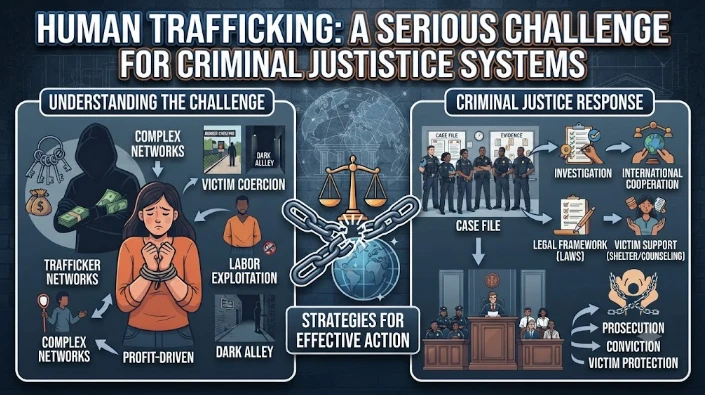
Human trafficking is described as a highly profitable, transnational form of modern slavery involving forced labor, sexual exploitation, forced marriage, debt bondage, and increasingly forced criminality in cyber-scam operations. The article emphasizes that traffickers exploit poverty, conflict, migration vulnerabilities, weak institutions, digital platforms, and cross-border jurisdictional gaps. Women, girls, children, migrant workers, and economically marginalized people face particular risks. Modern trafficking networks also use social media, encrypted communication, false job offers, and financial technologies to recruit and control victims. Prosecution remains difficult because coercion is often psychological or economic, victims may fear retaliation, and some are manipulated into committing offenses themselves. The article highlights technology-assisted financial analysis, international cooperation, the Palermo Protocol, coordinated data systems, and victim-centered Safe Harbor approaches as important responses. Successful intervention requires collaboration among law enforcement, healthcare, courts, civil society, and support providers. The central argument is that combating trafficking requires prevention, protection, prosecution, partnership, and structural reforms that reduce vulnerability while treating trafficked people as survivors rather than offenders.
Human trafficking which is sometimes known as modern slavery remains to be one of the most urgent issues to criminal justice systems worldwide. However, with every passing quarter of the year , it is becoming more apparent to the world that this crime is no longer restricted to the far boundaries or some distant corners of the world; rather it is a widespread, multi-billion dollar crime organization that extends its efforts and services in the online and offline space, taking advantage of the most vulnerable individuals in the society. Human trafficking may have been mostly invisible to the law enforcers and policymakers but currently, it has become a multifaceted, high profit business that needs equally multifaceted solutions. Although the way to detect them has been enhanced, the criminals are keeping up, and are using artificial intelligence, encrypted communications, and world crises to scale their activities. It is important to know how this crime works and the systemic issues it brings in to devise effective interventions and make sure that not only justice is sought, but it is realized.
The human trafficking crisis is huge. The number of individuals living under the circumstances of modern slavery amounts to fifty million individuals all around the world at any given time, according to the latest estimates provided by the International Labour Organization and the United Nations Office on Drugs and Crime. Approximately twenty-eight million people have been forced laborers and twenty-two million forced marriages represent the various forms of human exploitation. Human trafficking has become one of the most rapidly emerging criminal activities in the world, making it an estimated two hundred and thirty six billion dollars of illicit profits in the yearly turnover. It is important to note that the percentage of victims of sexual exploitation is lower than that of labor trafficking, but such exploitation generates seventy-three percent of the earnings of forced labor, which indicates the economic motivation of the trade and gender configuration of the victimization.
Females and girls have been the most vulnerable to human trafficking as some sixty-three percent of all victims registered around the world. According to recent reports ( ), there is an alarming rise in child trafficking, and the number of identified instances of minors has risen thirty-one percent relative to the situation before the pandemic. Such statistics demonstrate how traffickers are growing in strength and the increased vulnerability of children, especially in places where poverty, war, or instability of institutions are present. Although sexual exploitation has always been the most noticeable kind of trafficking, forced labor has become the most prevalent type of exploitation identified on the global level. Labor trafficking is a common occurrence in invisible industries like domestic services, agriculture, construction, and fishing business. Debt bondage is a major mode of control in the South Asian and Middle East countries, exploiting victims to ruthless labor by controlling them economically and against their will. The issue of forced labor is becoming more complicated, and perpetrators are using both coercion and economical reliance to keep their subjects under their control, which complicates their detection and intervention.
Women and girls remain a disproportionate victim of sexual exploitation. More than ninety percent of the victims of this type are women and traffickers are actively moving out of the street-level business and to the backdrop as well as the digital realm, and this includes hotels, short-term rentals and webcam studios. Such shift makes it difficult to detect and intervene by local law enforcement agencies as the traditional policing practices are usually poor tools to patrol the privately or technologically arbitrated space. Besides the issue of labor and sexual exploitation, a novel variant of the trafficking has developed in : forced criminality via cyber-scam centers. In some regions of Southeast Asia, people are enticed with fake employment opportunities and then manipulated to engage in online financial fraud, cryptocurrencies and other online offenses. Such facilities can be likened to compound-style facilities where victims are held, controlled, and used as an example of the widening scope of trafficking to new and highly lucrative spheres overlapping with the digital economy.
The task of prosecuting human traffickers is still gigantic regardless of the extent of crime. There is a low proportion of conviction against the victims identified. It was only a few perpetrators of traffickers who were successfully tried in 2025, per one thousand victims. This gap is attributed to a number of reasons. The former is the challenge of evidence. Contemporary traffickers do not use corsets and blatant forms of coercion very often. They instead use psychological instruments like debt bondage, threats to their relatives and denying them identification papers as instruments to subjugate victims. It is naturally hard to demonstrate coercion in court without a cooperative witness and the trauma of the victims usually prevents them to testify.
The second barrier is digitality of the recruitment and exploitation. Most of the cases of trafficking currently include social media, dating sites, or even encrypted messaging apps. Traffickers also take advantage of these tools to work across jurisdictions, stay anonymous, and unnoticed, making them difficult for investigators to overcome. Third, the trauma and fear of victims makes prosecution a harder undertaking. Almost all victims are terrified by law enforcement or may well fear retaliation and when they have been manipulated into committing a crime such as stealing or drug transportation they will not be willing to cooperate. Lack of trauma-sensitive prosecution practices often subject the victims to be treated as criminals as opposed to them being survivors, which compromises justice and leads to fewer successful convictions.
Irrespective of these challenges, has experienced an upsurge in forward and creative ways of fighting the vice of human trafficking. Technology is serving as a defensive barrier to and enforcement weapon by criminal justice systems. Robotic intelligence, machine learning systems, and software platforms are being used to scrutinize financial operations, detect abnormalities, and alert to possible references of human trafficking. These devices enable the police to identify illegal financial transactions, to connect traffickers to their victims, and plot intricate networks across jurisdictions. The authorities are enhancing the effectiveness, speed, and precision of interventions by replacing reactive investigation with predictive and evidence-based approaches.
The global community has also established itself as an essential part of the anti-trafficking response. Trafficking of humans is an international vice and the only way to deal with it is by working across borders. Palermo protocol is a system of such partnerships, which allows countries to exchange information, make joint investigations, and align legal practices. To standardize national reporting on trafficking, Bangladesh introduced a Digital Data Collection Platform in January to bring together trafficking data collection in different ministries at the international level. According to such initiatives, cross-border investigations, better identification of victims, and the general ability of authorities to respond systematically to the activities of traffickers that take advantage of gaps in jurisdiction become more possible.
The key to these reforms is the victim-centered approach. The model that illustrates such a philosophy is known as the Safe Harbor model, which means that the survivors will not be punished due to the crimes they were also made to commit when they were in the hands of the traffickers. Rather, the victims receive safe housing, legal aid, medical treatment, and psychological services immediately. This strategy will change the victims to be mere witnesses to participants in the justice process, as they will be able to give testimony without the fear of being retaliated or legally blamed. Focusing on safety and agency of victims will help criminal justice systems to collect more factual evidence, have an increased conviction rate, and break down trafficking networks more efficiently.
A multi-sectoral approach is also necessary to solve the human trafficking. The issue cannot be solved by the police only. Best practices include the partnership of law enforcement, support services, healthcare providers, judiciary, and civil society. Regular activities involve law enforcement where the victim is secured, evidence collected, support services where victims are sheltered, counseled and advocated, healthcare workers where injuries are documented and treatment offered and the courts that ensure that prosecution is swift and effective. By having these industries work in a closed loop system, where all the components of the system are synchronized, the loopholes that traffickers can use to target victims are reduced, and this will provide a full circle system of safety and solution to the short-run and long-run requirements.
Structural factors resulting in vulnerable people are another aspect of human trafficking that requires attention. Poverty, inequality, conflict and displacement is an environment, which subjects people to greater risk of exploitation. Moreover, the traffickers leverage the loopholes in labor laws, migration laws and electronic security systems to recruit, blackmail and manipulate victims. The principles of prevention and treatment of these underlying reasons should be tackled not only through enforcement but also prevention, in terms of education, economic empowerment programs, legal reform, and social support to vulnerable classes. Coupled with policymakers and civil society, the justice system should implement policies that would lower vulnerability to trafficking and provide quick and direct actions to those who engage into it.
Isolated interventions cannot solve human trafficking since it is a problem. It involves a long term, coordinated, and technologically aware strategy. Law enforcement, policymakers, the private sector, and the public should be aware that trafficking is successful in the unregulated areas of the society: unregulated labor markets, unsafe migration routes, digital anonymity, and insufficient resources to support the legal system. Combined with prevention, protection, prosecution, and partnership, the fight against trafficking thus will be effective indeed. Through ensuring the safety of the victims, maximizing on the use of technology, improving international collaboration and curbing the very structural forces that have been fuelling the trafficking rings, societies can commence to tear down the trafficking networks and break the coercion and abuse cycles that have continued to thrive over the decades.
To summarize, the problem of human trafficking in will continue to be among the most pressing and ethically compelling issues in the criminal justice systems all over the world. It is a vice that thrives on weakness, disparity, and technological advancement and it uses people in both pernicious and deep ways. However, it has been demonstrated that in cases where the burden of proof is reversed on traffickers, victims are addressed as survivors and not criminals, and where law enforcement, support services and international partners work together, significant gains could be realized. Human trafficking is not only a police or a court duty but a societal necessity that should be tackled by organizing actions, creating awareness among people, and maintaining a political commitment. It is under extensive, victim-centered and technologically knowledgeable approaches that we can start taking down networks of exploitation, reclaim dignity to the survivors, and enforce the basic human rights of the most vulnerable. Focusing on security, justice, and rehabilitation, societies can reverse the trend of current slavery and build the system according to which the rules of law and humanity meet each other protecting the weakest and most vulnerable representatives of the global community.
CITE THIS ARTICLE
Das, B. C. (2025). Human Trafficking: A Serious Challenge for Criminal Justice Systems. https://www.bikashchandra.com/article/2155e5a3-c4df-53fe-9fff-92acb10ac93e
B. C. Das, “Human Trafficking: A Serious Challenge for Criminal Justice Systems,” 2025. [Online]. Available: https://www.bikashchandra.com/article/2155e5a3-c4df-53fe-9fff-92acb10ac93e
Das, B. C. (2025) ‘Human Trafficking: A Serious Challenge for Criminal Justice Systems’. Available at: https://www.bikashchandra.com/article/2155e5a3-c4df-53fe-9fff-92acb10ac93e
Das, Bikash Chandra. “Human Trafficking: A Serious Challenge for Criminal Justice Systems.” 2025, https://www.bikashchandra.com/article/2155e5a3-c4df-53fe-9fff-92acb10ac93e.
Bikash Chandra Das. “Human Trafficking: A Serious Challenge for Criminal Justice Systems.” (2025). https://www.bikashchandra.com/article/2155e5a3-c4df-53fe-9fff-92acb10ac93e.
Das BC. Human Trafficking: A Serious Challenge for Criminal Justice Systems. 2025. https://www.bikashchandra.com/article/2155e5a3-c4df-53fe-9fff-92acb10ac93e
@misc{article_2155e5a3c4df53fe9fff92acb10ac93e,
  title = {Human Trafficking: A Serious Challenge for Criminal Justice Systems},
  author = {Bikash Chandra Das},
  year = {2025},
  url = {https://www.bikashchandra.com/article/2155e5a3-c4df-53fe-9fff-92acb10ac93e},
}
TY  - GEN
AU  - Bikash Chandra Das
TI  - Human Trafficking: A Serious Challenge for Criminal Justice Systems
PY  - 2025-07-23
UR  - https://www.bikashchandra.com/article/2155e5a3-c4df-53fe-9fff-92acb10ac93e
ER  -
This article explores why people volunteer in America’s national parks and how program design influences whether service remains meaningful. Volunteer motivations often overlap and include personal values, learning, social connection, career development, confidence, purpose, and attachment to place. The article uses motivational frameworks to show that volunteers are more likely to remain engaged when they experience autonomy, growing competence, respectful relationships, and a clear connection
Probation and parole are presented as essential community-based alternatives to incarceration that combine supervision, accountability, and reintegration. Probation generally allows eligible offenders to remain in the community instead of serving a prison sentence, while parole provides conditional release after part of a custodial sentence has been completed. The article explains that both approaches can preserve employment, family ties, education, and housing, all of which reduce the risk of r
This article defines the ethical boundaries that protect volunteers who support visitor safety and law-enforcement-related functions in national parks. Although volunteers can assist with information, observation, traffic support, administrative work, backcountry roves, and reporting hazards, they must not exercise powers such as arrest, detention, search, citation, evidence handling, use of force, or other commissioned enforcement duties. The article emphasizes clear position descriptions, accu