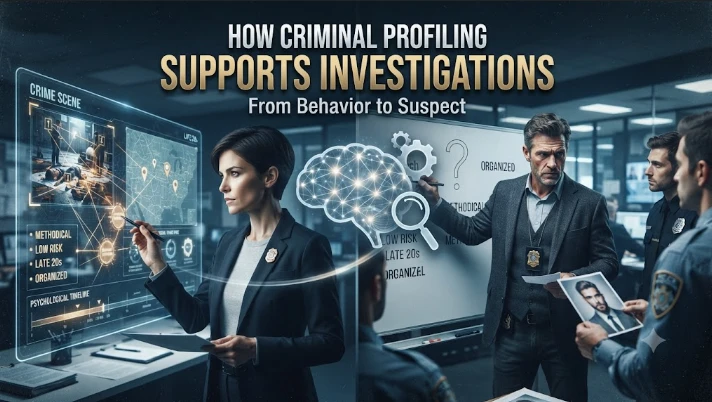
Criminal profiling is described as a structured investigative tool based on behavioral science, psychology, crime patterns, and empirical analysis rather than intuition or dramatic guesswork. The article explains how profiling has evolved from early organized-versus-disorganized classifications toward investigative psychology, statistical databases, geographic analysis, and algorithm-assisted pattern recognition. Modern profiling can help narrow suspect pools, identify behavioral consistency, connect crimes through linkage analysis, and suggest interviewing strategies based on likely offender characteristics. Geographic profiling also examines the spatial patterns of offending to estimate areas associated with an offender’s routine activity. The article stresses, however, that profiles are probabilistic rather than definitive. Tunnel vision, stereotyping, cognitive bias, and historically biased data can lead investigators toward the wrong suspect. Artificial intelligence expands analytical capacity but can reproduce existing inequalities if used without oversight. Profiling therefore works best as a complement to forensic evidence, digital records, witness information, and field investigation. Used carefully, it can improve resource allocation and investigative focus without replacing evidence-based decision-making.
The commonly used idea in popular culture is that criminal profilers are some sort of near mystic who can tell the psychological state of a murderer, his background, or even minute personal details out of one crime scene. According to television shows and movies, the profiler is an amalgamation of forensic genius and intuitive genius in the sense that he or she can apparently see the perpetrator even before a suspect is questioned. Although entertaining, this dramatization clouds the fact that the field of criminal profiling, as described in , is based on hard scientific methods, empirical findings and behavioral psychology and not intuition and guesswork. Profiling is not supposed to help the investigators solve cases, but it is supposed to offer them evidence-based information that will help focus investigations, allocate resources effectively, and increase the overall effectiveness of conventional law enforcement processes.
The history of the development of profiling throughout the decades indicates a transition between an anecdotal and scientific method. Initial research by the FBI Behavioral Science Unit was based on the dichotomy of organized vs disorganized offender, a model that was built based on the interviews with incarcerated criminals. Introduced in the 1970s and influential during the 1980s, this framework was mostly based on the interpretation of the qualitative aspect and upon the subjective interpretation of the profiler. By , the discipline has radically changed to become what is now known as Investigative Psychology described as a sub-discipline and pioneered by such scholars as David Canter. Empirical profiling involves the creation of testable and actionable hypotheses based on statistical databases, behavior algorithm, and geographic modeling. Investigators can use the patterns, co-occurring behaviors, and predictive markers of various types of crime across regions and offenders using huge databases of serial killers such as the Serial Killer Database, which holds more than three thousand documented cases. Such combination of historical case material and modern investigative requirements is a turning point: profiling is no longer an intuitive element to investigations, but a scientific complement of investigations.
The behavioral consistency is one of the key principles of modern profiling. It is assumed that the behavior of an offender at a crime scene will have the answer to their non-criminal behavior. This will enable investigators to make some inferences of psychological or situational tendencies that would otherwise be concealed. This is supplemented by geographic profiling, which uses maps to trace hunting grounds since most offenders have a range of familiarity around their place of residence, work or other daily activities. This process is improved in with the help of AI and predictive algorithms that analyse spatial data to provide possible places where residence or activity centres are likely to be found and, consequently, optimise field investigations and patrol distribution. Although geographic profiling does not implicate a suspect, it enables the police to use their resources efficiently by targeting the areas of likely occurrence in order to be more efficient without necessarily relying on guess work or stereotyping.
The practical application of profiling is best observed in serial or stranger-on-stranger crime, where there is a lack of motive or evidence is limited. The main job is to narrow down the number of suspects by limiting the investigative work. As an example, in serial arson, there can be thousands of suspected offenders in a city. An effective behavioral profile can be used to suggest demographic, occupational and psychological attributes that best align with the behavior exhibited by the offender and this enables the investigator to narrow down to the few individuals. This focused strategy saves resources and speeds up the investigation process, and also the chances of arresting a person are more likely without the use of a mere chance or circumstantial evidence only.
The other important use of profiling is in directing the interrogation tactics. The knowledge of the behavioral patterns of a suspect is used to make that person respond in an ethical and effective way to an interview. People who get driven by power or control such as, are likely to react negatively to confrontational questioning. A profiler can recommend face-saving tactics to the law enforcement which would grant a suspect the chance to justify or contextualize the actions and enhance the possibility of the suspect confessing freely. These tactics are meant to get information not by coercion but rather by moral standards and also improve the investigative results. This element of profiling becomes formalized in , and the officers who have undergone profiling training in communication, cognitive interviewing and psychological assessment are more likely to make profiling recommendations that can be converted into actionable, legal and human-centered interrogation tactics.
Another fundamental role, is the linkage analysis that can be defined as the comparison of the modus operandi (MO) and signature behaviors in various crime scenes in order to establish whether two or more crimes are perpetrated by one person. The MO- are the operational steps required to commit a crime as compared to the signature- which are the unneeded ritualistic actions that meet the psychological needs. In , more advanced algorithms and pattern-recognition software will be used to enhance the capabilities of human analysts, which will then allow them to see cross-jurisdictional connections that would otherwise go undetected. As an illustration, different counties experiencing a series of burglaries may have some empirical behavioural characteristics such as mode of entry, target selection or post-offence behaviors that when put together one can detect one criminal. Profiling hence offers a structure as well as a speculation of connecting crimes, directing resource deployment and making a strategic decision amid intricate inquiries.
Profiling has its dangers and disadvantages, although it is useful. It is a probabilistic and not a deterministic tool and it should not be abused at the expense of justice. Among the dangers is tunnel vision in which investigators concentrate on suspects in a narrow way, which may ignore productive leads. The case studies of the Beltway Sniper investigation are a good example of the perils: the law enforcement officers initially focused on one white male on a white van, with the two Black men in a blue sedan being the real offenders. These biases may cause the investigator or juror to overrate the un-specific profile or the generalized profile assuming that a general statement is exact. Cognitive biases and the Barnum effect are among these biases. The use of AI in profiling brings a different dimension of risk in . Uncontrolled deployment of algorithms which have been trained on past crime statistics can replicate systemic biases and focus on a particular racial, socioeconomic or geographic group. Profiles should therefore be viewed with a lot of caution and human wisdom should be core to the investigative decision-making process so that context, nuance and equity are still at the core of the decision-making process.
Moving ahead, AI improved profiling is the trend of of greatest importance. Machine learning technology can process an enormous amount of data in social media, financial documents, electronic communication, and surveillance systems to detect anomalies in behavior and possible suspects. Although these systems are useful in increasing the profiling scope and speed, they are clearly aimed to supplement rather than to replace the expertise of trained professionals. The concept of crime is contextually multifaceted, enrolment in cultural, social and psychological structures, which cannot be adequately covered by the algorithms. Profilers offer the interpretive layer that is very crucial, as they evaluate the alignment between the observed behaviors and the motivations, cognitive patterns and environmental variables. This collaboration of AI and expert intuition will result in the synergy between the two, where the accuracy of the predictions will be the highest without compromising the ethical and procedural standards.
Finally, criminal profiling does not have anything to do with getting into the mind of an offender in any mystical sense; it is merely a matter of organizing behaviors that have been observed in order to come up with a hypothesis that guides the investigation agenda. Combining behavioral analysis with conventional forensic science, digital evidence, and field intelligence, profiling enables the law enforcement to strategically allocate resources, predict the actions of the offenders, and make evidence-based decisions that are more likely to lead to a resolution. It is also an anti-bias control to investigative bias, which advocates a more scientific method of explaining criminal behavior. The task of the profiler as an analyst and advisor has become inevitable in an age of more sophisticated, technologically mediated crime.
In , criminal profiling proves that there is no implement of actions that are completely in the dark. Though physical evidence can be hidden by criminals, psychological and geographical profiles have an imprint. Profilers convert these cues into practical understanding, which gives the investigative teams a glimpse of understanding in a situation that might not be clear. Profiling used ethically, rigorously and used alongside other investigative tools will create haste in justice, minimize waste in investigation, and increase community protection. It is a reminder that as technology, forensics and law enforcement procedures are advancing, knowledgeable examination of human behavior is an invaluable aspect of the contemporary criminal investigation which fills the divide between the crime scene and the delivery of the verdict.
CITE THIS ARTICLE
Das, B. C. (2025). How Criminal Profiling Supports Investigations. https://www.bikashchandra.com/article/194dcd8c-1c85-5347-abfc-3e7dde37ef88
B. C. Das, “How Criminal Profiling Supports Investigations,” 2025. [Online]. Available: https://www.bikashchandra.com/article/194dcd8c-1c85-5347-abfc-3e7dde37ef88
Das, B. C. (2025) ‘How Criminal Profiling Supports Investigations’. Available at: https://www.bikashchandra.com/article/194dcd8c-1c85-5347-abfc-3e7dde37ef88
Das BC. How Criminal Profiling Supports Investigations. 2025. https://www.bikashchandra.com/article/194dcd8c-1c85-5347-abfc-3e7dde37ef88
@misc{article_194dcd8c1c855347abfc3e7dde37ef88,
  title = {How Criminal Profiling Supports Investigations},
  author = {Bikash Chandra Das},
  year = {2025},
  url = {https://www.bikashchandra.com/article/194dcd8c-1c85-5347-abfc-3e7dde37ef88},
}
TY  - GEN
AU  - Bikash Chandra Das
TI  - How Criminal Profiling Supports Investigations
PY  - 2025-09-24
UR  - https://www.bikashchandra.com/article/194dcd8c-1c85-5347-abfc-3e7dde37ef88
ER  -
This article explores why people volunteer in America’s national parks and how program design influences whether service remains meaningful. Volunteer motivations often overlap and include personal values, learning, social connection, career development, confidence, purpose, and attachment to place. The article uses motivational frameworks to show that volunteers are more likely to remain engaged when they experience autonomy, growing competence, respectful relationships, and a clear connection
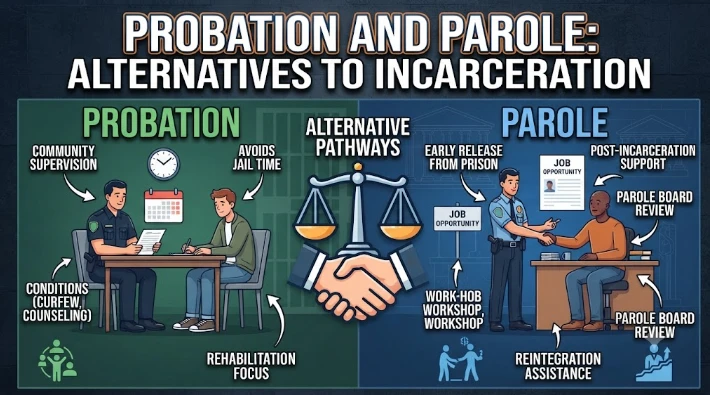
Probation and parole are presented as essential community-based alternatives to incarceration that combine supervision, accountability, and reintegration. Probation generally allows eligible offenders to remain in the community instead of serving a prison sentence, while parole provides conditional release after part of a custodial sentence has been completed. The article explains that both approaches can preserve employment, family ties, education, and housing, all of which reduce the risk of r
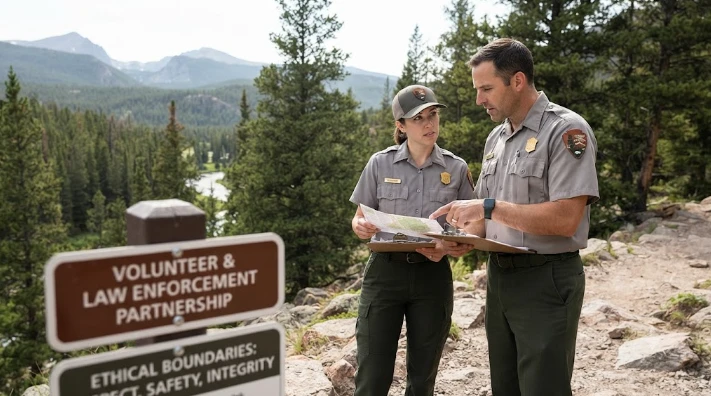
This article defines the ethical boundaries that protect volunteers who support visitor safety and law-enforcement-related functions in national parks. Although volunteers can assist with information, observation, traffic support, administrative work, backcountry roves, and reporting hazards, they must not exercise powers such as arrest, detention, search, citation, evidence handling, use of force, or other commissioned enforcement duties. The article emphasizes clear position descriptions, accu