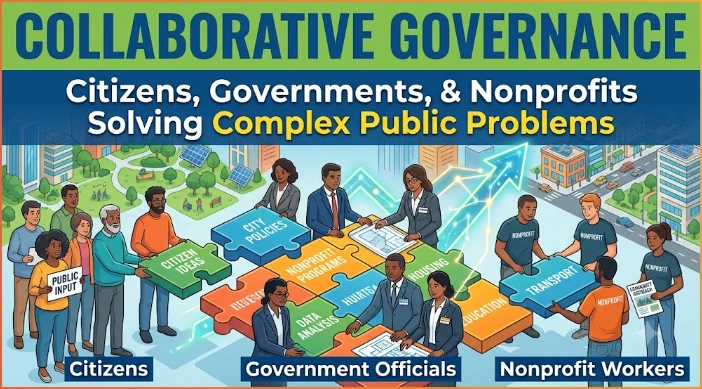
This article explains collaborative governance as a structured way for governments, citizens, nonprofits, and other actors to solve complex public problems that cross institutional boundaries. Issues such as homelessness, watershed restoration, health, and public safety require coordination because authority, knowledge, resources, and implementation capacity are distributed across different organizations. Successful collaboration begins with a shared understanding of the problem, careful stakeholder selection, transparent legal boundaries, and recognition of unequal power and resources. Facilitative leadership, clear data rules, defined responsibilities, conflict procedures, and credible small commitments help build trust. The article warns against excessive meetings, symbolic consultation, underfunded participation, and consensus rules that allow necessary action to be blocked. Citizens provide lived knowledge and democratic legitimacy, nonprofits contribute networks and flexible service capacity, and government retains legal responsibility. Evaluation should examine process quality, inclusion, trust, learning, decision speed, public value, distributional effects, and durability. The article concludes that collaboration works when interdependence is converted into organized responsibility without hiding disagreement or accountability.
There's no such thing as a single agency to solve a complex public problem. Housing is linked to health, employment, policing, education and social protection, and are all connected to homelessness. Watershed restoration is a process that brings together landowners, regulators, farmers, scientists, businesses and residents in multiple jurisdictions. From this practically comes collaborative governance, as a process of governance where the distribution of authority, knowledge and resources among the actors involved must be coordinated without the loss of all differences.
It refers to the cooperative arrangement of public institutions and nonstate actors for collective decision-making and implementation. It is not a typical consultation, in which partners do not have any further involvement after a single hearing. It is not the same as contracting since the relationships are more complex than just buying a service and the decisions made are not solely based on one individual. Shared capabilities for tasks across organisational boundaries is the key promise.
Institutional design, facilitative leadership and a process of building a collaborative process through face-to-face dialogue, trust, commitment and shared understanding are all aspects of research focused by Christopher Ansell and Alison Gash that emphasize starting conditions. Later frameworks broadened the focus to include interest in system context, principled engagement, shared motivation, and the ability to engage in shared action. These models demonstrate that working together isn't a chat. It's designed to be deliberate architecture.
The dynamics of a partnership can be set from the beginning on a positive or negative note. Participants in the conflict often bring different amounts of resources, histories of conflict, priorities, and consequences. During the same delay, a national agency may still have staff and funding to carry on, while a small, nonprofit agency may lose staff and funding. At the outset, gaps in power, legal restrictions, existing problems and lack of trust should be identified from an early stage.
The first challenging task is to reach a common understanding of the problem. A crisis could be seen as a crisis by one organisation and not another, depending on what issues are discussed as to the cause of the crisis, its magnitude, who is responsible, and what is acceptable to take on. These differences can be revealed through data workshops and community testimony, causal mapping, and joint site visits. Partnerships don't need to agree on all explanations, just one that works for them as a group to explain what they want to take collective action on.
Design of membership has an impact on legitimacy and performance. When the decision makers are alone at a table, they might be able to transfer resources, but not lived experience. An open attendance table excludes those affected who might not have time, transport, or confidence, or who do not have institutional connections. Integrated stakeholder mapping, targeted recruitment, compensation, accessibility and transparent selection processes can help establish a better balance.
There are special obligations to public agencies within collaboration. The powers of law, the people and money, and of democracy, may not be given by default. There should be a clear understanding by the officials of what decisions partners can influence, what duties are statutory and what information cannot be shared. Boundaries that are not kept are better for maintaining trust than promises of equal power that aren't backed by law.
Service knowledge, community relationships, and advocacy, along with flexible practice are provided by nonprofit organizations. In times like that, government can undermine the strengths through its use of nonprofits as cheap delivery systems and its use of them as government partners. Funding rules (and reporting requirements and short contracts) can enable criticism to be silenced. To collaborate, one must allow for non-uniformity of views and opinions, but not endanger the very life of the organization.
Participation of the citizens provides the democratic foundation of collaboration. Residents have the opportunity to recognise barriers, track progress, question experts' views, and evaluate for fairness of results. Participation can impact on questions, options and evaluation, not as a testimonial participant in ceremonial meetings. Community representatives should be supported to dare to interpret technical material and consult more extensive communities.
The nature of facilitative leadership is more of a facilitative approach than command. The facilitator safeguards the process, interprets between professional languages, brings up conflict and guides participants from positions to underlying interests. Power and consensus need to be negotiated and won through strong facilitation. It brings to the fore the fact of authority, and it establishes equitable avenues for disagreement, revision and decision.
Credible small actions are the basis of trust. A bold proclamation is not as impactful as delivering a promised dataset, an inaccurate record, and paying an invoice promptly, or changing a meeting time. The first assignments should be able to be done but not too hard. Small gains give the evidence of value creation through cooperation and that commitments outlast inconvenience.
Rules are needed to govern information. There needs to be a consensus among partners in relation to data ownership, confidentiality, access, publication, security and future re-use. Shared dashboards can be effective at enhancing coordination, but can also be poorly designed to reveal sensitive information or incentivize doing more for less purposeful results. Data systems should be set up to show outcomes that are agreed by both and there should be avenues to correct for errors.
It's hard to be held accountable when lots of organizations have an impact. There may be multiple winners for success and multiple losers for failure; or there may be multiple winners and multiple losers for the failure. A clear responsibility matrix should state who is responsible for decisions, who is delivering the work, where it is being reviewed and who is escalating if it needs to be. Public reporting should tell both what progress is being made collectively and what each individual needs to do.
There can be consensus, but there can't always be! Unanimity can result in a veto by any one actor, in a postponing of necessary action, or in the use of weasel words. There must be rules for consensus, qualified agreement, formal dissent and emergency authority in the partnerships. Minority views in recorded form can aid in maintaining legality when action is taken when not everyone agrees.
Resources shape participation. Funding from paid staff at agencies or large organizations, and volunteering of evenings, travel, emotional labor and preparation from residents and small groups. The use of stipends, child care, translation, technical assistance and flexible scheduling, all help to minimize the unequal burden. Budgeting shows what, if anything, is a priority for inclusion and fair participation costs money.
Too many meetings can be a way collaborative governance can fail. Networks sometimes produce calendars, committees, and shared documents without changing frontline practice. There should be a decision purpose, information to be shared and delegated tasks at each meeting. Periodic review should be for who or what adds value and who or what is only using capacity.
When partners are genuine differences, then there is always going to be conflict. The farmers' row are not on the same side of the fence when it comes to regulation, and police and community groups don't always agree on strategies for safety, while service providers fight for scarce dollars. Productive conflict is about claims, impacts and alternatives and protects the people involved from the possibility of being retaliated against. When there is suppression, there may be a continuation of conflict as withdrawal or noncooperation in the future.
Evaluation is more than just the end result. Changes to complex problems can be gradual and external factors can hinder local efforts. Process measures may include looking at how well the process is implemented, decision speed, shared learning, information quality, trust, and inclusion. The outcome measure(s) should measure the value for the public, the distributional impact, unintended adverse impacts, and durability.
Network analysis can be used to determine if there is one major influenceer in the network or a number of strong ties. Interviews can help to elucidate why information flows through some organizations but not others. Comparative case analysis can help to detect the institutional design that operates under various legal and political contexts. It is important to undertake longitudinal research as enthusiasm for leadership often dissipates following a leadership change.
The early stages of the exit rules need to be addressed. A partner may lose funding, may have a conflict of interest or may choose to not engage in a project for its constituency. Withdrawal and replacement, data return and unfulfilled obligations procedures minimise disruption. A partnership that is dependent on membership in one of the partners is rather fragile.
The legislation can either facilitate or hinder collaboration. It depends on rules of procurement, privacy legislation, professional licensing, budget cycles, and jurisdictional boundaries, as to which resources can move, and who can make the decision. Legal pro should get in on the ground floor so that options are not only available but viable.
Adaptive management maintains a link to collaboration with changing conditions. Partners may define review periods, conduct assessments of a limited number of interventions, share the findings and adjust the assumptions prior to scaling up. These cycles must have clear protections in place to prevent putting risk on vulnerable groups without an understanding of the potential effects of experimentation. When the failed options are recorded rather than forgotten then learning becomes credible.
To be democratic, a process needs to be visible to the public, but must not reveal all negotiations before they have actually taken place. Records of the meetings, membership lists, criteria for decision making, fund-raising, performance and complaint systems should be available. There is some confidential space that allows free problem solving, but there shouldn't be a wall behind which to hide from the questions. Collaborators are responsible for giving an account for closed information.
Interdependence becomes organized responsibility and that is the basic element of collaborative governance. Lived knowledge and democratic judgment come from citizens, networks and service capacity from nonprofits, and legal authority and resources from governments. The key to success is transparent boundaries and fair participation, disciplined learning, and accountability for process and results. There is no escaping politics; collaboration is a challenging approach to governance in difference.
CITE THIS ARTICLE
Das, B. C. (2025). Collaborative Governance: Citizens, Governments, and Nonprofits Solving Complex Public Problems. https://www.bikashchandra.com/article/19c3e661-d989-512a-b499-c1cc440508ba
B. C. Das, “Collaborative Governance: Citizens, Governments, and Nonprofits Solving Complex Public Problems,” 2025. [Online]. Available: https://www.bikashchandra.com/article/19c3e661-d989-512a-b499-c1cc440508ba
Das, B. C. (2025) ‘Collaborative Governance: Citizens, Governments, and Nonprofits Solving Complex Public Problems’. Available at: https://www.bikashchandra.com/article/19c3e661-d989-512a-b499-c1cc440508ba
Das, Bikash Chandra. “Collaborative Governance: Citizens, Governments, and Nonprofits Solving Complex Public Problems.” 2025, https://www.bikashchandra.com/article/19c3e661-d989-512a-b499-c1cc440508ba.
Bikash Chandra Das. “Collaborative Governance: Citizens, Governments, and Nonprofits Solving Complex Public Problems.” (2025). https://www.bikashchandra.com/article/19c3e661-d989-512a-b499-c1cc440508ba.
Das BC. Collaborative Governance: Citizens, Governments, and Nonprofits Solving Complex Public Problems. 2025. https://www.bikashchandra.com/article/19c3e661-d989-512a-b499-c1cc440508ba
@misc{article_19c3e661d989512ab499c1cc440508ba,
  title = {Collaborative Governance: Citizens, Governments, and Nonprofits Solving Complex Public Problems},
  author = {Bikash Chandra Das},
  year = {2025},
  url = {https://www.bikashchandra.com/article/19c3e661-d989-512a-b499-c1cc440508ba},
}
TY  - GEN
AU  - Bikash Chandra Das
TI  - Collaborative Governance: Citizens, Governments, and Nonprofits Solving Complex Public Problems
PY  - 2025-02-19
UR  - https://www.bikashchandra.com/article/19c3e661-d989-512a-b499-c1cc440508ba
ER  -
This article explores why people volunteer in America’s national parks and how program design influences whether service remains meaningful. Volunteer motivations often overlap and include personal values, learning, social connection, career development, confidence, purpose, and attachment to place. The article uses motivational frameworks to show that volunteers are more likely to remain engaged when they experience autonomy, growing competence, respectful relationships, and a clear connection
Probation and parole are presented as essential community-based alternatives to incarceration that combine supervision, accountability, and reintegration. Probation generally allows eligible offenders to remain in the community instead of serving a prison sentence, while parole provides conditional release after part of a custodial sentence has been completed. The article explains that both approaches can preserve employment, family ties, education, and housing, all of which reduce the risk of r
This article defines the ethical boundaries that protect volunteers who support visitor safety and law-enforcement-related functions in national parks. Although volunteers can assist with information, observation, traffic support, administrative work, backcountry roves, and reporting hazards, they must not exercise powers such as arrest, detention, search, citation, evidence handling, use of force, or other commissioned enforcement duties. The article emphasizes clear position descriptions, accu