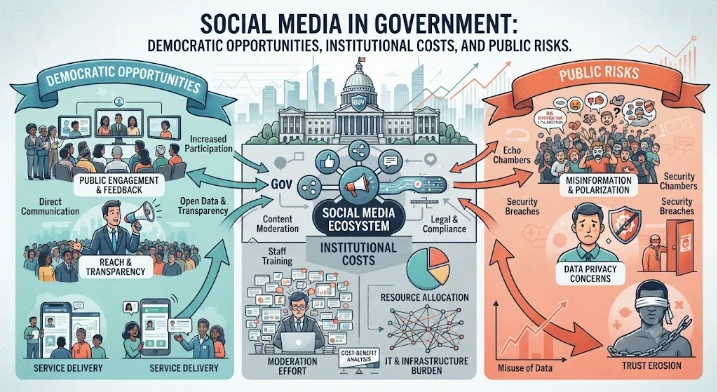
This article examines the democratic opportunities and institutional risks created when government communicates through social media. Platforms allow agencies to distribute service updates, emergency information, meeting notices, public explanations, and responses quickly, while also reaching people who rarely use traditional government channels. At the same time, public institutions face higher obligations concerning accuracy, records management, privacy, security, accessibility, moderation, and political neutrality. The article discusses crisis verification, archiving, sensitive citizen information, account security, platform dependency, the digital divide, employee speech, misinformation, and the limitations of engagement metrics such as likes and views. It argues that social media listening can identify service problems and public confusion, but monitoring must not become surveillance. Agencies need clear moderation standards, alternative communication channels, human escalation routes, and risk-based approval processes. Government communication succeeds when it is accurate, respectful, accessible, and transparent. Social media creates democratic value only when platform speed and popularity do not replace accountable institutional communication.
The government's social media pages are caught between a rock and a hard place. In case of an emergency citizens want to know things quickly, get answers directly and see people in the public. The public institutions should be accurate, records, fair, private and restricted. An environment for quick and emotionally-charged feedback can facilitate democratic communication, and deplete the conditions for honest administration.
The democratic opportunity is very apparent. Agencies can inform the public and share service updates, meeting notices, health updates, road closures, environmental alerts and budget explanation without having to wait for traditional media cycles. The residents are able to ask questions in public and see the official answers. This visibility could make Government 'seem' more accessible than a 'distance' Web site or formal Press Office release.
Social media can help broaden social engagement to policy. Public problems can be pushed into everyday information spaces via short videos, live question sessions, polls, multilingual posting, and by providing links to consultation materials. The tools are particularly effective tools for reaching younger adults and those who seldom attend official meetings. But if a comment and reaction are believed to be representative public opinion, engagement is low.
This mixed picture was reflected in the results of the cross-national surveys published in 2024 by Pew Research Center. 20 out of 27 of the countries surveyed saw a majority rating social media as a positive influence on democracy. The United States was a big outlier, however, as 64 percent said social media was harmful, while 34 percent said it was beneficial. More information and increased concerns with manipulation, division and misinformation yield public attitudes.
The government communication has a greater responsibility than normal posting. Wrong recommendations from restaurants make things more inconvenient and if an evacuation route or benefit deadline are incorrect, it can cause serious problems. Approval process must be commensurate with risk. Health and safety, legal and election content needs to be subject reviewed and authorised.
Verification can be a challenge with speed in crisis. Rumors get disseminated through networks before agencies make formal checks—thus putting pressure on them to respond without being fully informed. You can have an information void, but too early to make a statement can cause loss of credibility. Preapproved crisis protocols are necessary that specify what is a fact, what is being investigated, when to take precautionary measures and when to anticipate updates.
Commercial websites aren't exempt from public records requirements. Posts, comments, direct messages, edits, deleted content and moderation actions may be a part of the official record. Before the advent of today's full-scale platforms, federal agency practices were reviewed by the Government Accountability Office for records management, privacy and security information. A system for archiving data and a schedule for keeping it must work without relying on the platform interfaces.
It is important to recognize that not just the information an agency posts is under risk of breaching privacy, but also the entire website. When citizens come to the case with an issue, they are likely to discuss the details of cases, addresses, health issues, immigration status or financial difficulties in comments or private messages. Staff should have scripts that ensure that sensitive cases are passed on to secure channels but not as if they are being discarded. Protected responses should never be confirmed by the public response, just because the citizen has divulged it.
There are some security issues like account takeover, impersonation, malicious links and unauthorized posting. Rapid recovery plans, device controls, limited administrator access and role-based permissions, and multi-factor authentication all help to limit exposure. Quickly remove former employees from access to accounts. Having a verified badge can be helpful but verification policies are in the hands of the private companies and could change.
Institutional vulnerability: because of platform dependency. Algorithms determines the content getting attention, commercial rules dictate the moderation, and technical alterations may impede access without public negotiation. Government sources should not be the only source of information that is vital. There is sufficient redundancy in the information sent out by the following: Official websites, email alerts, telephone lines, local media and physical notices.
Democracy is not reaching everybody due to the digital divide. Social media users are not a representative sample of the population and there are differences among people in terms of their social media preferences based on things such as age, income, language, disability status, and location. Agencies must have data that provides them with information about who is getting information and who is not. When you can't access it online, offline communication isn't outmoded.
Automated captions are not enough to accommodate accessibility needs. Always provide alternative text for the images, captions and transcripts for the videos, ensure color contrast for readability and provide simple language explanations for more complex graphics! Usually high speed posts do not bother doing such work. Accessibility review should be integrated into the process of creating content, and not happen post-production.
Moderation raises a challenge of law and democracy. The public accounts may be subject to criticism, misinformation, harassment and threats. Eliminating all negative feedback from comments may stifle constructive criticism and leaving any negative feedback on targeted participants may push them out. Prohibited behaviors should be clearly stated in published rules and guidelines; maintaining viewpoint neutrality and documenting action and review routes.
It is important that employees' speech are separated. While staff are free to have personal opinions and political stance, there are additional responsibilities for staff to maintain confidentiality, represent and uphold public trust. Policies should address: authorization, disclaimers, campaign activity, professional conduct, and use of government devices. Broadly worded rules have the potential to restrict and give rise to inconsistent enforcement of lawful speech.
Metrics can be misleading in communicating strategy. The fact that something has been liked, viewed, shared or had many followers does not mean that users understand or trust the content or that service was improved. It can be much more effective to make a joke, rather than explain a policy, and add minimal value to the public discourse. Agencies should have outcome measures that are tied to the reach of information, quality of response, timely referrals, timely corrections and clarity of confusion.
With care listening can yield useful intelligence. The various questions may lead to ambiguous forms, service failures, rumours or new hazards. Social media monitoring should be directed more towards a social purpose rather than a social surveillance. The boundaries of data collection, storage, analysis and sharing must be clearly defined and subjected to a review of privacy.
In order to combat misinformation, a proactive approach is necessary that is much more complex than simply addressing misinformation. OECD activities with respect to public communication focus on closing information gaps, providing institutional capacity building, interagency coordination and information integrity. Corrections have to be in easy-to-understand language, with visible sources, and at the appropriate time in the rumor cycle. Reiterating a falsehood out loud can be a mistake and make it more widespread.
Tone is as important as frequency in making a trustworthy relationship. Evasiveness can be created by robotic language and a lack of level of formality can be a diminishment of seriousness in times of tragedy or controversy. Public communication teams require a cohesive voice to be respectful, accurate and consistent within the team. Humor can only be successful if context, audience, and power differences are taken into consideration.
Staffing is needed for a two way communication. Unresponded open messages and direct messages can make for a more frustrating situation. During emergencies, agencies require the same services that they do in regular hours, with the added requirements of subject specialists, coverage outside of normal hours, and service standards, plus escalation paths. While automation is effective in shaping a typical question, the citizens should be informed when communicating with a bot and have an alternate way to reach a human agent.
Political leaders and career agencies play different roles in terms of communication. Administrative accounts should be uninterrupted, legally correct and be treated equally, while elected officials should promote policy and political priorities. When people are distracted by campaign information and become confused, they have an increased risk of missing the service information. Governance, branding and accountability are separate, supporting institutional integrity in times of leadership change.
All the platform data should be supplemented by survey, interview, service and experiments. Comparative testing can be done to look at the formats that enhance understanding and to identify formats that have not been used in the past. Qualitative analysis can shed light on the reasons behind citizens' trust in one account but not in another. An experiment in which there is any urgent public information need has safeguards to prevent unequal access to it, or its failure to be accurate.
The platform terms, data transfers, advertising features, analytics, and third-party integration should be the first areas of interest to be reviewed by the procurement and legal teams. Access to is free may be a cover for reliance on commercial profiling and variations in contracts. Agencies must develop plans for exiting the program, have exportable archives, have approved integration lists, and review vendor practices periodically. If the rules of a service are not understood by the account owners then it's not a service that will be able to support public communication.
Government has a great public door through which to engage in social media. But the public door is the place of private infrastructure. When agencies inform, listen to, explain and correct in that space, and keep alternative access, then democratic value is created. Institutional expenses include staffing, archiving, security, access and moderation. When the speed of adoption, the popularity of a platform, or a platform's logic take the place of accuracy or accountable communication, the risk to the public increases.
CITE THIS ARTICLE
Das, B. C. (2025). Social Media in Government: Democratic Opportunities, Institutional Costs, and Public Risks. https://www.bikashchandra.com/article/aa22728e-a0b7-550a-b576-bfbeef77b3f3
B. C. Das, “Social Media in Government: Democratic Opportunities, Institutional Costs, and Public Risks,” 2025. [Online]. Available: https://www.bikashchandra.com/article/aa22728e-a0b7-550a-b576-bfbeef77b3f3
Das, B. C. (2025) ‘Social Media in Government: Democratic Opportunities, Institutional Costs, and Public Risks’. Available at: https://www.bikashchandra.com/article/aa22728e-a0b7-550a-b576-bfbeef77b3f3
Das, Bikash Chandra. “Social Media in Government: Democratic Opportunities, Institutional Costs, and Public Risks.” 2025, https://www.bikashchandra.com/article/aa22728e-a0b7-550a-b576-bfbeef77b3f3.
Bikash Chandra Das. “Social Media in Government: Democratic Opportunities, Institutional Costs, and Public Risks.” (2025). https://www.bikashchandra.com/article/aa22728e-a0b7-550a-b576-bfbeef77b3f3.
Das BC. Social Media in Government: Democratic Opportunities, Institutional Costs, and Public Risks. 2025. https://www.bikashchandra.com/article/aa22728e-a0b7-550a-b576-bfbeef77b3f3
@misc{article_aa22728ea0b7550ab576bfbeef77b3f3,
  title = {Social Media in Government: Democratic Opportunities, Institutional Costs, and Public Risks},
  author = {Bikash Chandra Das},
  year = {2025},
  url = {https://www.bikashchandra.com/article/aa22728e-a0b7-550a-b576-bfbeef77b3f3},
}
TY  - GEN
AU  - Bikash Chandra Das
TI  - Social Media in Government: Democratic Opportunities, Institutional Costs, and Public Risks
PY  - 2025-03-05
UR  - https://www.bikashchandra.com/article/aa22728e-a0b7-550a-b576-bfbeef77b3f3
ER  -
This article explores why people volunteer in America’s national parks and how program design influences whether service remains meaningful. Volunteer motivations often overlap and include personal values, learning, social connection, career development, confidence, purpose, and attachment to place. The article uses motivational frameworks to show that volunteers are more likely to remain engaged when they experience autonomy, growing competence, respectful relationships, and a clear connection
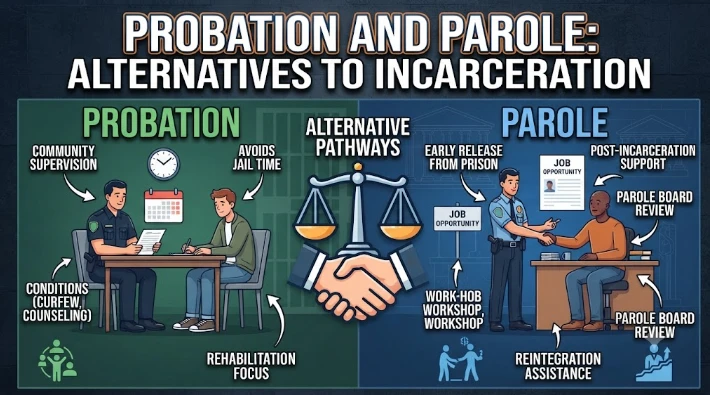
Probation and parole are presented as essential community-based alternatives to incarceration that combine supervision, accountability, and reintegration. Probation generally allows eligible offenders to remain in the community instead of serving a prison sentence, while parole provides conditional release after part of a custodial sentence has been completed. The article explains that both approaches can preserve employment, family ties, education, and housing, all of which reduce the risk of r
This article defines the ethical boundaries that protect volunteers who support visitor safety and law-enforcement-related functions in national parks. Although volunteers can assist with information, observation, traffic support, administrative work, backcountry roves, and reporting hazards, they must not exercise powers such as arrest, detention, search, citation, evidence handling, use of force, or other commissioned enforcement duties. The article emphasizes clear position descriptions, accu