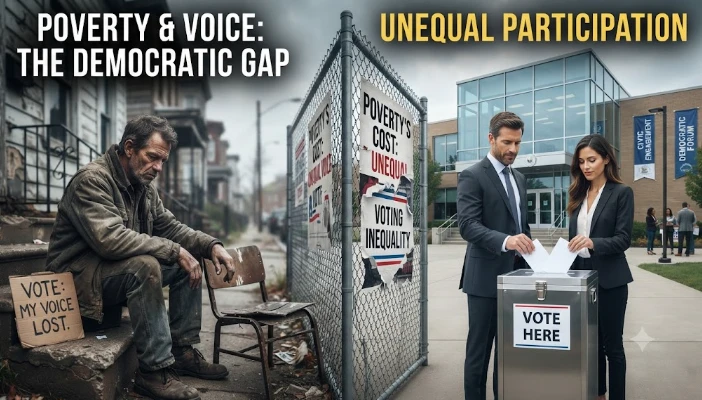
This article explains how poverty creates unequal civic voice even when formal political rights are equal. Participation requires resources such as time, transport, stable housing, childcare, information, digital access, confidence, and social networks, all of which can be constrained by financial hardship. The article links poverty with lower participation through administrative burden, housing instability, transport barriers, digital inequality, weak organizational connections, stigma, and repeated experiences of unresponsive institutions. It also distinguishes presence from influence: low-income citizens may attend public processes without controlling agendas, evidence, or final decisions. Compensation, targeted outreach, participatory budgeting, practical civic education, simplified public services, and community organizations can reduce participation costs and expand effective voice. Evaluation should track not only turnout or attendance but also whose proposals shape policy and how responsiveness differs across income groups. Research must protect privacy, dignity, consent, and community interpretation. The article concludes that material disadvantage becomes political invisibility through institutional design, and democratic reform must lower participation costs while increasing public responsiveness.
Democracy is a right to citizenship on an equal footing, but resources are needed for participation and poverty gradually absorbs these. Voting, meeting attendance, reaching out to an official, and membership in an organization are all affected by time, transportation, stable housing, child care, information, digital access, confidence and social connections. While rights are important, equal rights don't necessarily mean equal civic voice.
When people are poor, the need to participate and survive are in direct competition with each other. If a worker who has an unpredictable shift misses registration or has a hearing or neighborhood meeting, he is still missing. If a parent is considering taking a car trip versus eating, he cannot view public involvement as free. When an institution cannot go to a student, it is often viewed as lack of interest.
The causal analysis of acute financial hardship is a research approach that can shed light on this burden. A study based on the timing of bank working days, revealed that short term income shortages decreased turnout intentions and actual turnout among individuals who were already poor. The estimated impact was approximately at 4-5 percentage points. Financial stress can be a narrowing of the focus, loss of social contacts and loss of political efficacy.
Chronic neighborhood deprivation can help to perpetuate the same trend. Moving to Opportunity was used in research to look at how families' later voting behavior changed based on the housing opportunities provided. The study began with a solid political science observation that the less well-off the voter the less likely he or she is to vote. Place is important because neighbourhoods create institutions, networks, safety, information and expectations of public response.
The resource model of participation provides an understanding why income is related to voice. It may take time, money, knowledge, and organizational skill to engage in civic action. Communication skills, planning and leadership skills can be gained from education and employment and are valued by institutions. Poverty restricts opportunities to those settings, and provides administrative needs that absorb those skills.
Political silence can occur before citizens are even able to act politically, because of administrative burden. Multiple documents and appointments for benefit applications, eligibility determination, housing disputes, debt collection, court dates and service appeals. Immense amounts of time are invested in establishing needs to the public agencies. A system that is based on survival administration, weakens citizens in terms of collective participation.
Disrupting the civic connection with unstable housing. Moving often can result in a new district, new schools, new transportation routes and different organizations in the community. Postal mail fails, neighbors are not known and public information can be received past due. Stable housing is typically not called democratic infrastructure but stability in housing contributes to continuity of civic life.
Transport helps to determine access to institutions. Government offices, council chambers, polling sites, public hearings and community organizations may be far removed from low-income communities, or may not provide services at convenient times outside of working hours. Some routes are available online, which can be helpful for some participants, but cannot accommodate all physical routes. When designing a meeting, its actual travel time and travel cost must be taken into account.
Digital participation is ridden with inequality. The Internet tools can close the gap and increase access, but the quality of the devices and the costs of data, broadband reliability, literacy and privacy vary. Pew's earlier findings revealed a wide division between people by income and education on a variety of online and offline political behaviors. The influence of the technology is changed without auto-equaling the channel.
The spread of political information is as much via social networks as it is via the media. Knowledge and invitations are shared with workplaces, unions, religious communities, schools, clubs and neighborhood groups. Poverty may lead to low levels of institutional attachment to institutions with civic resources. Especially when they can interpret the policy and make trusted pathways to action, community organizations play a key role.
Recruitment by organisations goes beyond neutrality. People who vote, give, attend and have formal membership are typically contacted by campaigns, advocacy groups and public agencies. This seems to be an effective way of doing things but it exacerbates inequality by extending invitations to active citizens more. Outreach targeted at groups that do not show up, because they have not been there, can reach these groups.
Culture can produce barriers in the class without being deliberate discriminatory practices. Technical jargon, dressiness, unfamiliar process, lack of payment and presuming a flexible time frame is a cue to who belongs. The poor who are directly affected by the public systems can share this knowledge and are less respected than professionals. Facilitation must acknowledge expertise in people's lived experience and not allow status to prevail in the discussion.
Voice is different than presence. A low-income person may be able to come to consultation, but is unlikely to be able to control the agenda, evidence or decision. Officials are able to listen but can be more forceful in reply to donors and property owners, organized business, or frequent participants. Evaluation should track the change of policy as a result of the proposals made and not the number of bodies in a room.
Money is a powerful form of influence, and it's a factor that is particularly present in political and lobbying activities. Money enables donations, the ability to advocate professionally, research, legal counsel and ongoing access to decision makers. Low-income citizens are more likely to be members of coalescing organizations. An absence of strong unions, weak nonprofits and limited civic space diminish that counterweight.
Repeated use of institutional structures can impact political efficacy as a result of poverty. If one complains and their complaint isn't addressed, or if they are denied and they don't know why, or if it isn't possible to go and hear them, then they learn that participation isn't rewarding. Policy feedback can go in both directions: fair policy can help to increase belonging, and punitive administration can help to increase withdrawal. Democratic inclusion is achieved through respectful service delivery.
There is another barrier due to stigma. Assistance recipients may be subject to assumption of responsibility, incompetence or unworthiness. Poverty policy is occasionally the subject of public meetings that speak about those impacted as a thing to be discussed, not as a part of the discussion. Participation can be made safer and more dignified by using confidential, compensation, and shared agenda setting.
There's no better democratic reform than compensation. Costs of participating in an advisory board or deliberative forum can be lessened by the inclusion of stipends, transportation, child care, meals, translation and leave pay. Some critics postulate that payment can cause corruption of the civic spirit. That concern does not take into account the unequal ability to give unpaid time.
Participatory budgeting can empower towards communities that are in need of material when design is participatory. Projects can be proposed and trade-offs among local expenditures are made transparent to residents. Technical support can help to develop a concept into a viable proposal. The size and implementation of the budget is important, as symbolic budget amounts can't address greater distributional inequity.
There are indirect ways to boost voice with universal service design. Simplicity, fixed hours, automatic enrollment, convenient transportation, easy communication, and benefits that are not too costly lessen the administrative burdens of poverty. Citizens have more time and are more secure in their family, work and public life. Basic institutions which do not require constant crisis management make it easier for people to participate in a democracy.
Civics education should be more than just in school. Libraries, community centers, legal aid groups, unions and service organizations can tell you about all of your rights, budgets, public records, and decision routes. education must not be left at the level of glorification of democracy but must be practical action. Authorities must be identified and how to question them.
When lawful and ethical, data on participation should be disaggregated by income, education, housing status, disability, age, race and geography. Average turnout (consultation) rates can obscure significant differences. Qualitative interviews can help to clarify the numbers. A longitudinal analysis can reveal if reforms provide for lasting inclusion.
Care needs to be taken in research on poverty and voice. Routine surveys can be a drain on personal miseries and not enhance any institution. It is essential to have the results, privacy, compensation and consent of the participants. Finding community partners to help interpret the findings helps avoid deficit narratives that characterize poor citizens as not being civically minded.
Policy makers should look at participation and at responsiveness. When public choices are still more responsive to the preferences of the well-off, a greater turnout or attendance at meetings is not enough. Representation studies can be used to assess the policy outcomes compared to preferences across income groups. The issue of accountability demands attention to voice after expression – whose voice is it that does or is supposed to get acted upon.
There is one other type of inequality that local journalism can help to minimize. News about what the council does, changes to services, policy on the landlords, school and public spending provides common information for residents to act on. News deserts give an edge to those in the know with their own networks. Independent local information provides support to participation, but not political conclusions.
Disproportional civic voice is not a by-product of poverty. It is manifested by the lack of time, the lack of stability in the institutions, the administrative pressure, imbalanced recruitment, economical force, and multiple messages of what is relevant knowledge. The costs of participation need to be lowered, and the responsibility must be heightened – for democratic reform. Equal citizenship becomes possible when there is no longer a correlation between material disadvantage and political invisibility.
CITE THIS ARTICLE
Das, B. C. (2025). Poverty, Democratic Participation, and the Unequal Distribution of Civic Voice. https://www.bikashchandra.com/article/931bafc1-a474-5a85-83ae-9561531252aa
B. C. Das, “Poverty, Democratic Participation, and the Unequal Distribution of Civic Voice,” 2025. [Online]. Available: https://www.bikashchandra.com/article/931bafc1-a474-5a85-83ae-9561531252aa
Das, B. C. (2025) ‘Poverty, Democratic Participation, and the Unequal Distribution of Civic Voice’. Available at: https://www.bikashchandra.com/article/931bafc1-a474-5a85-83ae-9561531252aa
Das, Bikash Chandra. “Poverty, Democratic Participation, and the Unequal Distribution of Civic Voice.” 2025, https://www.bikashchandra.com/article/931bafc1-a474-5a85-83ae-9561531252aa.
Bikash Chandra Das. “Poverty, Democratic Participation, and the Unequal Distribution of Civic Voice.” (2025). https://www.bikashchandra.com/article/931bafc1-a474-5a85-83ae-9561531252aa.
Das BC. Poverty, Democratic Participation, and the Unequal Distribution of Civic Voice. 2025. https://www.bikashchandra.com/article/931bafc1-a474-5a85-83ae-9561531252aa
@misc{article_931bafc1a4745a8583ae9561531252aa,
  title = {Poverty, Democratic Participation, and the Unequal Distribution of Civic Voice},
  author = {Bikash Chandra Das},
  year = {2025},
  url = {https://www.bikashchandra.com/article/931bafc1-a474-5a85-83ae-9561531252aa},
}
TY  - GEN
AU  - Bikash Chandra Das
TI  - Poverty, Democratic Participation, and the Unequal Distribution of Civic Voice
PY  - 2025-05-07
UR  - https://www.bikashchandra.com/article/931bafc1-a474-5a85-83ae-9561531252aa
ER  -
This article explores why people volunteer in America’s national parks and how program design influences whether service remains meaningful. Volunteer motivations often overlap and include personal values, learning, social connection, career development, confidence, purpose, and attachment to place. The article uses motivational frameworks to show that volunteers are more likely to remain engaged when they experience autonomy, growing competence, respectful relationships, and a clear connection
Probation and parole are presented as essential community-based alternatives to incarceration that combine supervision, accountability, and reintegration. Probation generally allows eligible offenders to remain in the community instead of serving a prison sentence, while parole provides conditional release after part of a custodial sentence has been completed. The article explains that both approaches can preserve employment, family ties, education, and housing, all of which reduce the risk of r
This article defines the ethical boundaries that protect volunteers who support visitor safety and law-enforcement-related functions in national parks. Although volunteers can assist with information, observation, traffic support, administrative work, backcountry roves, and reporting hazards, they must not exercise powers such as arrest, detention, search, citation, evidence handling, use of force, or other commissioned enforcement duties. The article emphasizes clear position descriptions, accu