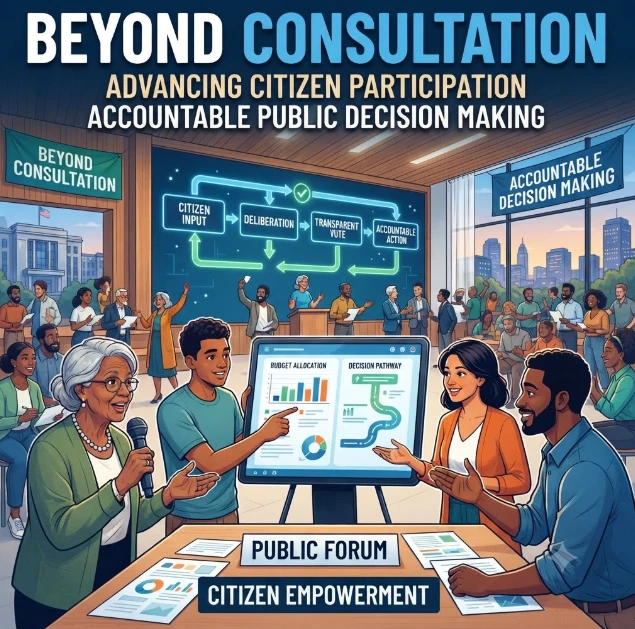
Public consultation is frequently the last step in a process that has already gone through a budgeting process, put into legal form, been favored by the decisionmaker, and had a political deadline. A document will be sent to the citizens, a hearing will be held and they are left to wait for a final decision similar to the original proposal. These processes gather reactions, but have limited influence. There is a need to shift the relationship between the public authority and citizen judgment from consultation to moving beyond.
A genuine decision space is a critical ingredient to meaningful participation. Authorities should say what questions are still pending, who is making all the decisions, what are the rule-makers and whether and how the public can affect the results. If this isn't clear, then participation can be an invitation to talk but not to influence. Refrain from over promising and do more than is reasonably expected.
Consultation is one of a number of participatory techniques. According to the OECD guidelines (2022), there are multiple types of information sharing, open meetings, public consultation, open innovation, citizen science, civic monitoring, participatory budgeting and representative deliberation. Have each method used for a different purpose. Survey can reveal preferences, citizens' assembly can consider trade-offs following extended learning.
The manner and the time of engagement is as important as the manner and time of play. Citizens have the opportunity to contribute throughout the process of problem identification, option development, decision, implementation and evaluation. With early involvement, the nature of the problem may be altered and that renders agencies incapable of solving the wrong problem efficiently. Involvement later delivers monitoring of delivery, and shows if intended benefits reached affected groups.
Begin with the problem as the target of participation and not the preferred technique. The community drainage problem may need to be mapped out, explained, observed by residents and budgeted for. If there is a national ethical controversy, it may need to be deliberated by representatives, with expert testimony. Firstly, choose an attractive process without authority; secondly, define the decision before choosing the process.
To ensure representative participation, deliberate recruitment must be done. Typical participants in open meetings are citizens who are flexible, confident, have transportation, educational and institutional connections. Random selection may result in diverse group, targeted outreach may include direct burdens. Practical exclusion is reduced due to stipends, child care, translation, disability access and travel support.
The quality of the participation is dependent on information quality. Citizens should have well-balanced, easily-accessible information on the issue, legal limits, costs, uncertainties, distributional impact and conflicting arguments. Assumptions should be made clear by the expert and questions should be answered in a straightforward manner. It is also important for the participants to have room to share lived experience and community knowledge which is not included in official briefings.
Facilitation safeguards discussions about fairness. A room can be dominated by a group of people who speak out more often and look down on those who don't, by professional jargon, or by how much money they have, or by who they are organized around. Facilitators use their skills to control the speaking time, to keep the discussion apart from personal attacks, to evaluate the areas of agreement, and to record the points of disagreement. Process rules should be released prior to beginning the deliberation process.
Participative budgeting provides a tangible path towards the voice to allocation. The residents suggest projects, develop recommendations, determine feasibility, vote and debate a specific amount of funding. The method is transparent because the decisions to take in one project will impact resources available in another. This democratic value is based on inclusion, technical support and faithful implementation.
Participatory budgeting can be implemented in various institutional designs as has been seen in cities like Porto Alegre, Paris, Lisbon and Seoul. Some systems focus on neighborhood meetings and others integrate proposals online with city-wide voting. Quality is not necessarily related to scale. It's better to have a small process where you have some influence, than to have a big platform with little influence.
Citizen Assemblies are for a different purpose. A wide cross-section of people discusses an intractable problem during a series of meetings, asks questions of experts, listens to opposing points of view and proposes solutions. These assemblies are meant for discussion (as opposed to counting votes) when there is something to discuss that calls for informed judgement. The role of public response by decision makers will continue to be vital as long as there is no accountability mechanism that provides a connection to the deliberation process, as it can otherwise become another report.
Civic monitoring provides involvement in implementation. The residents can follow the completion of the project, procurement, standards of service, environmental conditions or public spending. When agencies begin to publish usable data, and offer avenues for addressing issues, monitoring is strongest. Citizen observation is not an alternative to professional audit, but should be used in addition.
Digital participation may have the effect of reaching new audiences but lead to a false sense of openness. Social media sites tend to get a lot of users that are very motivated, recognize short answers, and turn away the less connected, less confident users. Care needs to be taken in verifying identity, dealing with harassment, privacy and manipulation. Blended processes are a mix of online, telephone and paper and face-to-face.
Institution fatigue occurs when there is a request for participation that goes unheeded for a long period of time. Meetings can take hours, surveys are to be filled and retelling hard experiences takes hours from citizens. It is vitally important for agencies to coordinate request, to be able to reuse information with ethics, and to not have several departments asking communities to explain the same barrier to several different agencies. Basic accountability responsibility is respecting the time of the participants.
Feedback completes the participation loop. A public response should include the various recommendations accepted, modified, deferred, or rejected, and provide a reason for their acceptance or rejection, which should follow the law, the budget, the evidence, or competing values. Insufficient praise is no excuse for not explaining. Appropriate feedback enables citizens to determine if participation made a difference to a decision, and if additional action is warranted.
Records of decisions must record dissent. Minority concerns can be eliminated by consensus language, particularly where there are concentrated harms to vulnerable minorities. Reports should include any alternative proposals, un-resolved risk and distribution disputes. A decision may still be made but there needs to be a record of consideration and resolution of competing claims by public authority.
The power analysis should be part of each participatory design. Legal authority and information are controlled by the government, organized groups have networks and advocacy skill, and citizens have unequal exposure to outcomes, supplied by businesses. Identifying such differences can assist organizers when deciding on the type of safeguards to be used. Just because both parties are spoken, doesn't mean that both have equal influence.
Reach, quality, influence and outcomes should be assessed in the context of evaluation. Participation counts don't show if the activity is representative or if it has an impact. Understanding, respect, trust and perceived voice can be measured through surveys, and the document analysis can be used to track which proposals made it into policy. Interviews may provide an explanation of the reasons for continued engagement and withdrawal.
It is particularly important that the distributions be evaluated. A process may have a positive impact on satisfaction levels overall, but lose some of the rural residents, migrants, shift workers, low income families, or people with disabilities. Data should be broken down by appropriate groups and sites. Patterns may be captured by community partners which do not show up in administrative categories.
Participation is not dependent on a single leader who is supportive. Citizen engagement can become an on-going aspect of good governance through laws, set budgets, trained personnel, public standards, independent review and regular reporting. However, too many steps will limit adaptation. Stable principles are to go hand in hand with decisions on the method to be used.
In a sense, public servants have to have participation skills. You need to be knowledgeable in the policy, but that doesn't make you an expert in facilitation, conflict resolution, writing and accessible policy, recruitment or community partnership. Ethical engagement, power, trauma, cultural context, data stewardship and drafting responses are areas where training should take place. Time and authority must be provided for staff to use such skills appropriately.
Capacity support is for the benefit of citizens as well. The provision of technical assistance and preparatory workshops, independent advice and access to data enables participants to challenge official assumptions. The support should not lead citizens to a desired solution. It's designed to make complicated decisions easy to comprehend and to limit reliance on experts.
There are risks associated with participation which need to be protected. Information can be revealed in the open and can lead to being the object of organised harassment and silence in the case of marginalised groups when governments are involved. Ensuring safer participation through consent, confidentiality, anonymous input, secure data handling and anti-retaliation procedures. There is no democratic way of speaking when people have to take undue risk.
Not everything can be voted on and decision making is accountable. The legal responsibilities, expertise and liability of elected officials and administrators for consequences still exist. Those decisions are enhanced by meaningful participation, which broadens knowledge, assesses their legality, and uncovers costs. When leaders are accountable for the actions they took based on the citizen judgment, they are still accountable.
Moving beyond consultation is about designing participation to be a part of governing – not a public relations exercise. Citizens require truly genuine questions, information that can be trusted, equitable access, good facilitation, a visible influence, and documented response. Processes are needed in public institutions which allow them to translate experience into decisions, not lose responsibility within the law. When the speech moves to consideration, it is legitimate in its participation as long as the power is not finalised and can be challenged in the public.