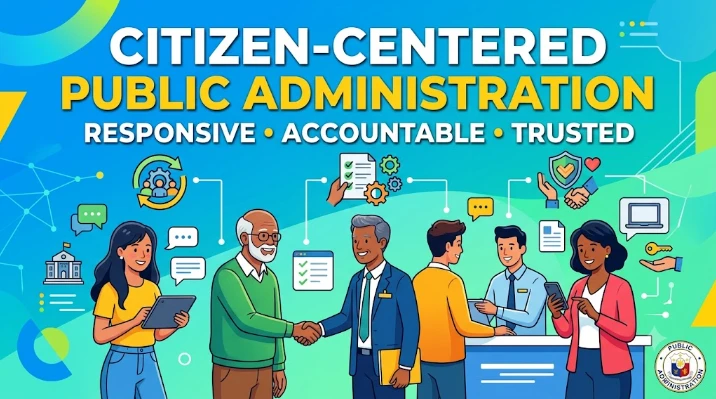
This article presents citizen-centered public administration as a model in which everyday encounters with government are treated as part of democratic legitimacy. Responsiveness begins with understanding how people actually experience services, including confusing procedures, delays, documentation requirements, accessibility barriers, and frontline discretion. The article emphasizes clear eligibility rules, plain language, multiple service channels, procedural fairness, privacy protection, meaningful complaint systems, and transparent explanations of decisions. Citizens should be involved throughout the policy cycle through co-design, participatory budgeting, civic monitoring, deliberation, and service testing, with special efforts to include people who face economic, linguistic, disability, geographic, or digital barriers. Administrative data, surveys, interviews, and complaint patterns can reveal unequal burdens and opportunities for reform. The article also stresses that trust cannot be created through branding when service experience is poor. Accountability requires correction mechanisms, public reporting, and leadership support for responsible experimentation. Ultimately, trusted government is described as government that listens before deciding, explains authority clearly, protects access, corrects errors, and remains open to challenge.
Public administration becomes visible during ordinary moments: renewing a license, applying for assistance, reporting a hazard, challenging a tax decision, or seeking emergency support. The idea of the government is never experienced as an abstraction of a constitution by the citizens. They have to wait for forms, wait for explanations, wait for waiting times, and so on, and they are subjected to discretion and the actions of the front-line staff. Citizen-centered system takes each encounter as a part of the democratic legitimacy, not as an insignificant act.
The first step to being responsive is to know people's needs as opposed to any administrative assumption. The services are frequently organised around the departments of agencies and citizens are confronted with interdependent issues related to income, housing, health, transport and documentation. Journey mapping, interviews, analysing complaints and observation can identify the points where people can get ‘confused and excluded’. These approaches embody the lived experience into operational knowledge.
Only 39 percent of the people surveyed around the participating OECD countries reported a high or moderately high level of trust in the national government in OECD's trust survey 2024. Only 41 percent said that the Government used the best available evidence in decision making. These results suggest that there is a joint issue with performance and perception. Trust must be based on competent delivery, but citizens have to witness the process of decision making.
Political voice has a special significance. An analysis of OECD data revealed that there was a significant difference between those who felt they could have an impact on the decisions government makes and those who felt they had no voice in government. Sixty-nine percent of the respondents that felt they were influenced had a high or moderately high level of trust in the national government compared with 22 percent of those who didn't feel influenced. It is not a show for the audience if voice can be so influential of the confidence of the institutions.
The first step for a citizen agency is to establish the services in public. Individuals should have a lot of information about the eligibility criteria, the documents that are required, how long it will take to process the information, what will be used to decide their eligibility and what will be done if they are denied. Standards should be available in multiple languages, disability formats, digital, over the phone and in person. Clarity leads to less reliance on informal brokers and to the same treatment of everyone.
There is a need to provide support instead of denial for frontline discretion. Unfortunately, no rules can foresee all the family situations, disabilities, problems with documentation or unusual situations. Staff should be trained, supervised, guided in an ethical manner and be provided with avenues of support in more challenging cases. Discretion without control creates inconsistencies and, automation without flexibility can lead to unjustified exclusion where it is right to be excluded.
Procedural fairness impacts upon people's perceptions of even negative decisions. When treated with respect, a person denied a benefit or permit will be more likely to feel that the process is legitimate if they are given an explanation and are provided with a review. Even good manners will not suffice when there are standards that are not made public. Fair process is comprised of dignity, neutrality, accuracy, voice and correction.
Avoid unneeded distances in administrative language. Simple obligations may be confused by terms used in law, finance and internal policy. When testing with intended users, there is a chance that you will find phrases that are confusing and missing instructions. Translation does not simply involve substituting words, but requires cultural and contextual analysis, in order to ensure that the sentence is formally correct and, at the same time, readily understandable.
While digital services can help to cut down on travelling and waiting, digital-first policy shouldn't be interpreted as digital-only exclusion. Technological devices and connectivity, identity verification, documents upload, and accessing the device or documents are challenges older citizens, persons with disabilities, rural homes, migrants, low income families, and citizens in crisis may have. Assisted digital supports, telephone completion, trusted community access and paper supports are maintained. With regards to service quality, channel choice is a part of that.
Data should be used to see trends that agencies can learn from before the complaint turns into the scandal. Processing times, abandonment rates, appeal outcomes, and error corrections, repeat contacts, and geographic gaps can all highlight weak points. Disaggregated analysis can reveal unequal burdens by income, race or ethnicity, language, age, disability, and location. Safeguarding privacy is still important as it is with any citizen because of the sensitive information that is frequently given by vulnerable citizens.
Complaint systems should be independent and have value for learning. An complaint ought to not be lost through the very same unit that created the initial issue without being obviously checked. Ombuds offices can set up, appeal panels can establish, service recovery teams can create, and external audit can provide credible correction. Themes of complaints should be aggregated and help to inform policy revisions, not be kept as individual case files.
Individually, this should take place throughout the policy cycle. Citizens can become involved in identifying issues, developing programs, try out forms, oversee implementation, assess results and make recommendations for changes. Participatory budgeting, civic monitoring, citizen science and deliberative processes are just some of the methods outlined in the OECD guidelines for citizen participation. The method, as well as the decision, must take into account the time available and the influence that is possible.
Consultation is problematic when the key decision is made and then the officials call for consultation. Participants invest time and reveal their experiences and then come up with proposals but do not get an explanation of what changed. All processes must have a published answer with accepted recommendations, ideas turned down, reasons and next steps. Citizens are not subjected to symbolic participation when it comes to this topic of accountability for participation.
As Co-design is very effective when using representative recruitment. An open invitation will draw in people who are confident, have time, education, and the connections. Widening participation can be achieved through targeted outreach, random selection, the provision of stipends, provision of transport, child care, translation, providing venues that are accessible, and flexible timing. Agencies need to question why some people didn't sign up, why they stopped signing up early and why there was still a voice on the sidelines.
It is important for public servants to be allowed to report on failure. A blame culture fosters a reactionary style of communication, to conceal, to delay, and to blame. Learning reviews can be used to distinguish between confusion of understandings, poor process and changing conditions. When citizens can see that people are discovering issues and taking action in the interests of the community instead of protecting the reputation, they can gain trust in the institutions.
There are a number of directions of accountability. Citizen-centred administration is a form of accountability that is added to that of staff who answer to law, budget, elected leaders and also to professional standards, but add accountability externally to users of and to affected communities. There are additional responsibilities with cross-agency partnerships, as it becomes easy to lose sight of responsibilities. Published ownership charts, and named case responsibility, create an opportunity for citizens to be passed from hand to hand, rather than being passed over.
Public value measures should be used as a measure of performance. Agencies may record applications filed, answered calls or completed inspections but don't necessarily record if these activities resulted in an equitable resolution of problems. Other indicators are better are first contact resolution, successful access by vulnerable populations, accuracy, appeal reversals, understanding by users, and ongoing results. Qualitative feedback describes the reasons for numerical targets to be good or bad.
Branding is not an effective way to build trust. However, while good communication is important to the public, it is not as effective as it is in good campaigns when everyday experience is at odds with the official message. An agency's credibility is enhanced when it admits uncertainty, provides explanations on tradeoffs, corrects mistakes, and provides similar performance data. Promotional language doesn't have the same sense of legitimacy as a consistency between language and service.
The reform needs to be citizen-centered, which requires political and administrative protection. Changes to forms, sharing of information, modifying eligibility, or cross-silo resource transfers can have the potential to upset existing processes and interests. Senior leaders should establish clear accountability, allocate resources for change and take measures to safeguard those employees who make improvements responsibly by testing. If there is no capacity for the reform, then a new promise is put forward which the frontline offices are unable to deliver.
There are possibilities to expand reach through local partnerships. Barriers are often known before they are identified by central agencies, and they are likely to be found in libraries, schools, community centres, legal aid offices, health clinics and in non-profit organisations. Having formal referral systems, and having a paid liaison role can help to increase access. There should not be a transfer of difficult work to underfunded partners, but responsibility for it should remain with government.
Requires Evidence, repeated measurement. Trust, satisfaction, understanding and perceived fairness can be measured through surveys, and delay, error and unequal access through administrative records. Hidden mechanisms can be discovered through citizen and staff interviews. While awaiting more widespread adoption of redesigned services, comparative pilots can be used to test these services by only offering equal protection to the participants and by honestly reporting unsuccessful approaches.
This must be followed in the design of the budget. Often accessibility, outreach, translation, user testing, appeals etc. are considered afterthoughts to be added on to the core project. Such functions in practice will help or hinder policies from reaching intended groups. Pre- and post- implementation publication of the effects of distribution can alert officials to administrative convenience transfers of costs from more resourceful to less resourceful citizens.
There are thousands of design decisions which constitute a responsive, accountable and trusted government. Citizen-centred administration tunes into the citizens' voice before making a decision, communicates its authority, enables frontline decision making, safeguards access, and rectifies errors. It doesn't use the voice as a PR instrument or a means to voice a message. While the only thing that is always trusted is the public power that is understandable, just and open to challenge, the institutions earn that trust.
CITE THIS ARTICLE
Das, B. C. (2025). Citizen-Centered Public Administration for Responsive, Accountable, and Trusted Government. https://www.bikashchandra.com/article/1a19cb84-01fc-5de1-968d-c4ee576cbcf9
B. C. Das, “Citizen-Centered Public Administration for Responsive, Accountable, and Trusted Government,” 2025. [Online]. Available: https://www.bikashchandra.com/article/1a19cb84-01fc-5de1-968d-c4ee576cbcf9
Das, B. C. (2025) ‘Citizen-Centered Public Administration for Responsive, Accountable, and Trusted Government’. Available at: https://www.bikashchandra.com/article/1a19cb84-01fc-5de1-968d-c4ee576cbcf9
Das, Bikash Chandra. “Citizen-Centered Public Administration for Responsive, Accountable, and Trusted Government.” 2025, https://www.bikashchandra.com/article/1a19cb84-01fc-5de1-968d-c4ee576cbcf9.
Bikash Chandra Das. “Citizen-Centered Public Administration for Responsive, Accountable, and Trusted Government.” (2025). https://www.bikashchandra.com/article/1a19cb84-01fc-5de1-968d-c4ee576cbcf9.
Das BC. Citizen-Centered Public Administration for Responsive, Accountable, and Trusted Government. 2025. https://www.bikashchandra.com/article/1a19cb84-01fc-5de1-968d-c4ee576cbcf9
@misc{article_1a19cb8401fc5de1968dc4ee576cbcf9,
  title = {Citizen-Centered Public Administration for Responsive, Accountable, and Trusted Government},
  author = {Bikash Chandra Das},
  year = {2025},
  url = {https://www.bikashchandra.com/article/1a19cb84-01fc-5de1-968d-c4ee576cbcf9},
}
TY  - GEN
AU  - Bikash Chandra Das
TI  - Citizen-Centered Public Administration for Responsive, Accountable, and Trusted Government
PY  - 2025-02-12
UR  - https://www.bikashchandra.com/article/1a19cb84-01fc-5de1-968d-c4ee576cbcf9
ER  -
This article explores why people volunteer in America’s national parks and how program design influences whether service remains meaningful. Volunteer motivations often overlap and include personal values, learning, social connection, career development, confidence, purpose, and attachment to place. The article uses motivational frameworks to show that volunteers are more likely to remain engaged when they experience autonomy, growing competence, respectful relationships, and a clear connection
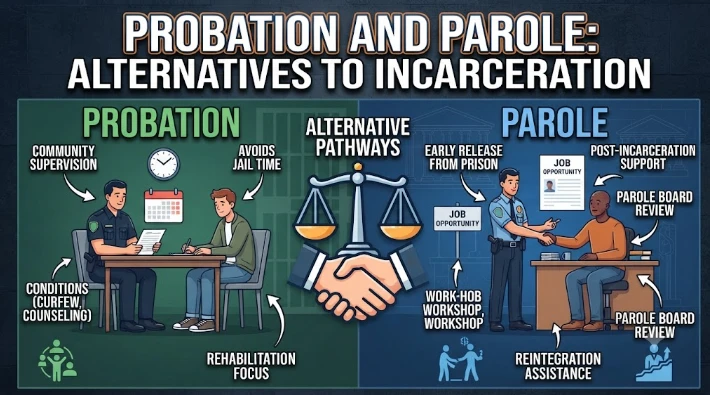
Probation and parole are presented as essential community-based alternatives to incarceration that combine supervision, accountability, and reintegration. Probation generally allows eligible offenders to remain in the community instead of serving a prison sentence, while parole provides conditional release after part of a custodial sentence has been completed. The article explains that both approaches can preserve employment, family ties, education, and housing, all of which reduce the risk of r
This article defines the ethical boundaries that protect volunteers who support visitor safety and law-enforcement-related functions in national parks. Although volunteers can assist with information, observation, traffic support, administrative work, backcountry roves, and reporting hazards, they must not exercise powers such as arrest, detention, search, citation, evidence handling, use of force, or other commissioned enforcement duties. The article emphasizes clear position descriptions, accu