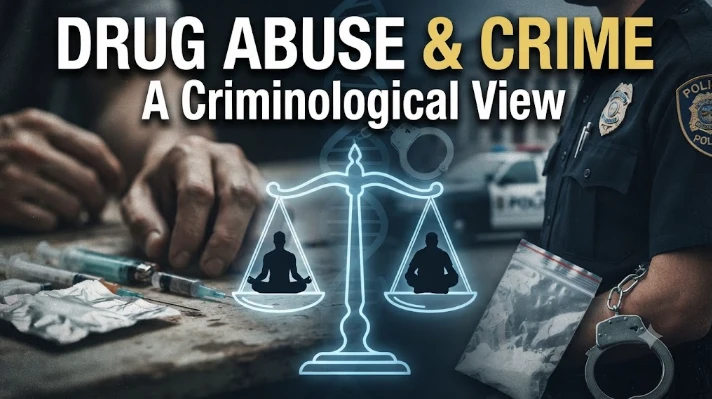
Drug abuse and drug-related crime are examined through the interaction of addiction, criminal behavior, illicit markets, and social disadvantage. The article presents three criminological explanations: the psychopharmacological model, where substances can influence aggression or impaired judgment; the economic-compulsive model, where people commit property crime to finance dependence; and the systemic model, where violence emerges from illegal drug markets and organized trafficking. It also discusses the growing challenge of potent synthetic drugs and the elevated overdose risk faced by people immediately after release from prison. Traditional punitive approaches are criticized for overcrowding prisons without addressing addiction, trauma, poverty, or mental health needs. The article instead highlights drug courts, medication-assisted treatment, behavioral therapy, reentry support, supervised consumption services, needle exchange programs, and other harm-reduction measures. Enforcement remains important against violent trafficking networks, but users with addiction require treatment-oriented responses. The article concludes that sustainable crime reduction depends on combining public health, rehabilitation, social support, and targeted law enforcement rather than relying on punishment alone.
By the middle of the first quarter of , the overlap of the substance abuse and criminal justice issue will continue to be among the most complicated, acute concerns of policymakers, law enforcement agencies, and communities across the globe. The long-standing war on drugs, marked by a heavy emphasis on punitive regulation and mass incarceration, is starting to be viewed through a critical perspective as research and real-time data turn out that mostly punitive approaches are not effective when it comes to dealing with the underlying causes of addiction-motivated offending. Drug use is not merely a medical problem; it is closely connected with criminal activity trends, social exclusion and social instability. Overlooking the real causes of crime-related with drugs can result in recidivism cycles, prison overcrowding, social disruption, which cannot be broken by the conventional methods of correction. In this respect, a subtle perception of the interplay between drugs and crime is critical to the creation of evidence-based interventions that would strike the right balance between the safety of the community and proper rehabilitation.
Trends in the world show the extent of the task. The World Drug Report estimates that over 316 million individuals globally had used drugs in the past year, or twenty-eight percent higher than the increase observed in the past decade, which is greater than population rises. This epidemic is an indicator both of an ever-expanding health crisis and a criminological one with addiction being a cause of property crime, violent crime and organized crime as a system. Substance abuse has a very wide-ranging effect not only on the individual taking the drugs but also on the families, communities, and the legal and economic systems. The criminal justice systems are faced with a two-fold challenge of preventing both the short-term impacts of the crimes related to drugs, as well as the reduction of the social expenditure in the long run in terms of chronic addiction, poverty, and alienation.
Three main models explaining the relationship between drugs and crime have been identified as long as criminologists consider them; they present a different view of causality and intervention. Psychopharmacological model postulates that some substances directly affect behavior making them irritable, paranoid, or lacking impulse control which may result in violent activities. The statistics show that in 2025, alcohol remains the drug most directly related to violent attacks and domestic violence, and the increase in synthetic stimulants like methamphetamine has been linked to unpredictable instances of extreme agitation or so-called agitated delirium when interacting with the police. This framework promotes the significance of dealing with the neurochemical and psychological consequences of substances use as a more comprehensive crime prevention approach, combining the mental health support and behavioral intervention with law enforcement.
Another perspective called the economic-compulsive model views crime as a way to finance addiction. In this model, people engage in crimes like shoplifting, burglary, or robbery not because of ill will but because it is an easy way of survival, they need to ease the withdrawal effects or maintain their costly habit. The current opioid crisis in North America and certain regions of Europe has perpetuated the occurrence of property crime, as users are likely to resort to criminal behavior to escape physical and psychological effects of withdrawal. By recognizing this dynamic, the focus is moved away and towards social and economic support, with a necessity of interventions that target underlying addiction and poverty and not focusing on punitive actions alone.
The systemic model emphasizes the violence and instability of the illicit drug market in itself. The networks of organized criminal activities, gang conflicts and the bribery of the law enforcement officers provide a system where violence is so common and so structural. In Global Organized Crime Index, there is a duopoly of cocaine and synthetic drugs that runs the global drugs market, with transit hubs in West Africa and Southeast Asia recording high rates of endemic violence. This model underlines that the criminality related to the use of drugs does not belong to the personal risk of individual users but to the community and the police officers who have to deal with the violent and illicit markets. To disrupt such networks, a coordinated, intelligence-based approach necessitates a combination of cooperation against international law enforcement, financial surveillance, and involvement in the community.
Another aspect that is expected to complicate the criminological landscape in is the introduction of synthetic substances that are more difficult to detect and more powerful than conventional opioids. Nitazenes are a category of synthetic opioids that have provoked red warnings by the European health authorities because of their high level of extreme potency and the common occurrence in the counterfeit pills. Such substances lead to the increasing rates of accidental overdose in people that might not even know that they are on opioids, posing an urgent problem of public health and justice. Meanwhile, it is also evident that special programs, like Drug Courts, are becoming effective. These courts are projected to keep reducing recidivism by an average of twenty-six percent in over the more traditional criminal court procedures that are more focused on incarceration. Drug Courts view addiction as a medical condition of the brain and not a vice, and they combine medical care, counseling, and social assistance with the legal justice response to drug-related crime.
This is one of the most crucial points of the addiction and crime cycle as the person comes out of prison. A -based research indicates that the initial two weeks following release of prison walls, also known as the so-called reentry cliff, is a period of both high vulnerability. Introduced to the uncontrolled drug market with reduced tolerance, the formerly imprisoned people are at a forty-fold risk of dying because of an overdose. This underscores the significance of organized reentry programs where the formerly incarcerated can access medication-assisted therapy, mental health services, housing, and job opportunities so that they have the means to keep the recovery process and prevent recidivism or reintegration into crime.
Conventional punitive methods of crime involving drugs have stretched to their extremes. The financial and societal price of imprisonment is mind blowing as the US and the UK prisons are at ninety nine percent capacity, of which most are caused by drug related crimes. It is estimated that it is expensive to keep a high-security prison bed between fifty thousand and sixty-five thousand dollars a year, but on the other hand, high-quality programs using Medication-Assisted Treatment (MAT) administered within the community can only cost less than six thousand dollars a year. In addition to the economic cost, prison does not usually treat the behavioral, social and psychological causes of addiction and once released, the person is likely to repeat the crime. These facts highlight the fact that a paradigm shift is needed to shift towards evidence-based and harm reduction-oriented methods and methods that treat, recover and reintegrate, and not just punish.
Harm reduction measures have become popular effective evidence based methods of controlling drug related crime and health outcomes to the population. Supervised consumption facilities, such as those, can offer safe areas where people can use substances under medical care, which eliminates overdoses and community lawlessness. Needle exchange programs reduce the spread of HIV, Hepatitis C and other blood born diseases and safeguard the users and other members of the communities. Decriminalizing possession would shift the emphasis on making the individual user criminal to high-level criminal and organized networks. In late 2025, the United Nations High Commissioner of Human Rights noted that the criminalization of people who take drugs facilitates social exclusion and stigma and marginalization, ultimately contributing to the same behaviors that are being targeted by the justice system. Through combining harm reduction strategies with punitive action against traffickers and dealers, the societies will be able to minimize the health and safety risks of substance use as well as maintain the sanctity of law enforcement and judicial procedures.
The breadth of incorporating the public health strategies and criminal justice interventions is also cognisant of the socioeconomic factors that give rise to addiction. Social marginalization, poverty, unemployment, insufficient education, trauma exposure, lack of education, and poverty are all factors that put people at risk of substance abuse and commit related crimes. Well-defined policies in are made up of enforcement and social support, treatment and economic empowerment opportunities, and provide a framework in which prevention and rehabilitation can be as important as punishment. Crime that is drug related cannot be considered as an issue of personal choice or personal moral deficiency, it is also intertwined with structural disparities and social determinants of health, and the multifaceted nature of illicit markets. It is crucial to deal with these factors in order to minimize recidivism and encourage recovery, at the same time ensuring the safety and well-being of communities.
The best criminal justice systems in will be those that strike a balance between enforcement and organization networks and compassionate treatment based on science of the users. Breaking down transnational drug cartels, disrupting trafficking networks, and prosecuting violent players are still important in keeping the people safe. Simultaneously, considering addiction as a chronic and treatable illness, as opposed to a criminal offense only, the system gets to treat the problem that leads to offending, ease congestion in prisons, and improve the social reintegration performance. Programs that involve medication-assisted treatment, behavioral therapy, vocational training, and constant observation have been proven to reduce significantly the reoffending, and also enhance health outcome and social stability among both individuals and communities.
To sum up, it is possible to note that drug abuse and drug-related crime will be one of the most problematic issues that criminal justice systems will have to deal with in . The facts are obvious: punitive-only solutions are not enough to control addiction-based offending, to ensure the safety of the population, and to decrease recidivism. Rather, the combination of the public health approach, harm reduction efforts, treatment modularities and community-based interventions with conventional law enforcement yields the best results. It is as important to address the root cause of trauma, socioeconomic deprivation, and structural vulnerabilities as it is to break the trafficking networks and convict perpetrators. Through a middle way, evidence-based strategy of focusing on accountability and recovery as equal, the criminal justice systems can end the loop of addiction and crime, lessen human suffering, and build healthier and safer communities. To succeed in this field, not merely policy creation and enforcement, but also a complete change in the way society perceives and reacts to substance use, shifting towards a perspective of science-based intervention, as opposed to moral judgment, towards treatment, as opposed to punishment, and towards sustainable prevention, as opposed to crisis management.
CITE THIS ARTICLE
Das, B. C. (2025). Drug Abuse and Drug-Related Crime: A Criminological Perspective. https://www.bikashchandra.com/article/484c0eb5-5f44-5d67-9888-f69e16f24965
B. C. Das, “Drug Abuse and Drug-Related Crime: A Criminological Perspective,” 2025. [Online]. Available: https://www.bikashchandra.com/article/484c0eb5-5f44-5d67-9888-f69e16f24965
Das, B. C. (2025) ‘Drug Abuse and Drug-Related Crime: A Criminological Perspective’. Available at: https://www.bikashchandra.com/article/484c0eb5-5f44-5d67-9888-f69e16f24965
Das, Bikash Chandra. “Drug Abuse and Drug-Related Crime: A Criminological Perspective.” 2025, https://www.bikashchandra.com/article/484c0eb5-5f44-5d67-9888-f69e16f24965.
Bikash Chandra Das. “Drug Abuse and Drug-Related Crime: A Criminological Perspective.” (2025). https://www.bikashchandra.com/article/484c0eb5-5f44-5d67-9888-f69e16f24965.
Das BC. Drug Abuse and Drug-Related Crime: A Criminological Perspective. 2025. https://www.bikashchandra.com/article/484c0eb5-5f44-5d67-9888-f69e16f24965
@misc{article_484c0eb55f445d679888f69e16f24965,
  title = {Drug Abuse and Drug-Related Crime: A Criminological Perspective},
  author = {Bikash Chandra Das},
  year = {2025},
  url = {https://www.bikashchandra.com/article/484c0eb5-5f44-5d67-9888-f69e16f24965},
}
TY  - GEN
AU  - Bikash Chandra Das
TI  - Drug Abuse and Drug-Related Crime: A Criminological Perspective
PY  - 2025-07-30
UR  - https://www.bikashchandra.com/article/484c0eb5-5f44-5d67-9888-f69e16f24965
ER  -
This article explores why people volunteer in America’s national parks and how program design influences whether service remains meaningful. Volunteer motivations often overlap and include personal values, learning, social connection, career development, confidence, purpose, and attachment to place. The article uses motivational frameworks to show that volunteers are more likely to remain engaged when they experience autonomy, growing competence, respectful relationships, and a clear connection
Probation and parole are presented as essential community-based alternatives to incarceration that combine supervision, accountability, and reintegration. Probation generally allows eligible offenders to remain in the community instead of serving a prison sentence, while parole provides conditional release after part of a custodial sentence has been completed. The article explains that both approaches can preserve employment, family ties, education, and housing, all of which reduce the risk of r
This article defines the ethical boundaries that protect volunteers who support visitor safety and law-enforcement-related functions in national parks. Although volunteers can assist with information, observation, traffic support, administrative work, backcountry roves, and reporting hazards, they must not exercise powers such as arrest, detention, search, citation, evidence handling, use of force, or other commissioned enforcement duties. The article emphasizes clear position descriptions, accu